June 19, 2012 at 20:39
Samsung Galaxy Note: It Never Happens or Testing a 4700 mAh Battery
Introduction
Testing and writing this post was provoked by the habra users Igor_kh and HeavyRazzer , who were the first to master and submit their works on the Mugen Power products to the habra community . Due to the reasons set forth below, I also decided to test the increased battery for the Samsung Galaxy Note GT-N7000.
How it all began
A bit of background ...
It all started on a cold November evening when I watched the presentation of the new Samsung Galaxy Note smartphone, popularly nicknamed the “ceiling”. Looking longingly at my Siemens A50, I decided it was time to change something. And this phone hooked me with both its screen and battery capacity, so I hopefully (in Chisinau it was officially sold only in April) I started looking for it in online stores.
The first surprise was that after 5 days the phone was already in the hands. The guys who sold it to me assured that they bought it in the Czech Republic, but judging by the German language, which was the default, he also did not immediately get to the Czech Republic.
As any person would do, the first thing I started to study was the miracle of Korean thought and was not surprised when the battery ran out after 6 hours. Having charged it and turned on full 3G, I began to deal with software from the market and then the battery lasted 7 hours. Within a month, the first disappointments began to comprehend me. The phone had to be charged 2 times a day, and the second time it happened at night, but when I disconnected it from charging and went to work at 8, it lasted until 5:00 p.m. (there was little charge left and after 2 hours I would be unavailable) . At the same time, I realized that I was “devouring” my resources so actively: this was mainly a screen and 3G, if the first was used actively for 1-2 hours at most, the second never turned off.
After 2 months, I installed a Wi-Fi router at home and figured out the access point at work (there was a weak signal to my workstation) and I decided to check the operation of my Galaxy Note using only Wi-Fi. And then a little paradox happened in my head: in all guides and energy-saving programs, the first point is always to turn off Wi-Fi, but in my case the phone could last 5 hours longer than usual. (I can only assume that with a 3G connection, my phone was in the area where the cells intersected, so there was a constant reconnection). It made me happy, but anyway, with the “native” 2500 mAh, charging the phone once a day, and even being able to stay at the most inopportune moment with a “brick” in my pocket did not make me very happy.to option from Mugen Power .
Order and delivery
Of course, the amount requested for the increased battery was huge (compared to the standard battery), but I decided to try to contact technical support, especially since there were already positive experiences, judging by the previously published posts.
After talking with the Russian-speaking representative of Mugen for 2 weeks and arranging for delivery, I flew to Bordeaux University, and the amplified battery flew out from Hong Kong. And a month later we met with him.
The parcel arrived safe and sound, the bag inside was upholstered with a patch of polyethylene, protecting the contents from shaking. Everything is the same as with 2 previous authors.

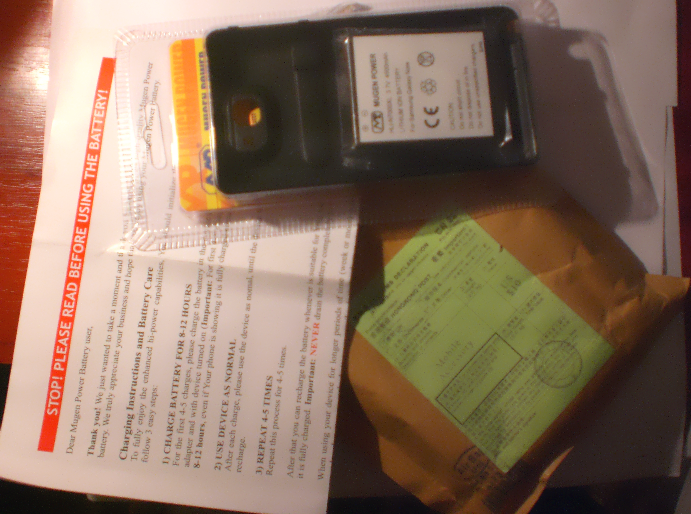
The inner world of the package presented me with a battery pack and a brief instruction
Appearance
As you can see, the phone is 2 times thicker compared to the standard equipment, but on the weight it is not much felt. I also read the comment that the sound on the phone becomes muffled due to the cavity that forms under the cover, but during the testing period for a total of 3 weeks, I did not notice anything similar. An interesting holder gives your hands a rest when you watch a movie or read (how did I miss it on the plane when my hands were numb from continuous holding).
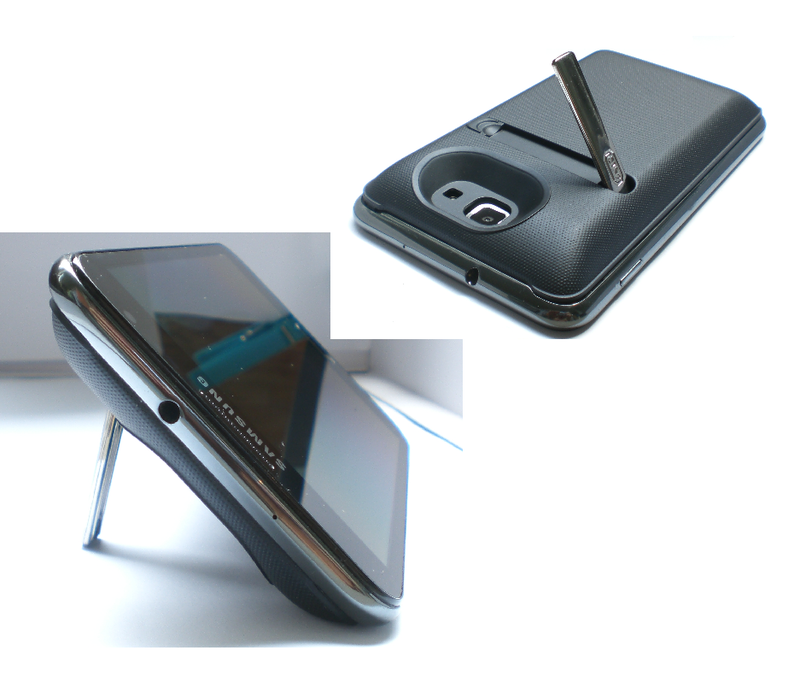
Phone with a new battery and cover
The new battery is very different, both in weight and in size, except that the contacts remained in the same place. Unfortunately, I did not manage to “track out” the battery capacity using software, so I have to believe what is written on the label. But judging by the data presented below, the figures are clearly "not taken from the head."
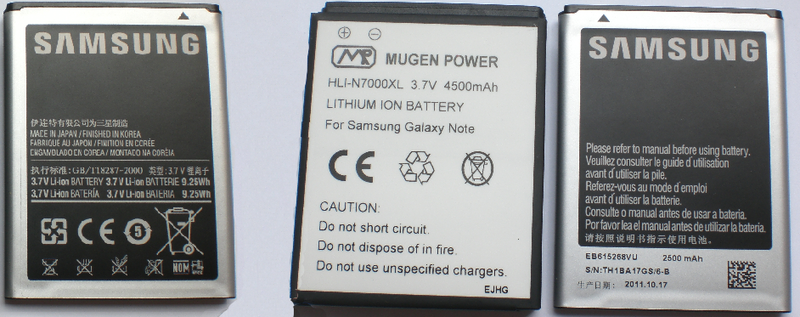
Technological comparison of rechargeable batteries
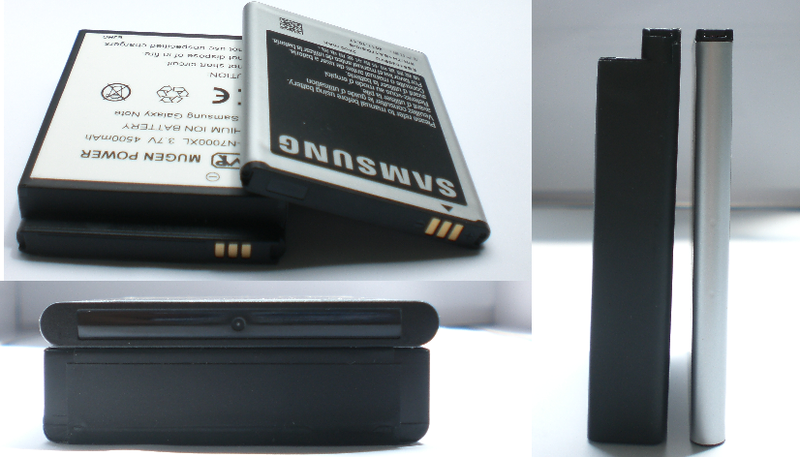
Visual comparison of rechargeable batteries
In order to imagine how much the phone will grow, I decided to bring photographs of comparing the phone as standard and a separate cover for the new battery. You can make a conclusion yourself, it didn’t cause any inconvenience to me personally, the phone calmly felt in my pocket, like its predecessor, but I didn’t have to think about charging during the day.

Visual comparison of the phone with the old and new cover.

The phone versus the cover
And this is how the new battery in the phone looks. It doesn’t look very elegant, but you can sacrifice beauty for energy.

Phone battery
Testing
Testing was carried out using several utilities from PlayMarket: Battery Drain is an interesting utility that shows battery consumption every hour, and also allows you to collect statistics on battery usage in the form of “percent / hours”; Battery Dr.Saver - allows you to conduct a cycle of a full charge of the battery, and also allows you to pinpoint the time spent on charging; Battery HD - allows you to calibrate the battery and shows preliminary numbers of battery usage (unfortunately, not always accurate); and of course, Battery Monitor Widget is a comprehensive tool that combines all the previous tools.
Also, testing was carried out in Android 2.3.6 Gingerbread and Android 4.0.3 Ice Cream Sandwich (its release for Galaxy Note just coincided with the time of writing the post).
During testing, 2 unpleasant incidents occurred: 1) after switching to Android 4.0.3, the battery began to “eat” like crazy, the increased battery lasted for a maximum of 4-5 hours, the standard one and even less, only battery calibration helped me; 2) during the month of testing, it so happened that some data was irretrievably lost both from Dropbox and the phone, therefore, in some places the performance of the original battery may be absent, mainly Android 2.3.6.
Speaking in dry numbers, here they are:
- during standard testing (the usual day of using the phone, Wi-Fi and 3G turned on all the time, reading and playing music - about an hour, half an hour playing for the child, all the time 2 monitoring systems turned on, web surfing - about an hour) battery consumption was about 4% -6% per hour.
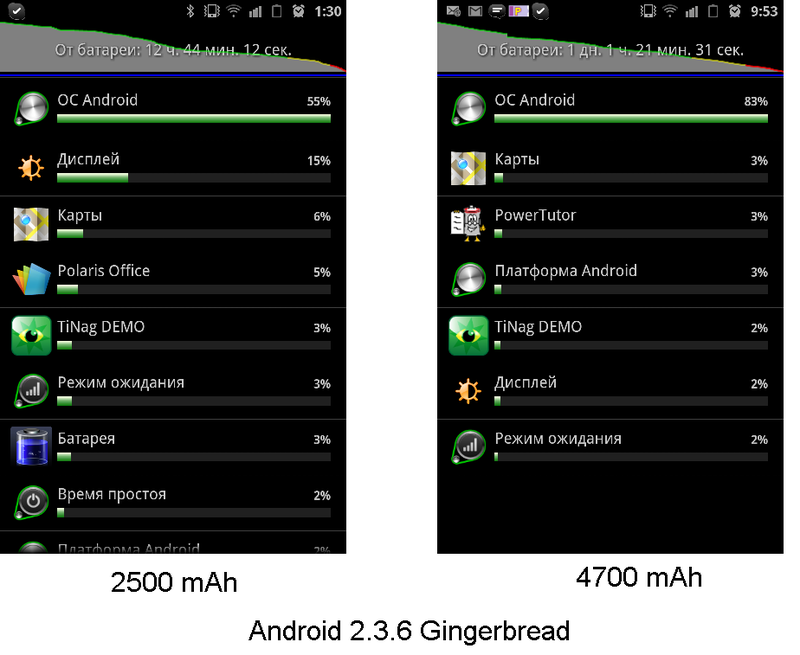
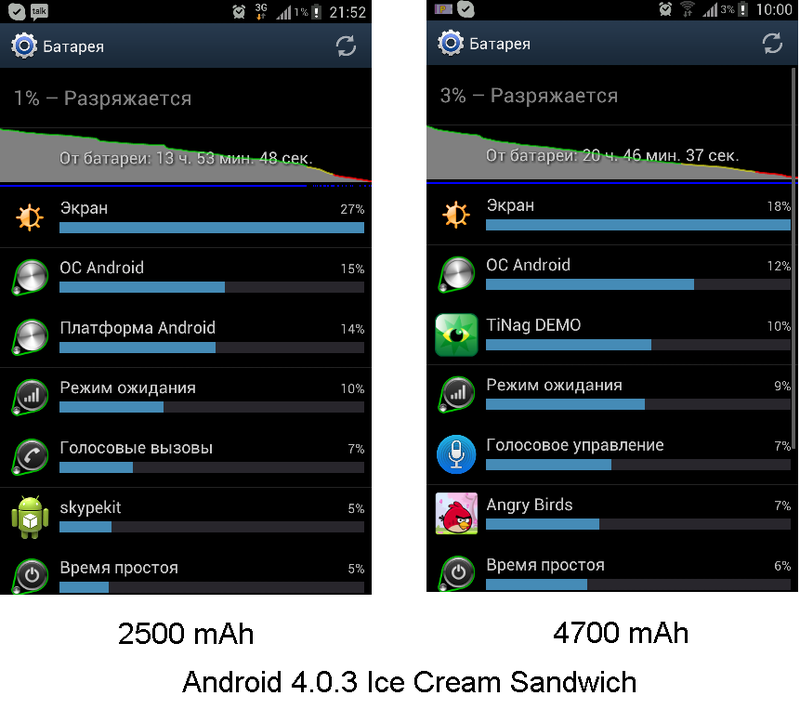
As we can see, the growth is almost 2 times, which means that wherever I go, I have about 36-40 hours without recharging, without limiting myself in using the phone. (there was a feeling that under Android 4.0.3 I violated the testing conditions a bit, the data is smaller than I expected) - during intensive testing (everything is the same as on a normal day + GPS and Bluetooth turned on all the time, using the camera in photo and video shooting), the battery consumption was about 12% -14% per hour.
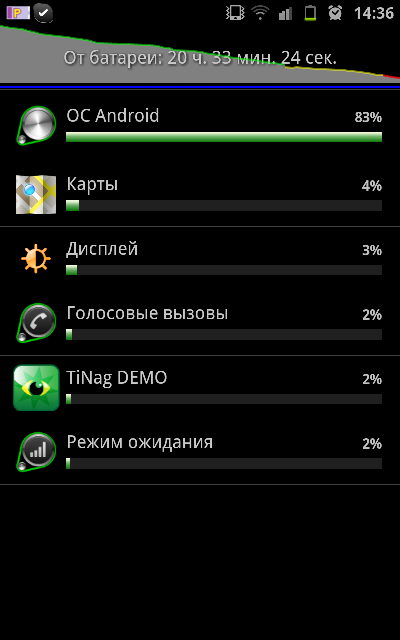
4700 mAh - Android 2.3.6
No wonder, except that the original numbers are smaller, but this once again confirms the capacity of the increased battery. - during extreme testing (using AnTuTu Tester and Battery Killer programs), the battery consumption was about 21% -42% per hour.
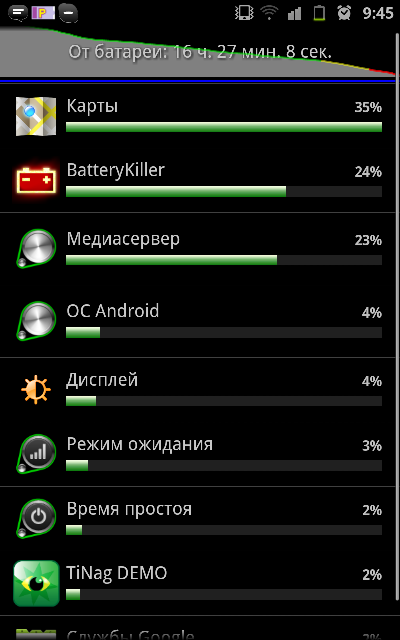
4700 mAh - Android 2.3.6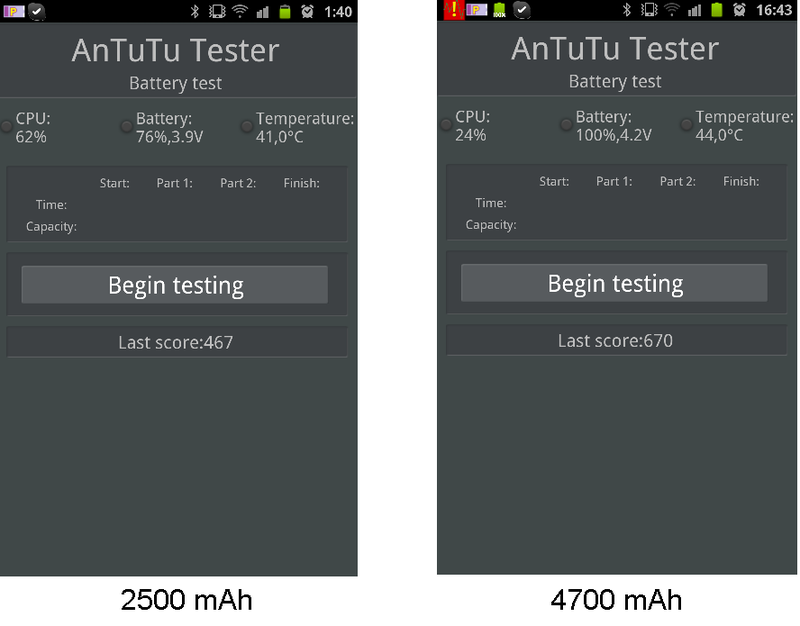
The purpose of the last test was to identify the maximum performance of the phone and battery, but for some reason I did not think about the time at which it would be able to withstand such work. And since the testing was carried out at night, data on the operating time were not saved and the result had to be laid out in the "parrots" from AnTuTu Tester. One thing I can say is that the original battery lasted for 3-4 hours, the increased one - by 7-8 (take my word for it).
Battery Charge Time
I would also like to mention the battery charge time:
- A full charge cycle for a battery from Mugen Power is about 4 hours and 30 minutes, normal charge is 3 hours 40 minutes
- a full charge cycle for a standard battery is about 2 hours 15 minutes, typical charge is 1 hour 45 minutes
I did not compare the charge via the USB port, mainly because I rarely use this feature.
conclusions
I will try to make the pros and cons of using such a battery based on the opinions of my friends who saw my device before and after:
+ Really long battery life, without limiting myself in capabilities;
+ The weight of the device and its functionality has not changed much, at least for the hand it does not look unusual, just the first time;
+ The device both warms up and continues to bask in the area of the camera, but it definitely does not depend on the battery (this has been proved empirically);
+ Mugen Power already has a 5400 mAh battery , which has the same dimensions, which will give a significant increase by another 14%.
- The thickness of a super-thin smartphone has doubled, which is a bit uncomfortable, but it seems to me only the first time;
- There is no way to accurately determine the capacity of a new battery, at least with free software;
- “ironic minus” - after using this battery when returning to standard, you again have to remember to charge the phone more often;
- It is unlikely that you will want to keep it as the main one all the time, it all depends on the habits and duties assigned to your phone.
The pros and cons turned out equally, but in fact some of them are “sucked from the finger”, so I will tell you my feeling and opinion on this invention. Definitely this battery is indispensable if you are often on business trips or your activity rarely intersects with the presence of outlets (which in modern realities sounds rather strange). Tactile sensations appear only when he moves the standard sample to an enlarged one and vice versa, but they last for a maximum of a couple of hours, then everything is taken for granted. Of course, you can buy a bunch of batteries and change them like gloves, but why not take an x2 battery and a docking station and not feel uncomfortable with 3-4 batteries.