
 March 16, 2012 at 11:49
For Intel's CeBIT 2012 Seats
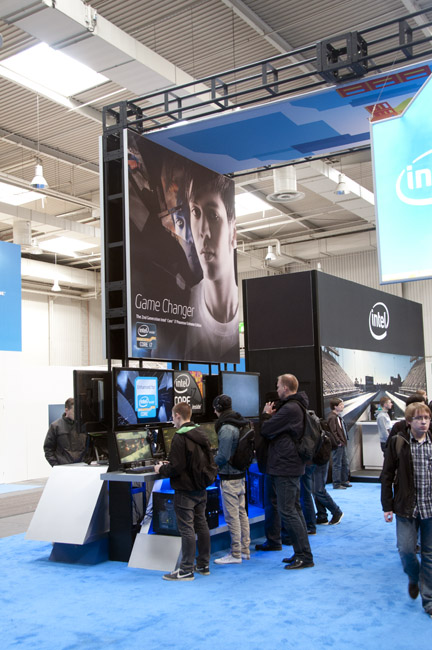
They say that CeBIT is not the same as before. Indeed, the times when all the most interesting things happened in the world of desktop computers have either ended, or at least are on a different turn in the spiral of history. CES became the place for the announcement of mega-novelties; mobile devices prefer to be shown at the Mobile World Congress ... And yet, if you are not lazy, you should not leave CeBIT empty-handed. Especially if you go to the Intel booth, which occupied an entire pavilion.
True, the first little sensation awaited me halfway to the Intel booth. It's not even that the Gigabyte company, known primarily for its quality components for the PC, has released two ultrabook models. And not that they work on third-generation Intel Core processors (Ivy Bridge) that were not yet announced at the time of the exhibition.


Really striking is the use of the discrete graphics core of NVidia, which is quite powerful, modern and ... also not officially existing at that time. On the first day I still managed to read that the GeForce GT640M chip is working inside, but then the owners of the stand smeared its name with a black felt-tip pen. From sin. Some publications hastened to declare that the presence of a third-party GPU makes ultrabooks "not real", but Intel does not think so. The position of the holder of the Ultrabook trademark is as follows: if the manufacturer manages to meet the requirements for dimensions and battery life, then you can embed at least two GPUs in SLI mode. And many still succeed: Acer and Samsung have already announced the release of ultrabooks with discrete graphics.
Intel itself introduced at CeBIT the new server processor Xeon E5-2600 (its Moscow presentation took place on March 15). Compared to its predecessor, the Xeon 5600, it can run up to 80% faster with the same power consumption. Acceleration is achieved through the use of a set of Intel Advanced Vector Extensions (Intel AVX), up to two times increasing the number of floating point operations per working cycle when launching technical, financial, scientific and digital content development applications. Also, Xeon E5 introduced Turbo Boost 2.0 technology, thanks to which the processor can significantly increase the operating frequency under load. For comparison, if the Xeon 5690 core could “overclock” to 266 MHz, then in the E5-2690 it could go up to 900 MHz. Of course, Xeon is unlikely to live with any of us at home (unless your homeownership originally had a server room in the project), but for corporate customers this is a long-awaited processor. At a time when everything and everyone is moving to the cloud, there is no unnecessary performance, and if it is provided it is achieved with a similar, if even less energy consumption ... As they say, give two containers.

We talked a bit about ultrabooks. Karen Regis, responsible for global marketing in this area, assured everyone that everything was going according to plan and even demonstrated a touch-screen sample running on Windows 8. They say that Lenovo created a hand in its creation.

For the first time since the Centrino announcement, Intel talked about laptop accessories at Intel's presentation. Designer Michael Michalski presented his vision of what the right ultrabook bag should be like. The vision was nice and expensive: from 700 euros per copy. True, the complaisant Michael promised to make a cheaper version - from leatherette and factory tailoring instead of handmade. We hope that then we can manage to keep the euro at 400.


Is it expensive anyway? Oh, you know how much people put out for much less useful accessories? In addition, I will tell you a secret - in 2012 the market for mobile computer bags is considered one of the most attractive, because it is growing by a rapid jack. And now many new manufacturers immediately rushed to it. And what happens when competition increases dramatically? That's right.
And a few more words about ultrabooks. In the huge pavilion occupied by Intel, a separate stand was allocated for them. There was something to see.


One guy did seem to meet the ultrabook of his dreams!

The branded young lady famously drove on a virtual car, and instead of the helm she had a piece of paper with the image of the steering wheel printed on it. The camera of the serial ultrabook Acer Aspire S3 quite successfully tracked the movement of the picture. Is it worth it to clarify that the game itself was also not running on a supercomputer hidden under a raised floor.


Her merchandise repeated the movements following the painted bear. Of course, he also danced on the ultrabook screen.

Not so beautiful, but obviously more skillful guys fought in 3D-shooters and realtime-strategies. Judging by the concentration, the prizes at stake were serious.


Big space? So this is from the strength of half the entire area on which Intel is located. I would even say a third.

However, something we sat in the Intel pavilion. Let's step aside, turn left and stumble ... Well, for example, here is such a charm. This is not just a motherboard. This is a real computer, outperforming the top Pentium 4s in performance and functionality (remember those? :)), but consuming much less power. A processor, video, four (!) Gigabit Ethernet ports, an integrated power supply, and even a place for a small SSD. Add only memory - and that’s all, you can work.

And the dimensions ... judge for yourself.

The following picture shows the SSD with the mSATA interface, which is increasingly used in ultrabooks. It is very small - the chips are standard on it, like on memory modules, so you can imagine the size of the design yourself. The volume is quite decent - up to 120 gigabytes. That's what I will do the very, thinnest models!

But do not think that mSATA is an option only for mobile computers. We go to the Gigabyte stand, take a closer look at the motherboards for the third generation Intel Core ... Yes, it can not be! They found a place for such a small SSD.
For example, the gaming G1.Sniper 3 on the latest Z77 chipset. In the lower left corner is the mSATA connector.

Here is a more massive model. It doesn’t look so harsh, but they have not forgotten about the place for mSATA.

And so - on all new ATX boards. Of course, in most cases there will be small-sized SSDs that accelerate the start of the computer and reduce the time to wake up from sleep mode. But if one of the wealthy guys puts a 120-gigabyte model, there may be enough space for the operating system. As a result, everything is loaded quickly and silently from the SSD, and the traditional hard disk is left with the storage of installation files, especially of “heavy” programs and just file storage.
Why all this? Well, for example, it’s nice to tell friends about such a bunch at least :)
Seriously, the smaller the wires in the case, the better. SATA cables are now surprisingly frail, and, for example, in my home NAS, working around the clock, I already changed them twice. Therefore, transferring SSD directly to the board not only speeds up work, but also provides reliable contact. Fewer wires - easier air travel - more efficient cooling of the HDD and other components. So the computer will live longer without external intervention and will annoy its owner less.
And you, do you personally like mSATA on the motherboard? Or is it a whim unnecessary?

At CeBIT, the series of exhibitions is temporarily ending, and there will be some lull before June Computex. However, Intel is unlikely to pause for so long, because in April there will be a traditional Intel Developer Forum in Beijing, and certainly not without significant announcements. I hope to read about them on this blog, or even attend.
True, the first little sensation awaited me halfway to the Intel booth. It's not even that the Gigabyte company, known primarily for its quality components for the PC, has released two ultrabook models. And not that they work on third-generation Intel Core processors (Ivy Bridge) that were not yet announced at the time of the exhibition.
Really striking is the use of the discrete graphics core of NVidia, which is quite powerful, modern and ... also not officially existing at that time. On the first day I still managed to read that the GeForce GT640M chip is working inside, but then the owners of the stand smeared its name with a black felt-tip pen. From sin. Some publications hastened to declare that the presence of a third-party GPU makes ultrabooks "not real", but Intel does not think so. The position of the holder of the Ultrabook trademark is as follows: if the manufacturer manages to meet the requirements for dimensions and battery life, then you can embed at least two GPUs in SLI mode. And many still succeed: Acer and Samsung have already announced the release of ultrabooks with discrete graphics.
Intel itself introduced at CeBIT the new server processor Xeon E5-2600 (its Moscow presentation took place on March 15). Compared to its predecessor, the Xeon 5600, it can run up to 80% faster with the same power consumption. Acceleration is achieved through the use of a set of Intel Advanced Vector Extensions (Intel AVX), up to two times increasing the number of floating point operations per working cycle when launching technical, financial, scientific and digital content development applications. Also, Xeon E5 introduced Turbo Boost 2.0 technology, thanks to which the processor can significantly increase the operating frequency under load. For comparison, if the Xeon 5690 core could “overclock” to 266 MHz, then in the E5-2690 it could go up to 900 MHz. Of course, Xeon is unlikely to live with any of us at home (unless your homeownership originally had a server room in the project), but for corporate customers this is a long-awaited processor. At a time when everything and everyone is moving to the cloud, there is no unnecessary performance, and if it is provided it is achieved with a similar, if even less energy consumption ... As they say, give two containers.
We talked a bit about ultrabooks. Karen Regis, responsible for global marketing in this area, assured everyone that everything was going according to plan and even demonstrated a touch-screen sample running on Windows 8. They say that Lenovo created a hand in its creation.
For the first time since the Centrino announcement, Intel talked about laptop accessories at Intel's presentation. Designer Michael Michalski presented his vision of what the right ultrabook bag should be like. The vision was nice and expensive: from 700 euros per copy. True, the complaisant Michael promised to make a cheaper version - from leatherette and factory tailoring instead of handmade. We hope that then we can manage to keep the euro at 400.
Is it expensive anyway? Oh, you know how much people put out for much less useful accessories? In addition, I will tell you a secret - in 2012 the market for mobile computer bags is considered one of the most attractive, because it is growing by a rapid jack. And now many new manufacturers immediately rushed to it. And what happens when competition increases dramatically? That's right.
And a few more words about ultrabooks. In the huge pavilion occupied by Intel, a separate stand was allocated for them. There was something to see.
One guy did seem to meet the ultrabook of his dreams!
The branded young lady famously drove on a virtual car, and instead of the helm she had a piece of paper with the image of the steering wheel printed on it. The camera of the serial ultrabook Acer Aspire S3 quite successfully tracked the movement of the picture. Is it worth it to clarify that the game itself was also not running on a supercomputer hidden under a raised floor.
Her merchandise repeated the movements following the painted bear. Of course, he also danced on the ultrabook screen.
Not so beautiful, but obviously more skillful guys fought in 3D-shooters and realtime-strategies. Judging by the concentration, the prizes at stake were serious.
Big space? So this is from the strength of half the entire area on which Intel is located. I would even say a third.
However, something we sat in the Intel pavilion. Let's step aside, turn left and stumble ... Well, for example, here is such a charm. This is not just a motherboard. This is a real computer, outperforming the top Pentium 4s in performance and functionality (remember those? :)), but consuming much less power. A processor, video, four (!) Gigabit Ethernet ports, an integrated power supply, and even a place for a small SSD. Add only memory - and that’s all, you can work.
And the dimensions ... judge for yourself.
The following picture shows the SSD with the mSATA interface, which is increasingly used in ultrabooks. It is very small - the chips are standard on it, like on memory modules, so you can imagine the size of the design yourself. The volume is quite decent - up to 120 gigabytes. That's what I will do the very, thinnest models!
But do not think that mSATA is an option only for mobile computers. We go to the Gigabyte stand, take a closer look at the motherboards for the third generation Intel Core ... Yes, it can not be! They found a place for such a small SSD.
For example, the gaming G1.Sniper 3 on the latest Z77 chipset. In the lower left corner is the mSATA connector.
Here is a more massive model. It doesn’t look so harsh, but they have not forgotten about the place for mSATA.
And so - on all new ATX boards. Of course, in most cases there will be small-sized SSDs that accelerate the start of the computer and reduce the time to wake up from sleep mode. But if one of the wealthy guys puts a 120-gigabyte model, there may be enough space for the operating system. As a result, everything is loaded quickly and silently from the SSD, and the traditional hard disk is left with the storage of installation files, especially of “heavy” programs and just file storage.
Why all this? Well, for example, it’s nice to tell friends about such a bunch at least :)
Seriously, the smaller the wires in the case, the better. SATA cables are now surprisingly frail, and, for example, in my home NAS, working around the clock, I already changed them twice. Therefore, transferring SSD directly to the board not only speeds up work, but also provides reliable contact. Fewer wires - easier air travel - more efficient cooling of the HDD and other components. So the computer will live longer without external intervention and will annoy its owner less.
And you, do you personally like mSATA on the motherboard? Or is it a whim unnecessary?
At CeBIT, the series of exhibitions is temporarily ending, and there will be some lull before June Computex. However, Intel is unlikely to pause for so long, because in April there will be a traditional Intel Developer Forum in Beijing, and certainly not without significant announcements. I hope to read about them on this blog, or even attend.