October 14, 2011 at 12:45
V-Ray and Iray. Comparison and review
Rendering speed or quality of the result? - that's the question. Sooner or later, you have to choose the second, and the duration of the rendering begins to be hours, days, weeks. There is no money for the render farm, so you have to manage with one 6-core processor.
But all of a sudden, Mental Images, a subsidiary of NVIDIA Corporation, is releasing a new Iray rendering system that will allow rendering on a graphics card. This has created the hope that multi-core GPUs can significantly reduce rendering time.
I decided to compare the quality and performance of V-ray, which uses only the CPU, and Iray, which counts on both the CPU and GPU. He began to check on NVIDIA cards with CUDA support and an Intel Core i7-980 processor.
I'll start by comparing video cards with each other in the Iray environment. In fairness, the graph shows the performance results of video cards without taking into account the performance of the central processor.
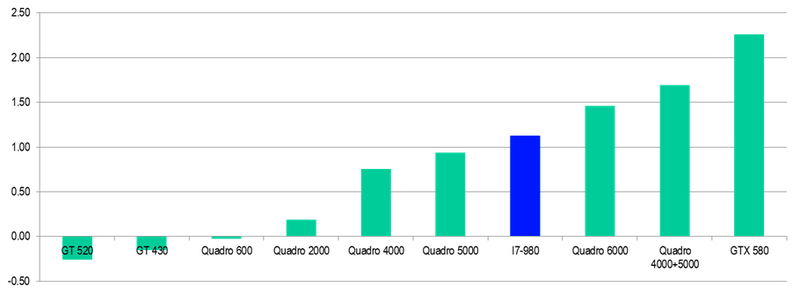
From the diagram it follows that the younger Quadro (and especially the younger GeForce) are absolutely not adapted for the calculation tasks. Moreover, the performance of the Quadro 600 was even negative, i.e. the processor coped with the task alone faster than when paired with the Quadro 600. On the contrary, the uncut full-fledged GF110 chip in the GeForce GTX 580 showed tremendous results, beating the two Quadro 4000 and 5000 paired.
Everything is clear with the rendering speed - in the Iray 2xGTX 580 system they give a 4-fold increase in productivity compared to the i7-980, at the same cost. And what about quality? What rendering quality can Iray produce compared to V-ray?

The illustrations show the result of Iray rendering using the metal material and the elevation map (25 minutes) and the V-ray rendering result using the mirror material and the reflection map (2 minutes). And all this despite the fact that Iray rendered both on the video card and on the central processor.
Another example is a monochrome model with one light source.

The examples show that acceptable picture quality in V-ray is achieved already with 9-second rendering. Quality Iray continues to "limp" and with a longer miscalculation.
An interesting feature of the Iray system is that there are no settings as such that allow you to change the quality. The user is given the opportunity to set the time that he wants to spend on rendering. And the miscalculation of the entire image is not stopped - improving the image quality over and over again.
The downside of Iray, for me personally, is that it is practically not compatible with mental ray. I didn’t manage to transfer the mental materials to Airy - I had to texture it all over again.
And finally, I want to offer a table comparing the performance of the CPU when rendering V-Ray.
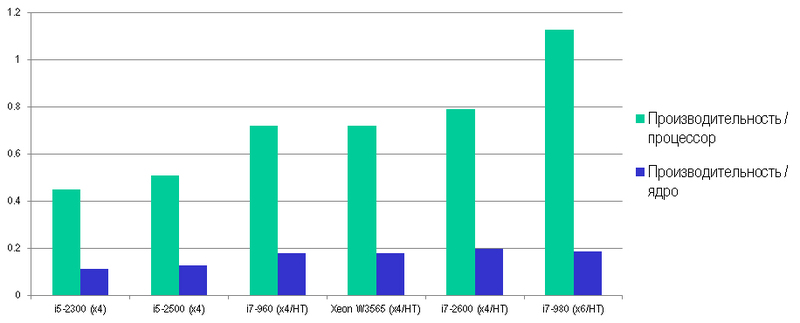
Due to the fact that rendering supports multichannel, processor performance depends more on the number of cores than on frequency characteristics. However, the core performance separately is higher for the Sandy Bridge i7-2600 processor.
The conclusion that I made for myself: rendering is a very complex computational process and so far it is too tough for GPUs. A render farm of multi-core CPUs is the only salvation to date.
But all of a sudden, Mental Images, a subsidiary of NVIDIA Corporation, is releasing a new Iray rendering system that will allow rendering on a graphics card. This has created the hope that multi-core GPUs can significantly reduce rendering time.
I decided to compare the quality and performance of V-ray, which uses only the CPU, and Iray, which counts on both the CPU and GPU. He began to check on NVIDIA cards with CUDA support and an Intel Core i7-980 processor.
I'll start by comparing video cards with each other in the Iray environment. In fairness, the graph shows the performance results of video cards without taking into account the performance of the central processor.
From the diagram it follows that the younger Quadro (and especially the younger GeForce) are absolutely not adapted for the calculation tasks. Moreover, the performance of the Quadro 600 was even negative, i.e. the processor coped with the task alone faster than when paired with the Quadro 600. On the contrary, the uncut full-fledged GF110 chip in the GeForce GTX 580 showed tremendous results, beating the two Quadro 4000 and 5000 paired.
Everything is clear with the rendering speed - in the Iray 2xGTX 580 system they give a 4-fold increase in productivity compared to the i7-980, at the same cost. And what about quality? What rendering quality can Iray produce compared to V-ray?
The illustrations show the result of Iray rendering using the metal material and the elevation map (25 minutes) and the V-ray rendering result using the mirror material and the reflection map (2 minutes). And all this despite the fact that Iray rendered both on the video card and on the central processor.
Another example is a monochrome model with one light source.
The examples show that acceptable picture quality in V-ray is achieved already with 9-second rendering. Quality Iray continues to "limp" and with a longer miscalculation.
An interesting feature of the Iray system is that there are no settings as such that allow you to change the quality. The user is given the opportunity to set the time that he wants to spend on rendering. And the miscalculation of the entire image is not stopped - improving the image quality over and over again.
The downside of Iray, for me personally, is that it is practically not compatible with mental ray. I didn’t manage to transfer the mental materials to Airy - I had to texture it all over again.
And finally, I want to offer a table comparing the performance of the CPU when rendering V-Ray.
Due to the fact that rendering supports multichannel, processor performance depends more on the number of cores than on frequency characteristics. However, the core performance separately is higher for the Sandy Bridge i7-2600 processor.
The conclusion that I made for myself: rendering is a very complex computational process and so far it is too tough for GPUs. A render farm of multi-core CPUs is the only salvation to date.