Personal computers: in the prime of life!
This year marks the thirty-five years since the birth of the first personal computer, Apple I, and thirty since the release of the first computer named IBM PC - model 5150. In light of this event, it will not be amiss to look back at the path that information technologies have gone beyond this time, re-evaluate and, possibly, rethink its significance for today's day.
Once upon a time, when the displays were smaller, the disks and processors were slower, the RAM was expensive, the games excited the imagination with variety and spoiled the originality, the connection was slow and tried to break off at the most inopportune moment, and the worldwide network was just trying to get on its feet and make the first uncertain steps to observe the development of information technology was no less interesting than now ...
When things were so uncomplicated
In those glorious times, the story of the founders of modern computers originates.
On April 1 (!) 1976, three comrades - Steven Jobs (Steven Jobs), Steve Wozniak (Stephen Wozniak) and Ronald Wayne (Ronald Wayne) - founded a company selling personal computers, really small and affordable. Very many people thought then that this was a joke. And in vain ... Apple I
MachineIt was initially offered at an “attractive” starting price of $ 666.66 (in a year it will be reduced to $ 475) and was a finished printed circuit board with components already installed. Assembling Wozniak and Jobs, the manual was written by Ronald Wayne. The user had to connect a keyboard, a display (in this role a regular TV set could play), a tape recorder (to work with which later it was proposed to purchase another board for an additional $ 75), a power supply and “put on” all this in the case. Of course, there were practically no stores for the sale of components and software, nor personal computers, except, perhaps, the Xerox Alto and the IBM 5100 (we will talk about it later), as well as the MITS Altair 8800 and its direct competitor IMSAI 8080. So it almost certainly meant do-it-yourself. For a year and a half (until October 1977) about two hundred cars were sold. Now they are all rare and representgreat collection value: until today, no more than fifty original Apple I have survived intact.


By the way, today anyone can follow the path of Wozniak and Jobs and, with the soldering iron at the ready, assemble a full-fledged analogue of Apple I ( video ).

On the tape cassette, which, along with the manual was attached to the computer, the BASIC interpreter was recorded - a kind of forerunner of modern scripting programming languages in the sense that it was used both for solving relatively simple and routine tasks, and for writing relatively complex programs. As a demonstration of the possibilities, several simple games were offered to the attention of the user (no graphics, only text mode). And, of course, there was an assembly language that made it possible, with due talent and experience of a programmer, to squeeze out everything that is possible from a modest (by today's standards, of course) hardware ... and a little more.
The project was aimed more at electronic enthusiasts, although this is not surprising: Steve Wozniak, who then worked at Hewlett-Packard, began developing the computer in his spare time and purely for his own needs. Only later, when he actually demonstrated the results of his research to members of the Homebrew Computer Club , long-time friend and associate Steve Jobs offered to sell it. As they say, the beginning was laid ...
The era of personal computers was born.
Already in January 1977, the consumer electronics company Commodore International entered the market with the Commodore PET computer . His somewhat clumsy “retro-futuristic” appearance today involuntarily causes a smile ... Five years later, in August 1982, the cult will be releasedCommodore 64 s, as the name suggests, 64 KB of RAM. In terms of price and performance characteristics of graphics and sound at that time, the C64 was much more attractive than its competitors. Largely thanks to him, a new near-computer subculture was formed - the demoscene (today, for Commodore 64, “ demos ” and even games are still being created ). In total, until 1994, a record number of cars of this model will be sold - 17 million units. Computers became mass.
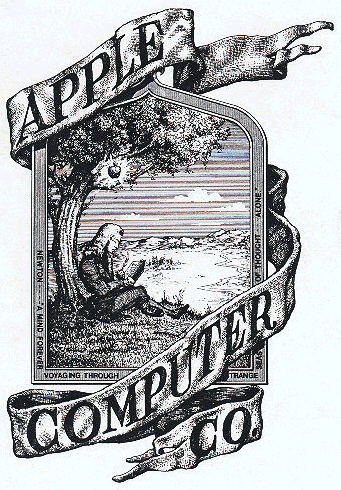
A little over a year after the release of Apple I, a new model appeared - the Apple II with the MOS Technology 6502 microprocessoroperating at a frequency of 1 MHz, and 4-48 KB of RAM. It was no longer a home-made designer assembled in the garage, but a high-quality product. On the keyboard, which was also a system unit, drives for five-inch floppy disks (they will be added later, in 1978) and the display, alluding to the support of color graphics, proudly flaunted a rainbow bitten apple - the new company logo (the previous one, with Isaac Newton under the tree, came up with the same Ronald Wayne).
This computer was an incredible success! And in many respects thanks to the fact that the VisiCalc table processor will initially be released on Apple II, the machine will become especially attractive to small and medium-sized businesses. Things will go uphill sharply, but Jobs and Wozniak will not even have time to look back, as they will become millionaires. This model will be released in several versions (including portable ) and will be sold for 16 years, until 1993. There will be many compatible (and often cheaper) cars from other manufacturers. An analogue called Agate will be produced even in the Soviet Union. The latest modification, Apple IIGS , will be released in September 1986. It will already carry a 16-bit processor, and will run an operating system with a graphical user interface.
In 1979, deliveries of two more 8-bitcomputers - Atari 400 and Atari 800. Prior to this, Atari, Inc. very successful in the production of slot machines and home set-top boxes . Generally speaking, most often it was games that were the driving force behind the development of personal computers. For example, Steve Jobs and Jay Miner , the main developer of personal computers at Amiga , worked at Atari for some time .

The appearance of the Atari 400 was also very unusual: the developers decided to use a membrane-type keyboard (a similar design solution was also used in the Soviet 16-bit personal computer Electronics BK-0010 of 1985, but was rejected in subsequent modifications) and the ROM connector 8 KB cartridges. Downloading a program from a tape required a lot of time, the first drives, although they were much faster than tape cassettes, remained very expensive, and the five-inch floppy disks themselves were never very reliable. The programs recorded in the removable ROM were ready to work immediately after turning on the power. The main difference of the Atari 800 was the keyboard - it was the most ordinary (and therefore more reliable), but this model was sold worse.
Exactly thirty years ago, in 1981, events occurred that not only influenced the entire subsequent IT industry, but also determined the interests and occupation of many of those who read these lines now.
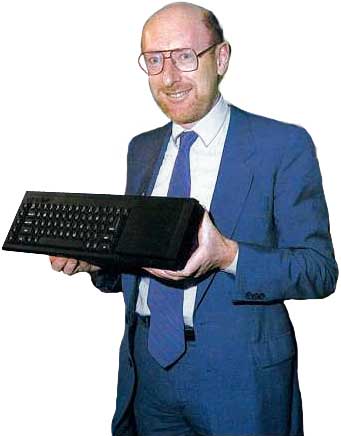
In March 1981, entrepreneur Clive Sinclair (full name Sir Clive Marles Sinclair), who previously produced portable radios and televisions, pocket calculators, and watches, also invented the Sinclair ZX81 computer in the UK.. It was extremely simple, contained a minimum of details, and therefore was cheap and aimed at the mass consumer. The machine was equipped with a Zilog Z80 microprocessor with a frequency of 4 MHz, RAM from 1 to 64 KB, like the Atari 400 had a membrane-type keyboard and was offered in two versions. At a price of about 50 pounds in the form of a constructor, which you had to assemble yourself with a soldering iron, multimeter, oscilloscope and other instruments familiar to a ham radio operator. Or at a price of about 70 pounds in assembled form for those who have never held a soldering iron in their hands.
A more perfect model in 1982 was called ZX Spectrumfor the fact that, unlike its predecessor, it already knew how to work with color graphics. She quickly became a bestseller in the UK and Europe, competing in popularity with the American Commodore 64. In 1983, Clive Sinclair will be knighted for creating this wonderful computer. Speccy , as the fans affectionately call him, not only paved the way for everyone to the exciting world of games, mathematics and computer creativity, he became an excellent school for future IT specialists, then teenagers. For example, Linus Torvalds had the Sinclair QL - the latest model released by Sinclair Research , a company of Sir Clive, in 1984.
It is also interesting that in the late eighties and early nineties in the USSR, and then in the CIS countries and neighboring countries, this architecture was granted a second life. Domestic analogues, most often home-made, significantly exceeded the characteristics of the original model. It was such computers for many in their childhood that became the first. In the post-Soviet space, these little cars until the mid-nineties deservedly considered "folk." We still love them, continue to improve and release them in the form of a designer board called ZX Evolution .
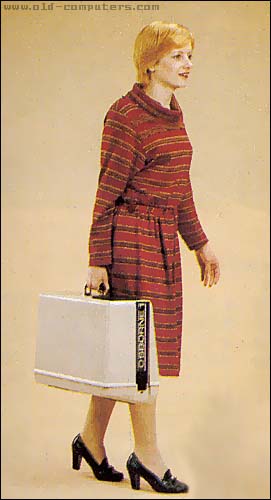
In April 1981, Osborne 1 appeared on the market.A very entertaining exhibit. It may well be considered the first truly “portable” computer. However, its design was different from today's laptops: a built-in monochrome CRT display with a diagonal of only 5 inches (it was possible to connect an external one), two drives for five-inch floppy disks, a hinged keyboard cover and a carrying handle. All this with a weight of about 11 kilograms. The microprocessor Zilog Z80 was used, the amount of RAM was 64 Kb. The CP / M operating system was supplied with the computer (we will still have an occasion to recall it), the Basic interpreter, two text adventure games, several office programs. Despite the considerable weight and dimensions, they willingly bought it.
On August 12, 1981, International Business Machines introduced the IBM Personal Computer 5150 to the general public. Having engaged in the creation and sale of powerful, large and very expensive machines for several decades, the “blue giant” decided to make a name for itself in the rapidly growing personal computer market. No wonder: by then a real boom had begun here!

Even before the beginning of the eighties, PCs were bought mainly by specialists or enthusiasts, and, of course, some companies that already managed to discern an “affordable” effective tool for doing business in the “staff”. For the mass consumer, it was still far from always clear what a “personal computer” was, and most importantly, what to do with it: it was still not cheap, it was difficult to master, and it turned out that the programs themselves had to be written. What good could it be?
Now everything has changed. Hardly anyone and everyone wanted to see the new product at home. There were several reasons for this: this was popularization (and, of course, advertising) in the press, on radio and television. Enthusiastic reviews from colleagues and acquaintances who, at lunchtime, spent their free time playing on a work computer. And the children, who, of course, dreamed that for Christmas or birthday, instead of a bicycle, their parents gave them this electronic miracle. But the most significant thing was that now to solve typical problems, whether it was working with files and text, preparing a financial report or reading e-mail, you did not need to be seven spans in your forehead and learn an incomprehensible programming language (the resources of the first machines were modest, therefore, they wrote most often in assembler). It is enough to purchase the appropriate program and carefully familiarize yourself with the accompanying manual. More and more companies, teams and simply independent developers began to appear who wrote and sold products that made the computer more friendly and closer to a simple user.
For IBM, this was not the first attempt to create a more or less compact desktop computer.
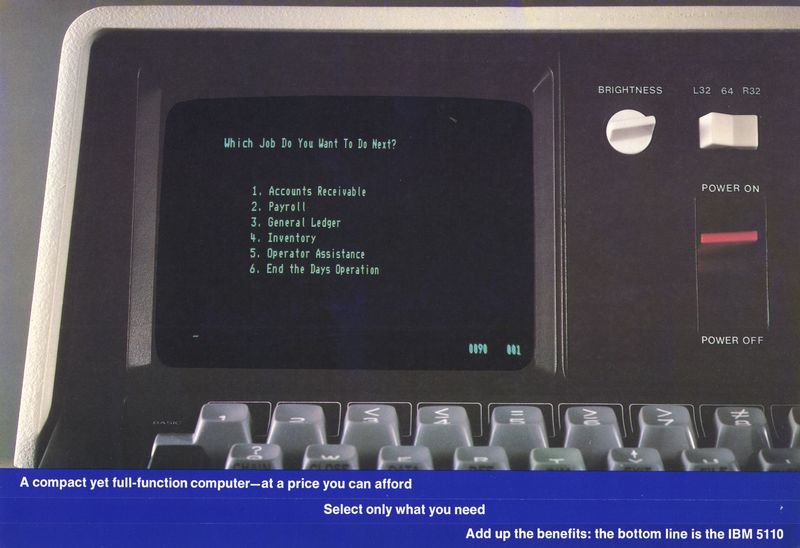
In 1975, sales of the IBM 5100 Portable Computer began. Among his large-sized brothers and predecessors of the sixties and seventies, he stood out favorably by price (from $ 11,000 for 16 KB of RAM and up to 20,000 for 64 KB), miniature and weight - about 25 kg. This was very important, since computers of those times most often weighed hundreds of kilograms and took up a lot of space (although there were exceptions), but there was no need to talk about the cost. The most significant drawback was the tiny display (with a diagonal of 5 inches, like the Osborne 1). Therefore, the panel was a three-position switch, allowing you to choose between 64 × 16 characters mode or display in 32 × 16 characters the right or left half of the screen. As carriers used cartridges with magnetic tape. The user could choose one of two programming languages (an operating mode switch was also provided for this): the already familiar BASIC and the functional language APL (A Programming Language), which was used on IBM mainframes. The keyboard was marked with special characters specific to this language. The production of the IBM 5100 ceased only in 1982, a year after the release of the first IBM PC.

The direct descendant of the IBM 5100 is the 5120 model released in February 1980.- it used the same 16-bit processor of its own design. It was called IBM PALM (Put All Logic in Microcode) and was not a microcircuit, but a separate printed circuit board with installed logical components and the microcode “flashed” into them. Eight-inch floppy disks replaced the magnetic tape, and the integrated display diagonal was already 9 inches. By the way, with a weight of about 45 kg. it remains the heaviest desktop computer ever created - such a peculiar record.
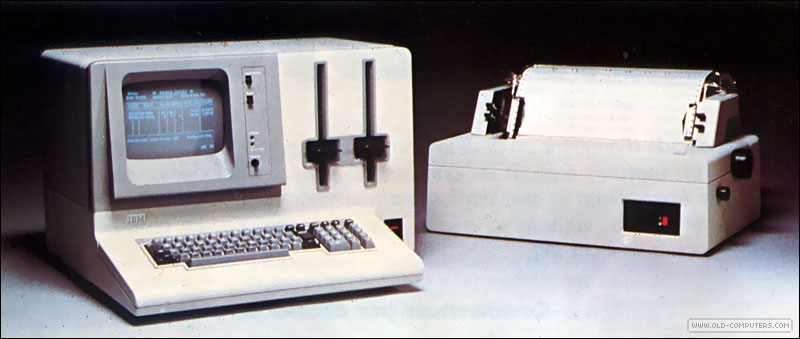
And finally, in July 1981, just a month (!) Before the release of the IBM PC, the System / 23 Datamaster computer appeared. Outwardly, it was very similar to 5120: the differences were only in the keyboard (BASIC remained the only language, but they decided to abandon the APL, therefore, there was no need for its special characters) and display (it, like the VT100 terminal, which had already become standard de facto) from Digital Equipment Corporation , displayed 80 × 24 characters). The fundamental change was the use of the 8-bit Intel 8085 processor.
But nevertheless, with the advent of the world, “personalities” (and even modern models of “Makovs”) owe not to them at all, but ... to chess. Under the code name “Project Chess”, in 1980, IBM began work on a project to create a new computer architecture, which was to not only compete with the three main players in the market - Apple, Atari and Commodore - but also how history would manage with time , become its absolute leader ...
The Blue Giant starts and wins! Don Estridge
volunteered to lead the development(Philip Donald Estridge). He and eleven other employees had a difficult task - to meet the shortest possible time (before that, IBM engineers usually took several years to develop new computers). At a certain stage, the Estridge team faced a choice: to use only the company's own developments or to rely on ready-made components from third-party manufacturers. As a result, it was decided instead of the experimental IBM 801 RISC processor developed in 1974 (by the way, it formed the basis of the Power processor architecture) take the 16-bit Intel 8088. We took the keyboard and expansion slots with some changes from System / 23 Datamaster, added the display already available from IBM and installed the floppy drive. Moreover: today it sounds like nonsense, but the IBM PC 5150 also had a port for connecting a cassette recorder (!), And it was also possible to use a regular TV as a display. In ROM, the interpreter of the good old BASIC was also “flashed”.
With the choice of the operating system for the new computer, everything turned out to be much more interesting. The fact is that for 8-bit Intel 8080 microprocessors (as well as its advanced but fully compatible analogue of Zilog Z80 ) and Intel 8085OS already existed. It began to be developed in 1973-74 by Gary Kildall , and it was called CP / M(Control Program for Microcomputers - English. The Control Program for Microcomputers). To better promote the system on the market, he will create the company Intergalactic Digital Research (later it will be simply called Digital Research) and together with his wife will lead it. Kildol’s ambitions will pay off in full, and very soon CP / M will be in demand and widespread - it will be used on many machines (starting with the MITS Altair 8080 and IMSAI 8800). The secret of success was that the OS was originally conceived as platform-independent, which, with the “mottling” of the first computers, was by no means superfluous. To write most of the system, Kildol has developed a special high-level language - PL / M. But at the same time, it remained undemanding to system resources (everything,
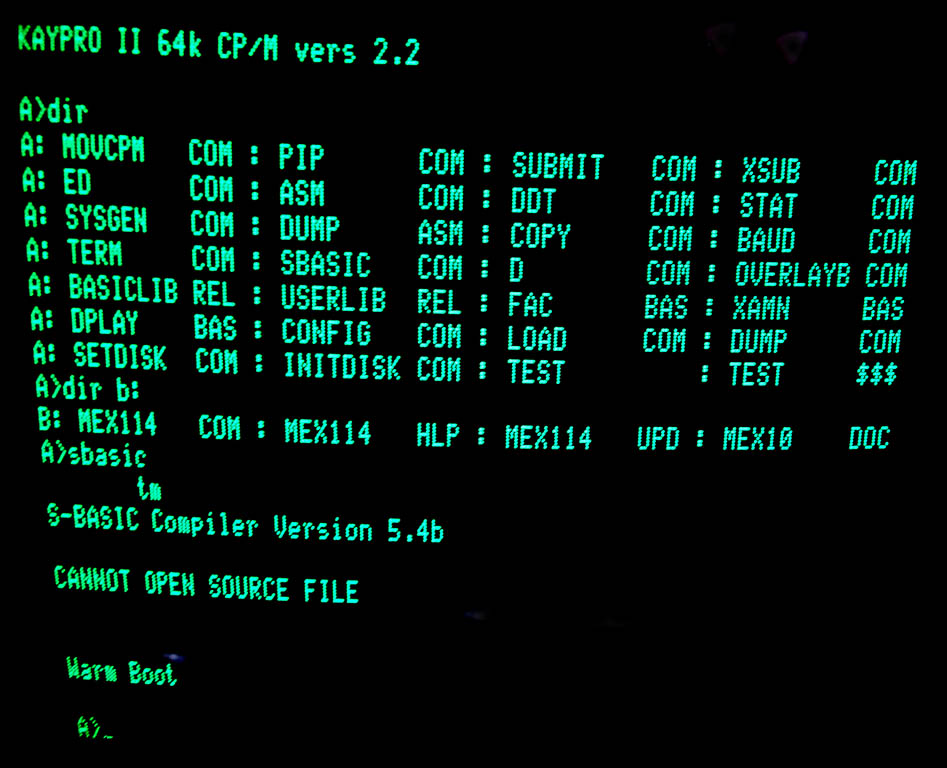
Therefore, IBM initially relied on a popular product from Digital Research. Of course, this does not mean at all that IBM programmers would not be able to develop their own operating system (note that we will have to do this anyway). Just for CP / M at that time a lot of system and application programs had already been written and put on the market (for example, the debut version of AutoCAD was presented just for her). This was to save developers from the need to rewrite everything anew and would contribute to the speedy advancement of the computer in the business environment for which it was designed. Porting the system to a 16-bit architecture also did not present an insurmountable problem. But Gary Kildol and IBM representatives still failed to agree and sign the papers ...
Так на большую сцену вышел Билл Гейтс (Bill Gates) и основанная им и Полом Алленом (Paul Allen) компания Microsoft (название сначала писали через дефис — Micro-Soft). Гейтс к тому времени уже был, как говорится, широко известен в узких кругах тем, что представил Altair BASIC, коммерческий интерпретатор Бейсика для микрокомпьютера Altair 8080. А также тем, что обратился к энтузиастам-компьютерщикам с открытым письмом «An Open Letter to Hobbyists» (оно было опубликовано в январе 1976 года в информационном бюллетене Homebrew Computer Club, а затем и других изданиях сходной тематики) и уже тогда выразил беспокойство по поводу нарушения авторских прав разработчиков программного обеспечения.
At that time, Microsoft did not have its own operating system - the company was developing and selling its own BASIC implementations for the first personal computers. Therefore, when such a tempting offer from IBM came, Gates, without further ado, just bought the rights to a similar CP / M, but written by Seattle Computer Products for the 16-bit Intel 8086 microprocessor OS 86-DOS. Then it was slightly corrected, renamed to MS-DOS and introduced to IBM as an original product. The deal took place ... As part of IBM's computers, the operating system will ship under the name IBM PC-DOS.

The first versions of MS-DOS and PC-DOS were in many ways suspiciously similar to the original CP / M. It even allowed Kildol to accuse IBM of copyright infringement. In response to this, the company still agreed to release a PC version. However, this could not radically change anything: a system from Digital Research called CP / M-86 will cost several times more and sell much worse, and eventually begin to lose PC-DOS positions.
Pretty soon, the second OS available for the IBM PC will sink into oblivion (later Digital Research will release DR-DOS, but now, ironically, it will be based on DOS). But there was one more! Forgotten today, like CP / M, the system with the unpronounceable name UCSD p-System, was written in Pascal (!) and due to the interpretation of the bytecode, it also allowed you to run programs developed for it on different machines. For a while, it enjoyed a certain popularity among users of the Apple II computer.
What was the IBM Personal Computer 5150 ? Silicon heart of a computer, Intel 8088 16-bit microprocessorbeat at a frequency of 4.77 MHz. At the minimum configuration — without a floppy drive, operating system, or display — the computer was priced at $ 1,565, and the RAM was just 16 KB. In this case, it was possible to work only with a cassette recorder and BASIC. The most running configuration cost $ 3,000. It included a monochrome display and floppy drive. The amount of RAM was 64 KB (this is the minimum required for working with PC-DOS). In subsequent modifications, it will be increased to 256 KB. And finally, the most complete set included already two drives, a color display and a printer. It was designed for business applications and sold for $ 4,500. There were five internal expansion slots on the computer. The first two usually occupied the floppy drive controller and video adapter.

The reason for the dizzying success of the computer created by IBM was not at all the outstanding characteristics of the hardware or software (but the operating system did have many significant shortcomings). Most importantly, for the first time in the company's history, key architecture specifications remained open to all, without exception. In the future, this factor will play a key role in the ubiquity of the IBM PC platform. However, the full significance of such a solution and its consequences were not fully recognized immediately, and according to the initial plan, this was only to encourage third-party manufacturers to start developing and releasing components and peripherals, and programmers to write application software. After some time, many companies will rush to present their own computers on the market, hardware and software compatible with it. Sometimes, even for machines with a completely different architecture, they will release add-ons that provide compatibility to one degree or another. In the end, this will lead to the emergence of the concept of "IBM PC compatible."
After the triumph of the IBM PC, so unexpected even for the management of the company, the career of its creator, Don Estridge , quickly went uphill. The little-known fact that Steve Jobs himself suggested he become president of Apple Computer is also interesting. Estridge, however, did not agree. By 1984, he will already be vice president of IBM. However, the irreparable happened: on the second of August 1985, Don and his wife died in a plane crash. He was only 48 years old ...

By that time, IBM Personal Computer / AT will enter the market , and the 5150 model will last until 1987.
To be continued?
Once upon a time, when the displays were smaller, the disks and processors were slower, the RAM was expensive, the games excited the imagination with variety and spoiled the originality, the connection was slow and tried to break off at the most inopportune moment, and the worldwide network was just trying to get on its feet and make the first uncertain steps to observe the development of information technology was no less interesting than now ...
When things were so uncomplicated
In those glorious times, the story of the founders of modern computers originates.
On April 1 (!) 1976, three comrades - Steven Jobs (Steven Jobs), Steve Wozniak (Stephen Wozniak) and Ronald Wayne (Ronald Wayne) - founded a company selling personal computers, really small and affordable. Very many people thought then that this was a joke. And in vain ... Apple I
MachineIt was initially offered at an “attractive” starting price of $ 666.66 (in a year it will be reduced to $ 475) and was a finished printed circuit board with components already installed. Assembling Wozniak and Jobs, the manual was written by Ronald Wayne. The user had to connect a keyboard, a display (in this role a regular TV set could play), a tape recorder (to work with which later it was proposed to purchase another board for an additional $ 75), a power supply and “put on” all this in the case. Of course, there were practically no stores for the sale of components and software, nor personal computers, except, perhaps, the Xerox Alto and the IBM 5100 (we will talk about it later), as well as the MITS Altair 8800 and its direct competitor IMSAI 8080. So it almost certainly meant do-it-yourself. For a year and a half (until October 1977) about two hundred cars were sold. Now they are all rare and representgreat collection value: until today, no more than fifty original Apple I have survived intact.
By the way, today anyone can follow the path of Wozniak and Jobs and, with the soldering iron at the ready, assemble a full-fledged analogue of Apple I ( video ).
On the tape cassette, which, along with the manual was attached to the computer, the BASIC interpreter was recorded - a kind of forerunner of modern scripting programming languages in the sense that it was used both for solving relatively simple and routine tasks, and for writing relatively complex programs. As a demonstration of the possibilities, several simple games were offered to the attention of the user (no graphics, only text mode). And, of course, there was an assembly language that made it possible, with due talent and experience of a programmer, to squeeze out everything that is possible from a modest (by today's standards, of course) hardware ... and a little more.
The project was aimed more at electronic enthusiasts, although this is not surprising: Steve Wozniak, who then worked at Hewlett-Packard, began developing the computer in his spare time and purely for his own needs. Only later, when he actually demonstrated the results of his research to members of the Homebrew Computer Club , long-time friend and associate Steve Jobs offered to sell it. As they say, the beginning was laid ...
The era of personal computers was born.
Already in January 1977, the consumer electronics company Commodore International entered the market with the Commodore PET computer . His somewhat clumsy “retro-futuristic” appearance today involuntarily causes a smile ... Five years later, in August 1982, the cult will be releasedCommodore 64 s, as the name suggests, 64 KB of RAM. In terms of price and performance characteristics of graphics and sound at that time, the C64 was much more attractive than its competitors. Largely thanks to him, a new near-computer subculture was formed - the demoscene (today, for Commodore 64, “ demos ” and even games are still being created ). In total, until 1994, a record number of cars of this model will be sold - 17 million units. Computers became mass.
A little over a year after the release of Apple I, a new model appeared - the Apple II with the MOS Technology 6502 microprocessoroperating at a frequency of 1 MHz, and 4-48 KB of RAM. It was no longer a home-made designer assembled in the garage, but a high-quality product. On the keyboard, which was also a system unit, drives for five-inch floppy disks (they will be added later, in 1978) and the display, alluding to the support of color graphics, proudly flaunted a rainbow bitten apple - the new company logo (the previous one, with Isaac Newton under the tree, came up with the same Ronald Wayne).
This computer was an incredible success! And in many respects thanks to the fact that the VisiCalc table processor will initially be released on Apple II, the machine will become especially attractive to small and medium-sized businesses. Things will go uphill sharply, but Jobs and Wozniak will not even have time to look back, as they will become millionaires. This model will be released in several versions (including portable ) and will be sold for 16 years, until 1993. There will be many compatible (and often cheaper) cars from other manufacturers. An analogue called Agate will be produced even in the Soviet Union. The latest modification, Apple IIGS , will be released in September 1986. It will already carry a 16-bit processor, and will run an operating system with a graphical user interface.
In 1979, deliveries of two more 8-bitcomputers - Atari 400 and Atari 800. Prior to this, Atari, Inc. very successful in the production of slot machines and home set-top boxes . Generally speaking, most often it was games that were the driving force behind the development of personal computers. For example, Steve Jobs and Jay Miner , the main developer of personal computers at Amiga , worked at Atari for some time .
The appearance of the Atari 400 was also very unusual: the developers decided to use a membrane-type keyboard (a similar design solution was also used in the Soviet 16-bit personal computer Electronics BK-0010 of 1985, but was rejected in subsequent modifications) and the ROM connector 8 KB cartridges. Downloading a program from a tape required a lot of time, the first drives, although they were much faster than tape cassettes, remained very expensive, and the five-inch floppy disks themselves were never very reliable. The programs recorded in the removable ROM were ready to work immediately after turning on the power. The main difference of the Atari 800 was the keyboard - it was the most ordinary (and therefore more reliable), but this model was sold worse.
Exactly thirty years ago, in 1981, events occurred that not only influenced the entire subsequent IT industry, but also determined the interests and occupation of many of those who read these lines now.
In March 1981, entrepreneur Clive Sinclair (full name Sir Clive Marles Sinclair), who previously produced portable radios and televisions, pocket calculators, and watches, also invented the Sinclair ZX81 computer in the UK.. It was extremely simple, contained a minimum of details, and therefore was cheap and aimed at the mass consumer. The machine was equipped with a Zilog Z80 microprocessor with a frequency of 4 MHz, RAM from 1 to 64 KB, like the Atari 400 had a membrane-type keyboard and was offered in two versions. At a price of about 50 pounds in the form of a constructor, which you had to assemble yourself with a soldering iron, multimeter, oscilloscope and other instruments familiar to a ham radio operator. Or at a price of about 70 pounds in assembled form for those who have never held a soldering iron in their hands.
A more perfect model in 1982 was called ZX Spectrumfor the fact that, unlike its predecessor, it already knew how to work with color graphics. She quickly became a bestseller in the UK and Europe, competing in popularity with the American Commodore 64. In 1983, Clive Sinclair will be knighted for creating this wonderful computer. Speccy , as the fans affectionately call him, not only paved the way for everyone to the exciting world of games, mathematics and computer creativity, he became an excellent school for future IT specialists, then teenagers. For example, Linus Torvalds had the Sinclair QL - the latest model released by Sinclair Research , a company of Sir Clive, in 1984.
It is also interesting that in the late eighties and early nineties in the USSR, and then in the CIS countries and neighboring countries, this architecture was granted a second life. Domestic analogues, most often home-made, significantly exceeded the characteristics of the original model. It was such computers for many in their childhood that became the first. In the post-Soviet space, these little cars until the mid-nineties deservedly considered "folk." We still love them, continue to improve and release them in the form of a designer board called ZX Evolution .
In April 1981, Osborne 1 appeared on the market.A very entertaining exhibit. It may well be considered the first truly “portable” computer. However, its design was different from today's laptops: a built-in monochrome CRT display with a diagonal of only 5 inches (it was possible to connect an external one), two drives for five-inch floppy disks, a hinged keyboard cover and a carrying handle. All this with a weight of about 11 kilograms. The microprocessor Zilog Z80 was used, the amount of RAM was 64 Kb. The CP / M operating system was supplied with the computer (we will still have an occasion to recall it), the Basic interpreter, two text adventure games, several office programs. Despite the considerable weight and dimensions, they willingly bought it.
On August 12, 1981, International Business Machines introduced the IBM Personal Computer 5150 to the general public. Having engaged in the creation and sale of powerful, large and very expensive machines for several decades, the “blue giant” decided to make a name for itself in the rapidly growing personal computer market. No wonder: by then a real boom had begun here!
Even before the beginning of the eighties, PCs were bought mainly by specialists or enthusiasts, and, of course, some companies that already managed to discern an “affordable” effective tool for doing business in the “staff”. For the mass consumer, it was still far from always clear what a “personal computer” was, and most importantly, what to do with it: it was still not cheap, it was difficult to master, and it turned out that the programs themselves had to be written. What good could it be?
Now everything has changed. Hardly anyone and everyone wanted to see the new product at home. There were several reasons for this: this was popularization (and, of course, advertising) in the press, on radio and television. Enthusiastic reviews from colleagues and acquaintances who, at lunchtime, spent their free time playing on a work computer. And the children, who, of course, dreamed that for Christmas or birthday, instead of a bicycle, their parents gave them this electronic miracle. But the most significant thing was that now to solve typical problems, whether it was working with files and text, preparing a financial report or reading e-mail, you did not need to be seven spans in your forehead and learn an incomprehensible programming language (the resources of the first machines were modest, therefore, they wrote most often in assembler). It is enough to purchase the appropriate program and carefully familiarize yourself with the accompanying manual. More and more companies, teams and simply independent developers began to appear who wrote and sold products that made the computer more friendly and closer to a simple user.
For IBM, this was not the first attempt to create a more or less compact desktop computer.
In 1975, sales of the IBM 5100 Portable Computer began. Among his large-sized brothers and predecessors of the sixties and seventies, he stood out favorably by price (from $ 11,000 for 16 KB of RAM and up to 20,000 for 64 KB), miniature and weight - about 25 kg. This was very important, since computers of those times most often weighed hundreds of kilograms and took up a lot of space (although there were exceptions), but there was no need to talk about the cost. The most significant drawback was the tiny display (with a diagonal of 5 inches, like the Osborne 1). Therefore, the panel was a three-position switch, allowing you to choose between 64 × 16 characters mode or display in 32 × 16 characters the right or left half of the screen. As carriers used cartridges with magnetic tape. The user could choose one of two programming languages (an operating mode switch was also provided for this): the already familiar BASIC and the functional language APL (A Programming Language), which was used on IBM mainframes. The keyboard was marked with special characters specific to this language. The production of the IBM 5100 ceased only in 1982, a year after the release of the first IBM PC.
The direct descendant of the IBM 5100 is the 5120 model released in February 1980.- it used the same 16-bit processor of its own design. It was called IBM PALM (Put All Logic in Microcode) and was not a microcircuit, but a separate printed circuit board with installed logical components and the microcode “flashed” into them. Eight-inch floppy disks replaced the magnetic tape, and the integrated display diagonal was already 9 inches. By the way, with a weight of about 45 kg. it remains the heaviest desktop computer ever created - such a peculiar record.
And finally, in July 1981, just a month (!) Before the release of the IBM PC, the System / 23 Datamaster computer appeared. Outwardly, it was very similar to 5120: the differences were only in the keyboard (BASIC remained the only language, but they decided to abandon the APL, therefore, there was no need for its special characters) and display (it, like the VT100 terminal, which had already become standard de facto) from Digital Equipment Corporation , displayed 80 × 24 characters). The fundamental change was the use of the 8-bit Intel 8085 processor.
But nevertheless, with the advent of the world, “personalities” (and even modern models of “Makovs”) owe not to them at all, but ... to chess. Under the code name “Project Chess”, in 1980, IBM began work on a project to create a new computer architecture, which was to not only compete with the three main players in the market - Apple, Atari and Commodore - but also how history would manage with time , become its absolute leader ...
The Blue Giant starts and wins! Don Estridge
volunteered to lead the development(Philip Donald Estridge). He and eleven other employees had a difficult task - to meet the shortest possible time (before that, IBM engineers usually took several years to develop new computers). At a certain stage, the Estridge team faced a choice: to use only the company's own developments or to rely on ready-made components from third-party manufacturers. As a result, it was decided instead of the experimental IBM 801 RISC processor developed in 1974 (by the way, it formed the basis of the Power processor architecture) take the 16-bit Intel 8088. We took the keyboard and expansion slots with some changes from System / 23 Datamaster, added the display already available from IBM and installed the floppy drive. Moreover: today it sounds like nonsense, but the IBM PC 5150 also had a port for connecting a cassette recorder (!), And it was also possible to use a regular TV as a display. In ROM, the interpreter of the good old BASIC was also “flashed”.
With the choice of the operating system for the new computer, everything turned out to be much more interesting. The fact is that for 8-bit Intel 8080 microprocessors (as well as its advanced but fully compatible analogue of Zilog Z80 ) and Intel 8085OS already existed. It began to be developed in 1973-74 by Gary Kildall , and it was called CP / M(Control Program for Microcomputers - English. The Control Program for Microcomputers). To better promote the system on the market, he will create the company Intergalactic Digital Research (later it will be simply called Digital Research) and together with his wife will lead it. Kildol’s ambitions will pay off in full, and very soon CP / M will be in demand and widespread - it will be used on many machines (starting with the MITS Altair 8080 and IMSAI 8800). The secret of success was that the OS was originally conceived as platform-independent, which, with the “mottling” of the first computers, was by no means superfluous. To write most of the system, Kildol has developed a special high-level language - PL / M. But at the same time, it remained undemanding to system resources (everything,
Therefore, IBM initially relied on a popular product from Digital Research. Of course, this does not mean at all that IBM programmers would not be able to develop their own operating system (note that we will have to do this anyway). Just for CP / M at that time a lot of system and application programs had already been written and put on the market (for example, the debut version of AutoCAD was presented just for her). This was to save developers from the need to rewrite everything anew and would contribute to the speedy advancement of the computer in the business environment for which it was designed. Porting the system to a 16-bit architecture also did not present an insurmountable problem. But Gary Kildol and IBM representatives still failed to agree and sign the papers ...
Так на большую сцену вышел Билл Гейтс (Bill Gates) и основанная им и Полом Алленом (Paul Allen) компания Microsoft (название сначала писали через дефис — Micro-Soft). Гейтс к тому времени уже был, как говорится, широко известен в узких кругах тем, что представил Altair BASIC, коммерческий интерпретатор Бейсика для микрокомпьютера Altair 8080. А также тем, что обратился к энтузиастам-компьютерщикам с открытым письмом «An Open Letter to Hobbyists» (оно было опубликовано в январе 1976 года в информационном бюллетене Homebrew Computer Club, а затем и других изданиях сходной тематики) и уже тогда выразил беспокойство по поводу нарушения авторских прав разработчиков программного обеспечения.
At that time, Microsoft did not have its own operating system - the company was developing and selling its own BASIC implementations for the first personal computers. Therefore, when such a tempting offer from IBM came, Gates, without further ado, just bought the rights to a similar CP / M, but written by Seattle Computer Products for the 16-bit Intel 8086 microprocessor OS 86-DOS. Then it was slightly corrected, renamed to MS-DOS and introduced to IBM as an original product. The deal took place ... As part of IBM's computers, the operating system will ship under the name IBM PC-DOS.
The first versions of MS-DOS and PC-DOS were in many ways suspiciously similar to the original CP / M. It even allowed Kildol to accuse IBM of copyright infringement. In response to this, the company still agreed to release a PC version. However, this could not radically change anything: a system from Digital Research called CP / M-86 will cost several times more and sell much worse, and eventually begin to lose PC-DOS positions.
Pretty soon, the second OS available for the IBM PC will sink into oblivion (later Digital Research will release DR-DOS, but now, ironically, it will be based on DOS). But there was one more! Forgotten today, like CP / M, the system with the unpronounceable name UCSD p-System, was written in Pascal (!) and due to the interpretation of the bytecode, it also allowed you to run programs developed for it on different machines. For a while, it enjoyed a certain popularity among users of the Apple II computer.
What was the IBM Personal Computer 5150 ? Silicon heart of a computer, Intel 8088 16-bit microprocessorbeat at a frequency of 4.77 MHz. At the minimum configuration — without a floppy drive, operating system, or display — the computer was priced at $ 1,565, and the RAM was just 16 KB. In this case, it was possible to work only with a cassette recorder and BASIC. The most running configuration cost $ 3,000. It included a monochrome display and floppy drive. The amount of RAM was 64 KB (this is the minimum required for working with PC-DOS). In subsequent modifications, it will be increased to 256 KB. And finally, the most complete set included already two drives, a color display and a printer. It was designed for business applications and sold for $ 4,500. There were five internal expansion slots on the computer. The first two usually occupied the floppy drive controller and video adapter.
The reason for the dizzying success of the computer created by IBM was not at all the outstanding characteristics of the hardware or software (but the operating system did have many significant shortcomings). Most importantly, for the first time in the company's history, key architecture specifications remained open to all, without exception. In the future, this factor will play a key role in the ubiquity of the IBM PC platform. However, the full significance of such a solution and its consequences were not fully recognized immediately, and according to the initial plan, this was only to encourage third-party manufacturers to start developing and releasing components and peripherals, and programmers to write application software. After some time, many companies will rush to present their own computers on the market, hardware and software compatible with it. Sometimes, even for machines with a completely different architecture, they will release add-ons that provide compatibility to one degree or another. In the end, this will lead to the emergence of the concept of "IBM PC compatible."
After the triumph of the IBM PC, so unexpected even for the management of the company, the career of its creator, Don Estridge , quickly went uphill. The little-known fact that Steve Jobs himself suggested he become president of Apple Computer is also interesting. Estridge, however, did not agree. By 1984, he will already be vice president of IBM. However, the irreparable happened: on the second of August 1985, Don and his wife died in a plane crash. He was only 48 years old ...
By that time, IBM Personal Computer / AT will enter the market , and the 5150 model will last until 1987.
To be continued?