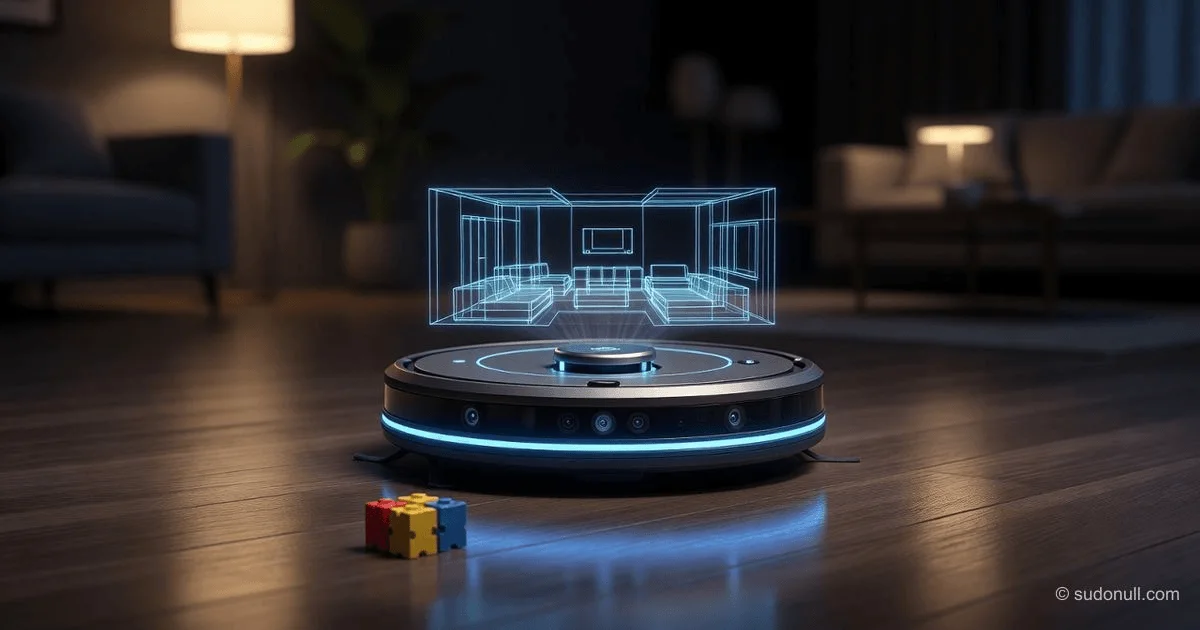
Industrial Robot Vacuum Matic Enters the Market with AI-Based Navigation System Without LiDAR
Startup Matic has unveiled a premium device that uses cameras and neural networks for navigation, similar to self-driving cars. The robot can recognize objects and dirt in real time, operating fully autonomously without data from cloud servers.
The Robot That Sees: Why Matic Kills LiDAR and the Industry Doesn't Notice
Author: Independent Robotics and Edge Computing Analyst
Date: June 11, 2026
While Tesla tries to teach its cars to drive without radar, a small startup from Silicon Valley has already solved this problem for the home. Matic is not just another "smart vacuum." It is the world's first mass-produced consumer robot that doesn't use LiDAR at all, relying solely on cameras and neural networks running on the edge of edge computing capabilities.
And this changes everything. The robot vacuum market is worth $15 billion annually. It is dominated by companies like iRobot (which, by the way, recently went bankrupt), Roborock, and Dreame, which build their maps using rotating laser "turrets." Matic enters the battlefield empty-handed—five cameras, an Nvidia Jetson Orin Nano chip, and zero cloud dependency. And it scores 10/10 from Wired, "Editor's Choice" from Gizmodo, and Best Robot Vacuum from The Verge.
The silence around this release in mainstream media is deafening. Why? Because Matic didn't just launch a product—it buried the old paradigm. And those who don't switch to "vision" in the next 12 months will die. Literally, like iRobot.
[The Core]: What's Really Happening
From a technical standpoint, Matic's approach is "Tesla FSD for your floors." Most robot vacuums use LiDAR to create a real-time 2D map of the room. This works, but it has fundamental limitations: LiDAR doesn't distinguish objects. To it, a charging cable, a child's sock, and a pile of dog "surprises" are just "obstacles." As a result, the robot either gets stuck or smears the problem all over the house.
Matic uses five RGB cameras and creates not a 2D plan but a voxel 3D model with accuracy down to 1 cubic centimeter. The onboard neural network (Nvidia Jetson Orin Nano, by the way) classifies every object in real time: "this is a carpet, this is a toy, and this is..."—and decides: go around, climb over, or, in the case of a stain, treat it specially.
But the point isn't the technology itself. The point is economics and privacy. A typical LiDAR for a robot costs $50-100. A camera costs $5-10. But processing camera data requires 10-20 times more computing power. Previously, this was prohibitively expensive for the mass market. But now that Nvidia sells the Jetson Orin for $199 wholesale, the economics align. Matic became possible only now, in 2026, because only now has the price of "brains" fallen below the price of "eyes."
And second: no cloud. Competitors (Roborock, Ecovacs) upload maps of your home to cloud servers in China or the US. Matic processes everything on-device. You can even turn off Wi-Fi—the robot will continue working via Bluetooth. In an era of total data leaks and spy mania (especially after iRobot's bankruptcy, when it's unclear who now owns user maps)—this is not a feature, it's a must-have.
| Feature | Matic | Flagship Roborock S8 MaxV Ultra |
|---|---|---|
| Navigation | 5 RGB cameras + AI (no LiDAR) | LiDAR + obstacle camera |
| Processor | Nvidia Jetson Orin Nano (40 TOPS) | Specialized Rockchip chip |
| Privacy | Fully local (on-device) | Cloud-based mapping and recognition |
| Suction Power | ~3,200 Pa | 10,000 Pa |
| Price | $1,245 | ~$1,600 (with dock) |
Table 1. Comparison of Matic with the LiDAR robot market leader
[Timeline and Context]
Officially, Matic was announced back in late 2023 to early 2024 with a price of $1,800 and plans for delivery in March 2024. At the time, it looked like another "Kickstarter failure." Too expensive, too unclear.
But the founding team (ex-Google Nest engineers) spent the last two years on titanic work: reducing costs, optimizing AI models for the Nvidia chip, and, more importantly, building distribution channels. By June 2026, the price dropped to $1,245, and the robot earned a "10/10 Wired" rating.
Today's context: iRobot (maker of Roomba) went bankrupt. The market lost its main veteran. Into this void bursts Matic. But the key difference from Chinese competitors (Roborock, Dreame, Ecovacs) is architectural independence. The Chinese build their "AI cameras" as an overlay on LiDAR, turning the robot into a hybrid. Matic is built as "camera first." This is not evolution; it's revolution.
And another important context: Matter. In a recent update, Matic added Matter support, allowing integration into Home Assistant locally, without firewall holes. This turns the vacuum from a gadget into a smart home element that doesn't spy on you. For the Home Assistant community (millions of enthusiasts worldwide), this is an event on par with "a new iPhone is out."
[Who Wins and Who Loses]
Obvious winner: Nvidia. Every Matic sells one Jetson Orin Nano chip. Multiply by volume (if Matic goes mass market—hundreds of thousands of units)—that's millions of dollars in revenue for the green giant. But more importantly, Nvidia gets a reference design for a "vision-first robot" that they can sell to other OEMs. Matic is a proof-of-concept that Nvidia GPUs can replace LiDAR everywhere: from drones to warehouse carts.
Obvious loser: LiDAR manufacturers for consumer robotics. Companies like Ouster, Hesai (the Chinese LiDAR monopoly), or Velodyne lose a huge market segment. If Matic proves that cameras are sufficient for navigation, no one will pay for an extra "dish" on the robot's lid. This hits the gross margins of all robot manufacturers currently buying LiDAR. They will be forced to switch to cameras, but they lack the software.
Hidden winner: Qualcomm. Their Snapdragon chips for robots (RB series) can also process cameras. But for now, Matic chose Nvidia. However, Qualcomm is eyeing this market and thinking, "We can do the same for $50 per chip." If Qualcomm rolls out a cheap SoC for vision robots in 2027, they could seize the initiative from Nvidia in the budget segment. But for now—Nvidia wins.
Hidden loser: iRobot (creditors). iRobot's bankruptcy didn't happen in a vacuum. They couldn't transition to vision-based navigation because they were tied to LiDAR patents and lacked internal AI expertise. Matic is the "Roomba killer" that delivered the final blow. iRobot's creditors will get pennies because investors no longer believe in LiDAR robots.
| Entity | Win/Loss | Reason |
|---|---|---|
| Matic (startup) | Win | Breakthrough in navigation, critical acclaim, loyal community |
| Nvidia | Win | Reference design, Jetson sales, robotics ecosystem |
| Roborock / Dreame | Loss/Adaptation | Must urgently switch to Vision, but their software lags |
| LiDAR manufacturers | Loss | Loss of mass market, retreat to automotive niche |
| Qualcomm | Potential win | Niche opens for cheap Vision chips |
Table 2. Distribution of gains and losses from Matic's release in the robotics market
[What the Media Isn't Saying]
First omission: "speed problem" as a strategy. Matic is slow. It cleans 0.52 square meters per minute, while the average robot does 0.75. Where Roborock finishes in an hour, Matic will chug for three hours. But this is not a bug; it's a feature. Slow movement allows the neural network to analyze every centimeter of the floor, detect stains, and decide "wipe or pass by." Matic doesn't just collect dust; it "patrols" the home. Journalists write "slow," but they should write "thorough." But that doesn't sell in headlines.
Second omission: death of "auto-empty." Matic has no self-cleaning base. It uses disposable bags for mixed waste and water (HEPA bags). Dirty water doesn't drain into a separate tank; it's absorbed into the bag and dries out. This is brilliant from a hygiene standpoint—no rotting "swamp" in the dock. But it's a disaster from a TCO (total cost of ownership) perspective. Bags cost $2.50 each. With daily cleaning, that's $75 per month just on consumables. Matic is a subscription to cleanliness, not a purchase. No media outlet has fully calculated this.
Third, most hidden insight: the "thick client" architecture returns. In the era of "smart" things, we got used to the cloud doing all the computing. Matic returns us to the 90s model: the device itself handles its intelligence. This is possible because chips have become powerful enough and batteries capacious enough. If Matic takes off, we'll see an avalanche of "thick" robots: lawn mowers, pool cleaners, security bots that don't depend on the internet. This shifts the IoT market from "SaaS subscription" back to "hardware." Shareholders of SaaS companies (like Tuya Smart) should be panicking, but they haven't realized it yet.
[Forecast: Next 30 Days and 90 Days]
30-day forecast (July 2026): Matic will announce a partnership with a major retailer (Best Buy or Target). Currently, the robot is sold only online. Going offline will boost sales 3-5 times. Also expect a reaction from Roborock—they'll announce a "fully LiDAR-free" version of their next flagship, but it will cost $1,800+ due to the need for a more powerful processor.
90-day forecast (September 2026): Benchmarks from Consumer Reports. Currently, Matic has 10/10 from Wired, but Consumer Reports tests reliability. The key metric is failure of the Nvidia chip after 500 hours of operation under vibration. If the Jetson holds up, the rating will be high. If not, Matic faces a recall campaign. I bet Nvidia made quality hardware. Also expect a lawsuit from some LiDAR patent holder (e.g., Velodyne) trying to block Matic sales in the US, claiming "camera navigation infringes our obstacle detection patents." This is standard practice, and Matic will have to fight back.
Final scenario matrix for the vision robot market:
| Scenario | Probability | Market Impact | Bet |
|---|---|---|---|
| Matic goes mainstream (sales >500k in 2027) | 30% | Death of LiDAR in consumer segment within 2 years | Buy Nvidia stock (chip gains) |
| Niche success (sales <100k, but "premium" status) | 50% | Coexistence: LiDAR for budget, Vision for luxury | Invest in Vision-robotics startups |
| Failure due to price and bags (users complain about consumables) | 15% | Return to LiDAR, market consolidation by Chinese | Short Matic (via crowdfunding) |
| Acquisition by Apple (Apple buys Matic for HomeKit) | 5% | Market explosion, integration with Apple Intelligence | Buy Apple (long-term) |
Table 3. Probability matrix for vision robotics development
Final advice: Matic as a company is private; direct investment is nearly impossible. But you can bet on Nvidia (NVDA) winning in edge-AI. Every future smart robot will use Jetson or similar. Also watch Chinese startup Dreame—they've already copied Matic's approach and will release a cheap clone in 9 months for $799. It will use Horizon Robotics chips (China's Nvidia equivalent). If you believe in China, buy Horizon. If you believe in privacy and quality, buy Matic when they go public. But remember: a robot that sees every corner of your bedroom costs $1,245. And the price of your private data if it leaks from Roborock to China is priceless. Matic is betting on the latter. And it seems to be winning.
— Editorial Team










No comments yet.