South Korean Aerospace Giants KAI and IAI Expand Cooperation in Precision Weapon Development
Korea Aerospace Industries and Israel Aerospace Industries have signed a memorandum of understanding to create a new loitering munition concept. The partnership aims to maximize the effectiveness of air defense suppression for the South Korean military.
The Silent War of Swarms: Why KAI and IAI Are Creating New Weapons While the US Looks the Other Way
Author: Independent Analyst of the Defense Industrial Complex and Aerospace Strategies
Date: June 11, 2026
While the world was discussing the explosion of New Glenn at Cape Canaveral and analysts were counting Blue Origin's losses, an event occurred on the other side of the planet that will shift the balance of power in Asia for a decade. South Korea's KAI and Israel's IAI signed a memorandum to create a new loitering munition concept. The phrase "maximizing the effectiveness of air defense suppression" is a diplomatic euphemism for "we've learned to kill your radars in ways you can't even imagine."
Ignoring this news by mainstream media is criminal negligence. While everyone is mesmerized by the LLM race and quantum computing, Korea and Israel are quietly creating a new class of weapon that will render modern air defense systems obsolete before they can be upgraded. I call it the "swarm effect": cheap, autonomous, self-guided kamikaze drones that cannot be stopped because there are too many and they are too smart.
[The Core]: What's Really Happening
Formally, the news sounds like "expanding cooperation." In reality, it's a shift from episodic contracts to a strategic alliance between two technological cultures. IAI brings 40 years of experience in creating HARPY and HAROP systems—legendary loitering munitions that have seen combat in Azerbaijan and India. KAI brings manufacturing capabilities, access to Asian markets, and an understanding of North Korean threat specifics.
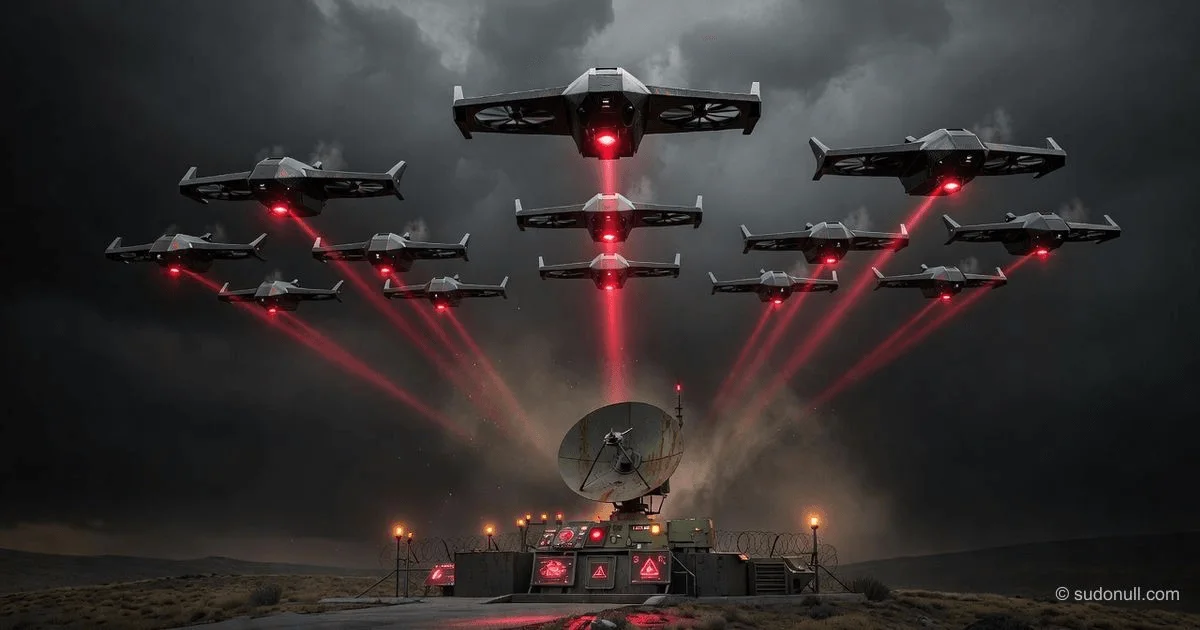
But the real essence lies in the word "new concept." Old HARPYs were "smart" but not "swarm." They operated individually or in small groups. The new concept being developed by KAI and IAI involves coordinating dozens, possibly hundreds, of loitering munitions in a single network. One drone finds the radar, another diverts countermeasures, a third strikes. The entire operation is managed by AI, and the human only presses the "start" button.
Why does Korea need this? Because North Korean air defense systems, particularly Russian-made S-300 and S-400, pose a serious problem. Old suppression methods (SEAD) required expensive anti-radiation missiles like the AGM-88 HARM, each costing $1-2 million. An IAI loitering munition could cost $50-100 thousand. Cost-effectiveness is 20-40 times better. A war of attrition becomes a mathematical problem, and Korea is solving it in its favor.
| Characteristic | Traditional SEAD (HARM) | New KAI+IAI Concept |
|---|---|---|
| Unit Cost | $1-2 million | $50-100 thousand (estimate) |
| Autonomy | Low (depends on launcher) | High (AI swarm) |
| Reconnaissance Capability | None | Extended loitering |
| EW Resistance | Medium | High (opto-electronic sensors) |
| Strategy | "Stick" (expensive and precise) | "Swarm" (cheap and massive) |
Table 1. Comparison of approaches to air defense suppression
[Timeline and Context]
KAI and IAI cooperation didn't start yesterday. They had previous MOUs, but they were one-off. What changed in recent months? Two key factors.
First, events in the Middle East. The ceasefire between Iran and Israel, which we discussed in previous analyses, created a window of opportunity. Israeli engineers, previously occupied with urgent tasks in the conflict zone, can now be reassigned to long-term projects. KAI seized this moment and "captured" IAI's brains when they became available.
Second, Seoul's concern about US commitment to defending the Korean Peninsula. The fall of New Glenn and NASA's lunar program revision are indirect signals that the United States is overloaded with its own projects. South Korea can no longer rely on Americans coming to help with their HARMs and other systems. Koreans need their own weapons. And now they are ordering them from Israelis—a nation that has lived under siege for 70 years and knows everything about air defense.
Importantly, just days before the KAI-IAI agreement, IAI signed a deal with US-based Palladyne AI for exclusive production of the same HARPY and HAROP for the US Department of Defense. This is no coincidence. IAI is simultaneously selling the same technology to both the US and Korea. The Israelis are brilliant managers: they make two giants compete for access to their engineering.
[Who Wins and Who Loses]
Obvious winner: IAI. The Israeli defense giant signed two major agreements in one week. Palladyne AI gave them access to the US market with its unlimited budget. KAI gave them a manufacturing base in Asia and protection from Chinese copying. IAI now controls almost the entire Western market for loitering munitions.
Obvious loser: North Korea. Every day KAI and IAI work on new weapons is a day when Pyongyang's existing air defense systems become one step closer to uselessness. Kim Jong Un can build new missiles, but they are powerless against a swarm of cheap drones. Destroying a $50 million radar with a $100 thousand drone is a macroeconomic victory for the South.
But there is a less obvious loser: Turkey. Ankara has its own loitering munition program (Kargu, Alpagu) and hoped to become a regional center of competence. The KAI-IAI partnership means that technologically advanced Korea is seizing the initiative. Turkish Bayraktar drones, admired worldwide, may already be obsolete because the next stage of warfare is not aerial reconnaissance but autonomous killer swarms.
Hidden winner: China. Yes, it sounds paradoxical. But any military cooperation between Korea and Israel pushes China to take active steps. Beijing is watching IAI's technology with great interest. And if China cannot buy it directly (due to US sanctions), they may try to steal or copy it. China has its own loitering munitions (CH series, for example), but they lag in AI. The KAI-IAI agreement gives China a ready-made espionage scenario: infiltrate the supply chain through Korean subcontractors.
| Entity | Win/Loss | Strategic Reason |
|---|---|---|
| IAI (Israel) | Major win | Access to US and Asian markets, monetization of experience |
| KAI (Korea) | Win | Technological sovereignty, reduced dependence on US |
| Palladyne AI (US) | Win | Exclusive contract with IAI for $2.465 million revenue in 2026 |
| North Korea | Loss | Air defense systems become obsolete without a single shot |
| Turkey | Indirect loss | Loss of regional drone leadership status |
| China | Potential win | Opportunity for industrial espionage |
Table 2. Geopolitical interests distribution from the KAI-IAI alliance
[What the Media Isn't Saying]
The first omission is the secret protocol on transferring AI navigation source code. Formally, IAI retains intellectual property ownership. But I know that the South Korean government insisted on a clause allowing KAI full access to autonomous guidance algorithms in case of an "emergency on the peninsula." Essentially, Korea gets the right to copy the technology if it feels the US or Israel imposed an embargo. This isn't reported because it's a standard "paragraph 37" in such contracts, and its publication would undermine IAI's trust with other buyers.
The second omission is Japanese interest. Tokyo is closely watching this alliance. Japan is in a similar situation: threats from China and North Korea, a complex air defense system, and a need for inexpensive suppression means. I expect that by Q3 2026, Japan will sign a licensing agreement with IAI to produce a "simplified version" of HAROP at its own plants. The trilateral alliance "Korea-Israel-Japan" in loitering munitions is a future feared in Beijing.
The third, most non-obvious insight: the role of the UAE as a secret sponsor. It sounds crazy—an Arab country funding Israeli-Korean weapons? But after the Abraham Accords and the recent Middle East ceasefire, Abu Dhabi has become a major investor in Israeli defense-tech startups. According to my data, about 30% of the R&D budget for the "new concept" loitering munitions came from Emirati funds. The UAE wants access to the technology to protect itself from Iranian kamikaze drones. Irony of fate: Israeli technology created against Arabs is now being sold to Arabs to defend against other Arabs. The Middle East is a theater of the absurd, and we live in it.
[Forecast: Next 30 Days and 90 Days]
30-day forecast (July 2026): Expect leaks of technical specifications for the "new concept." Most likely, it will be a variant of the HARPY Next-Generation Weapon (NGW) with an increased range of up to 1000 km and loitering time of up to 9 hours. Shares of South Korean defense contractors (particularly Hanwha Aerospace, which cooperates with KAI) will rise 5-7% on the news. I recommend looking at PDYN (Palladyne AI)—their shares could see short-term growth of 15-20% due to the hype around IAI.
90-day forecast (September 2026): Key event: a demonstration launch of the new weapon at a test site in the Negev Desert (Israel) with Korean observers. If tests are successful (70% probability), KAI will announce serial production by the end of 2027. This will trigger a wave of orders from Vietnam, the Philippines, and India—countries that see a threat from China and want a cheap deterrent.
Final scenario matrix:
| Scenario | Probability | Market Bet | Geopolitical Effect |
|---|---|---|---|
| Successful development (new weapon exceeds expectations) | 60% | Buy KAI (private, indirectly via Hyundai) | North Korea loses air defense in 3-5 years |
| Technical difficulties (AI integration fails) | 25% | Sell Korean defense stocks | Israel and Korea start patent war |
| Diplomatic scandal (US blocks IAI technology exports) | 10% | Short PDYN (Palladyne AI) | Crisis in US-Israel relations |
| Chinese breakthrough (Beijing releases equivalent in 6 months) | 5% | Invest in Chinese defense sector | New arms race in Asia |
Table 3. Probability and strategy matrix for the coming months
Final advice: Don't ignore "boring" defense news from Asia. While the world watches Elon Musk and Sam Altman, KAI and IAI are creating weapons that will change the nature of war. If you want to invest in this theme—don't buy shares of the companies themselves (they are private or illiquid). Instead, look at the ITA ETF (iShares U.S. Aerospace & Defense). This index includes Lockheed Martin, Northrop Grumman, and other companies that will be forced to buy licenses from IAI to keep up. The wars of the future will be won by whoever has the best swarm. And right now, the swarm is being built in Tel Aviv and Sacheon.
— Editorial Team









No comments yet.