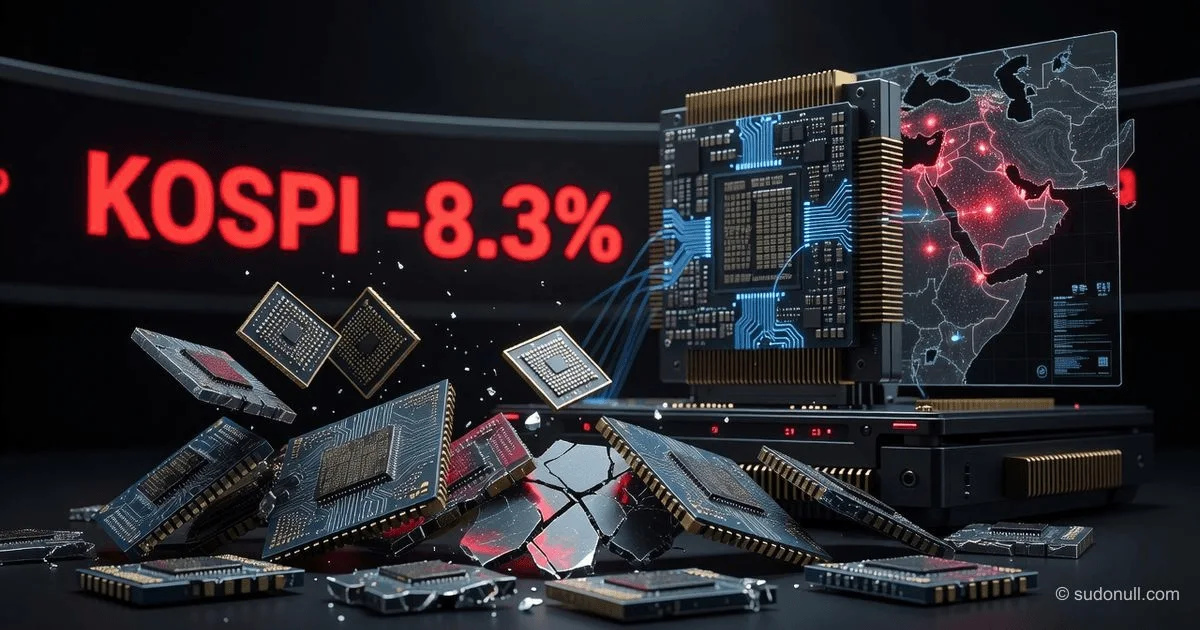
Global stock markets in turmoil as chipmaker shares plunge amid geopolitical tensions
Asian and European stock indices saw sharp declines amid escalating conflict in the Middle East and massive sell-offs in the tech sector. South Korea's KOSPI index, which hit record highs earlier this year, crashed 8.3% as investors fled chipmaker and AI equipment stocks.
Insight beyond the hype: Analysis of the KOSPI crash and the burst of the "AI bubble" in June 2026
While Silicon Valley and Seoul were celebrating new records for the NASDAQ and KOSPI, up 79% year-to-date, a ticking time bomb was already set. What we saw on June 8, 2026, when KOSPI crashed 8.3% (and nearly 9% intraday) and the Philadelphia Semiconductor Index lost 10% in a single day, was not a "standard correction." It was something much more serious.
Mainstream media will, of course, write about "geopolitics," "Iran," and "Fed rates." But insiders understand: the chip market didn't burst because of the war. The war was merely the trigger for a much deeper crisis — a crisis of confidence in the "AI frenzy" business model. Money simply got scared of what hedge funds had been whispering about for months: AI capital expenditure had reached a saturation point, and monetization hadn't arrived. And you know what? They were right.
The essence: what's really happening
In reality, we are witnessing not a news-driven sell-off, but a narrative collapse. Throughout 2025 and the first half of 2026, the market lived by the motto: "Buy everything related to Nvidia and HBM memory." Trading became a self-reinforcing cycle. Hyperscalers (Microsoft, Google, Amazon) announced billions in AI infrastructure capex, chipmakers reported record revenues, stocks soared, and funds used that money to buy even more stocks. A beautiful carousel — until it broke.
Reality is harsh. Broadcom, one of the industry's barometers, released a quarterly report that the market deemed not hot enough. But the knockout blow came from news about Nvidia's Vera Rubin platform. It turned out that the new architecture would consume significantly less DRAM than expected. For SK Hynix and Samsung, which earn billions supplying HBM for existing GPUs, this is an existential threat. If Nvidia optimizes its chips and needs less memory, the growth model for memory makers collapses. The question is: who's next?
Numbers speak louder than words:
| Company / Index | Drop on June 8, 2026 | Context |
|---|---|---|
| KOSPI | -8.3% (intraday -9%) | Record crash after 79% annual gain |
| Samsung stock | -10...-11% | Key index weight (>50% of KOSPI) |
| SK Hynix stock | -7.7...-10% | Existential threat from Vera Rubin |
This is not panic. This is a revaluation of the entire AI value chain.
Timeline and context
This was not a sudden disaster, but a perfect storm that had been brewing for months. Here's how the drama unfolded:
| Date | Event | Consequences |
|---|---|---|
| May 2026 | Strait of Hormuz closed for 4th month; Brent oil: $60-70 → $96-97 | US inflation stops declining, market prices in Fed rate hike |
| June 5 (Friday) | Strong US labor market data | NASDAQ falls 4.2%, Broadcom loses 8% in a day |
| June 7-8 (weekend) | Israel retaliates against Iran after April 8 ceasefire | Hopes for reopening Hormuz vanish |
| June 8 (Monday) | Asia opens in the red; KOSPI drops 8.3% | Trading halted for 20 minutes — first time since March; Nikkei -4.5%, Taiex -3.5% |
Why is this not just a technical correction? Because a domino effect tied to structured products kicked in. Due to the popularity of leveraged ETFs, an 8% drop turns into 20-30% losses for funds using 3x leverage. These funds began forced liquidation, causing even steeper declines. Classic fire in a theater where everyone rushes to the same exit.
Who wins and who loses
Nvidia wins (paradoxically). Jensen Huang, watching the stock drop, called it a "buying opportunity." And he's right. It's not the "shovel sellers" that are falling, but the "gold prospectors." Nvidia is always needed, even if Vera Rubin consumes less memory. They still need to buy GPUs. Companies with low debt and real 10-year contracts win.
Short sellers (speculators betting on declines) win. This is their moment of glory. Those who shorted Samsung or SK Hynix in May made 30-40% in a single day. Short interest in semiconductors hit its highest since 2022.
China wins (relatively). While South Korea and Taiwan are burning, Chinese markets fell less. They have their own "isolated" chip ecosystem, less dependent on global speculative sentiment.
South Korea loses. This is not just a loss of $1.1 trillion in market cap for nine US giants. For Korea, it's a blow to national wealth. Samsung and SK Hynix account for over 50% of the KOSPI index weight. When funds pull money out of Korea (massive liquidity rotation), the won falls, imports (including oil) become more expensive, and inflation accelerates.
Broadcom and second-tier manufacturers lose. Their stocks fell even more than Nvidia's. The market told them: "Your AI revenue forecast isn't crazy enough." This is a death sentence for those who tried to ride the AI wave without Nvidia's absolute monopoly.
What the media isn't telling you
Here's the key insight that mainstream financial media carefully avoids. (Surprise, right?)
The media doesn't mention that the June 8, 2026 crash is payback for the "HBM liquidity illusion."
The HBM memory market was artificially overheated. In 2025, manufacturers (Samsung, SK Hynix, Micron) signed long-term contracts with Nvidia at fixed prices. But everyone forgot that technology evolves. Nvidia announces Rubin with reduced memory consumption — and the HBM shortage turns into a capacity glut overnight. Classic: yesterday a shortage, today corpses in warehouses.
The second nuance involves Japan and Taiwan. Everyone focuses on KOSPI's fall, but forgets that the BOJ (Bank of Japan) continues to raise rates amid inflation driven by expensive oil. The Nikkei's 4.5% drop marks the end of the "cheap yen" era that inflated carry trade positions. Investors who borrowed in yen to buy US chip stocks are now being crushed by exchange rate differences. This is a hidden bomb that goes unmentioned.
The third nuance: the role of Anthropic and the "regulatory brake." Swissquote directly noted that sentiment worsened after Anthropic's calls for AI development restrictions. The market realized: if the US and EU governments start regulating AI (e.g., an AI safety law), hyperscaler capex could be frozen for years. Panic is not just about money, but also about fear that the state will ban profiting from AI.
Forecast: next 30 days and 90 days
30 days:
Volatility will remain high. The KOSPI 200 volatility indicator exceeded 90 points for the first time. That's crisis level. Expect swings of ±3-5% every week. Trading will be unbearable for long-term investors.
Dead Cat Bounce. The Fed may signal it won't raise rates aggressively to calm markets. This could trigger a 5-7% bounce, but it will be a trap for bulls. A second rally won't happen until the Iran ceasefire situation clears.
Portfolio restructuring by funds. Large pension funds (e.g., NPS in Korea, which holds Samsung shares) will start reducing tech exposure. They will rotate into "defensive" sectors: pharma, energy (despite prices), utilities.
90 days (September 2026):
Consolidation at -20% from peaks. KOSPI will stabilize around 6,500-7,000 (currently ~7,484 after the drop). This is the "new normal" after the bubble.
HBM forecast revisions. SK Hynix and Samsung will be forced to issue downward guidance for 2027. This will trigger another wave of decline, but less sharp (5-7%).
Political intervention. The South Korean government will announce a $20-30 billion stabilization fund to buy chipmaker stocks. This will anchor the market, stopping panic. The US will then consider "emergency measures" to support the semiconductor industry ahead of elections.
Conclusion for strategists
June 2026 will go down in history as the moment the "AI Bubble" showed its first serious crack. This is not the end of the story. Artificial intelligence isn't going anywhere. But the market is moving from the "euphoria of buying anything labeled AI" phase to a "brutal selection" phase.
Now investors will look not at how many GPUs a startup bought, but when that startup will start showing cash flow. Samsung shares will no longer rise on rumors of Nvidia supply deals. They will stagnate or fall until Samsung proves it can make money without HBM orders (e.g., on automotive electronics).
For the average investor: if you hold chipmaker stocks, now is not the time to sell at the bottom, but buying in hopes of a quick return to ATH (All Time High) is suicide. We have entered a long phase of "licking wounds." And honestly, no one knows when the next growth driver will appear — whether it's AGI from OpenAI or an unexpected peace in the Middle East. For now, welcome to the new reality.
— Editorial Team








No comments yet.