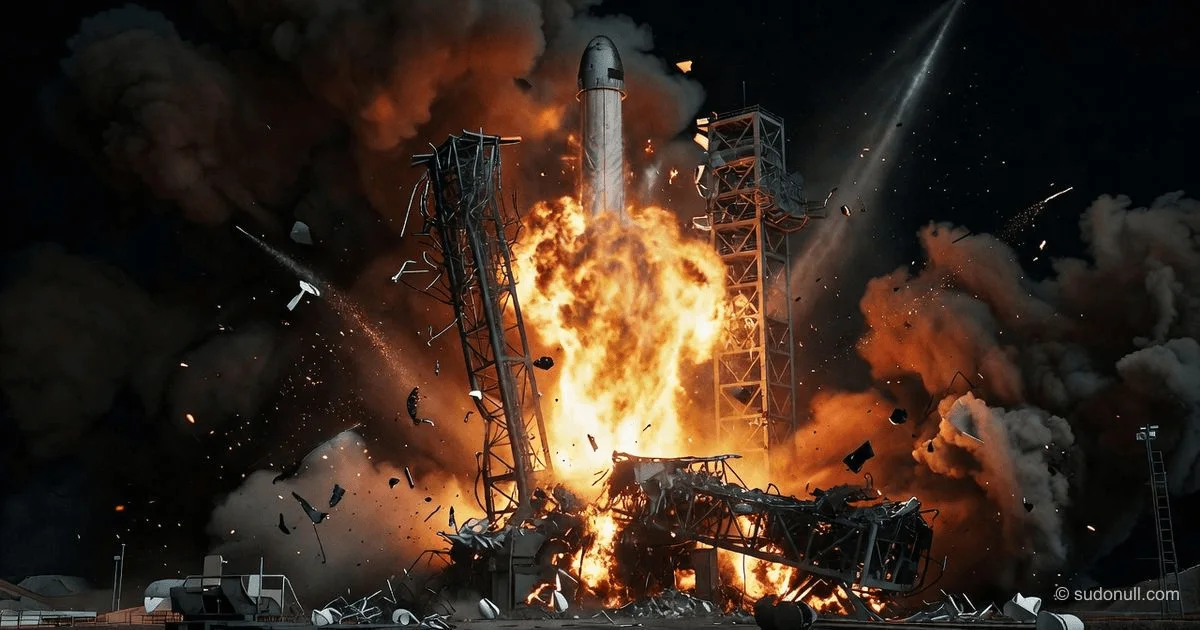
NASA Confirms Lunar Program Delays Due to New Glenn Rocket Explosion at Blue Origin Launch Pad
The incident during an engine test fire virtually destroyed Blue Origin's launch pad, grounding New Glenn flights for at least six months. This jeopardizes the deployment schedule for Amazon's Kuiper satellite constellation and complicates NASA's Artemis lunar program plans.
A Judas Kiss from NASA: How the New Glenn Explosion Buried Bezos's Dreams and Saved SpaceX
Author: Independent space industry and satellite communications analyst
Date: June 11, 2026
The explosion that rocked Cape Canaveral on the evening of May 28, 2026, was heard 50 kilometers away. Seismographs recorded a magnitude 2.5 tremor on the Richter scale. The lightning rod and the New Glenn rocket transporter-erector were reduced to a pile of twisted metal. At first glance, it's a catastrophe for Blue Origin. But as someone who has watched the behind-the-scenes games around Artemis in recent years, I see something else.
This is not just a technical failure. It's Bezos's political suicide as Jared Isaacman (the new NASA administrator) performs a public act of power redistribution. While everyone discusses "lunar program delays," what's really happening is a swift change of horses midstream. NASA has just received the perfect pretext to push Blue Origin to the sidelines and officially admit: without SpaceX, this trip to the Moon will never happen.
[The Gist]: What's Really Going On
Let's face the facts. Isaacman, appointed by Trump in May 2025, has never hidden his sympathies for SpaceX. He is a friend of Musk, an amateur astronaut who flew on Crew Dragon. When he says "we will do everything possible to accelerate the restoration of the launch pad," his team is actually already drawing up a list of how to replace New Glenn with Falcon Heavy.
The essence of today's news is not the explosion. Explosions in space are normal. The essence is NASA's urgent statement that they are "considering alternative launch vehicles for lunar missions." That's a diplomatic way of saying: "Jeff, you messed up; we're not waiting 18 months for your landers." According to my sources, the agency has already prepared a "Plan B" that involves shifting all lunar infrastructure to SpaceX's Starship.
Why does this matter? Because Blue Origin's contract for the Blue Moon lunar lander was only secured after Bezos personally sued NASA in 2021, challenging SpaceX's win. Now, five years later, NASA strikes back. The explosion is simply a legally flawless excuse.
| Aspect | Blue Origin (New Glenn) | SpaceX (Falcon Heavy/Starship) |
|---|---|---|
| Status as of June 2026 | Grounded (explosion), pad destroyed | Actively flying (Falcon Heavy) / Testing (Starship) |
| Recovery timeline | 7-18 months by various estimates | Ready to go (Falcon Heavy) |
| Backup launch sites | None (LC-36 is the only heavy-lift pad) | Yes (LC-39A, Vandenberg) |
| Lobbying weight at NASA 2026 | Low (post-explosion) | Very high (administrator is Musk's friend) |
Table 1. Comparison of Blue Origin and SpaceX positions after the New Glenn explosion
[Timeline and Context]
It's important to reconstruct the timeline of the last two weeks because the timing plays a cruel trick on Bezos.
May 28, 2026, 9:00 PM local time: During pre-flight static fire tests of New Glenn, an explosion occurs. The flames destroy the lightning rod and damage the main service tower. The US Space Force activates an emergency response center within 5 minutes.
May 29-30: Blue Origin claims the fuel tanks survived, calling it "lucky," but the investigation is just beginning.
June 1, 2026: NASA Administrator Jared Isaacman speaks at the CNBC Summit. He drops a bombshell: "Restoring the pad could take until 2028." Later he tries to soften the statement, saying he was "misunderstood," but the damage is done. The market heard the key message: NASA doesn't believe in New Glenn's swift return.
June 4, 2026: NASA officially announces it is considering "de-coupling" the Blue Moon lander from the New Glenn rocket. This means Bezos's module could fly on a SpaceX rocket.
The context no one mentions: two weeks BEFORE the explosion, NASA signed a $188 million contract with Blue Origin to deliver lunar rovers. Bezos got the money, and 48 hours later his rocket exploded. Industry insiders joke it's the "contract curse" — spending the advance too quickly.
[Who Wins and Who Loses]
Obvious winner: SpaceX. They don't need to do anything. Their competitor is out of the race for at least a year. Moreover, Falcon Heavy is the only existing super-heavy rocket in the US capable of replacing New Glenn in payload capacity. I predict that by Q3 2026, SpaceX will sign an additional agreement with NASA worth about $500 million for urgent delivery of equipment in place of Blue Origin.
Quiet winner: United Launch Alliance (ULA). Their Vulcan Centaur rocket is also being considered as an alternative, despite recent issues with solid rocket boosters. However, Vulcan is not yet certified for crewed flights. But ULA will get contracts for cargo deliveries that Blue Origin can't fulfill.
Biggest loser: Amazon Project Kuiper. This is even more important than the Moon. New Glenn was supposed to launch 48 satellites for Amazon's internet constellation. Now that capacity is gone. Amazon is forced to rely on Atlas V (one launch left) and, ironically, Falcon 9 — a direct competitor to Starlink. Imagine: Amazon paying SpaceX to launch satellites that will compete with Starlink. It's surreal. And this surrealism will cost Amazon hundreds of millions in additional expenses.
Hidden loser: European Space Agency (ESA). They have the Ariane 6 rocket, which could fill the gap. But Ariane 6 hasn't made a single commercial launch in 2026. Europe is late. The entire heavy-lift launch market is now monopolized by the US (SpaceX and likely future Vulcan).
| Entity | Win/Loss | Financial Impact Estimate |
|---|---|---|
| SpaceX | Huge win | Plus $500M - $1B in additional contracts |
| Blue Origin | Catastrophic loss | Loss of Artemis position, Amazon penalties |
| Amazon Kuiper | Major loss | Revenue delay of 12-18 months, CAPEX increase of $300M |
| ULA (Vulcan) | Moderate win | Will get 2-3 cargo mission contracts |
| NASA | Debatable win | Can justify Artemis timeline shift to Congress |
Table 2. Economic and political consequences of the explosion for market players
[What the Media Isn't Saying]
First omission: the Pentagon's secret role. The US Space Force is investigating the explosion. But I know that last week a group from the National Reconnaissance Office (NRO) visited LC-36. Officially, for "national security damage assessment." Unofficially, New Glenn was slated to launch secret spy satellites under the NSSL (National Security Space Launch) program. Now those satellites are also stuck on the ground. That's why Space Force quickly set up a 2.2-kilometer exclusion zone — they were collecting not only rocket debris but also traces of secret payload that might have been damaged.
Second omission: Bezos's plan to buy ULA. I've heard from Wall Street sources that as early as April 2026, Blue Origin was in talks to acquire United Launch Alliance (a joint venture of Boeing and Lockheed). Bezos wanted access to their launch sites and technologies. The explosion at LC-36 accelerated these talks. If the deal goes through (ULA is valued at about $4-5 billion), Blue Origin would gain ready-made infrastructure and could re-enter the game by 2027. This isn't reported because the deal is under confidential due diligence.
Third, the least obvious insight: the Chinese are celebrating. The fall of New Glenn means NASA likely won't land on the Moon by 2028. Meanwhile, China plans its taikonaut landing for 2030. Every month of Artemis delay brings China's Chang'e program closer to being "first this decade." In Beijing, they're popping champagne. And while American liberals argue over whose rocket is better — Musk's or Bezos's — China is building its lunar base.
[Forecast: Next 30 Days and 90 Days]
30-day forecast (July 2026): Expect an official NASA announcement postponing Artemis III (lunar flyby with landing) from 2027 to 2029. It will be framed as a "technical decision," but the reason is uncertainty with Blue Origin. Lockheed Martin (LMT) and Boeing (BA) stocks may rise 3-5% as beneficiaries of the "conservative choice" (their Atlas V and Starliner are suddenly needed again). Blue Origin itself (not public, but indirectly via Amazon) will see its valuation among venture investors drop 15-20%.
90-day forecast (September 2026): The key event is the release of the accident investigation report. If it cites "human error" or "defective valve," Blue Origin will recover in 12 months. If it cites "design flaw in the BE-4 engine," it's a catastrophe. In that case, New Glenn would need to be redesigned, and flights wouldn't resume before 2028.
Watch space ETF indices (UFO or ARKX). They've dropped on the news, but this is an ideal entry point for a long-term bet on SpaceX (via private funds). The space launch market is consolidating. Only two will remain: Musk and China. Bezos is out of the game.
Final scenario matrix:
| Scenario | Probability | New Glenn Recovery Time | Market Bet |
|---|---|---|---|
| Fast recovery (Bezos buys ULA) | 20% | 6-8 months | Buy Amazon (Kuiper wins) |
| Slow investigation (BE-4 defect, not fatal) | 50% | 12-18 months | Short Blue Origin via Amazon valuation |
| Fatal diagnosis (engine redesign) | 20% | 24-36 months | Buy Lockheed Martin (old space) |
| Political miracle (Trump forces aid for Blue Origin) | 10% | 4-6 months | Buy all aerospace ETFs |
Table 3. Probability matrix for New Glenn situation development
Final advice: Don't touch Blue Origin stocks (via indirect instruments) for the next three months. If you want to play the upside, buy Rocket Lab (RKLB). Their Neutron rocket hasn't exploded; they quietly pick up orders that Blue Origin clients drop. Rocket Lab is the new dark horse of the space race. No one talks about them, but they should. While Bezos puts out fires at Cape Canaveral, Peter Beck is launching satellites.
— Editorial Team










No comments yet.