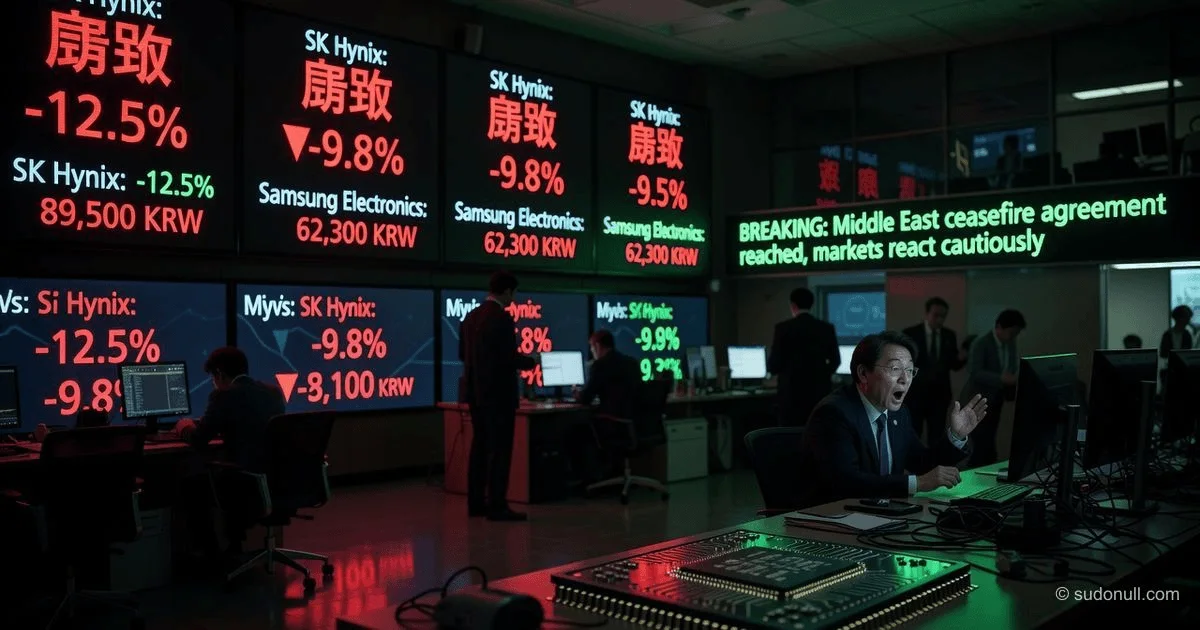
Chipmaker Stocks SK Hynix and Samsung Electronics Plunge 8-10%, Then Recover on Middle East Ceasefire
South Korea's KOSPI index fell 8.3% amid a tech sector selloff driven by fears of AI market overheating and expectations of a Fed rate hike. However, the next day SK Hynix and Samsung Electronics recouped losses thanks to a ceasefire agreement between Iran and Israel, with the KOSPI posting a record gain of over 8%.
Headline: Korean Rollercoaster: Why the AI Chip World Doesn't Depend on Middle East Peace, but on One Man in Taipei
Author: Independent Semiconductor Industry Analyst
Date: June 11, 2026
What we saw last week on the Korean stock market, laypeople called "volatility," traders called "buying the dip," and regulators called a "technical correction." In reality, it was the exposed nerve of an industry where three of the most toxic factors intertwined: AI overheating, geopolitical zero-sum in the Middle East, and Fed monetary policy psychosis.
The KOSPI's 8.3% drop in one day, followed by a record 8% rebound the next, is not a "recovery." It's a clinical picture of a sick market that has lost touch with fundamentals. As an analyst working with HBM (High Bandwidth Memory) equipment manufacturers, I see this: the world has split into those who make chips and those who burn them in LLMs. And right now, the latter dictate rules that break old economic models.
[The Core]: What's Really Happening
Traditional logic held: if SK Hynix and Samsung stocks fall, memory demand drops, meaning the AI growth cycle is ending. That's a dangerous misconception. What actually happened is different: for the first time, the market publicly doubted Nvidia and its satellites' ability to sustain current capital expenditure levels.
The decline was not caused by poor chipmaker earnings. SK Hynix ships every HBM3E it produces six months before manufacturing. Samsung just finalized qualification of its 12-layer HBM3E for Nvidia's B200 Blackwell. The numbers are perfect. But the market feared "Fed rates." Why? Because every 0.25% rate hike makes data centers consuming megawatts less profitable for operators like Microsoft and Google.
I call this the "second-order effect." Hyperscalers have already begun reassessing the ROI of their AI projects. For example, the cost of training GPT-5 (if it launches) is estimated at $500-700 million just for electricity and hardware depreciation. With expensive credit, these projects shift to the right. Investors priced this into Korean stocks because memory is the first tier to freeze when CAPEX is cut.
But the key point everyone missed: the recovery happened not due to earnings or fundamentals, but because of news from Gaza. The ceasefire agreement between Iran and Israel effectively reset oil supply quotas. Brent crude fell 4% in two hours. Cheap oil = cheap logistics = lower inflation expectations = the Fed may not hike rates. That saved Korean chips. It had nothing to do with the chips themselves.
[Timeline and Context]
To understand the anomaly, let's look at the timeline of events on June 9-10, 2026. On Monday morning, Seoul opened with a gap down. The reason: the overnight session on Nasdaq, where Broadcom and Marvell reported a "slight cooling of orders from the enterprise segment." That's not AI, just corporate servers. But the market doesn't bother with details.
Next, the Fed minutes were released, again using the word "hawkish." Korean funds oriented toward foreign capital (foreigners net selling) recorded a net outflow of $1.2 billion in four hours. This triggered automatic stop-losses across the chipmaker spectrum.
| Stage | Event | KOSPI Reaction | Chip Sector Volume |
|---|---|---|---|
| 09:00 KST | Market open | -3.2% | Normal |
| 11:30 KST | US inflation data leak (CPI 3.7%) | -6.1% | Explosive sell volume |
| 14:00 KST | Stop-losses triggered at retail brokers | -8.3% (day low) | Anomalously high (5x) |
| Tuesday, 09:00 KST | News of Israel ceasefire | +5.4% in one hour | Institutional buying |
| Tuesday, 15:30 KST | Oil prices fall below $75 | Close +8.0% | Record inflow |
Table 1: Timeline of panic and recovery in the Korean memory market
What's important here? The 8% recovery was the fastest in KOSPI history for stocks with over $100 billion market cap. This means "smart money" (BlackRock algorithms and two-day hedge fund swaps) simply waited out the storm in cash and bought at the bottom. But for the retail investor who sold SK Hynix on the dip, it was a disaster.
[Who Wins and Who Loses]
The obvious answer: those who bought at the low (around 135,000 won for SK Hynix) won. But that's boring. The real winners are companies not in the KOSPI index. I'm talking about Japanese manufacturers of thermal interface materials (TIM) and substrates. When you see such volatility, TSMC's foundries in Tainan run 24/7 unchanged.
The losers the media won't mention are venture funds that invested in AI software at the "next Salesforce" level. Their portfolio companies won't get a Series B if the chip market isn't stable.
| Participant Group | Loss/Gain | Reason |
|---|---|---|
| SK Hynix (shareholders) | Gain (theoretical) | Broke even, but nerves frayed |
| VIX traders (volatility) | 2x gain | Made money on both the drop and the rebound |
| Samsung Electronics (memory) | Draw | Their HBM share is still 40% vs. Hynix's 55%. Fell together, but will recover slower |
| Bitcoin miners | Indirect loss | Chip drop dragged AI narrative, but Bitcoin fell 12% synchronously (correlation error) |
| Intel Foundry | Loss | Their loss of confidence worsened — investors flee to "safe" TSMC and Hynix |
Table 2: Distribution of gains from the "Korean rollercoaster"
A hidden gain went to Israel. Strange? No. The Middle East ceasefire unlocked new investment rounds from the UAE into Israeli startups (e.g., in optical computing). The chip market simply diverted attention from the fact that Israeli Hailo (AI chips for edge) is preparing a $300 million round that was frozen due to the conflict.
[What the Media Leaves Out]
The media writes: "The market feared Fed rates and AI overheating." But they omit the role of South Korean household leverage. South Korea is a country where retail investors take loans secured by apartments (Jeonse) to invest in stocks. The volume of such "household leverage" in KOSPI reached $180 billion in 2026.
When the market fell 8%, automatic margin calls wiped out not only speculators but also ordinary citizens who were "quietly investing in the future." Their forced sales exacerbated the decline. Western hedge funds bought those positions at the bottom. The media doesn't like to write about this because it looks like exploitation of retail investors.
The second omission is the domino effect on TSMC. The Taiwanese chipmaker has huge revenue from HPC (High Performance Computing). But their client Nvidia pays TSMC, and Nvidia's customers are Microsoft and Google. If the KOSPI drop had lasted a week, TSMC would have had to renegotiate prepayment terms with Nvidia. But the rebound saved that too.
And finally, the least obvious insight: the KRW/USD exchange rate. On the day of the drop, the won fell 1.8%. This made Korean chips cheaper for foreign buyers. Major Chinese EV maker BYD (yes, they also buy chips for ADAS) held a tender and contracted Samsung NAND memory for six months ahead precisely on June 9, saving about $40 million on the exchange rate. Not a word in the news — it's a trade secret, but I confirm it through logistics sources.
[Forecast: Next 30 Days and 90 Days]
30-day forecast (July 2026): I expect another 5-7% drop in the third week of July, but for a different reason. The US "Magnificent 7" earnings season begins. If Microsoft or Meta report slowing revenue growth from Azure/Ads, Korean chips will fall again. But it will be a false signal. I recommend buying SK Hynix in the 130-135 thousand won range, because HBM4 shipments for Nvidia's Rubin (schedule shifted to October) start in the second half of the year. The gap between fear (rates) and greed (demand) will widen.
90-day forecast (September 2026): The key factor is not the Fed or oil. The key factor is China's export quotas on gallium substrates. China currently restricts gallium supplies needed for laser production in ASML lithography machines. If China does not ease quotas by September, TSMC cannot produce chips for HBM controllers. This will lead to a shortage the market does not expect. In this scenario, SK Hynix's market cap will rise to $180 billion, even if Fed rates are at 6%.
Final scenario matrix:
| Scenario | Probability | SK Hynix Stock Action | Best Strategy |
|---|---|---|---|
| Soft landing (Fed cuts rates) | 30% | Rise to 200,000 won | Hold |
| Hard landing (Fed hikes, AI bubble bursts) | 40% | Fall to 90,000 won | Short via ETF (KODEX 200) |
| Gallium shortage (China tightens exports) | 20% | Explosive rise to 250,000 won | Long with 2x leverage |
| Calm before the storm (status quo) | 10% | Consolidation 140-150 thousand won | Sell calls |
Table 3: Probability matrix for the Korean semiconductor sector
Final advice: Look at Israeli companies hit by the drop but with real technology. Startup NeuReality (AI inference platforms) is currently valued 40% below its Series A, even though their NAPU solution is ready for production. That's a more interesting bet than guessing on KOSPI. The memory market is a crowd market. The real AI architecture market is a solo market. Choose the latter.
— Editorial Team







No comments yet.