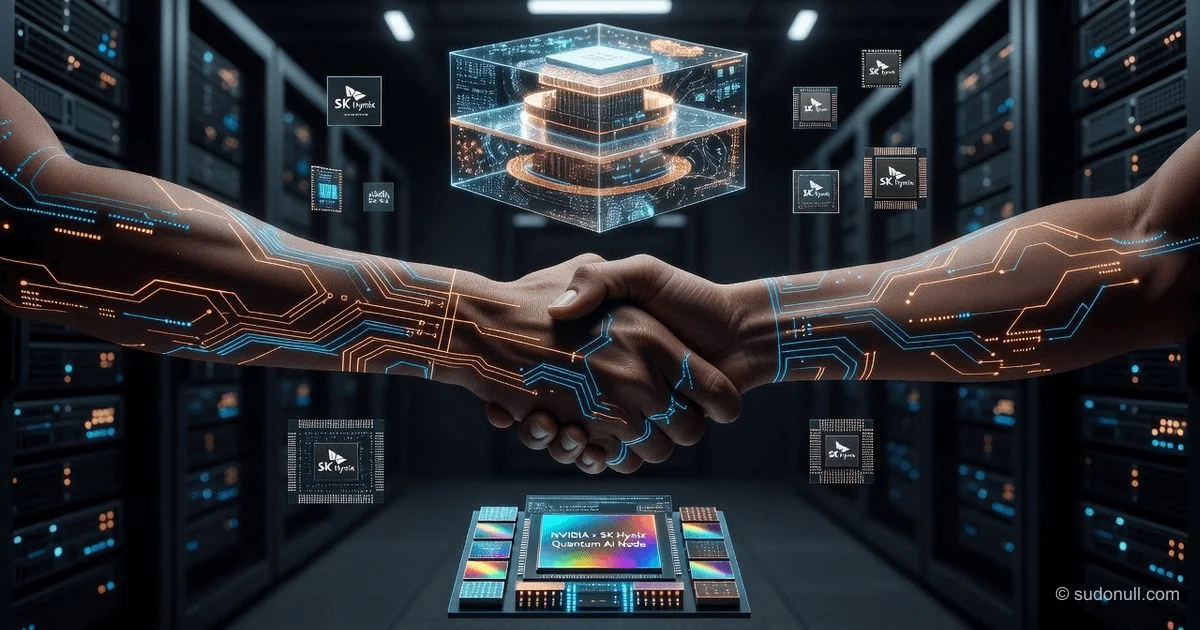
Nvidia and SK Hynix Announce Joint Development of Next-Generation Memory for AI Supercomputers
Nvidia and SK Hynix have signed a multi-year technology partnership agreement aimed at developing specialized memory for the Vera Rubin AI supercomputer platform. The collaboration also involves using AI technologies to automate semiconductor design and create digital twins of production lines.
Insider Insight Beyond the Hype: Analyzing the Nvidia-SK Hynix Partnership — $2 Billion a Year for an "Orange Ticket" to the Era of Physical AI
While global stock markets burned red on June 8, 2026, and the KOSPI crashed 8.3%, something opposite was happening on the 52nd floor of SK Group's headquarters in Seoul. Jensen Huang and SK Group Chairman Chey Tae-won shook hands, announcing a partnership that analysts have already dubbed the "alliance of two whales." Mainstream media will, of course, write about a "multi-year memory supply agreement." But insiders understand: this contract is not about HBM4. And it's not even about money (though Huang let slip that Nvidia already buys "billions and billions of dollars annually from SK Hynix, and that amount will grow significantly").
This contract is about reshaping the industry. SK Hynix is no longer the "number two supplier" (after Samsung). From now on, they are Nvidia's architectural ally in the race for physical AI. And the fact that SK Hynix shares fell 7.7% on the day of the announcement is the best proof that the market understood nothing. Absolutely nothing.
The Essence: What's Really Happening
In reality, Huang and Chey didn't sign a chip supply contract but a protocol for technological integration at the R&D level. The key phrase everyone missed: "joint development of roadmaps." Previously, SK Hynix received specifications from Nvidia and designed memory accordingly. Now, SK Hynix engineers will sit in the same room as Nvidia engineers, determining what memory will look like in 3-5 years. And you know what? This turns the entire logic of the semiconductor business upside down.
The agreement covers not only Vera Rubin (already in production and set to ship in Q3 2026) but also future generations — Rubin Ultra, post-Rubin. SK Hynix is entering three new markets simultaneously: AI infrastructure (data centers), personal AI (RTX Spark PC), and physical AI (Jetson Thor for robots). The last one is the most important. Huang directly said: "No country is better prepared for robotics than Korea, with its wealth of AI researchers and leadership in heavy industry."
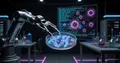
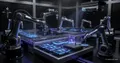
The quiet insider angle lies in digital twins. SK Hynix commits to using Nvidia's Omniverse to create a full virtual copy of its factories. This means Nvidia gains access to the holy of holies — SK Hynix's manufacturing processes. In return, SK Hynix gets software for autonomous factory management, where robots (on Jetson Thor) will move around, optimizing logistics without human intervention. This isn't a "partnership." It's a hostage exchange. Nvidia takes over digital management of SK Hynix's production, and SK Hynix becomes the de facto sole memory supplier for Nvidia.
Timeline and Context
This alliance was forged over years, but its public announcement came at a unique historical moment.
| Date | Event |
|---|---|
| March 2026 (GTC) | Huang announces Vera Rubin. The platform requires 288 GB HBM4 per GPU with 22 TB/s bandwidth. SK Hynix is one of the few capable of producing it. |
| May 2026 | Vera Rubin enters full-scale production. Nvidia confirms first systems will ship to customers (Anthropic, OpenAI, xAI, Oracle, ByteDance) in fall 2026. Demand for HBM4 skyrockets. |
| June 5-7, 2026 | Huang arrives in Seoul. Meets with SK Group Chairman Chey, LG CEO Koo Kwang-mo, esports star Faker. |
| June 8, 2026 (morning Korea time) | Agreement signed. Huang and Chey personally announce a "multi-year technology partnership." |
| June 8, 2026 (evening Korea time) | Markets crash. SK Hynix shares fall 7.7%, Samsung falls 10.2%. |
Why is this important now? Because June 8, 2026, became the day the "old" market (speculators scared by inflation and the Middle East) diverged from the "new" market (strategic alliances defining the future for a decade). The panic on the exchange was irrational. Those who sold SK Hynix on June 8 sold an asset that had just become indispensable to Nvidia. It feels like they dumped Toyota shares on the day it announced the invention of a perpetual motion machine.
Who Wins and Who Loses
SK Hynix wins (strategically, not tactically). The company just transformed from "another HBM supplier" into an "architectural partner." Chey Tae-won emphasized that their relationship is moving from "supplier-contractor" to "alliance." SK Hynix will participate in developing specifications for Vera Rubin, RTX Spark, and Jetson Thor. This increases their value for future deals and insulates them from the threat of Nvidia switching to Samsung.
Naver wins (indirectly). The same day, Naver announced an agreement with Nvidia to build AI factories, which will now use SK Hynix memory. A triple alliance forms: Nvidia (chips + software) + SK Hynix (memory) + Naver (cloud services) — a Korean wall against American hyperscalers.
Nvidia wins. They just tied one of the world's two largest memory manufacturers (the other being Samsung) to themselves. Huang secured supply guarantees for years ahead in a market where HBM4 demand exceeds supply. Plus, Nvidia gains access to SK Hynix's industrial expertise in factory automation — know-how they will later sell to other chipmakers as a "Reference Design for Smart Fab."
Samsung Electronics loses. This is a disaster for Samsung. Competitor SK Hynix just signed a de facto exclusive joint development agreement with Nvidia. Samsung also produces HBM4, but now they are second-class. Moreover, Samsung planned to use its factories as a bargaining chip with Nvidia. Now Nvidia has digital twins of SK Hynix's factories on Omniverse and can design chips perfectly tailored to SK Hynix's processes, ignoring Samsung. Samsung shares fell 10.2% — and rightfully so.
Intel loses (indirectly). Intel is trying to enter contract chip manufacturing (foundry). But Nvidia just showed that its strategic partners are TSMC (GPU production) and SK Hynix (memory). Intel Foundry is not needed by Nvidia. Moreover, the automation Nvidia is deploying at SK Hynix factories will become the standard that Intel will have to buy from Nvidia if it wants to compete.
What the Media Isn't Saying
Here's the main insight that both Korean and American media are carefully downplaying.
The media isn't saying that "physical AI" is a euphemism for "military robots," and Korea is the perfect testing ground. Huang said: "The era of physical AI has finally arrived. And no country is better prepared for robotics than Korea." What did he mean? Korea has the Demilitarized Zone (DMZ) with North Korea. It's one of the most militarized borders in the world. Patrolling, mine clearance, logistics — all ideal tasks for robots on Jetson Thor. The memory for these robots will be supplied by SK Hynix. Nvidia isn't just selling chips for civilian robotics — they're entering the defense sector through the back door.
The second nuance concerns "digital twins." SK Hynix will use Omniverse to create virtual copies of factories. But Omniverse isn't just a "visualization toy." It's a data collection tool. Every time an SK Hynix engineer moves a virtual object, Nvidia receives telemetry on how production lines are designed and optimized. This is training data for the next generation of AI for factory automation. SK Hynix has become Nvidia's guinea pig in Industry 4.0.
The third nuance: the stock market paradox. SK Hynix shares fell 7.7% on the day a multi-billion dollar contract was signed. This perfectly illustrates market myopia. Investors saw "geopolitics" and "inflation" and hit the red button. They didn't see that SK Hynix just signed a contract guaranteeing capacity utilization for 3-5 years ahead. Those who bought SK Hynix on the June 8 dip will be up triple in a year. Ask yourself: when was the last time a 7.7% drop was a "buy now" signal? Exactly.
Forecast: Next 30 Days and 90 Days
30 days:
- Finalization of HBM4 technical specs for Vera Rubin. Nvidia and SK Hynix engineering teams will enter "integration mode." Expect news on achieving target bandwidth (22 TB/s) and power consumption.
- Announcement of the first factory digital twin. SK Hynix will publicly showcase (possibly at the SK AI Summit) a working prototype of a digital twin of one of its factories in Icheon, built on Omniverse. This will become a case study for selling similar solutions to Samsung and Micron (irony of fate).
- Market correction. SK Hynix shares will recover 5-10% as analysts finally reread the press release and understand what happened. Expect target price upgrades from Goldman Sachs and Morgan Stanley.
90 days (September 2026):
- Start of Vera Rubin shipments. In September-October, the first NVL72 racks with 72 Rubin GPUs and 36 Vera CPUs will reach customers. This will catalyze a new round of memory purchases. SK Hynix will report record Q3 revenue.
- Announcement of "SK Hynix AI" — a new division. Under Nvidia's pressure, SK Hynix will create a separate business unit for developing memory for physical AI (robots, vehicles). It will likely be headed by an engineer who interned at Nvidia.
- Start of antitrust investigation in Korea. Korea's Fair Trade Commission (FTC) may investigate whether the Nvidia-SK Hynix alliance creates barriers for Samsung. Expect document requests and informal hearings. Outcome: "no violations, but be cautious." Nothing serious.
Conclusion for Strategists
The Nvidia-SK Hynix partnership is not the deal of the year. It's the deal of the decade. Huang and Chey rewrote the rules of the semiconductor industry. There are no longer "memory suppliers" and "chip buyers." There is an "architectural alliance" that defines what AI hardware will look like in 5 years.
For SK Hynix, this is a chance to escape Samsung's shadow and take a place next to Nvidia at the top of the AI food chain. For Nvidia, it's a guarantee that the most scarce component (HBM) won't dry up at the most critical moment. For Samsung, it's a red card. They slept through the moment and will now be playing catch-up.
To investors: that 7.7% drop in SK Hynix on June 8, 2026, will go down in textbooks as a "herd behavior error." Those who didn't panic and bought will see +50-70% in 12-18 months. Those who sold will remember this day forever. Because on June 8, 2026, Korea ceased to be just a "memory factory." It became the brain and muscles of physical AI. And SK Hynix is now the main beneficiary of this transition.
— Editorial Team





No comments yet.