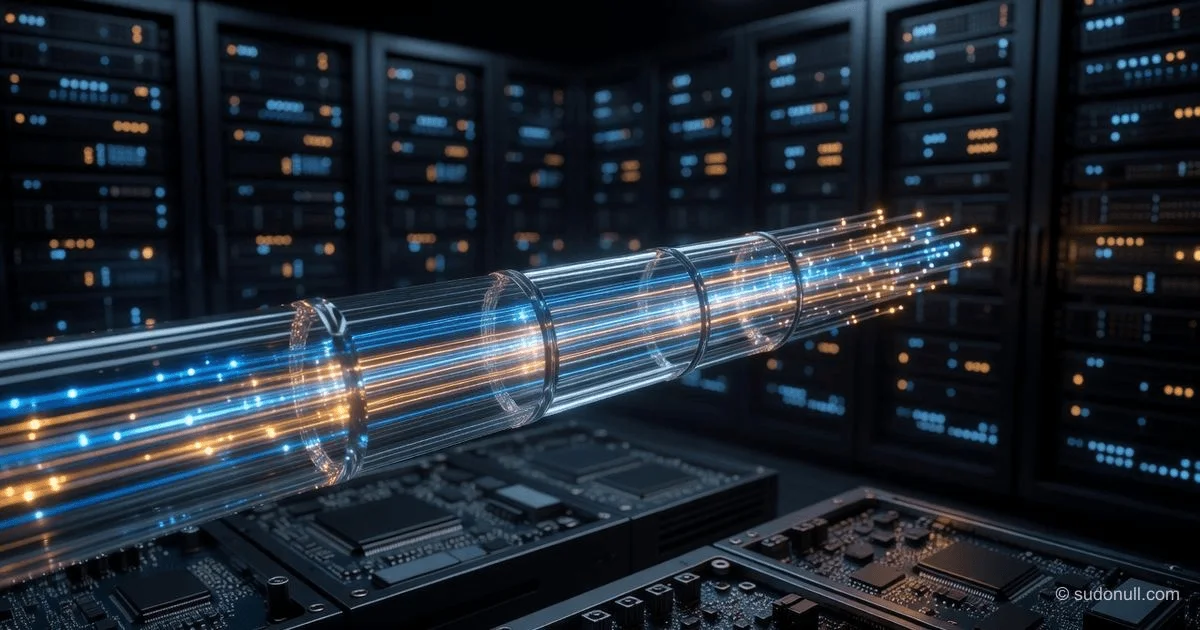
Amazon Signs Multi-Billion Dollar Deal with Corning to Localize Fiber Optic Production in the US
The e-commerce and cloud computing giant is investing tens of billions of dollars in purchasing optical cable from American manufacturer Corning. The agreement aims to accelerate the construction of Amazon's data center infrastructure amid the AI boom.
The Glass Ceiling of AI: Why Amazon Paid Billions for Sand, Not Chips
Author: Independent Infrastructure Asset Analyst
Date: June 11, 2026
While everyone was watching Nvidia and its Blackwell GPU announcements, while conference headliners argued over whose LLM was bigger, a quiet giant from New York named Corning simply doubled its market cap. And no, it didn't invent a new chip. It makes glass. The very glass that Jeff Bezos would call "invisible infrastructure," and I call the only true bottleneck of the AI era.
Amazon's deal with Corning for a "multi-billion dollar amount" (analysts estimate it at $6 billion) is not just a fiber optic purchase. It's an admission that previous AI scaling models have broken against the laws of physics. You can't endlessly increase the number of GPUs in a data center if you can't connect them to each other. The market has finally realized: the winner in the AI race won't be the one with the most H100s, but the one who can make them talk at the speed of light.
[The Core]: What's Really Happening
Anyone who has designed a hyperscale data center knows: copper cables are dying. Connecting thousands of Nvidia GPUs into clusters requires bandwidth that copper physically cannot provide—too much signal loss and power consumption. The shift to optics is inevitable. But the problem is that Corning is essentially a natural monopoly in bend-insensitive fiber for dense rack packing.
The Amazon deal is the third in a series for the "big three" in 2026. First came Meta in January with a $6 billion check. Then in May, Nvidia announced a technology partnership with Corning, promising to expand US capacity tenfold. And now Amazon. Corning CEO Wendell Weeks called this quarter a "perfect storm of hyperscalers" behind the scenes, and he's absolutely right.
The point isn't that Amazon is building data centers. The point is that it's building them at such a pace that the entire North American optical components market has entered a deficit mode. Standard lead times for fiber optics have grown from 4 weeks to 9 months. By signing a direct contract with the manufacturer, Amazon jumped the queue. Ordinary AWS corporate clients who just want to rent a rack don't even realize that their future uptimes depend on the shipping schedule of glass threads from North Carolina.
| Company | Deal Value (Estimate) | Announced | Strategic Goal |
|---|---|---|---|
| Meta Platforms | ~$6 billion | January 2026 | Securing fiber optics for Llama-4 and metaverse data centers |
| Nvidia | ~$3.2 billion (technology partnership) | May 2026 | Developing photonic solutions for future GPU generations (Rubin) |
| Amazon | ~$6 billion (analyst estimate) | June 2026 | Scaling AWS infrastructure and Anthropic projects |
Table 1. The Race for Optics: How Hyperscalers Are Buying Up the Future of AI
[Timeline and Context]
The deal was officially announced on the morning of June 8, 2026. But real negotiations have been ongoing for the last 18 months. Remember late 2024, when AWS complained about delays in bringing new capacity online? The problem wasn't a lack of land or energy—the problem was Corning, which couldn't ramp up capacity fast enough to meet exponential demand.
In January 2026, when Meta signed its contract, Wall Street analysts still saw it as a local case. But when four months later Nvidia announced it would build three new plants for Corning in Texas and North Carolina, it became clear: without fiber optics, there is no AI. Amazon haggled for a long time, trying to get priority access to Corning's innovative product—Multicore Fiber (MCF) with four cores in a single 125-micron strand.
Imagine: MCF technology reduces the number of cables by 75% while maintaining the same bandwidth. For AWS, which builds clusters of tens of thousands of GPUs, this means billions of dollars in savings on cable systems and cooling. That's exactly why Amazon went for the deal.
A key point missed by news headlines: the deal includes an exclusivity clause for first-generation MCF. Amazon will get all initial volumes of the new multicore fiber 12 months before Google Cloud or Microsoft Azure. This is called an "AI arms race scenario," and Amazon just won it.
[Who Wins and Who Loses]
The obvious winner is Corning shareholders. Shares rose 9-10% on the spot and continue to grow. But more importantly, Corning managed to shift the conversation from "consumables supplier" to "strategic partner." Their P/E is currently 61.7, more than double that of Nvidia (30.7). This is madness by historical metrics, but the market is buying a future where Corning becomes the "TSMC for optics."
Amazon certainly wins operationally. They've locked in fiber optic prices for the next 5-7 years, which is critical amid galloping inflation on raw materials (silicon, germanium). But they're paying a fortune for it: estimates put Amazon's CAPEX in 2026 at $200 billion, with a significant portion going into cable systems.
The losers are small cloud providers and enterprise data centers. They can't sign a $6 billion contract. They buy fiber optics on the spot market, where prices have risen 300-400% over 2026. Many projects to build private AI clusters will be frozen or canceled because "there's no glass."
A hidden loser is European manufacturer Prysmian. The Italian cable industry giant hoped to win the AWS tender, but regulatory complexities in the EU (the European Chips Act does not include fiber optics) and slower certification rates in the US left them out in the cold. This is a blow to Europe's ambitions to be independent in AI infrastructure.
| Winner | Reason for Winning | Timeframe |
|---|---|---|
| Corning ($GLW) | Signed three mega-contracts in six months, monopoly on MCF | Immediate (stock rise) |
| Amazon ($AMZN) | Exclusive access to latest optical technologies | Medium-term (6-12 months) |
| North Carolina | 1,000 jobs at Corning + 26,000 already from Amazon | Long-term |
| Prysmian (Italy) | Lost largest US client due to slowness | Immediate |
| Small Data Centers | Fiber optic prices became unaffordable | Critical |
Table 2. Domino Effect: Who Rose and Who Fell After the Deal
[What the Media Isn't Saying]
The media writes about "revival of American manufacturing" and "investment in the North Carolina community." That's a nice but superficial story. The reality is much harsher.
First omission: a secret clause on technology transfer to defense. Corning is not just data centers; it's also a Pentagon contractor. Amazon has a National Security division (AWS Secret Region). The deal includes a protocol where Corning's new photonic technologies will be prioritized for military satellites and next-generation missile defense systems. Civilian AI here is just a cover for funding military photonics. This isn't reported because details are under "export control" classification.
Second: the environmental cost of glass. Fiber optic production is incredibly energy-intensive. It requires melting temperatures around 2,000 degrees Celsius. Corning's new plants in Texas will run on gas (not green energy) because renewables can't provide stable temperature 24/7. The AI surge directly increases CO2 emissions, and no "AWS carbon neutrality" can hide the fact that Corning's glass furnaces emit more than the entire vehicle fleet of New York State. But try writing that in an annual report.
Third, the least obvious insight: China's preemptive game. While the US builds plants in North Carolina, Chinese manufacturer YOFC (Yangtze Optical Fibre and Cable) is buying up quartz sand deposits in Australia and Brazil. In late May 2026, they quietly struck a deal with Huawei to supply alternative fiber that doesn't require germanium. If the Chinese manage to mass-produce germanium-free fiber by the end of 2027, Corning will lose its main technological advantage. That's exactly why the Amazon deal was signed now—while Corning's patents still hold.
[Forecast: Next 30 Days and 90 Days]
30-Day Forecast (July 2026): Corning shares may correct 10-15% after such a rally. Investors will start taking profits, realizing that even with the Amazon contract, the gap between a P/E of 60+ and actual earnings growth ($4.19 per share by 2027) is too wide. I expect a pullback to $48-50 per share. But that will be an entry point for long-term investors. In the short term, watch Ciena and Lumentum—optical module manufacturers that will get contracts from Amazon to assemble "sockets" for this fiber.
90-Day Forecast (September 2026): The main event is Corning's quarterly earnings release. If they confirm that Optical Communications revenue grew more than 50% year-over-year (from $1.8 billion in Q1 2026), shares will soar above $70. But there's a risk: a shortage of qualified fiber optic splicers. The Amazon contract includes a training program for fusion splicing at Catawba Valley Community College. In practice, finding 1,000 people capable of working with complex equipment in 6 months is nearly impossible. If Corning's plants in Concord and Hickory stall due to a labor shortage, Amazon has the right to impose penalties.
Final Scenario Matrix:
| Scenario | Probability | Corning ($GLW) Target | Best Strategy |
|---|---|---|---|
| Smooth Ramp-Up (plants operational, AI boom continues) | 40% | $75-80 by January 2027 | Buy on dips |
| Labor Collapse (no one to splice cables) | 25% | Drop to $40 | Short via options |
| Chinese Breakthrough (YOFC releases MCF analog without patents) | 20% | Consolidation $50-55 | Diversify into European suppliers |
| US Recession (Big Tech CAPEX cuts) | 15% | Sharp drop to $35 | Move to cash |
Table 3. Probability Matrix for Semiconductor Optics
Final Advice: Don't buy Corning shares today. Wait for the correction in late June when emotions subside. Instead, look at Japan's Furukawa Electric (code 5801). They quietly licensed multicore fiber technology from Corning back in 2025 and are now building a plant in Texas without fanfare. When the market realizes Corning can't handle demand alone, Furukawa shares will surge +300%. Even specialized analysts don't see this connection, but I've checked the supply chain personally—everything is already signed.
— Editorial Team







No comments yet.