ASUDD: The Evolution of Smart Traffic Lights
Last time, in the article “ ASUDD: What hangs over the road? ” We skimmed through the hardware installed on the highways: by types of traffic detectors, LED displays and road controllers.
Today we will continue to talk about traffic management, but already in the city. Let us consider what the traffic light control cycle consists of, what exactly control systems “rule” with and how it all started.
For a long time I did not dare to start writing this post, since the topic of traffic control on city streets is so voluminous and versatile that when you discuss it, you constantly risk being in the role of a “lamer” in related areas. But I still take a chance and try.
In order to understand what exactly control algorithms “steer”, it is necessary to know five basic definitions of traffic light regulation.
We open the textbook “Technical means of traffic management” by Mr. Kremenets and read the definitions (American analogs of the terms are indicated in parentheses):
Here is a picture that well illustrates the concept of cycle, phase and interval:

Now open the American book " Traffic Control Systems Handbook ". The Americans are adding two more definitions that are key to automating the regulatory process:
Split Section. The percentage of the control cycle allocated to each of the control phases.
Roughly speaking, by varying the percentage of time per phase, one can control the duration of the green signal in the most loaded direction. At a stand-alone intersection, this gives a reduction in delays.
Offset The difference (in seconds or percent of the regulation cycle) between the clock at a particular intersection and the master clock (at a network of intersections).
Since the term sounds a little abstruse, here is a picture that illustrates it very well.
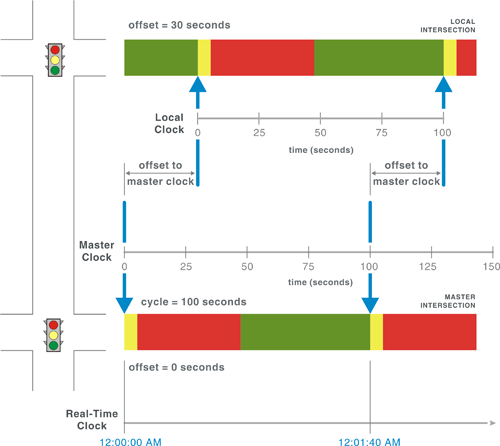
It can be seen that the phases at the next intersection are shifted relative to the previous one. The displacement time is just enough for a group of cars to drive up to him and slip into green. The calculation is usually performed for some average speed adopted in a given region. Therefore, "racers" and "brakes" usually break off on such highways.
Here you can read about everything mentioned in detail. From there the last picture.
The main types of “smart” traffic lights are interesting to consider in a historical perspective, as they did not appear immediately and developed from simple to complex.
Traffic lights came to us from the railroad. The first manual electric traffic light in the United States was installed in Cleveland in 1914. And just three years later, in 1917, a system was developed in Salt Lake City to control traffic lights at six intersections at once. The role of the road controller was performed by the traffic controller. In 1922, Houston did the same, but at twelve crossroads. Management was carried out in manual mode from a special tower.
The concept of automatic traffic light was proposed in 1928. Any electrician could install and configure it, and everyone began to purchase and install such traffic lights. But immediately problems arose in large cities, where morning and evening rush hours exist, in which it would be nice to change plans for coordinating traffic lights so that traffic jams do not occur. The problems of staff shortages for this responsible business have risen to their full potential. An inquisitive American mind pondered the further improvement of road automation.
In the period from 1928 to 1930, the inventors proposed various designs of pressure detectors that detect the presence of cars at the intersection. This allowed us to make the first models of traffic lights that respond to transport (traffic-actuated). Such traffic lights had an effect on highways, where the red on the main course turned on only if a car drove up from the side of the secondary road. Such systems still exist in the United States and do a good job at isolated intersections. Pedestrian call buttons work in a similar way, when pressed, a pedestrian phase is built into the next control cycle.
In 1952, the first analog controller was installed in Denver, which allowed combining several isolated intersections into a single controlled network and switching pre-calculated coordination plans depending on the time of day and days of the week. Over the next decade, several hundred such systems were installed around the world.
Such systems have actively used the displacement parameter, including green, not immediately at all intersections, but with an offset depending on the distance between intersections and transport parameters (“green wave”). A specially trained engineer calculated and drew coordination schemes on a piece of paper, which were then put into the controllers. The system turned out to be so simple and reliable that it is still actively used in cities not burdened with excessive traffic.
In 1960, in Toronto, the first "real" computer was installed to control traffic lights - a chic IBM 650 unit with drum memory for 2,000 machine words. It was a colossal breakthrough in traffic management technology! Three years later, more than 20 intersections were under centralized management, and by 1973 the computer was already managing 885 intersections!
Seeing such a clear success, IBM continued to work on the use of its computers in the management of traffic lights. In 1964, a project started in the center of San Jose with an IBM 1710 computer, and in 1965, IBM 1800 (an advanced version of the 1130 model with an increased number of input / output ports) was installed for the city of Wichita Falls (Texas), which successfully managed 85 intersections. The computer in San Jose was also later replaced by the IBM 1800. The system turned out to be so successful that this configuration was used in many American cities from Austin and Portland to New York.
Here it is, the legendary IBM 1800 device ( source of image )

Work on the standardization of traffic light control systems started in 1967. As part of the pilot project, a control system was built for Washington, which included 113 intersections equipped with 512 inductive loop detectors. The computer got the opportunity not only to blindly switch coordination plans, but also to receive information about traffic queues at intersections (then Doppler radars were not used to measure flow velocity).
In short, a critical mass of traffic lights connected to computers was reached, and the transition from quantity to quality was only a matter of time. Extensive research has begun in the development of control algorithms.
The idea of having coordination plans for all occasions in theory was not bad, but, as it turned out, plans for all occasions would not be enough. The development of each plan in the 70s was carried out on paper and was a rather laborious and creative process. And if for a long street with traffic lights, like Leninsky Prospekt in Moscow, it was quite easy to calculate the algorithms, then on the street network it was already a completely non-trivial task. There are more that there are many cities, and not all of them can afford to keep a competent transport engineer on staff.
And in the 70s, the British research bureau TRRL (The Transport and Road Research Laboratory) developed and implemented the SCOOT system (Split, Cycle and Offset Optimization Technique) on the streets of Glasgow, which allowed “playing” with the parameters of the traffic light control cycle within certain limits depending from information from transport detectors measuring the presence and length of queues at traffic lights. SCOOT combined the advantages of fixed coordination plans for the network and adaptive control, when the “smart” traffic light itself “steers” the cycle and duration of green signals. SCOOT in the 80s had a number of successful deployments in Europe and North America. Moreover, now this algorithm (already in the third generation) is licensed to more than 100 companies for use in their systems.
SCOOT in the third generation shows the wonders of sophisticated management: it can handle non-standard situations, remove congestion, smooth out the effects of traffic controllers interfering with traffic and temporary blockages that you like to arrange in yourself know which country.
At the same time as SCOOT, similar control systems began to appear like mushrooms after rain in the 70s and 80s. The Australian SCATS (Sydney Coordinated Adaptive Traffic System) has become the main competitor of the British and has also been widely implemented around the world. Like SCOOT, SCATS refers to systems that are “traffic responsive”.
Also fully developed and adaptive control algorithms (traffic adaptive), which represented the world of OPAC (Optimized Policies for Adaptive Control) and RHODES, developed by the Arizona University.
Now the difference in the effectiveness of control between adaptive and "sensitive" systems has almost disappeared. Like the race of Internet browsers, these “blunt-ended” and “pointed” constantly conduct research to prove the effectiveness of their own algorithm, but reports by independent experts suggest that in general there is no special difference.
But now, with the development and cheapening of computer technology, opportunities have appeared to increase the survivability of control systems. Part of the control logic began to be sewn directly into the road controllers, which even in the event of a loss of communication with the center were not lost and began to merge into control clusters with neighboring controllers. In the conditions of geographically distributed control systems, the breakdown of communication channels is a common thing, and such a bonus has become quite useful.
He was going to round up for today and suddenly remembered that he had not mentioned the Russian (Soviet) experience in a word. So, I would really like for us to be unique and ahead of the rest, but this is not so. Most domestic road traffic management works are based on the translation of the 1972 American book. Unlike the defense industry, this area was not unique.
Work on centralized computer control of traffic lights began in our country in the early 80s (that is, 20 years later than the Americans). On the instructions of the Moscow government and the Ministry of Transport of the Russian Federation, a Start system was created in Default City, which was able to coordinate traffic lights in a coordinated manner. In the control center, a server was working on diesel fuel with an Informix database. Technically, the system was at the top of excellence available to our experts. More than 400 traffic lights throughout the city were controlled from a single center! But there was no talk of any adaptive management. In fact, it was an analogue of the systems that were introduced around the world in the 70s before the advent of adaptive algorithms. Then, well-known events struck everyone, which did not contribute to the development of domestic transport systems. And today we have a uniform zoo in different cities from fragments of Western management systems. But let's hope that over time the situation in this area will normalize and more interesting complex implementations will appear. There is nothing complicated about this. Really, colleagues?
On this, I propose to complete the review of control algorithms and go to transport modeling, which, in general, fills all this technique with meaning. I would like to tell in the next publication about the use of transport models, their variants and integration into the circuit of traffic control systems.
Links:
SCOOT
SCATS
Read at night
Today we will continue to talk about traffic management, but already in the city. Let us consider what the traffic light control cycle consists of, what exactly control systems “rule” with and how it all started.
For a long time I did not dare to start writing this post, since the topic of traffic control on city streets is so voluminous and versatile that when you discuss it, you constantly risk being in the role of a “lamer” in related areas. But I still take a chance and try.
Red, yellow, green ...
In order to understand what exactly control algorithms “steer”, it is necessary to know five basic definitions of traffic light regulation.
We open the textbook “Technical means of traffic management” by Mr. Kremenets and read the definitions (American analogs of the terms are indicated in parentheses):
- Tact regulation (Interval). Duration of a certain combination of traffic signals
- Signal Phase The combination of the main and subsequent intermediate measure
- Regulation Cycle (Signal Cycle). Periodically repeating set of all phases
Here is a picture that well illustrates the concept of cycle, phase and interval:
Now open the American book " Traffic Control Systems Handbook ". The Americans are adding two more definitions that are key to automating the regulatory process:
Split Section. The percentage of the control cycle allocated to each of the control phases.
Roughly speaking, by varying the percentage of time per phase, one can control the duration of the green signal in the most loaded direction. At a stand-alone intersection, this gives a reduction in delays.
Offset The difference (in seconds or percent of the regulation cycle) between the clock at a particular intersection and the master clock (at a network of intersections).
Since the term sounds a little abstruse, here is a picture that illustrates it very well.
It can be seen that the phases at the next intersection are shifted relative to the previous one. The displacement time is just enough for a group of cars to drive up to him and slip into green. The calculation is usually performed for some average speed adopted in a given region. Therefore, "racers" and "brakes" usually break off on such highways.
Here you can read about everything mentioned in detail. From there the last picture.
How traffic lights “grew”
The main types of “smart” traffic lights are interesting to consider in a historical perspective, as they did not appear immediately and developed from simple to complex.
Traffic lights came to us from the railroad. The first manual electric traffic light in the United States was installed in Cleveland in 1914. And just three years later, in 1917, a system was developed in Salt Lake City to control traffic lights at six intersections at once. The role of the road controller was performed by the traffic controller. In 1922, Houston did the same, but at twelve crossroads. Management was carried out in manual mode from a special tower.
The concept of automatic traffic light was proposed in 1928. Any electrician could install and configure it, and everyone began to purchase and install such traffic lights. But immediately problems arose in large cities, where morning and evening rush hours exist, in which it would be nice to change plans for coordinating traffic lights so that traffic jams do not occur. The problems of staff shortages for this responsible business have risen to their full potential. An inquisitive American mind pondered the further improvement of road automation.
In the period from 1928 to 1930, the inventors proposed various designs of pressure detectors that detect the presence of cars at the intersection. This allowed us to make the first models of traffic lights that respond to transport (traffic-actuated). Such traffic lights had an effect on highways, where the red on the main course turned on only if a car drove up from the side of the secondary road. Such systems still exist in the United States and do a good job at isolated intersections. Pedestrian call buttons work in a similar way, when pressed, a pedestrian phase is built into the next control cycle.
In 1952, the first analog controller was installed in Denver, which allowed combining several isolated intersections into a single controlled network and switching pre-calculated coordination plans depending on the time of day and days of the week. Over the next decade, several hundred such systems were installed around the world.
Such systems have actively used the displacement parameter, including green, not immediately at all intersections, but with an offset depending on the distance between intersections and transport parameters (“green wave”). A specially trained engineer calculated and drew coordination schemes on a piece of paper, which were then put into the controllers. The system turned out to be so simple and reliable that it is still actively used in cities not burdened with excessive traffic.
In 1960, in Toronto, the first "real" computer was installed to control traffic lights - a chic IBM 650 unit with drum memory for 2,000 machine words. It was a colossal breakthrough in traffic management technology! Three years later, more than 20 intersections were under centralized management, and by 1973 the computer was already managing 885 intersections!
Seeing such a clear success, IBM continued to work on the use of its computers in the management of traffic lights. In 1964, a project started in the center of San Jose with an IBM 1710 computer, and in 1965, IBM 1800 (an advanced version of the 1130 model with an increased number of input / output ports) was installed for the city of Wichita Falls (Texas), which successfully managed 85 intersections. The computer in San Jose was also later replaced by the IBM 1800. The system turned out to be so successful that this configuration was used in many American cities from Austin and Portland to New York.
Here it is, the legendary IBM 1800 device ( source of image )
Work on the standardization of traffic light control systems started in 1967. As part of the pilot project, a control system was built for Washington, which included 113 intersections equipped with 512 inductive loop detectors. The computer got the opportunity not only to blindly switch coordination plans, but also to receive information about traffic queues at intersections (then Doppler radars were not used to measure flow velocity).
In short, a critical mass of traffic lights connected to computers was reached, and the transition from quantity to quality was only a matter of time. Extensive research has begun in the development of control algorithms.
The idea of having coordination plans for all occasions in theory was not bad, but, as it turned out, plans for all occasions would not be enough. The development of each plan in the 70s was carried out on paper and was a rather laborious and creative process. And if for a long street with traffic lights, like Leninsky Prospekt in Moscow, it was quite easy to calculate the algorithms, then on the street network it was already a completely non-trivial task. There are more that there are many cities, and not all of them can afford to keep a competent transport engineer on staff.
And in the 70s, the British research bureau TRRL (The Transport and Road Research Laboratory) developed and implemented the SCOOT system (Split, Cycle and Offset Optimization Technique) on the streets of Glasgow, which allowed “playing” with the parameters of the traffic light control cycle within certain limits depending from information from transport detectors measuring the presence and length of queues at traffic lights. SCOOT combined the advantages of fixed coordination plans for the network and adaptive control, when the “smart” traffic light itself “steers” the cycle and duration of green signals. SCOOT in the 80s had a number of successful deployments in Europe and North America. Moreover, now this algorithm (already in the third generation) is licensed to more than 100 companies for use in their systems.
SCOOT in the third generation shows the wonders of sophisticated management: it can handle non-standard situations, remove congestion, smooth out the effects of traffic controllers interfering with traffic and temporary blockages that you like to arrange in yourself know which country.
At the same time as SCOOT, similar control systems began to appear like mushrooms after rain in the 70s and 80s. The Australian SCATS (Sydney Coordinated Adaptive Traffic System) has become the main competitor of the British and has also been widely implemented around the world. Like SCOOT, SCATS refers to systems that are “traffic responsive”.
Also fully developed and adaptive control algorithms (traffic adaptive), which represented the world of OPAC (Optimized Policies for Adaptive Control) and RHODES, developed by the Arizona University.
Now the difference in the effectiveness of control between adaptive and "sensitive" systems has almost disappeared. Like the race of Internet browsers, these “blunt-ended” and “pointed” constantly conduct research to prove the effectiveness of their own algorithm, but reports by independent experts suggest that in general there is no special difference.
But now, with the development and cheapening of computer technology, opportunities have appeared to increase the survivability of control systems. Part of the control logic began to be sewn directly into the road controllers, which even in the event of a loss of communication with the center were not lost and began to merge into control clusters with neighboring controllers. In the conditions of geographically distributed control systems, the breakdown of communication channels is a common thing, and such a bonus has become quite useful.
But what about in Russia?
He was going to round up for today and suddenly remembered that he had not mentioned the Russian (Soviet) experience in a word. So, I would really like for us to be unique and ahead of the rest, but this is not so. Most domestic road traffic management works are based on the translation of the 1972 American book. Unlike the defense industry, this area was not unique.
Work on centralized computer control of traffic lights began in our country in the early 80s (that is, 20 years later than the Americans). On the instructions of the Moscow government and the Ministry of Transport of the Russian Federation, a Start system was created in Default City, which was able to coordinate traffic lights in a coordinated manner. In the control center, a server was working on diesel fuel with an Informix database. Technically, the system was at the top of excellence available to our experts. More than 400 traffic lights throughout the city were controlled from a single center! But there was no talk of any adaptive management. In fact, it was an analogue of the systems that were introduced around the world in the 70s before the advent of adaptive algorithms. Then, well-known events struck everyone, which did not contribute to the development of domestic transport systems. And today we have a uniform zoo in different cities from fragments of Western management systems. But let's hope that over time the situation in this area will normalize and more interesting complex implementations will appear. There is nothing complicated about this. Really, colleagues?
On this, I propose to complete the review of control algorithms and go to transport modeling, which, in general, fills all this technique with meaning. I would like to tell in the next publication about the use of transport models, their variants and integration into the circuit of traffic control systems.
Links:
SCOOT
SCATS
Read at night