Leningrad NPP from the inside

Currently, 10 industrial nuclear power plants operate in Russia, at which 31 power units with a total capacity of over 23 gigawatts are operated. Despite the fact that nuclear energy accounts for about 16% of electricity production (the rest is divided between hydroelectric power plants - 21% and fuel energy - 63%), peaceful atom plays a crucial role in the country's energy system. Nuclear power plants are strategic facilities and it’s almost impossible for an average citizen to get there, so they usually don’t refuse such an opportunity. Last week I managed to visit the Leningrad Nuclear Power Plant, which has been operating for more than 36 years.
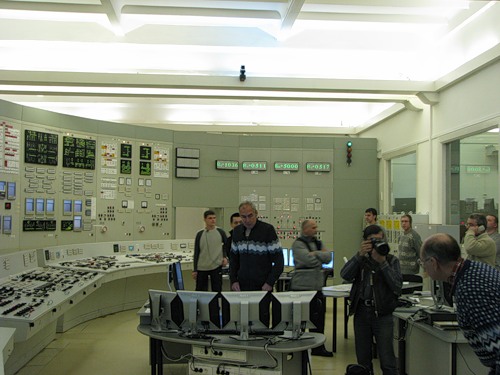
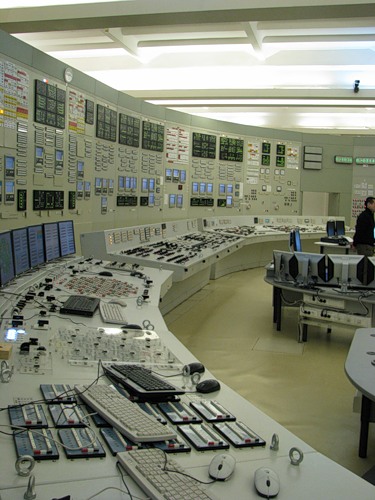
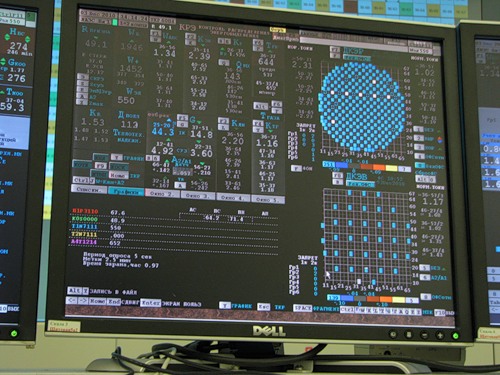
Despite the fact that the tour included visits to the central and engine rooms of the nuclear power plant, the station’s security service allowed me to take pictures only on the territory of the Training Center, so I’ll compensate for the missing photos on the Internet (unsigned pictures are mine). The reactor control room in the UTC almost completely repeats that of the 1st unit of the Leningrad NPP, adjusted for a time difference of 30 years. Since NPP units (total of 4) have been put into operation successively for almost 7 years, and subsequent upgrades have been uneven, the technical equipment of their control rooms can vary significantly. So, the role of the video wall (above) is quite successfully performed by the gauge devices and means of light indication (below). Photo - fritzmorgen
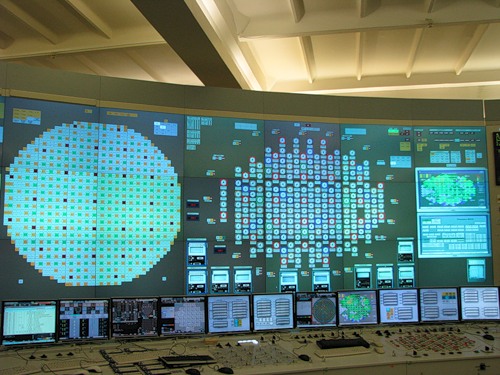
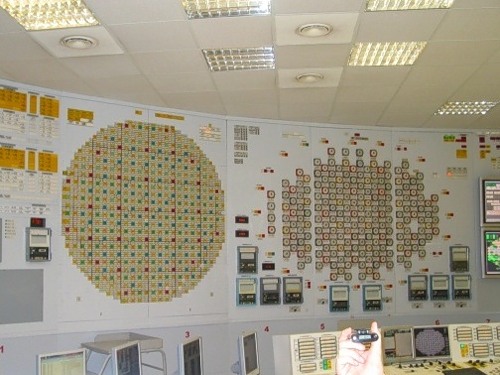
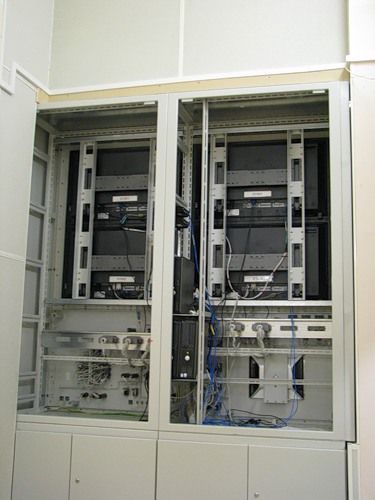
This is how this video wall looks at the back. Quite up-to-date equipment, Dell server: On the far wall there are signs with information about the current generation of electricity. The green traffic light means everything is fine. All electronics in the control room serves mainly to indicate the parameters of the reactor. Direct control of the station is carried out from the hardware remote. The automation of station protection controls the actions of the operator and does not allow increasing the power of the unit above certain values, even despite the fact that structurally the reactor can work stably in this mode. The “Red Button”, which stops the reactor of the nuclear power plant, is located under the monitors at the left edge of the image and is called the emergency protection key (AZ):
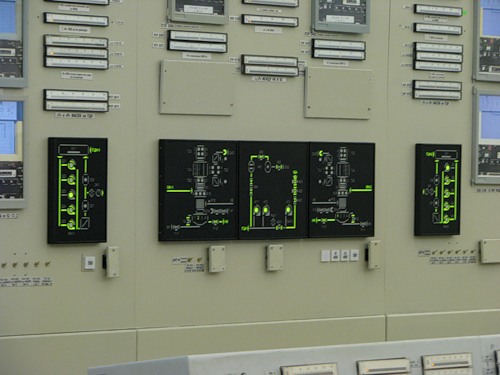
An auxiliary role is given to electronics not only in terms of monitoring the operation of the station, but also in terms of storing information. In addition to the classic paper magazine, paper recorders and listing printers are very common. There are also such block diagrams with illumination of active sections of the circuit. Very neat and informative.

The training center is designed to handle contingencies in the operation of nuclear power plants. Change of the control room consists of several people who are responsible for managing the reactor, power unit and turbine. The instructors behind the glass set the parameters for the training failure, a rather nasty siren is turned on, after which some of the engineers try to identify and fix the problems, another starts reporting everything on the phone. The instructor has the opportunity to listen to all conversations and direct multiple cameras to the remote control or workplace of any employee. Anticipating the main question of habrayuzer: yes, there Windows Server 2003 / XP. To simulate the work of the station, JADE JStation is used .
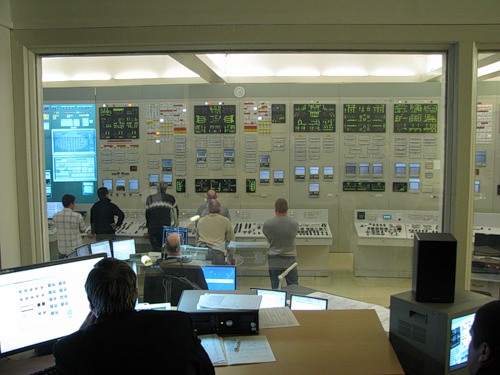
, part of the software is self-written. You can see even more beautiful photos of monitors with a littered horizon in the album on Yandex.Fotki. The Leningrad NPP is the first NPP in the USSR with the RBMK-1000 reactor, notorious after the Chernobyl accident. This reactor is a channel, heterogeneous, uranium-graphite (graphite-water moderator), boiling type, using thermal neutrons; Designed to produce saturated steam with a pressure of 70 kg / cm². The coolant is boiling water. A beautiful picture from Wikipedia is attached:
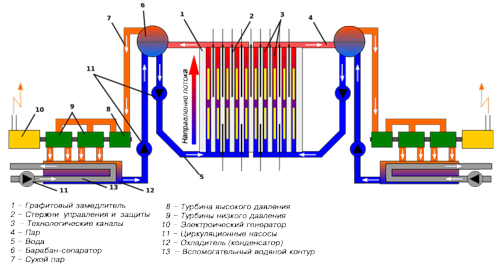
The core of the RBMK-1000 core is a graphite cylinder 7 m high and 11.8 m in diameter, composed of smaller blocks, which acts as a moderator. Graphite is penetrated by a large number of vertical holes, through each of which a pressure pipe passes, it is also a technological channel. In the photo “reactor cover” in the central hall of the nuclear power plant there are biological protection elements:
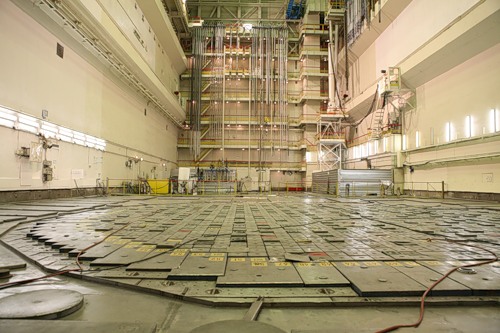
At the back wall, rods loaded into the reactor are visible. The last 7 meters are placed in the active zone, the rest is protective, with a special screw thread for protection against radiation. In the next picture, you can see bloggers (right) at the base of the loading and unloading machine (left), designed for operations with cores. The height of this machine corresponds to the height of the central hall (20-25 meters), while it ensures accuracy of alignment with the channel up to 1 mm. The machine operator is in another room behind a thick lead glass and controls all operations through a video camera. Photo - Rosenergoatom Press Service For almost an hour at the station (including the central hall), the radiation dose that I accumulated was 7 µSv

. This is approximately the same as each passenger receives a two-hour flight due to ionizing radiation. Those who fly often can calculate their accumulated dose here .
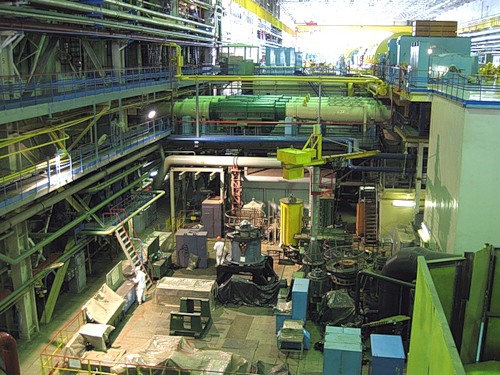
The power part of the station consists of turbines and a generator. In total, the power unit has 2 symmetrically located generators, each of which is associated with 4 turbines. In the engine room, only the upper part is visible, the rest of the structure is located underground on several floors. In real scale, they look like this (photo also from Leningrad NPP, generator blue, in the background, yellow turbines): Photo - sevastyan-rabdano
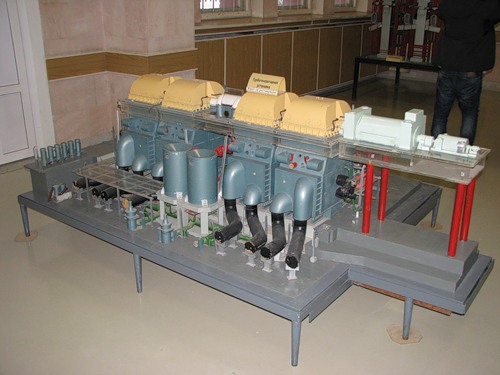

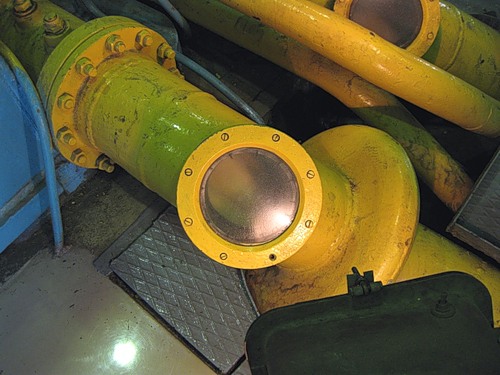
The engine room is very noisy (almost impossible to talk) and hot. Along the walls are the circulation pipes of the circuits. Interestingly, for the operation of each turbine, a constant flow of engine oil is required. To observe it, there are even special “windows”. 3 thick horizontal pipes in the photo - current conductors , 3 phases, which then go to 2 transformer complexes, which provide electric power transportation through power lines for 220 and 750 kV. Photo - belik
The scale of the engine room and the entire station as a whole are amazing. Many thanks to Rosenergoatom for organizing the tour. If you have any questions, I will try to answer them with pleasure. The excursion program also included participation in the inauguration of the innovative means of monitoring the environmental situation “New radiation boards” (pictured). The radiation background in the city of Sosnovy Bor is normal (proof in the photo), the city can sleep peacefully.