December 14, 2009 at 13:17
$ 5900 lens
In the world of photography, there remains an island of stability that is not subject to new-fangled trends, simply because the laws of physics do not change. This island of stability is professional optics. It does not become cheaper and does not decrease in size.
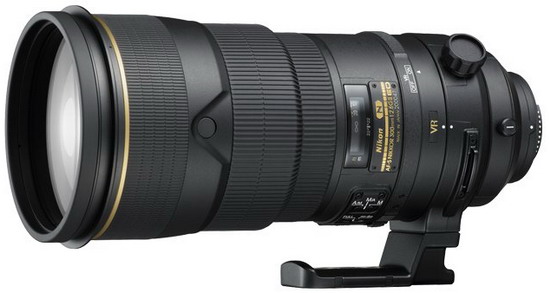
The new AF-S Nikkor 300mm f / 2.8G ED VR II TV sets the very fact of its existence to warm the soul of professional photographers. We will briefly explain why “crazy” people pay such money.
First of all, for speed. Thanks to the F2.8 aperture, you can take clear pictures with a shutter speed four times slower than when using a standard telephoto 200-250 mm for a couple of hundred dollars, because there is an F5.6 aperture. In other words, this professional monster with enlightened optics transmits an order of magnitude more light than ordinary lenses. Four times slower shutter speed is a very important quality, for example, for sports photography. Actually, without such a lens, a sports photographer can not go to work if he does not photograph chess.
To provide such aperture for a large photosensitive sensor, the lenses have to be made larger. That's why professional televisions look so monstrous like telescopes. Grinding large lenses to perfect shape and fitting the entire optical design of the lens is very expensive (incidentally, telescopes are also expensive for the same reason).
In addition to lower shutter speed, such a lens provides better image quality in all other parameters: less distortion, better sharpness, contrast and color reproduction, less attenuation at the corners of the frame, etc.
Each manufacturing company has its own proprietary patented technology, the development of which has been invested in years and resources. For example, Nikon has a Nano Crystal Coat lens nanocrystalline coating. They also take money for this.
Although optics themselves in professional lenses have not improved much over the years and decades, progress is being made in the field of stabilization mechanisms. Canon and Nikon now use miniature gyroscopes in professional televisions to stabilize lenses during handheld shooting. According to Nikon (professional photographers consider this figure too high), their stabilization system allows you to increase the exposure time by four stops without harm to the resulting image, that is, for example, from 1/400 to 1/25 (the previous model of the Nikon 300 mm F2 telephoto. 8 could only three stops).
via DeepTech
The new AF-S Nikkor 300mm f / 2.8G ED VR II TV sets the very fact of its existence to warm the soul of professional photographers. We will briefly explain why “crazy” people pay such money.
First of all, for speed. Thanks to the F2.8 aperture, you can take clear pictures with a shutter speed four times slower than when using a standard telephoto 200-250 mm for a couple of hundred dollars, because there is an F5.6 aperture. In other words, this professional monster with enlightened optics transmits an order of magnitude more light than ordinary lenses. Four times slower shutter speed is a very important quality, for example, for sports photography. Actually, without such a lens, a sports photographer can not go to work if he does not photograph chess.
To provide such aperture for a large photosensitive sensor, the lenses have to be made larger. That's why professional televisions look so monstrous like telescopes. Grinding large lenses to perfect shape and fitting the entire optical design of the lens is very expensive (incidentally, telescopes are also expensive for the same reason).
In addition to lower shutter speed, such a lens provides better image quality in all other parameters: less distortion, better sharpness, contrast and color reproduction, less attenuation at the corners of the frame, etc.
Each manufacturing company has its own proprietary patented technology, the development of which has been invested in years and resources. For example, Nikon has a Nano Crystal Coat lens nanocrystalline coating. They also take money for this.
Although optics themselves in professional lenses have not improved much over the years and decades, progress is being made in the field of stabilization mechanisms. Canon and Nikon now use miniature gyroscopes in professional televisions to stabilize lenses during handheld shooting. According to Nikon (professional photographers consider this figure too high), their stabilization system allows you to increase the exposure time by four stops without harm to the resulting image, that is, for example, from 1/400 to 1/25 (the previous model of the Nikon 300 mm F2 telephoto. 8 could only three stops).
via DeepTech