Transmission of emergency data in the ERA-GLONASS system
All cars produced or imported into the territory of the Russian Federation from January 1, 2017 must be equipped with ERA-GLONASS modules. New Lada cars have been equipped with emergency SOS buttons since 2016. The GOST on emergency response system in case of accidents appeared back in 2011, but so far no technical article has been written describing the principles of its operation. So who cares, please.
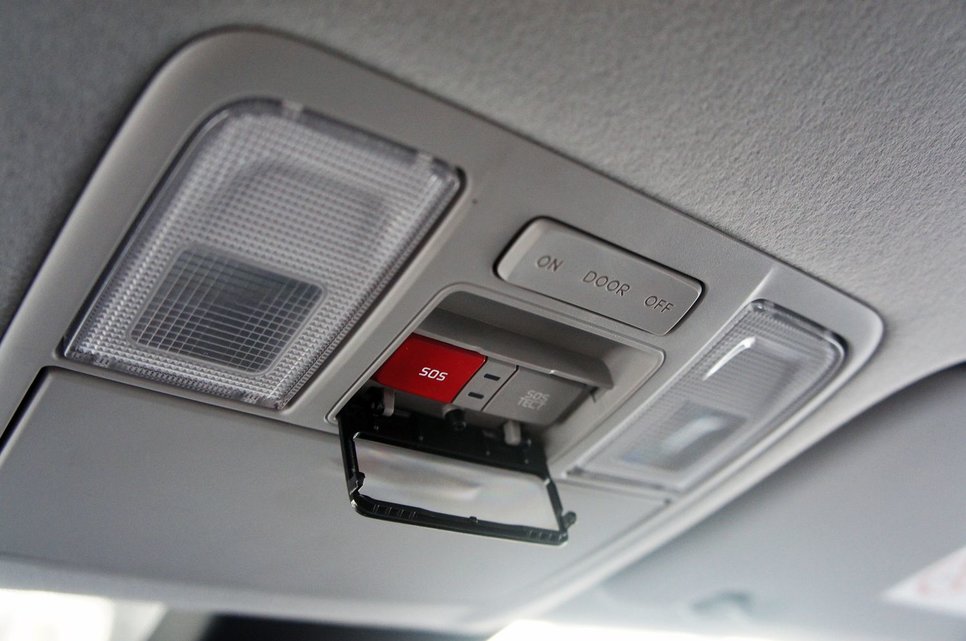
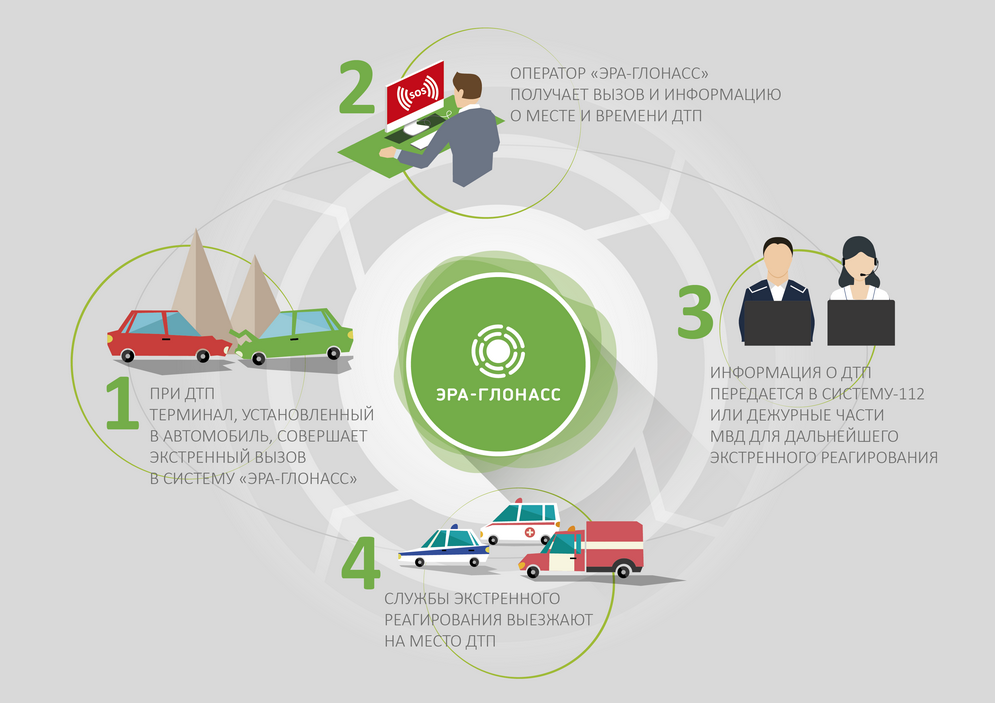
ERA-GLONASS is the Russian State Emergency Response System for Accidents, aimed at improving road safety and reducing road traffic fatalities by reducing the alert time for emergency services. In essence, this is a partially copied eCall European system with some differences in the transmitted data and partially backward compatible with the European parent. The principle of operation of the system is quite simple and logical: in case of an accident, the module built into the vehicle (IVS) in a fully automatic mode and without human intervention determines the severity of the accident, determines the location of the vehicle via GLONASS or GPS, establishes communication with the ERA-GLONASS infrastructure and in accordance with the protocol, transmits the necessary data on the accident (some kind of distress signal). Taking a distress call An employee of the call center of the ERA-GLONASS operator should call the on-board device and find out what happened. If no one answers, transfer the received data to Sistema-112 and send to the exact coordinates of the rescue team and the medical team, moreover, the last one to arrive at the place is given 20 minutes. And all this, I repeat, without human intervention: even if the people involved in an accident cannot independently call emergency services, the data on the accident will still be transmitted.
The infrastructure for the operation of the system can be divided into 3 main parts:
1. Emergency call devices installed in vehicles (according to the eCall standard, these devices are called IVS - In Vehicle System) and collecting and transmitting data from the Car
2. Mobile infrastructure, in fact , a single virtual mobile operator (MVNO), based not on one, but on all real mobile operators. Thus, in the case of an emergency call, it is sufficient to have coverage of any of the mobile operators operating in the Russian Federation, which in turn significantly increases the coverage area of the system. Also, in order to ensure maximum coverage, conventional GSM was chosen as the reference technology for data transmission.
3 Call reception and processing infrastructure (by eCall - PSAP - Public Safety Answering Point), which is a large call center for receiving and processing calls.
In fact, inside the car there is a usual mobile phone, which, when the airbags are triggered, automatically makes a call and “informs the operator about what happened”, and this is where the main technological “trick” of the ERA-GLONASS system and eCall lies: the tone modem.
Since the system was originally designed to work in places where mobile Internet connections may not be available (even GPRS is not always), a protocol was invented that still allows you to transfer a small amount of emergency data, called Minimum Dataset (MND). The essence of this protocol is that all data transmission takes place inside the GSM Voice Channel, almost like DialUp modems in the mid-2000s, but more robust, with support for time synchronization and ARQ.
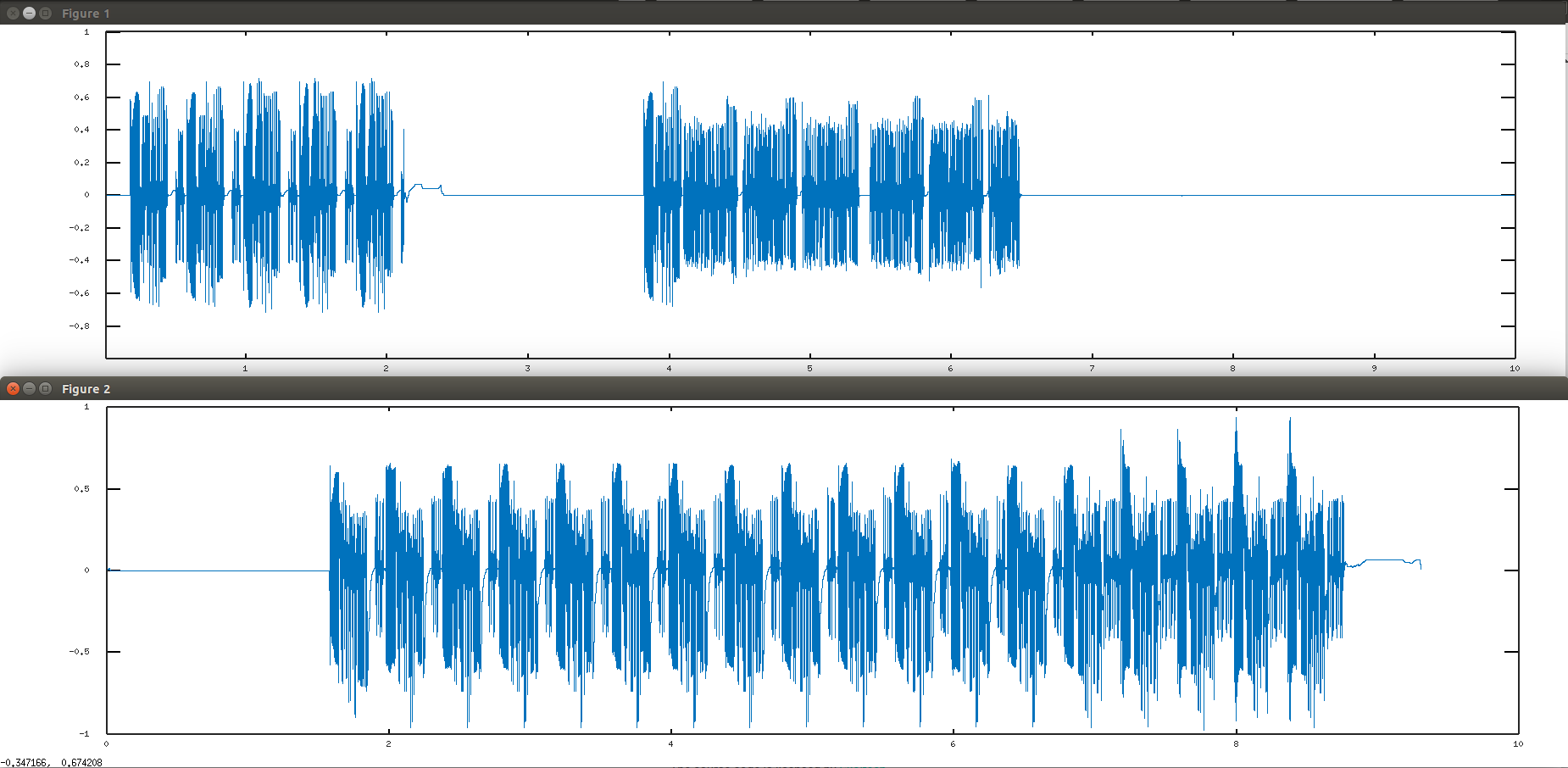
The figure below shows the temporal characteristic of the signal transmitted from the IVS (Uplink - Figure 1) and from the PSAP (Downlink - Figure 2) signal (within the voice channel):
Data transmission in a tone modem generally consists of 3 steps:
1. Synchronization ( Figure 1 - the left side)
2. Ready for data transfer (silence on Figure 1 and sending StartMSD messages on Figure 2)
3. Transmitting 'emergency data (right part of Figure 1, consisting of 3 blocks (in this case, the very first, this is the synchro sequence, then 3 blocks are the payload, and the rest are additional redundancy q I improve noise immunity). Moreover, additional blocks can be even more, which in turn will increase the likelihood of successful decoding.
If anyone is interested, the principle of operation of the tone modem can be studied in more detail in the open standard ETSI TS 126.267.
After receiving and decoding data from a channel on the PSAP side, there is an encoding using the ASN.1 message: From which, after the ASN.1 decoder, the “useful” Minimum data set is allocated:
You can not look at the values inside the packet, this is just an example in which test data was encoded in advance, it is only needed to understand the structure and amount of information transmitted.
As mentioned earlier, ERA-GLONASS is different from the eCall system. In addition to basic information:
Additional ERAGlonassAdditionalData data is also transmitted:
Many people understand that the transfer of MND is just a small part of all the possibilities offered to car owners and regulators: ERA-GLONASS car terminals can be used by car owners to provide a range of additional services related to navigation, information exchange for security purposes. traffic, remote vehicle diagnostics, etc. The infrastructure created in the framework of the ERA-GLONASS project can become the basis for the development of navigation information systems and intelligent traffic management systems in Russia - this is a sure step of Russia towards the technologies Connected Car.
I hope this article was useful, but if there are any points that I would like to know more, write in the comments and maybe I will tell about them in the next article. See you again!
Internet Laboratory of Things
Skolkovo Institute of Science and Technology
What is an ERA?
ERA-GLONASS is the Russian State Emergency Response System for Accidents, aimed at improving road safety and reducing road traffic fatalities by reducing the alert time for emergency services. In essence, this is a partially copied eCall European system with some differences in the transmitted data and partially backward compatible with the European parent. The principle of operation of the system is quite simple and logical: in case of an accident, the module built into the vehicle (IVS) in a fully automatic mode and without human intervention determines the severity of the accident, determines the location of the vehicle via GLONASS or GPS, establishes communication with the ERA-GLONASS infrastructure and in accordance with the protocol, transmits the necessary data on the accident (some kind of distress signal). Taking a distress call An employee of the call center of the ERA-GLONASS operator should call the on-board device and find out what happened. If no one answers, transfer the received data to Sistema-112 and send to the exact coordinates of the rescue team and the medical team, moreover, the last one to arrive at the place is given 20 minutes. And all this, I repeat, without human intervention: even if the people involved in an accident cannot independently call emergency services, the data on the accident will still be transmitted.
What is an ERA infrastructure?
The infrastructure for the operation of the system can be divided into 3 main parts:
1. Emergency call devices installed in vehicles (according to the eCall standard, these devices are called IVS - In Vehicle System) and collecting and transmitting data from the Car
2. Mobile infrastructure, in fact , a single virtual mobile operator (MVNO), based not on one, but on all real mobile operators. Thus, in the case of an emergency call, it is sufficient to have coverage of any of the mobile operators operating in the Russian Federation, which in turn significantly increases the coverage area of the system. Also, in order to ensure maximum coverage, conventional GSM was chosen as the reference technology for data transmission.
3 Call reception and processing infrastructure (by eCall - PSAP - Public Safety Answering Point), which is a large call center for receiving and processing calls.
How it works?
In fact, inside the car there is a usual mobile phone, which, when the airbags are triggered, automatically makes a call and “informs the operator about what happened”, and this is where the main technological “trick” of the ERA-GLONASS system and eCall lies: the tone modem.
Since the system was originally designed to work in places where mobile Internet connections may not be available (even GPRS is not always), a protocol was invented that still allows you to transfer a small amount of emergency data, called Minimum Dataset (MND). The essence of this protocol is that all data transmission takes place inside the GSM Voice Channel, almost like DialUp modems in the mid-2000s, but more robust, with support for time synchronization and ARQ.
The figure below shows the temporal characteristic of the signal transmitted from the IVS (Uplink - Figure 1) and from the PSAP (Downlink - Figure 2) signal (within the voice channel):
Data transmission in a tone modem generally consists of 3 steps:
1. Synchronization ( Figure 1 - the left side)
2. Ready for data transfer (silence on Figure 1 and sending StartMSD messages on Figure 2)
3. Transmitting 'emergency data (right part of Figure 1, consisting of 3 blocks (in this case, the very first, this is the synchro sequence, then 3 blocks are the payload, and the rest are additional redundancy q I improve noise immunity). Moreover, additional blocks can be even more, which in turn will increase the likelihood of successful decoding.
If anyone is interested, the principle of operation of the tone modem can be studied in more detail in the open standard ETSI TS 126.267.
After receiving and decoding data from a channel on the PSAP side, there is an encoding using the ASN.1 message: From which, after the ASN.1 decoder, the “useful” Minimum data set is allocated:
01580D0010410410410410410410410414100000000FFFFFFFFFFFFFFFFFF8020080200030104012328E

E6400400000000000000000000000000000000000000000000000000000000000000000000000000000000000000

00000000000000000000002000000080000000000000080000000000000004000800000000000000000000000000

000000000000<ECallMessage><id>1</id><msd><msdStructure><messageIdentifier>3</messageIdentifier><control><automaticActivation><false/></automaticActivation><testCall><true/></testCall><positionCanBeTrusted><false/></positionCanBeTrusted><vehicleType><passengerVehicleClassM1/></vehicleType></control><vehicleIdentificationNumber><isowmi>111</isowmi><isovds>111111</isovds><isovisModelyear>1</isovisModelyear><isovisSeqPlant>1111111</isovisSeqPlant></vehicleIdentificationNumber><vehiclePropulsionStorageType><gasolineTankPresent><true/></gasolineTankPresent></vehiclePropulsionStorageType><timestamp>0</timestamp><vehicleLocation><positionLatitude>2147483647</positionLatitude><positionLongitude>2147483647</positionLongitude></vehicleLocation><vehicleDirection>255</vehicleDirection><recentVehicleLocationN1><latitudeDelta>0</latitudeDelta><longitudeDelta>0</longitudeDelta></recentVehicleLocationN1><recentVehicleLocationN2><latitudeDelta>0</latitudeDelta><longitudeDelta>0</longitudeDelta></recentVehicleLocationN2></msdStructure><optionalAdditionalData><oid>1.4.1</oid><data>28EE640040000000000000000000000000000000000000000000000000000000000000</data></optionalAdditionalData></msd></ECallMessage><ERAAdditionalData><diagnosticResult><micConnectionFailure><false/></micConnectionFailure><speakersFailure><false/></speakersFailure><ignitionLineFailure><false/></ignitionLineFailure><uimFailure><false/></uimFailure><batteryFailure><false/></batteryFailure><batteryVoltageLow><false/></batteryVoltageLow><crashSensorFailure><false/></crashSensorFailure><gnssReceiverFailure><false/></gnssReceiverFailure><raimProblem><true/></raimProblem><eventsMemoryOverflow><false/></eventsMemoryOverflow></diagnosticResult></ERAAdditionalData>You can not look at the values inside the packet, this is just an example in which test data was encoded in advance, it is only needed to understand the structure and amount of information transmitted.
As mentioned earlier, ERA-GLONASS is different from the eCall system. In addition to basic information:
- Vehicle VIN
- Car type (cars, trucks, motorcycles, buses, etc.)
- Type of fuel (gasoline, gas, diesel, etc.)
- The number of seatbelt (for approximate determination of the number of victims)
- Geolocation data, including trajectory movement
- The time of the event
- Additional control information about the type of activation, the validity of coordinates, etc.
Additional ERAGlonassAdditionalData data is also transmitted:
- about the severity of accidents (calculated by the formula of GOST based on the acceleration profile obtained from accelerometers on board IVS)
- about the place of the initial strike (front, rear, side, with a vehicle coup)
- and the status of the emergency call device
Conclusion
Many people understand that the transfer of MND is just a small part of all the possibilities offered to car owners and regulators: ERA-GLONASS car terminals can be used by car owners to provide a range of additional services related to navigation, information exchange for security purposes. traffic, remote vehicle diagnostics, etc. The infrastructure created in the framework of the ERA-GLONASS project can become the basis for the development of navigation information systems and intelligent traffic management systems in Russia - this is a sure step of Russia towards the technologies Connected Car.
I hope this article was useful, but if there are any points that I would like to know more, write in the comments and maybe I will tell about them in the next article. See you again!
Internet Laboratory of Things
Skolkovo Institute of Science and Technology