Office Application History: Part I
Now it seems to be taken for granted that you can work on a table or a presentation at the same time as a whole team, while at the same time being in different parts of the planet for completely different devices. But before coming to this, office suites have evolved over the decades - and in the process such dramas have unfolded that it is time to film them. MyOffice remembers what was happening.

From what moment to count the history of office software? It is possible since the appearance of the first text editor for microcomputers: before this, the software for working with text already existed, but the life of ordinary offices did not radically change it.
Today it is hard to believe that this text editor appeared almost by accident. Michael Schreier, who had been involved in television advertising and filming for twenty years, bought the MITS Altair 8800 in 1975 and began programming as a hobby, not considering it as a source of income. Initially, he was not going to create a text editor (moreover, he had never even heard of such a concept) and was engaged in another project. But then he got tired of having to use a typewriter for project documentation: "I have a computer, why not do it right on it." So in 1976, the Electric Pencil appeared.- and Schreier was amazed at the demand for his “hobby”. However, the project, which was based on the enthusiasm of the creator, later gave way to competitors simply because the enthusiasm weakened: he was interested in programming, but did not want to bother with selling the created one. Schreier can be called a person who voluntarily surrendered leadership in the growing market for office software - an impressive lack of ambition to conquer the world.
It is not surprising that the leadership was intercepted by the project in which development and sales were separated. Seymour Rubinstein, who started out as a programmer, founded MicroPro in 1978, hired programmer Rob Barnaby and commissioned him to develop a word processor WordStar, and sales did not bother him. Under his leadership, Barnaby single-handedly created the first version in four months, writing 137,000 lines of code — according to Rubinstein, his acquaintances at IBM estimated the amount of work done at 42 person-years. Barnaby became one of the most famous programmers of the time, and WordStar became the most popular text editor right up until the mid-80s.
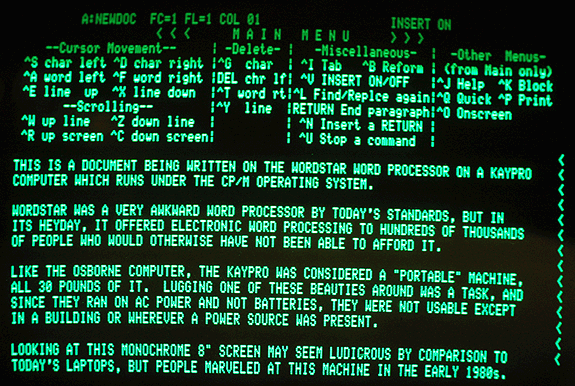
Wordstar , source: YourDictionary
In 1979, another product produced a revolution: VisiCalcwho opened the business spreadsheets. During the first year of its existence, it was available only for Apple II - and it is quite possible that if it were not for this circumstance, the history of the whole of Apple and computers as a whole would have been completely different. Because it has become one of the main killer app in history: an application that attracts users to its platform. There was a demand for the combination “VisiCalc and what it can be launched on” on the market, so a computer for $ 2,000 was purchased for $ 100 a couple of software. Today, when the Internet is perceived as a given, it is easy to forget that, before its distribution, office applications were almost the only mass use of a computer — not surprisingly, they played such a huge role in its selection.

VisaCalc , source: Wikimedia
Apple II text editors are not so famous, but without them, users also did not remain. In the same 1979, Apple published AppleWriter , written by a lone programmer Paul Lutus in a hut, which he himself built on top of a hill and to which he stretched 370 meters of electrical cable (today's freelancers complaining about an abundance of distractions have something to learn).
The success of Apple II was one of the factors that made IBM introduce its personal computer in 1981. Apple came to the conclusion that the IBM PC was technically inadequate, did not see any threat in it, and carelessly published an ad for “Welcome, IBM. Seriously. ” But in vain: from their own experience they could realize that the success of the platform depends not only on its technical characteristics.
VisiCalc was also available on the IBM PC, and in 1983 Lotus 1-2-3 also appeared., which included tables, graphs and database functionality ("1-2-3" in the title refers to these three components, and "Lotus" - to the enthusiasm of the developer Mitch Kepor transcendental meditation). And then sales of VisiCalc collapsed: it turned out that his success was not due to his perfection, but simply the lack of alternatives, and people massively switched to a more convenient option. Now Lotus 1-2-3 was selling the platform, and the then published idea of one journalist instead of “PC-compatible” says “1-2-3-compatible”: consumers were worried about this when buying a computer.
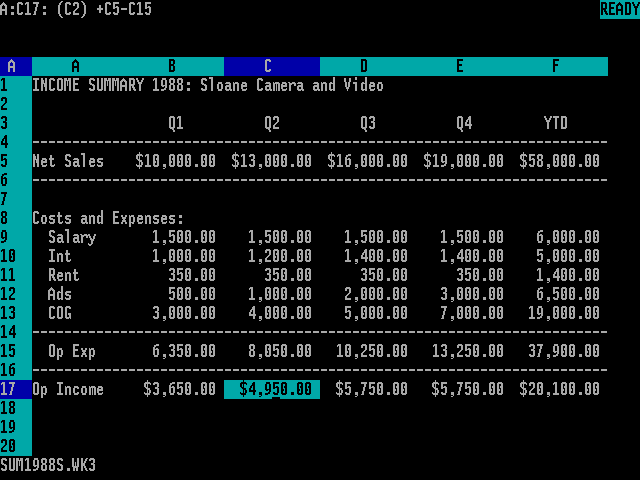
Lotus 1-2-3 , source: os2museum
When Apple released the Macintosh in 1984, the first time, the only table editor for it was Multiplan- from Microsoft. Although Multiplan was available for other platforms, Bill Gates then repeatedly stated that sales on the Mac were best. When Microsoft Excel came to replace Multiplan a year later, the first platform for it was Macintosh too. Today, such a friendship between Apple and Microsoft looks unusual - but it is worth remembering that at that time Bill Gates even participated in advertising for the Macintosh, praising him, and at Apple they saw IBM as their main rival, and not development partners.
At about the same time, another noticeable change occurred: popular office applications began to be distributed in packages, rather than one by one. One of the packages was Lotus Symphony , where a text editor and other services were added to the 1-2-3 analog. Other - AppleWorks: Apple released its own package in 1984, but not for the new Macintosh, but for the “old man» Apple II. The third is the Framework . Finally, the Commodore Plus / 4 computer is particularly indicative: its very name refers to the fact that it was sold immediately with four office applications.
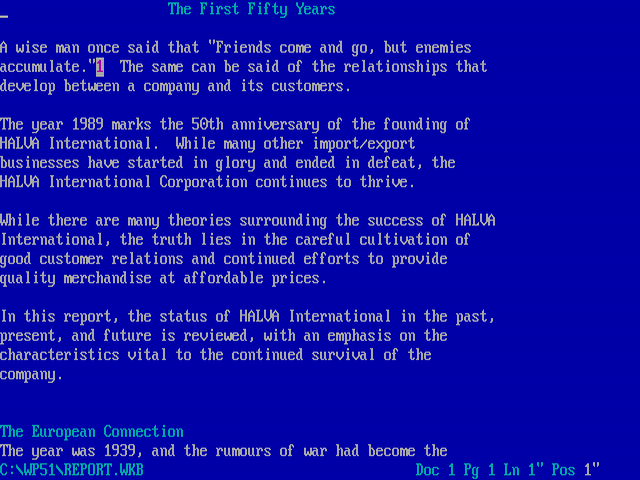
WordPerfect, source: Codinghorror
In the second half of the 80s, the text editors market underwent great changes. In WordStar after flowering things got much worse (this is linkedso that Rubinstein, being in the hospital after a heart attack, succumbed to someone else's influence and thoughtlessly signed a paper on which his shares ceased to be voting). A whole number of competitors claimed the place of the new king of the hill, from XyWrite, beloved by journalists, to Volkswriter (the name has nothing in common with Volkswagen - this editor rested on simplicity and mass character), but in the end WordPerfect became the new leader .
At least in the USA - in the USSR the trends were different. Regarding the cases, they acted according to the principle “let's take the western editor and change its name to Russian” (“Photon” was renamed UltraEdit), but there were also truly local developments: in the late 80s the Russian text editor “Lexicon” triumphed(You can read more about his story, for example, here ), and in the early 90s some of the users preferred to him the “Word and Case” . Lotus 1-2-3, like WordPerfect, also did not become the leader of its category on Soviet territory, losing in popularity to another Western product SuperCalc.
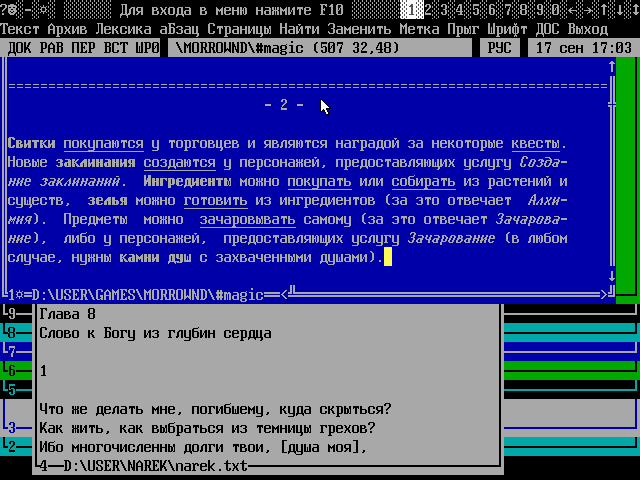
Lexicon , source: Wikimedia
Finally, in 1989, Microsoft combined its work in Word, Excel and PowerPoint into the Office suite.- and even here at first I released a version for Mac, although Windows had existed for several years by that time. However, it was not yet very popular, so the solution is understandable. But in 1990, when the first mass popular version of Windows was released (3.0, which sold two million copies in the first half year), the corresponding version of Office appeared.
The competitors did not immediately realize what phenomenon the Microsoft operating system gradually became, and some of them did not release Windows-versions of their products for a long time, while others did not pay much attention to these versions. In addition, they had their own dramas: XyWrite unexpectedly collapsed large-scale cooperation with IBM, and the package, which WordPerfect entered, began to actively change owners (in 1994, Borland sold it to Novell, and in 1996, Novell lost its losses Corel). Microsoft Office, meanwhile, was only getting better: if at first its name was a marketing designation for the sale of three applications, then the components became more and more unified, gradually becoming the single product we used to see office suites today.
It is not surprising that Office managed to become the definitive leader in its native platform. The platform itself, meanwhile, left the rest far behind, so that by the turn of the century, Microsoft Office had become the undisputed world leader - it seemed that it was impossible for anyone to push it. How can you poach people if they have already been offered everything that is required? Who is the player who is able to compete with such a giant - not Apple, about which everyone was waiting for “when it goes bankrupt” by this moment?
The XXI century showed that unmet needs remained and there is someone to compete with - but this is in the next text. In the meantime, if you yourself have found the described times and you have something to supplement our story, feel free to do it in the comments!
From what moment to count the history of office software? It is possible since the appearance of the first text editor for microcomputers: before this, the software for working with text already existed, but the life of ordinary offices did not radically change it.
1970 - 1980. Beginning
Today it is hard to believe that this text editor appeared almost by accident. Michael Schreier, who had been involved in television advertising and filming for twenty years, bought the MITS Altair 8800 in 1975 and began programming as a hobby, not considering it as a source of income. Initially, he was not going to create a text editor (moreover, he had never even heard of such a concept) and was engaged in another project. But then he got tired of having to use a typewriter for project documentation: "I have a computer, why not do it right on it." So in 1976, the Electric Pencil appeared.- and Schreier was amazed at the demand for his “hobby”. However, the project, which was based on the enthusiasm of the creator, later gave way to competitors simply because the enthusiasm weakened: he was interested in programming, but did not want to bother with selling the created one. Schreier can be called a person who voluntarily surrendered leadership in the growing market for office software - an impressive lack of ambition to conquer the world.
It is not surprising that the leadership was intercepted by the project in which development and sales were separated. Seymour Rubinstein, who started out as a programmer, founded MicroPro in 1978, hired programmer Rob Barnaby and commissioned him to develop a word processor WordStar, and sales did not bother him. Under his leadership, Barnaby single-handedly created the first version in four months, writing 137,000 lines of code — according to Rubinstein, his acquaintances at IBM estimated the amount of work done at 42 person-years. Barnaby became one of the most famous programmers of the time, and WordStar became the most popular text editor right up until the mid-80s.
Wordstar , source: YourDictionary
In 1979, another product produced a revolution: VisiCalcwho opened the business spreadsheets. During the first year of its existence, it was available only for Apple II - and it is quite possible that if it were not for this circumstance, the history of the whole of Apple and computers as a whole would have been completely different. Because it has become one of the main killer app in history: an application that attracts users to its platform. There was a demand for the combination “VisiCalc and what it can be launched on” on the market, so a computer for $ 2,000 was purchased for $ 100 a couple of software. Today, when the Internet is perceived as a given, it is easy to forget that, before its distribution, office applications were almost the only mass use of a computer — not surprisingly, they played such a huge role in its selection.
VisaCalc , source: Wikimedia
Apple II text editors are not so famous, but without them, users also did not remain. In the same 1979, Apple published AppleWriter , written by a lone programmer Paul Lutus in a hut, which he himself built on top of a hill and to which he stretched 370 meters of electrical cable (today's freelancers complaining about an abundance of distractions have something to learn).
1980 - 1990. Formation
The success of Apple II was one of the factors that made IBM introduce its personal computer in 1981. Apple came to the conclusion that the IBM PC was technically inadequate, did not see any threat in it, and carelessly published an ad for “Welcome, IBM. Seriously. ” But in vain: from their own experience they could realize that the success of the platform depends not only on its technical characteristics.
VisiCalc was also available on the IBM PC, and in 1983 Lotus 1-2-3 also appeared., which included tables, graphs and database functionality ("1-2-3" in the title refers to these three components, and "Lotus" - to the enthusiasm of the developer Mitch Kepor transcendental meditation). And then sales of VisiCalc collapsed: it turned out that his success was not due to his perfection, but simply the lack of alternatives, and people massively switched to a more convenient option. Now Lotus 1-2-3 was selling the platform, and the then published idea of one journalist instead of “PC-compatible” says “1-2-3-compatible”: consumers were worried about this when buying a computer.
Lotus 1-2-3 , source: os2museum
When Apple released the Macintosh in 1984, the first time, the only table editor for it was Multiplan- from Microsoft. Although Multiplan was available for other platforms, Bill Gates then repeatedly stated that sales on the Mac were best. When Microsoft Excel came to replace Multiplan a year later, the first platform for it was Macintosh too. Today, such a friendship between Apple and Microsoft looks unusual - but it is worth remembering that at that time Bill Gates even participated in advertising for the Macintosh, praising him, and at Apple they saw IBM as their main rival, and not development partners.
At about the same time, another noticeable change occurred: popular office applications began to be distributed in packages, rather than one by one. One of the packages was Lotus Symphony , where a text editor and other services were added to the 1-2-3 analog. Other - AppleWorks: Apple released its own package in 1984, but not for the new Macintosh, but for the “old man» Apple II. The third is the Framework . Finally, the Commodore Plus / 4 computer is particularly indicative: its very name refers to the fact that it was sold immediately with four office applications.
WordPerfect, source: Codinghorror
In the second half of the 80s, the text editors market underwent great changes. In WordStar after flowering things got much worse (this is linkedso that Rubinstein, being in the hospital after a heart attack, succumbed to someone else's influence and thoughtlessly signed a paper on which his shares ceased to be voting). A whole number of competitors claimed the place of the new king of the hill, from XyWrite, beloved by journalists, to Volkswriter (the name has nothing in common with Volkswagen - this editor rested on simplicity and mass character), but in the end WordPerfect became the new leader .
At least in the USA - in the USSR the trends were different. Regarding the cases, they acted according to the principle “let's take the western editor and change its name to Russian” (“Photon” was renamed UltraEdit), but there were also truly local developments: in the late 80s the Russian text editor “Lexicon” triumphed(You can read more about his story, for example, here ), and in the early 90s some of the users preferred to him the “Word and Case” . Lotus 1-2-3, like WordPerfect, also did not become the leader of its category on Soviet territory, losing in popularity to another Western product SuperCalc.
Lexicon , source: Wikimedia
Finally, in 1989, Microsoft combined its work in Word, Excel and PowerPoint into the Office suite.- and even here at first I released a version for Mac, although Windows had existed for several years by that time. However, it was not yet very popular, so the solution is understandable. But in 1990, when the first mass popular version of Windows was released (3.0, which sold two million copies in the first half year), the corresponding version of Office appeared.
Early 1990s. Dominance
The competitors did not immediately realize what phenomenon the Microsoft operating system gradually became, and some of them did not release Windows-versions of their products for a long time, while others did not pay much attention to these versions. In addition, they had their own dramas: XyWrite unexpectedly collapsed large-scale cooperation with IBM, and the package, which WordPerfect entered, began to actively change owners (in 1994, Borland sold it to Novell, and in 1996, Novell lost its losses Corel). Microsoft Office, meanwhile, was only getting better: if at first its name was a marketing designation for the sale of three applications, then the components became more and more unified, gradually becoming the single product we used to see office suites today.
It is not surprising that Office managed to become the definitive leader in its native platform. The platform itself, meanwhile, left the rest far behind, so that by the turn of the century, Microsoft Office had become the undisputed world leader - it seemed that it was impossible for anyone to push it. How can you poach people if they have already been offered everything that is required? Who is the player who is able to compete with such a giant - not Apple, about which everyone was waiting for “when it goes bankrupt” by this moment?
The XXI century showed that unmet needs remained and there is someone to compete with - but this is in the next text. In the meantime, if you yourself have found the described times and you have something to supplement our story, feel free to do it in the comments!