
 March 21, 2019 at 10:00
Microsoft Opens Business School to Learn AI Strategies, Culture, and Responsibility
In recent years, some of the fastest growing companies in the world have been introducing artificial intelligence (AI) to solve specific business problems. Microsoft conducted a study to understand how AI will affect business leadership, and found that the likelihood of active AI implementation in fast-growing companies is more than 2 times higher than in companies developing more slowly.
Moreover, fast-growing companies are already using AI much more actively, and about half of them plan to expand the use of AI next year to improve decision-making processes. Among companies with slow growth, only one in three has such plans. But, as the study showed , even among fast-growing companies, only one in five integrates AI in their operations.
Details under the cut!
This article is on our news site.
“There is a gap between people's intentions and the actual state of affairs in their organizations, the willingness of these organizations,” says Mitra Azizirad, Microsoft’s corporate vice president of AI marketing.
“Developing a strategy for AI goes beyond business matters,” Mitra explains. “In order to prepare the organization for the implementation of AI, organizational skills, competency and tools are needed.”
On the way to developing such strategies, top managers and other business leaders often stumble over the questions: how and where to start implementing AI in the company, what changes in the company's culture are needed for this, how to create and use AI responsibly, safely, protecting privacy, respecting laws and regulations?
Today, Azizirad and her team open Microsoft AI Business School to help business leaders understand these issues. The free online course is a series of workshops whose purpose is to give managers confidence in their actions in the AI era.
Focus on strategy, culture and responsibility
The business school course materials include short guides and case studies, as well as videos of lectures and discussions that busy executives can contact when they have time. A series of short introductory videos provides an overview of artificial intelligence technologies that drive change across industries, but most of the content focuses on managing the impact of artificial intelligence on a company's strategy, culture, and responsibility.
“This school will help you get a deeper understanding of how to develop a strategy and find obstacles before they prevent you from introducing AI into your organization,” says Azizirad.
New Business School complements other Microsoft training initiatives working with AI, including pro-development school AI School and a training program for professionals in the AI field (Microsoft Professional Program for Artificial Intelligence) , which gives a real experience, knowledge and skills necessary for engineers and general anyone who wants to improve their AI and data processing skills.
Azizirad says that the new business school, unlike other initiatives, is not focused on technical specialists, but on training managers to manage organizations in the transition to AI.
Analyst Nick McQuire, who writes reviews of intelligent technologies for CCS Insight , says that more than 50% of the companies surveyed by his company already research, test or implement specialized projects based on AI and machine learning, but very few use AI throughout their organization and looking for business opportunities and tasks related to AI.
“This is because the business community does not fully understand what AI is, what its capabilities are, and finally how it can be applied,” says McQuire. “Microsoft is trying to fill that gap.”
 Mitra Azizirad, vice president. Photo: Microsoft.
Case Studies
INSEAD , a master's business school with campuses in Europe, Asia and the Middle East, jointly with Microsoft developed the strategic module of the AI business school, incorporating the experience of companies from different industries that have successfully transformed their business using AI to study it.
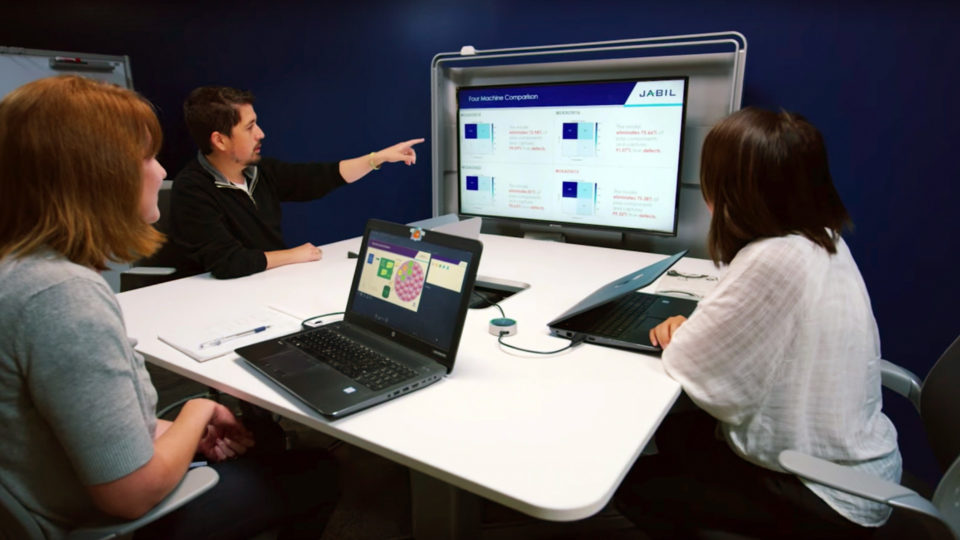
For example, Jabil’s experience shows how one of the world's largest suppliers of production solutions was able to reduce overhead costs and improve the quality of its production line by using AI to test electronic parts during their manufacturing process, which allowed employees to focus on other operations that were not available to machines.
“There is still a lot of work left to do without human capital, especially in processes that cannot be standardized,” explained Gary Cantrell, senior vice president and chief information officer, Jabil.
Cantrell added that the key to implementing AI was the leadership’s desire to explain to employees what the company's strategy for AI is: eliminate routine, repetitive actions so people can focus on what cannot be automated.
“If employees themselves guessed and made assumptions, then at some point it would begin to interfere with work,” he said. “The better you explain to your team what you are striving for, the more effective and faster the implementation will be.”
Cultivating culture for AI transition
Microsoft AI Business School’s culture and responsibility modules focus on data. As Azizirad explained, for the successful application of AI, companies need an open exchange of data between departments and business functions, and all employees need the opportunity to participate in the development and implementation of AI applications that process data.
“You need to start with an open approach to using organization data. This is the foundation for the implementation of AI, which allows you to get the results you are counting on, ”she said, adding that successful leaders take an inclusive approach to AI, combining different roles and getting rid of isolated data warehouses.
At Microsoft AI Business School, this is illustrated by the example of the Microsoft marketing department, who decided to use AI to better assess the potential opportunities that the sales department should be guided by. To arrive at this decision, the marketing staff, along with data processing specialists, created machine learning models that analyze thousands of variables to evaluate potential customers. The key to success was the unification of the knowledge of marketers about the quality of potential customers and the knowledge of experts in the field of machine learning.
“In order to change the culture and introduce AI, it is necessary to involve people closest to the business problem that you are trying to solve,” Azizirad said, adding that sales specialists use the model for evaluating potential customers because they are sure that it gives high results.
AI and responsibility
Building trust is also linked to the responsible development and deployment of AI systems. As Microsoft's marketing research showed, this resonates with business leaders. The more leaders of fast-growing companies know about AI, the more they realize that they need to ensure responsible AI deployment.
The Microsoft AI Business School module, dedicated to the impact of a responsible AI approach, demonstrates Microsoft's own work in this area. The course materials include real-life examples in which Microsoft leaders learned lessons such as the need to protect smart systems from attacks and identify biases in the datasets used to train models.
“Over time, when companies will depend on the algorithms and machine learning models they create, much more attention will be paid to management,” said McQuire, an analyst at CCS Insight.