February 25, 2019 at 16:33
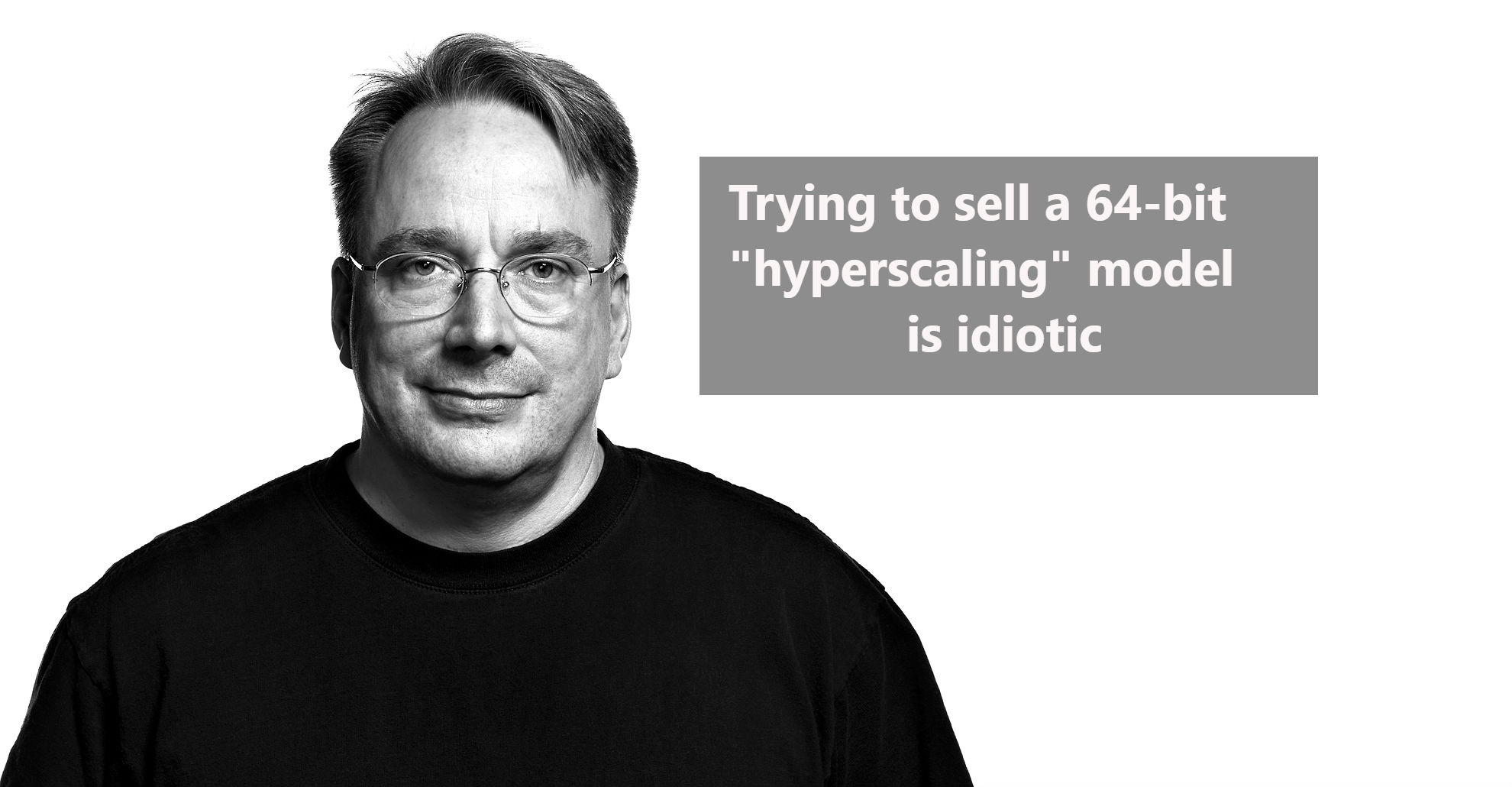
Linus Torvalds does not believe that servers on the ARM architecture will replace x86. “Selling a 64-bit model - idiocy”
Last week, ARM Holdings announced it was developing a new micro-architecture for server processors. The computing core that will be used in it is code-named Ares, and according to the promise it should give a 60% increase compared to the current platform. With each next generation, productivity should grow by another 30%.
The server market is not the largest for ARM yet. Now processors on its architecture are used in mobile and embedded devices. The performance leap that the company promises server manufacturers will be higher than Intel and IBM have done in the past few years.
However, Linux creator Linus Torvalds skeptically commented on the announcement. He believes that the future of new architecture is not so rosy.
I can guarantee that while everyone is engaged in cross-platform development, the platform will not be stable and successful. Some people think that the set of instructions is not important for the “cloud” - you develop at home, deploy everything (I mean “at home” not in the literal sense at home, but in your workspace).
This is complete nonsense. If you are developing on x86, then you will want to deploy on x86, because you can run what you tested at home. This means that you will gladly overpay a bit for hosting on x86, just so that it matches your working environment, and the errors received are transmitted easier.
Therefore, providers will receive more money from x86 servers and will keep them in priority. Any options from ARM will be secondary, and most likely they will throw off all kinds of silly nonsense, like front-end, static HTML and all that.
One of the claimed advantages of the ARM architecture, which allowed it to win in the mobile market, is energy consumption. The company believes that this will reduce the cost, and productivity will be no worse. This combination will help her compete among servers. But Torvalds thinks that success in the market is determined by other reasons.
In his opinion, the determining factor is precisely “home development”. Small companies test workloads on regular, cheap PCs, and when workloads increase, these computers take on the role of real servers. And only with a huge increase in workloads, companies transfer everything to the cloud, not wanting to change the architecture in order to avoid problems.
This is precisely what killed the vendors of RISC processors and made x86 the king of the hill among servers. To the extent that everything else is just an error. A couple of decades ago, this would have sounded like a fantasy.Linus believes that entering the server market without first creating an environment for development and not “flooding the market with cheap devboxes is complete idiocy”. In addition, he doubts that the benefits that ARM calls are truly considered advantages. According to him, all current servers on this architecture are actually slower, more expensive and are unlikely to save so much energy.
With the Torvalds did not agree the creator of Redis Salvatore Sanfilippo. He believes that most developers do not think of constant immersion in computing cores and generally does not attach importance to reproducibility of the environment at the architecture level. According to him, the transfer of Redis to the ARM architecture did not cause the problems that the creator of Linux scares:
Redis, which in itself is a low-level code, runs quietly on ARM, all tests pass, and there are no stability issues. And since the code written in C many years ago, when no one had thought about ARM, it works almost out of the box, nothing will happen to applications on Ruby or Node when they are poured onto ARM servers.The architecture company also responded to Torvalds. They agree with his opinion that development within one environment works much better, therefore they are announcing their own development platform, probably this week.
Iron producers are also moving toward the changes that Torvalds says are needed for the future of new architecture. For example, Apple is rumored to be preparing Macs with ARM processors for release, Qualcomm is developing ARM processors for laptops, and Microsoft is supporting ARM development for Windows 10.
Torvalds himself in his next post also reduced his skepticism:
Let's see what happens in reality, but now I definitely like ARM more than before.In a discussion of the issue on Reddit, they noted that most well-known architectures could not stand the competition with x86.
Until I see the widespread distribution of iron that people can use to develop and deploy, I will hold my own judgment. I just heard too many promises about hardware, which after the release, nobody needed anywhere else.
Hopefully ARM won't hit too much on rescaling. Maybe they will succeed, but to be honest, I doubt it. It takes a lot of time and effort. No need to swing at 64-128 cores, until you can do at least an 8-core normally. What they have not yet demonstrated.
But you never know, maybe they will surprise me.
m88k? Dead, or moved to something like PowerPC. i860? Dead. i960? Dead. PA-RISC? is dead. AMD 29000? Dead. IA64? Dead. Alpha? Dead.
However, the discussion agreed that the current market for server architectures is shared by three systems. ARM - as the weakest and cheapest. Power9 is the most powerful, but incredibly expensive. x86 among them is the golden mean in the ratio of price and quality:
Development and deployment on ARM is fine if you use Rasp. Pi. But you need something more powerful. With Power9, the opposite is true: the cheapest system is Talos II. Therefore, you need many thousands of dollars to collect a normal devbox on Power9. Of course it is good, but it is too expensive for ordinary development needs.But in the second quarter of this year, Raptor Computer Systems plans to release a desktop with a 4-core CPU based on Power9 architecture for $ 1,200. Therefore, if this trend continues - ARM will increase productivity, and Power9 will reduce the price - competition can again arise in the mass segment.
Therefore, x86 falls into the niche of mass consumption - laptops and desktops cost up to a thousand dollars.