November 6, 2015 at 18:37
The incredible adventures of Robert Hanbury Brown and Richard Twiss. Part 2: under the Southern Cross
The last time I was told how to use the radio telescope to detect Sputnik-1 launch vehicle, and why it is not enough for astronomy. And today, our main characters will figure out how to make telescopes orders of magnitude more powerful, set off to look for a clear sky and get acquainted with the intricacies of astronomy in Australia. Welcome to cat.
By and large, the principle of operation of double telescopes - stellar interferometers from the first part is based on three simple ideas:
1. In a small telescope, a star seems to be a point, in a large - an extended object. The same goes for two telescopes with a small / large distance between them.
2.If you change the distance between two telescopes, then sooner or later the image of a star from a point will become extended. From this one can determine the angular size of a star - one of the most important astronomical parameters.
3. How do I know at what point the image from a point becomes extended? It is possible by interference: a point object gives clear interference, an extended one gives no:

The first and second paragraph are simple and ingenious. But with the third there is a problem. The interference is always formed by two beams traveling along two different paths, and therefore it is terrifying how sensitive to the length of these paths. Turbulence, and just a slight movement of air is enough for the light to come into the telescopes a little earlier, then a little later. Because of this, the interference strips will move left and right and eventually blur the whole picture.

Interference: good (a), not very good (b), very bad (c).
It would be nice to come up with something to distinguish a point image of a star from an elongated one! Hanbury Brown meets with the second hero of our story, theoretical physicist Richard Twiss. Together they pay attention to the intensity of the star’s radiation - or rather, to the noise of this radiation.

Light from a star is not constant, but varies slightly in time. It's not about planets and eclipses - any light source is a little, but noisy. If the source is a point, then from whatever side you look at it, the noise will be the same (the point is the point, no matter how you twist it). But for an extended source this is not so: say, the noise of a light bulb, if you look at it from the left and from the right, is slightly different. The same is true for a star.
If both telescopes see the same noise, then the star seems to be a point. If the noise is different, then the star seems to be extended. Ingenious! No interference or other sensitive coupling between telescopes is necessary; the turbulence problem disappears by itself. This means that they can be separated hundreds of meters from each other without any problems! Our protagonists assemble the first telescope of the new system - an interferometer of intensities (by the way, it was already in 1952 - even before the Lovell telescope).

How do you know if two telescopes see the same noise or different? The simplest idea is to subtract the signal from one telescope from the signal from another. In fact, it’s much more efficient to monitor not the difference of signals from two telescopes, but their product . Moreover, not just a product, but its average value:

Triangular brackets are just averaging over time, that is, the average value hidden behind the noise. I 1 and I 2 - signal intensity from two telescopes. They are noisy, therefore their work is also noisy; but the average value is clearly defined.
To make it more convenient, this value is divided into the average values of I 1 and I 2 . What happened is called g (2) or a second-order correlation function :
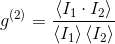
If the star is extended, then I 1 and I 2 come from different points of it, they are independent, and triangular brackets can be opened. The numerator and denominator of the fraction will become equal, and it will become a unit. That is, for an extended star g (2) = 1. It is convenient and easy to remember.
What about a point star? Which side do not look at her, and the intensity and noise will be the same. Therefore, I 1 = I 2 and therefore

Usually this value is greater than unity (ideally, it is equal to two). So, to measure the size of a star using two telescopes, you need to calculate g (2) , changing the distance between them:
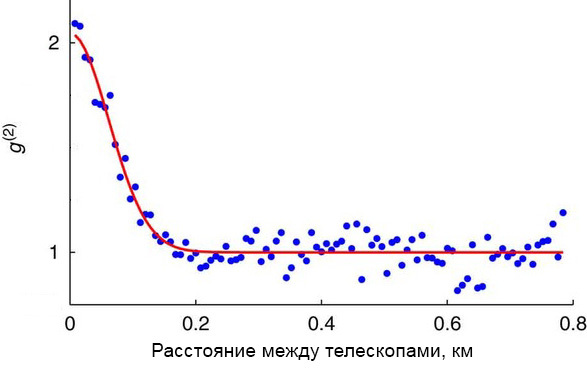
When g (2) begins to fall from two to one, the distance between the telescopes will determine the angular size of the star through the diffraction ratio. That’s the whole theory. It's time to move on to practice.
So, the two Hanbury Brown radio telescopes were not connected by anything, and they could be moved apart not by tens of meters, but by kilometers. One telescope was left in the observatory, the second was transported from one field to another, away from the first. Concerns about the radio sources Cygnus A and Cassiopeia A did not materialize - they turned out to be quite large, and the distance between the telescopes of several kilometers was quite enough to measure their size.
After the radio interferometer, Hanbury Brown decides to assemble a new double telescope - this time an optical one. At hand are old military searchlights, perfect for this purpose. Now they have to not scatter the light, but collect it, for which the lamps need to be replaced with photomultipliers:

Encouraged by previous success, Hanbury Brown sets himself the ambitious goal of measuring the size of Sirius, the brightest star in the sky. The task was complicated by the fact that Sirius (more precisely, its bright component Sirius A) is a small star comparable in size to the Sun. But these were still flowers. Quite suddenly, it turns out that the life of an optical astronomer in Britain is not so simple - the climate is not the same. And then the telescope was only assembled in the fall, so the measurements began in a wonderful British winter: wet, dank, well, of course, cloudy and fogon the Thames .

Winter at the Jodrell Bank Observatory.
It only remains to add that in Britain Sirius does not rise above 20 degrees above the horizon in principle! Astronomers were exhausted, spent the whole winter, but somehow miraculously measured the four experimental points with huge errors and roughly estimated the size of the star. The most amazing thing is that their result differs from modern data by less than twenty percent.

Having tasted all the charms of British astronomy, Hanbury Brown moves to a cloudless Australia, where he collects a new optical telescope. You may be a little surprised at how quickly he managed to make new telescopes. The fact is that they did not require high-quality pictures. You just need a large mirror that can collect light on the photodetector; the quality and aberrations of this mirror are completely unimportant. Australian telescopes were very similar to modern satellite dishes: a parabolic “dish” was assembled from 252 mirrors and focused the light on a photomultiplier mounted on the end of a long pipe:

For many years, some mirrors had to be removed, but this did not particularly affect the quality. The situation with the local fauna was much worse. At first the frogs attacked the observatory. Hanbury Brown did not like them terribly, so Twiss threw them out of the room with ice tongs. After the drought, the frogs disappeared, but mice appeared that began to gnaw the cable. But the worst of all were the birds: the small ones adored flying towards their reflection in the mirror before the sonorous impact of their beaks; and large multi-colored parrots with pleasure hung upside down on the cables, regularly scratching and nibbling them. I had to get a hawk, which guarded the telescopes from a variety of animals.
The telescopes themselves were mounted on two railway platforms and placed on circular rails. This made it possible to carry out measurements at two perpendicular orientations of the telescopes and, thus, to obtain a two-dimensional picture. In particular, this approach was very useful in the study of binary stars.

In the middle of the circle is the control center, a large building in the foreground is a garage for telescopes, and a security hawk lived in it.
The telescope in Narrabri made a real breakthrough in astronomy. With its help, it was possible to measure the angular dimensions of dozens of stars, including binary stars. This made it possible to supplement the Hertzsprung-Russell diagram, deal with the evolution of late stars, see stellar crowns and find out what is happening in them ... Interferometry of intensities took its place of honor among astronomical instruments, but its heyday fell on new radio telescopes.
Can two telescopes be carried even further? Of course! Yes, and why carry it, you can take any two radio telescopes on Earth and make them work in pairs. This is called super long base interferometry.. At the same time, telescopes do not need real-time communication: a signal from them can be recorded and then processed; the main thing is that the measurements are carried out simultaneously. Instead of changing the distance between them, the time delay is changed - just like in stellar interferometers.

The principle of operation of radio interferometry with extra-long bases.

Radio telescopes on a world map (by no means all). Any pair can form a radio interferometer.
A telescope the size of the diameter of the Earth - who would have thought! It turned out, and this is not the limit. Why not launch one telescope into space, and pair it with one of the earth's? This was first done at the Salyut-6 station, combining its telescope with the giant RT-70 near Evpatoria:

Due to the large diameter - as much as 10 meters - they decided to fix the telescope on the docking unit, and after completing the work just unhook it and push it away (you need to moor the Progress somewhere). But the telescope decided differently and managed to cling to the station building. I had to go into outer space. As soon as the astronaut Valery Ryumin cut one of the cables that caught the antenna, she immediately jerked and flew right at him. I had to dodge. In general, the real life of astronauts is never inferior to Gravity :).
Well, the pinnacle of creation for today is the legendary Radioastron projectwith the Space Telescope R-telescope. It flies in an elliptical orbit with an apogee of as many as 340 thousand kilometers - this means that the effective diameter of the telescope is approximately equal to the distance from the Earth to the Moon! As the second receiver, one of the ground-based telescopes is selected depending on the weather and tasks.

The successes of Radioastron over three years are impressive: he managed to determine the sizes of many quasars, relativistic jets, observe the behavior of space masers, and discover the unusual structure of pulsars ... Zelenyikot spoke well about some of the results . Today, Radioastron continues to observe, tasks for it are scheduled for a long time ahead, and I am sure that it will continue to please us with new results.
Hanbury Brown and Twiss made another scientific revolution. The intensity interferometer - understandable, easy to set up, incredibly effective - turned out to be a powerful tool in the hands of astronomers. But in his work there were a couple of incomprehensible moments. Most of all, it was surprising why g (2) for shifted telescopes equals exactly two:
It was believed that this was somehow connected with the noise of the star, but how exactly was unclear. Whether our heroes were aware or not, they stood one step away from a completely new world - quantum optics .
Continuation: part 3 .
Sources of
M. Fox. Quantum optics: An Introduction - Oxford University Press, 2006.
R. Hanbury Brown. The Intensity Interferometer. Its Application to Astronomy. - London: Taylor & Francis, 1974.
R. Hanbury Brown. Boffin: A Personal Story of the Early Days of Radar, Radio Astronomy and Quantum Optics - Bristol: Adam Hilger, 1991.
Glazkov Yu.N., Kolesnikov Yu.V. In outer space. - M.: Pedagogy, 1990.
2009 Workshop on Stellar Intensity Interferometry.
Obituary: Robert Hanbury Brown. Nature 416, 34 (2002).
PG Tuthill The Narrabri Stellar Intensity Interferometer: a 50th birthday tribute. Proc. of SPIE 91460C (2014).
Pictures: KDPV , 1 , 2 , 4 , 5 , 7 , 9 , 10 , 11 , 12 , 13 , 14 .
By and large, the principle of operation of double telescopes - stellar interferometers from the first part is based on three simple ideas:
1. In a small telescope, a star seems to be a point, in a large - an extended object. The same goes for two telescopes with a small / large distance between them.
2.If you change the distance between two telescopes, then sooner or later the image of a star from a point will become extended. From this one can determine the angular size of a star - one of the most important astronomical parameters.
3. How do I know at what point the image from a point becomes extended? It is possible by interference: a point object gives clear interference, an extended one gives no:
The first and second paragraph are simple and ingenious. But with the third there is a problem. The interference is always formed by two beams traveling along two different paths, and therefore it is terrifying how sensitive to the length of these paths. Turbulence, and just a slight movement of air is enough for the light to come into the telescopes a little earlier, then a little later. Because of this, the interference strips will move left and right and eventually blur the whole picture.
Interference: good (a), not very good (b), very bad (c).
It would be nice to come up with something to distinguish a point image of a star from an elongated one! Hanbury Brown meets with the second hero of our story, theoretical physicist Richard Twiss. Together they pay attention to the intensity of the star’s radiation - or rather, to the noise of this radiation.
Light from a star is not constant, but varies slightly in time. It's not about planets and eclipses - any light source is a little, but noisy. If the source is a point, then from whatever side you look at it, the noise will be the same (the point is the point, no matter how you twist it). But for an extended source this is not so: say, the noise of a light bulb, if you look at it from the left and from the right, is slightly different. The same is true for a star.
If both telescopes see the same noise, then the star seems to be a point. If the noise is different, then the star seems to be extended. Ingenious! No interference or other sensitive coupling between telescopes is necessary; the turbulence problem disappears by itself. This means that they can be separated hundreds of meters from each other without any problems! Our protagonists assemble the first telescope of the new system - an interferometer of intensities (by the way, it was already in 1952 - even before the Lovell telescope).
How do you know if two telescopes see the same noise or different? The simplest idea is to subtract the signal from one telescope from the signal from another. In fact, it’s much more efficient to monitor not the difference of signals from two telescopes, but their product . Moreover, not just a product, but its average value:
Triangular brackets are just averaging over time, that is, the average value hidden behind the noise. I 1 and I 2 - signal intensity from two telescopes. They are noisy, therefore their work is also noisy; but the average value is clearly defined.
To make it more convenient, this value is divided into the average values of I 1 and I 2 . What happened is called g (2) or a second-order correlation function :
If the star is extended, then I 1 and I 2 come from different points of it, they are independent, and triangular brackets can be opened. The numerator and denominator of the fraction will become equal, and it will become a unit. That is, for an extended star g (2) = 1. It is convenient and easy to remember.
What about a point star? Which side do not look at her, and the intensity and noise will be the same. Therefore, I 1 = I 2 and therefore
Usually this value is greater than unity (ideally, it is equal to two). So, to measure the size of a star using two telescopes, you need to calculate g (2) , changing the distance between them:
When g (2) begins to fall from two to one, the distance between the telescopes will determine the angular size of the star through the diffraction ratio. That’s the whole theory. It's time to move on to practice.
Lyrical digression: why second-order correlation
The Hanbury Brown-Twiss telescope measures the correlation of intensities , and the wave intensity is the square of its amplitude . And stellar interferometers from the first part measure interference (thanks, Cap!), Which is set by the amplitude of the wave.
Therefore, ordinary interference (aka g (1) ) is a first-order correlation (first degree of amplitude), and g (2) is a second-order correlation (second degree of amplitude = intensity).
The names for the amplitude interferometer (measuring g (1) ) and the intensity interferometer (g(2) ).
Therefore, ordinary interference (aka g (1) ) is a first-order correlation (first degree of amplitude), and g (2) is a second-order correlation (second degree of amplitude = intensity).
The names for the amplitude interferometer (measuring g (1) ) and the intensity interferometer (g(2) ).
So, the two Hanbury Brown radio telescopes were not connected by anything, and they could be moved apart not by tens of meters, but by kilometers. One telescope was left in the observatory, the second was transported from one field to another, away from the first. Concerns about the radio sources Cygnus A and Cassiopeia A did not materialize - they turned out to be quite large, and the distance between the telescopes of several kilometers was quite enough to measure their size.
After the radio interferometer, Hanbury Brown decides to assemble a new double telescope - this time an optical one. At hand are old military searchlights, perfect for this purpose. Now they have to not scatter the light, but collect it, for which the lamps need to be replaced with photomultipliers:
Encouraged by previous success, Hanbury Brown sets himself the ambitious goal of measuring the size of Sirius, the brightest star in the sky. The task was complicated by the fact that Sirius (more precisely, its bright component Sirius A) is a small star comparable in size to the Sun. But these were still flowers. Quite suddenly, it turns out that the life of an optical astronomer in Britain is not so simple - the climate is not the same. And then the telescope was only assembled in the fall, so the measurements began in a wonderful British winter: wet, dank, well, of course, cloudy and fog
Winter at the Jodrell Bank Observatory.
It only remains to add that in Britain Sirius does not rise above 20 degrees above the horizon in principle! Astronomers were exhausted, spent the whole winter, but somehow miraculously measured the four experimental points with huge errors and roughly estimated the size of the star. The most amazing thing is that their result differs from modern data by less than twenty percent.
Having tasted all the charms of British astronomy, Hanbury Brown moves to a cloudless Australia, where he collects a new optical telescope. You may be a little surprised at how quickly he managed to make new telescopes. The fact is that they did not require high-quality pictures. You just need a large mirror that can collect light on the photodetector; the quality and aberrations of this mirror are completely unimportant. Australian telescopes were very similar to modern satellite dishes: a parabolic “dish” was assembled from 252 mirrors and focused the light on a photomultiplier mounted on the end of a long pipe:
For many years, some mirrors had to be removed, but this did not particularly affect the quality. The situation with the local fauna was much worse. At first the frogs attacked the observatory. Hanbury Brown did not like them terribly, so Twiss threw them out of the room with ice tongs. After the drought, the frogs disappeared, but mice appeared that began to gnaw the cable. But the worst of all were the birds: the small ones adored flying towards their reflection in the mirror before the sonorous impact of their beaks; and large multi-colored parrots with pleasure hung upside down on the cables, regularly scratching and nibbling them. I had to get a hawk, which guarded the telescopes from a variety of animals.
The telescopes themselves were mounted on two railway platforms and placed on circular rails. This made it possible to carry out measurements at two perpendicular orientations of the telescopes and, thus, to obtain a two-dimensional picture. In particular, this approach was very useful in the study of binary stars.
In the middle of the circle is the control center, a large building in the foreground is a garage for telescopes, and a security hawk lived in it.
The telescope in Narrabri made a real breakthrough in astronomy. With its help, it was possible to measure the angular dimensions of dozens of stars, including binary stars. This made it possible to supplement the Hertzsprung-Russell diagram, deal with the evolution of late stars, see stellar crowns and find out what is happening in them ... Interferometry of intensities took its place of honor among astronomical instruments, but its heyday fell on new radio telescopes.
Can two telescopes be carried even further? Of course! Yes, and why carry it, you can take any two radio telescopes on Earth and make them work in pairs. This is called super long base interferometry.. At the same time, telescopes do not need real-time communication: a signal from them can be recorded and then processed; the main thing is that the measurements are carried out simultaneously. Instead of changing the distance between them, the time delay is changed - just like in stellar interferometers.
The principle of operation of radio interferometry with extra-long bases.
Radio telescopes on a world map (by no means all). Any pair can form a radio interferometer.
A telescope the size of the diameter of the Earth - who would have thought! It turned out, and this is not the limit. Why not launch one telescope into space, and pair it with one of the earth's? This was first done at the Salyut-6 station, combining its telescope with the giant RT-70 near Evpatoria:
Due to the large diameter - as much as 10 meters - they decided to fix the telescope on the docking unit, and after completing the work just unhook it and push it away (you need to moor the Progress somewhere). But the telescope decided differently and managed to cling to the station building. I had to go into outer space. As soon as the astronaut Valery Ryumin cut one of the cables that caught the antenna, she immediately jerked and flew right at him. I had to dodge. In general, the real life of astronauts is never inferior to Gravity :).
Well, the pinnacle of creation for today is the legendary Radioastron projectwith the Space Telescope R-telescope. It flies in an elliptical orbit with an apogee of as many as 340 thousand kilometers - this means that the effective diameter of the telescope is approximately equal to the distance from the Earth to the Moon! As the second receiver, one of the ground-based telescopes is selected depending on the weather and tasks.
The successes of Radioastron over three years are impressive: he managed to determine the sizes of many quasars, relativistic jets, observe the behavior of space masers, and discover the unusual structure of pulsars ... Zelenyikot spoke well about some of the results . Today, Radioastron continues to observe, tasks for it are scheduled for a long time ahead, and I am sure that it will continue to please us with new results.
Hanbury Brown and Twiss made another scientific revolution. The intensity interferometer - understandable, easy to set up, incredibly effective - turned out to be a powerful tool in the hands of astronomers. But in his work there were a couple of incomprehensible moments. Most of all, it was surprising why g (2) for shifted telescopes equals exactly two:
It was believed that this was somehow connected with the noise of the star, but how exactly was unclear. Whether our heroes were aware or not, they stood one step away from a completely new world - quantum optics .
Continuation: part 3 .
Sources of
M. Fox. Quantum optics: An Introduction - Oxford University Press, 2006.
R. Hanbury Brown. The Intensity Interferometer. Its Application to Astronomy. - London: Taylor & Francis, 1974.
R. Hanbury Brown. Boffin: A Personal Story of the Early Days of Radar, Radio Astronomy and Quantum Optics - Bristol: Adam Hilger, 1991.
Glazkov Yu.N., Kolesnikov Yu.V. In outer space. - M.: Pedagogy, 1990.
2009 Workshop on Stellar Intensity Interferometry.
Obituary: Robert Hanbury Brown. Nature 416, 34 (2002).
PG Tuthill The Narrabri Stellar Intensity Interferometer: a 50th birthday tribute. Proc. of SPIE 91460C (2014).
Pictures: KDPV , 1 , 2 , 4 , 5 , 7 , 9 , 10 , 11 , 12 , 13 , 14 .