# Accuracy of the Finite Element Method: Comparing SCAD++, Lira, and ammonit3d on a Single Element
The 3D cloud application ammonit3d demonstrated analytical accuracy on par with commercial packages SCAD++ and Lira in a test with a single finite element. At the same time, the solution provides cross-platform visualization of deflection and moment diagrams directly on the 3D model, simplifying result analysis for engineers.
Why Test with a Single Finite Element?
Checking the accuracy of finite element analysis (FEA) software on a single element is a rigorous test. If the mathematical model of the element is implemented correctly, the numerical solution should match the analytical one. For a beam based on the Euler-Bernoulli model, the analytical solution exists and is a fourth-degree polynomial. In such a test, there is no discretization error, as the problem is solved on a single element, and any deviation indicates an implementation error.
Commercial packages like SCAD++ and Lira are traditionally used in the construction industry and are considered the gold standard. However, cloud solutions like ammonit3d, developed using modern web technologies (Node.js, React, Three.js), offer new capabilities. A single-element test allows evaluating how accurately the basic algorithms are implemented in the new software.
Mathematical Model and Analytical Solution
The Euler-Bernoulli model describes the bending of an elastic beam under a distributed load. The equation for the elastic curve is:
EJ * d⁴v/dx⁴ = q(x)
where E is the Young's modulus, J is the moment of inertia of the cross-section, v is the deflection, q(x) is the distributed load.
For a uniformly distributed load q₀, the general solution is:
v(x) = (q₀/(EJ)) * (x⁴/24 - x³L/12 + x²L²/24)
The bending moment is calculated as:
M(x) = -EJ d²v/dx² = -q₀ (x²/2 - xL/2 + L²/12)
These formulas allow precise determination of deflection and moment at any point on the beam. For example, the maximum deflection at the midpoint of a 1 m long beam with q₀=3 kN/m is -1.165 mm, moments at the supports are -250 N·m, and at the midpoint — 125 N·m.
Test Setup: Beam with Fixed Ends
The test model is a steel beam 1 m long with a 25×25 mm square cross-section. Material — steel with Young's modulus 2.06e11 Pa and Poisson's ratio 0.3. The beam ends are rigidly fixed, with a uniformly distributed load of 3 kN/m applied along the entire length.
This test was chosen because:
- The analytical solution is known and easily computed.
- The load and boundary conditions create a typical stress-strain state seen in practice.
- Results are sensitive to the element implementation accuracy.
Comparison Results: Accuracy to Six Decimal Places
All three packages — SCAD++, Lira, and ammonit3d — matched the analytical solution to six decimal places. The table shows key values:
- Deflection at midspan (v(0.5)): -1.165000 mm (analytical), -1.164999 mm (SCAD++), -1.165000 mm (Lira), -1.165000 mm (ammonit3d).
- Moment at midspan (M(0.5)): 125 N·m (in all cases).
- Moment at support (M(0)): -250 N·m (in all cases).
Thus, the numerical cores of all programs correctly implement the Euler-Bernoulli model for the beam element. However, there are nuances in result presentation.
Visualization: How ammonit3d Stands Out?
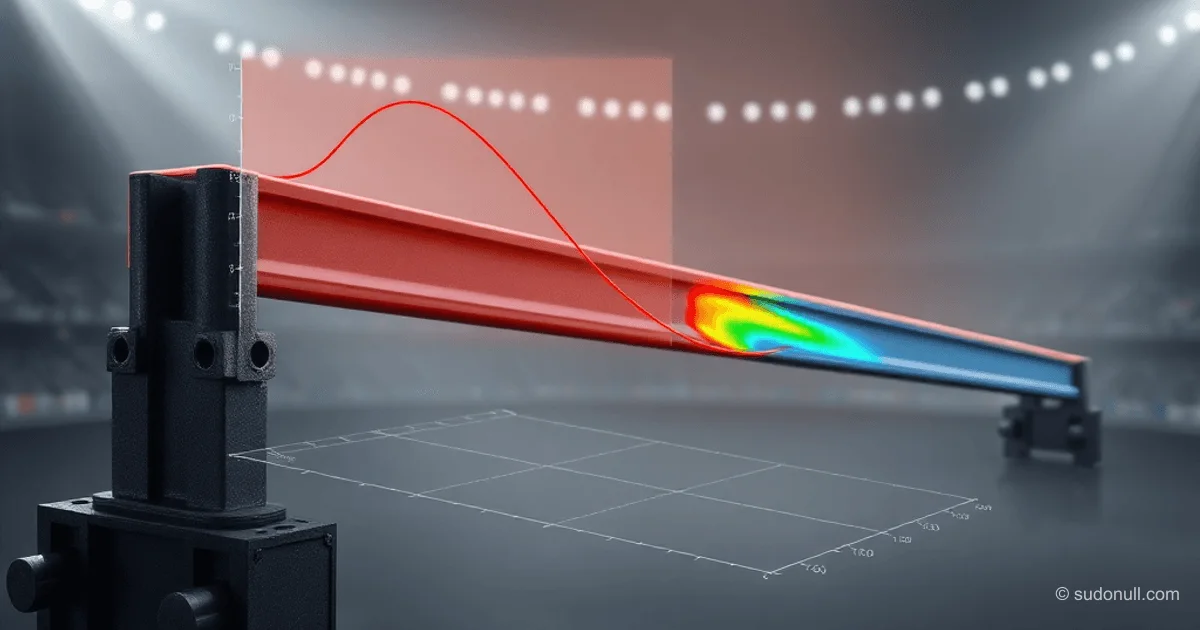
The main difference of ammonit3d from traditional packages is in visualization. SCAD++ and Lira display deflection and moment diagrams in separate windows, without integrating them into the 3D model. In ammonit3d, the diagrams are overlaid directly on the spatial scheme, allowing engineers to see deformations and stresses in the context of the entire structure.
Additionally, ammonit3d offers these advantages:
- Cross-platform: Runs in a browser on PCs, tablets, and smartphones.
- Cloud storage: Models accessible from anywhere with internet.
- Social features: Share models via links, post to social media, or email.
- Open access: Users can create and edit models without installing software.
These features make it convenient for team collaboration and quick result sharing.
Key Takeaways
- All three packages deliver analytical accuracy on a single finite element, confirming the correctness of their mathematical models.
- ammonit3d matches commercial analogs in accuracy but surpasses them in visualization and accessibility.
- Integrating diagrams into the 3D model speeds up result interpretation, especially for complex structures.
- Cloud architecture enables calculations on any device, lowering the entry barrier for engineers.
— Editorial Team










No comments yet.