# Onboard Computers in Lunar Missions: Reliability Lessons from Apollo to Artemis
Half a century separates the Apollo 13 and Artemis 2 missions, but the engineering principles embedded in their onboard systems remain relevant. Modern quantum computing and AI haven't eliminated the fundamental requirements for fault tolerance—especially when astronauts' lives hang in the balance.
The Mainframe Era: Foundation of the Lunar Race
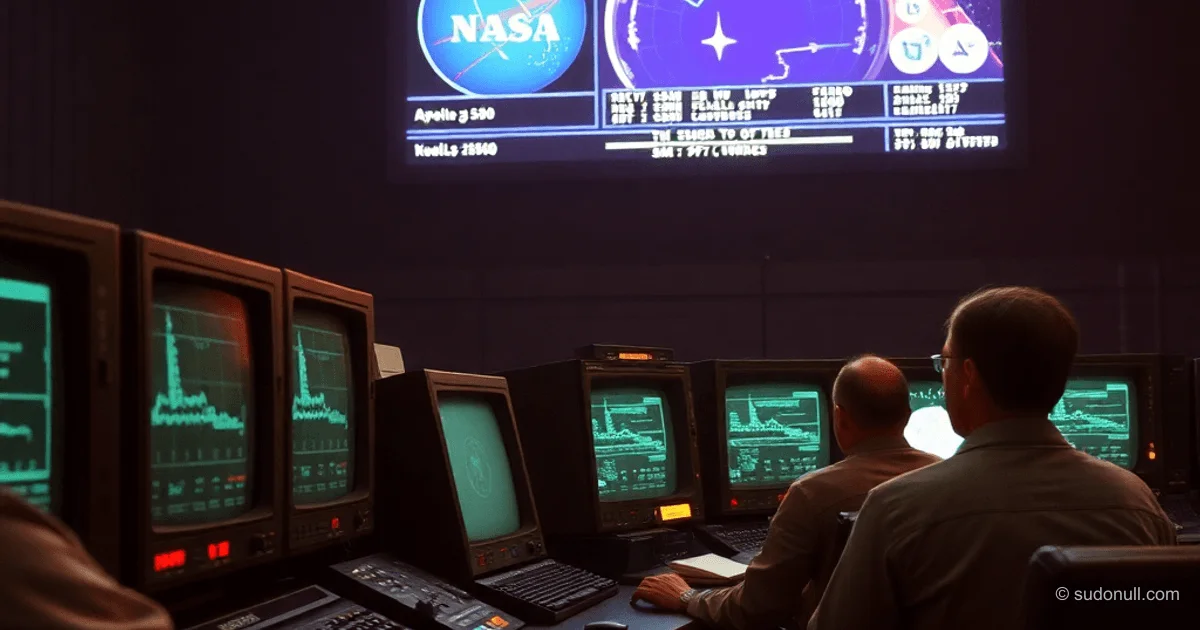
In the 1960s, computing was in its infancy. For the Apollo program, this meant reliance on IBM mainframes, which by today's standards were downright sluggish. The Real Time Computing Complex (RTCC) in Houston consisted of several IBM System/360s. These systems processed telemetry in real time, calculated flight trajectories, and managed communications. Each console in Mission Control displayed specialized data: from astronaut health status to spacecraft systems parameters.
Onboard Apollo was the Apollo Guidance Computer (AGC)—an engineering breakthrough for its time. Weighing 32 kg with just 36 KB of memory, it handled navigation and landing. The DSKY (Display and Keyboard) interface allowed entering commands via 20 buttons designed for gloved hands. Meanwhile, the Instrument Unit on the Saturn V rocket, built by IBM, managed stabilization and control during launch. Its reliability shone during the Apollo 12 launch, when it withstood a lightning strike.
Key components of Apollo's computing infrastructure:
- RTCC (Houston): Cluster of IBM mainframes for ground-based data processing.
- AGC: Onboard spacecraft computer with DSKY interface.
- Instrument Unit: Saturn V rocket control system.
- Specialized simulators: For crew training on routine and emergency scenarios.
From "Turtles" to Supercomputers: Evolution of Computing Power
Comparing computing power, the difference is staggering. The AGC ran at 1.024 MHz with 2 KB of RAM. Modern systems in Artemis 2 use IBM Power processors to handle hundreds of thousands of telemetry data points in real time. Yet the core task hasn't changed: instantly interpret data and make safety-critical decisions.
The main difference lies in fault-tolerant architecture. In the Apollo era, redundancy came from duplicating systems and human oversight. Today, AI algorithms predict failures and enable self-healing. For example, in 2025, IBM and NASA unveiled an open-source AI model for analyzing solar activity to prevent satellite damage.
That said, engineers emphasize that the basic principles endure:
- Minimize single points of failure.
- Rigorous testing on edge cases.
- A culture of accountability, where flawlessness is a matter of survival.
Reliability as the Prime Mission: Letter from the Apollo 13 Crew
The Apollo 13 crisis was a stress test for every system. When the oxygen tank exploded, the reliability of the Instrument Unit and ground-based IBM computers enabled the crew's safe return. Months later, the astronauts sent IBM a letter stressing: "For us [IBM reliability] is a matter of survival."
This episode captures an engineering philosophy that's still relevant today: no compromises in critical systems. Even with the 1960s resource constraints, the team focused on stress-testing every component. The AGC, for instance, was tested for vibration, radiation, and extreme temperatures—what saved Apollo 11 during landing.
Modern Challenges: AI and Quantum Computing in Space
In the Artemis 2 mission, IBM Power systems managed the countdown, processing data from sensors across the rocket. But the future lies in integrating AI and quantum computing. The IBM-NASA collaboration on an AI model for predicting solar storms is a first step. This system analyzes data from space telescopes to detect threats to orbital electronics.
However, adopting these new technologies comes with challenges:
- AI Verification: Algorithms must be provably reliable, not just "working."
- Quantum Resilience: Protection against future quantum attacks on satellite communications.
- Power Efficiency: Onboard power constraints demand optimized computing.
Just like in the Apollo era, the key is balancing innovation with proven methods. For example, Artemis still uses analog backup systems alongside digital ones.
Key Takeaways
- Reliability transcends eras: Even with the primitive computing power of the 1960s, the emphasis on fault tolerance saved lives during the Apollo 13 crisis.
- Culture of responsibility trumps technology: The crew's letter to IBM highlights that trust in systems stems from engineering discipline, not just hardware.
- Evolution, not revolution: Modern AI and quantum systems complement—but don't replace—core principles like redundancy, testing, and risk minimization.
Modern space missions inherit Apollo's lessons not just in technology, but in philosophy too. As long as humans venture into space, system reliability will remain the top priority—whether powered by System/360 mainframes or quantum processors.
— Editorial Team





No comments yet.