
 September 14, 2015 at 22:02
Google increased autonomous car production and hired former Hyundai director
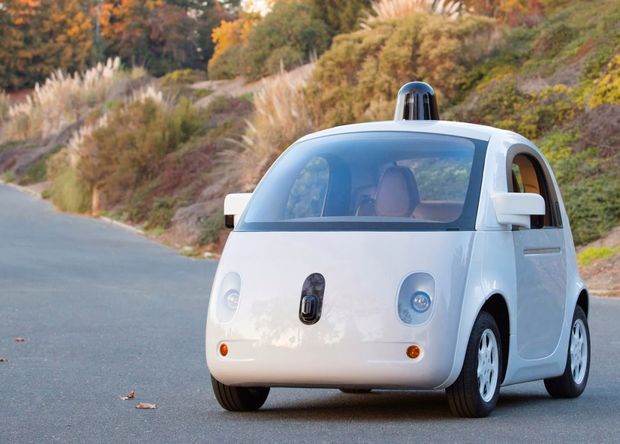
On the roads of California and Austin (Texas), several dozen experimental Google cars drive, but soon there will be more. Much bigger. Perhaps Google will even independently organize the mass production and sale of such cars.
When Google’s two-seater babies were just introduced last year, they announced a plan to produce a hundred pieces by the end of 2015. The expansion program is now mentioned Sarah Hunter (Sarah Hunter), director of the legal regulation of GoogleX, speaking before the Public Utilities Commission of California (California Public Utilities Commission).
Literally, Hunter said the following: “We make several hundred of these machines ... We make them so that our team truly mastered the production of unmanned vehicles from scratch.”
A month ago, it became known about the creation of a new company Google Auto LLC , which will manufacture cars without a steering wheel and pedals.
Previously, Google said it had no plans to produce and sell autonomous cars itself. Now this possibility is not excluded. Speaking to a large audience of politicians and regulatory officials, Sarah Hunter said: “The model in which we produce cars for sale will require the same type of electric car chargers that exist today. Our prototypes are now fully electric. This does not mean that if mass production begins, the car will not be equipped with a hybrid power plant. ”
All Google cars are currently manufactured on the outskirts of Detroit by third-party contractor Roush. In the case of the transition to mass production, it will be necessary to equip the production premises of a much larger size.
Sarah Hunter also revealed some details about how current prototypes work. They are equipped with three buttons: 1) Drive; 2) Slowly slow down and stop; 3) Stop quickly. The route of the trip is set with the help of voice commands into the microphone: “Take me to Safeway”, - the car paves the route itself.
Currently, cars need a very detailed digital map of the area where objects are plotted with centimeter accuracy: marking lines, traffic lights, etc. The maximum speed is artificially limited to 40 km / h. Cars are not yet ready to go on roads without a live driver for safety, and current legislation prohibits this.
Nevertheless, unmanned vehicles are improving very quickly, so that the start of mass production should be prepared now. Not surprisingly, Google is expanding the production of cars and developing the automotive business. Just today it became known that Google Auto hired John Krafcik, an industry veteran and former executive director of the American division of Hyundai (by the way, a very successful division) to manage the automotive project . John Krafchik is a training engineer, from 1990 to 2004 he worked at Ford, where he eventually became the chief engineer for the production of Expedition and Navigator SUVs.
Some experts believe that without unmanned vehicles, humanity will not be able to cope with the increase in the number of vehicles on the road: “If global growth continues at the same pace, then we will have 3.4 billion cars on the planet in 2050,” says Travis Kalanik (Travis Kalanick), CEO of Uber. - This is clearly unacceptable. This is partly why we think about stopping karmageddon. ” Uber, together with Google, plans to manage an unmanned taxi car service.