
 September 2, 2015 at 20:11
Ants are not inferior in effectiveness to pesticides
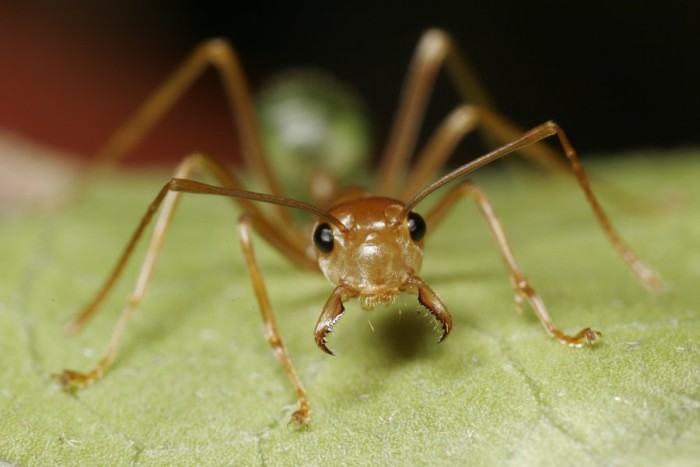
Scientists from Aarhus University (Denmark) have discovered a new way to protect crops from harmful insects. Surprisingly, they offered not some kind of genetic technology and not high tech, but rather a real low tech. It turned out that the most common ants cope with crop protection no worse than chemical pesticides .
Ants are truly unique creatures. One of their features is that they attack insects of any size , protecting their territory. In the photo above - the tailor ant (Oecophylla smaragdina) in the attack position. Some African ants can even scare an elephant and make it move away from the trees on which the colony lives.
On August 31, the Journal of Applied Ecology of the British Environmental Society published a review of more than 70 scientific studies that provide strong evidence that many crops, from coconut palms and citrus plants to oil palm and cedar trees, can be protected from harmful insects with the help of ant colonies. It is just as effective - and much cheaper - than using chemicals.
A review of the scientific work was prepared by Dr. Joachim Offenberg, a Danish ecologist who has been studying ants for almost twenty years. The review includes the results of studies of 50 species of pests in nine crops in eight countries in Africa, Southeast Asia and Australia.
In most studies, Asian tailor ants were planted to protect plants.(Oecophylla smaragdina, weaver ants). These green ants build nests on trees, connecting them from leaves. One colony can control the territory of up to 1500 m 2 , occupying more than ten trees. The total number of families ranges from 100,000 to 500,000 worker ants in 150 nests.
Asian tailor ants are aggressive predators; they actively defend their colonies and consume many species of invertebrates.
In various parts of Asia, pasta made from green tailor ants serves as a seasoning for curry vegetables or meat dishes. Eggs and larvae, as well as adults, are used in the preparation of Thai yum salad.
Putting ants to guard the garden is very simple. It is enough to transfer the nests to a tree that grows near crops. As soon as the colony has settled down and settled, the farmer needs to connect the trees along the perimeter with air bridges from ropes or vines. After this, the ants do not need any care, except for a little water in the dry season (just hang a few plastic bottles of water in the middle of the vines) and cut the trees between neighboring colonies so that they do not fight each other.
Ants carry out all work on the destruction of pests independently, without the help of a farmer.
Studies have shown that some crops, such as cashew nuts and mangoes, are exceptionally well protected from pests due to ants. The experiment in Australia lasted three years. As a result, cashew yield was 49% higher than on plantations that were treated with chemicals. The quality of nuts has also improved, as a result of which the yield of the plantation has grown by 71%. The mango harvest did not increase in weight, but the quality of the fruit also improved significantly and the cost of maintaining the farm and buying pesticides decreased. As a result, the farm with ants brought 73% more income.
Dr. Offenberg says that cases of superiority of ants over pesticides are rare, but very often studies show their approximately equal effectiveness. At the same time, ants are cheaper and more environmentally friendly.
It is unfortunate that ants of this species live only in tropical climates. One can only hope for geneticists who can adapt these little fighters to life on our apple and cherry trees.
In general, different species of ants live on all continents of the Earth, except Antarctica. Their total mass exceeds the mass of all people on Earth. This is one of the most successful in the evolutionary selection of animals in the history of the planet, so they definitely have to adapt to our trees.
A colony of ants is a single superorganism with a decentralized self-organizing structure ( swarm intelligence ). “Ants are great hunters,” says Dr. Offenberg, “and they work as a team.” When the ant finds prey, then with the help of pheromones it calls relatives from the nest. Together, they can fill up even a large insect. "