July 17, 2015 at 18:44
Personal experience: bike computers
Hi Geektimes! Today I want to share my experience with such a thing as a bike computer. Models are different, both cheap and expensive, but almost all of them, firstly, are equally designed and work on the same principle, and secondly, they have a similar set of functions.
So if you do not look in the direction of expensive models with GPS and all sorts of biometric sensors - that one model, that the other non-professional - there will be almost no difference.

It’s worth starting, as usual, with theory. There are two ways to measure distance and speed.
The first, the simplest from the point of view of implementation, requires us to know the radius or diameter of the wheel (and the number Pi), to calculate the number of revolutions per unit time.
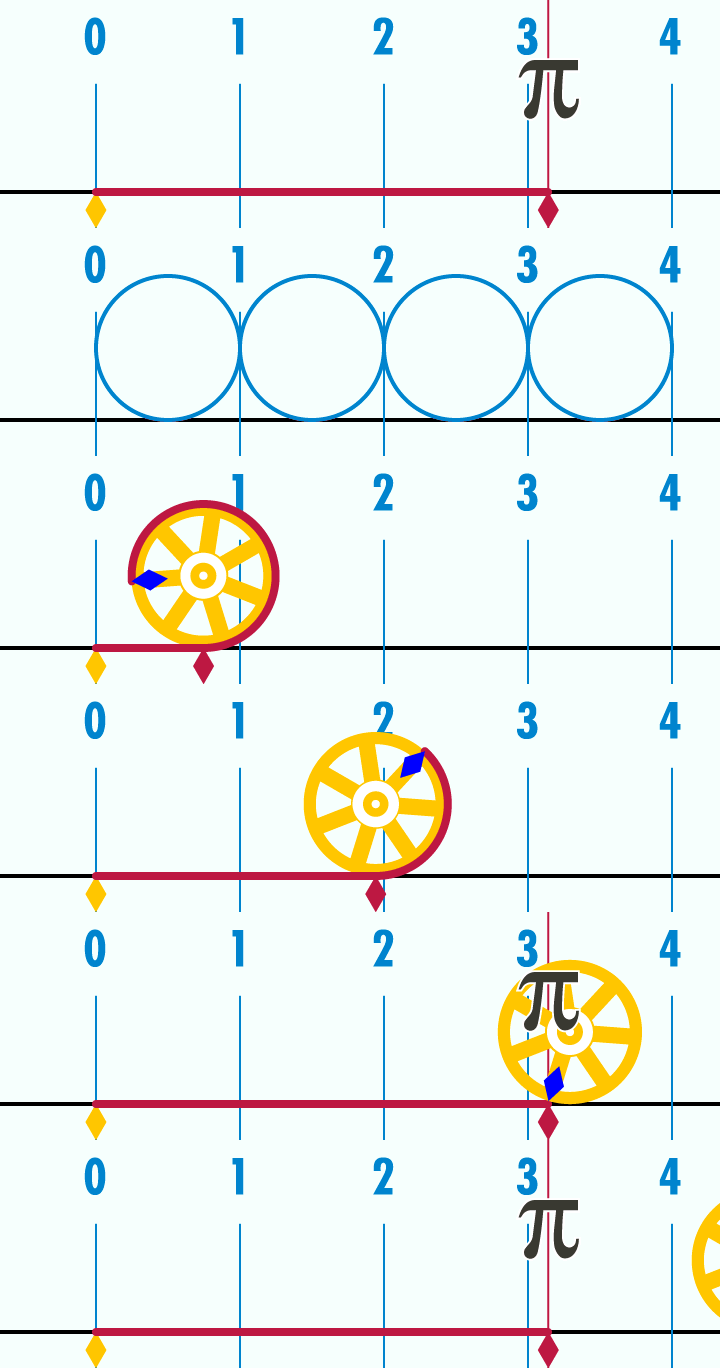
Then a little school arithmetic (calculate the circumference, multiply by the turns and divide by the time) and the results are in our pocket. Actually, this is how almost all modern speedometers work: what’s in the car, what’s on the bike.
The second way is to use GPS, by which everything also determines the distance traveled per unit of time. The method is more expensive, it has some limitations and disadvantages, but it does not depend on the technical condition of the vehicle and its mechanical parts. All measurement inaccuracies depend only on the receiver and the computer system. Now almost everyone has a smartphone (and some have two), so this method of measurement is also acceptable, especially since you carry everything you need in your pocket.
Cycling computers, of course, are made as cheap, reliable and unpretentious as possible (that is, the first), and consist of a magnet mounted on a wheel, a sensor that is mounted on a fork next to the magnet and triggers when the magnet approaches, and a remote module that conducts everything counting + displays the results.
I had two models on the test. The manufacturer, of course, is not the most popular, but this does not change the essence. Inside the boxes, the set is about the same: ties, mounts, the module itself, the battery, the reed switch on the plug, the magnet on the wheel.

In some models, there is an additional set of sensors for installation on connecting rods and a frame - such cycle computers can, in addition to speed and distance, determine cadence (cadence) and give recommendations for reducing / increasing the current gear.


Mounting on a bike is straightforward. We fasten the magnet on the needles with small ties, we attach the reed switch and the wire to the computer itself on the plug. We insert the battery into the computing module.

We lay the wiring so that it is not vulnerable to random branches, stones and other troubles (that is, on the back of the plug), we hook the display module somewhere on the steering wheel. Some people like to hang the bike computer to take out the steering wheel, but this placement did not suit me - the removal did not allow.
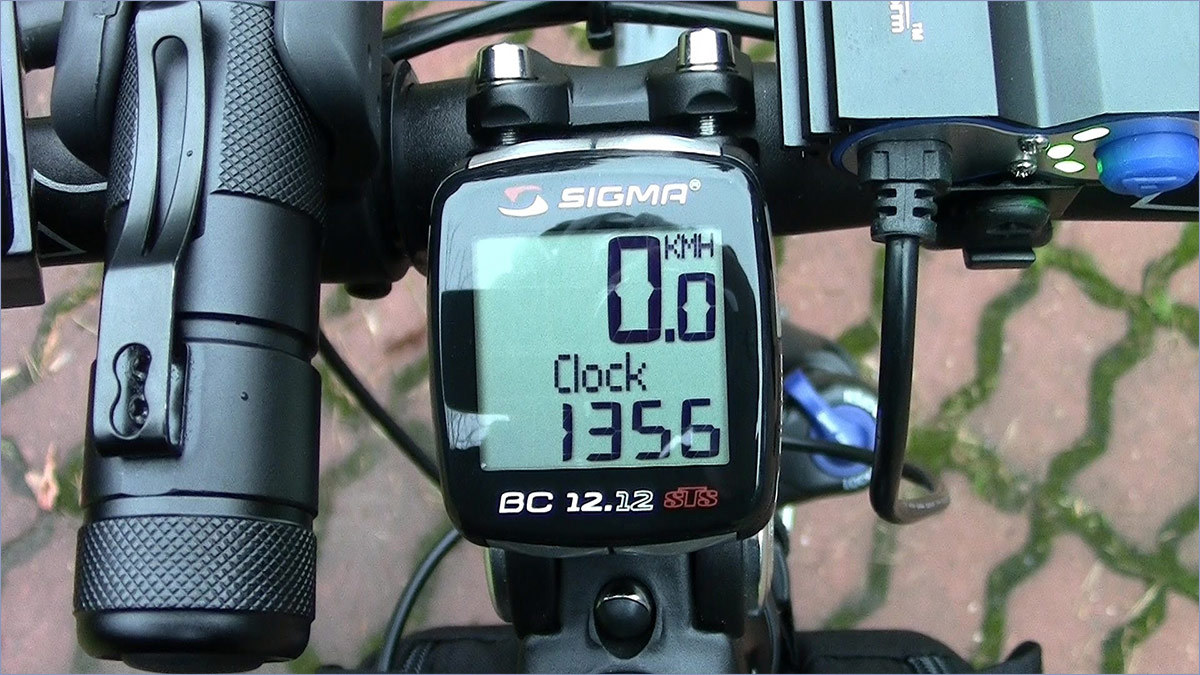
Next, we move on to the initial setup of all this splendor.

When you turn on the bike computer will ask you to enter the size of your wheel. Bicycle wheels (unless, of course, you have some wild self-build with non-standard wheels from a motorcycle) have long been standardized, and the circumference for them is calculated.
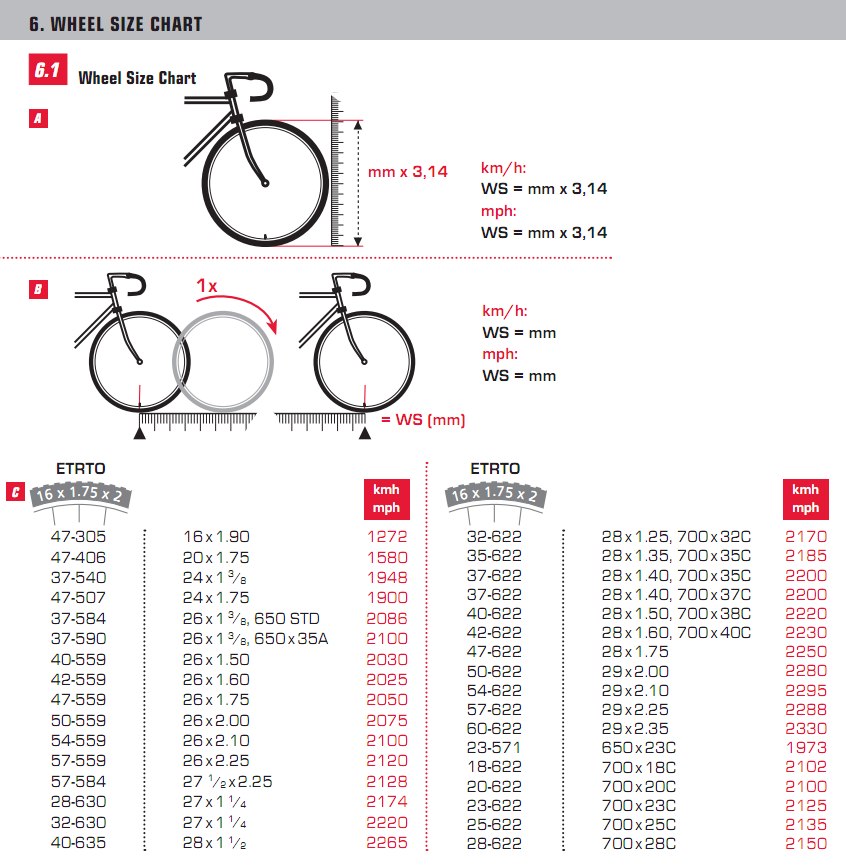
The hint can be located both in the instructions for the bike computer and on the box. We look at the side surface of the tire, we are looking for the cherished numbers. In my case (tires 26 ″ x 2.25 ″, the numbers 2115 should have been entered into the bike computer). Having set the same values on both computers and making sure that each one works only from its own magnet (both were set from different sides and at different heights) I rolled out for tests.
Before trusting the testimonies of these shaitan-boxes from China, it was necessary to check their testimonies at some distance that was known in advance. A corresponding track was found in the park, a control distance was measured along it (4 times 300 meters each), the readings of computers were reset to zero, the GPS tracker and speedometer on the phone were also brought into the corresponding modes.
The test run showed that, firstly, both computers have a bug (and one of them is larger than the other), and secondly, GPS + other methods for determining the speed and distance on the phone, if they made a mistake, then to the point of error due to the principles of GPS operation, and my imperfect trajectory.
To make adjustments to the work of the bike computer, I had to recalculate the “correct” wheel circumference for the received data: using a simple proportion S velo / S GPS = L desired / L entered . The calculated corrections were entered into computers, after which another test measurement was carried out. This time, all three indicators (GPS and two computers) coincided with an error of 2%, which I stopped at.
For two weeks I rode hard with one computer, then with another, and sometimes with two at once, checking whether the measurement error had left, and how accurately they measure relative to GPS.
The obvious advantages of the bike computer, in fact, are not really needed. Yes, you always know the distance traveled, the total mileage for the season and current speed. Is it needed in the park? When descending from a bridge or with an active enthusiasm for any cross-country? Perhaps, but not critical.
Of the unobvious advantages - the bike computer has been “warming up” interest in the trip for a long time: “ Yeah, how much did I wind up there? "And all sorts of" wow, 29 km / h, we must try to do 30+". In principle, a banal score'ing, so dearly beloved by many game-makers from Asia as a "scribbler" makes you ride more, faster, more technically.
Cons, by the way, is also there. Firstly, these devices simply flare violently in the sun, and at a “comfortable” angle for reading information, it also reflects the rays exactly in the eye. At least this is unpleasant, but at the maximum it is also dangerous from the point of view of short-term blindness. And from these glare neither matte films nor the “curve” installation angle can save. Sooner or later, a sneaky bunny of sun will overtake you. By the way, the same minus was noted by many familiar cycling enthusiasts. He decides to buy sports glasses that extinguish these very glare and reflections.
The second minus can hardly be called obvious, and, in fact, it is a continuation of the same "non-obvious" plus: in the pursuit of beautiful indicators, large numbers and other delights, some forget about safety and this leads to sad consequences.
The main question for me personally was whether you need a bike computer at all if you already have a navigator, speedometer and GPS tracker in your pocket. Perhaps it is easier to fix a smartphone on the steering wheel?
Actually, in terms of functionality and measurement accuracy, any smart device does simple cycling computers. The question is the reliable mounting and size of the device. If you have something compact, like iPhone 4s / 5, it will be convenient to use such a thing. Well, shovels like the Galaxy Note, Lumia 1520 and iPhone 6+ are more difficult to mount, and it's not so convenient to manage them. If a small smartphone weighing 120-140 grams can be hung on one of the sides of the steering wheel, and it will be almost invisible, then 170-210 gram shovels already noticeably change both the balance of the steering and simply get in the way, and the hanged ones take away (i.e. in the center of the steering wheel) become not very convenient to drive on the go.
In addition, with any fall or noticeable bump, there is a chance to lose the device, which costs 15-50 times more expensive than a bike computer. It’s good if you get off with a couple of scratches on the back panel or a broken screen, otherwise it can even scatter into parts so that you can’t assemble the parts.
The bike computer is a nice thing, but not without its drawbacks. Cool models with GPS and all sorts of heart rate sensors cost a lot and are needed, probably, by avid cycle enthusiasts who drive to work on a bike and cut through the park in winter. Inexpensive options will almost certainly require calibration (in addition, with tire wear, the readings will “float away” to the larger side).


With a neat ride in the city and the park, the smartphone has a million advantages, it’s not so big to find a normal steering wheel mount. For example, this . In the case of extreme sports ... Perhaps, a cycling computer will be preferable, both because of its mass and size, and because of considerations of potential damage if it falls. That's all for me, and you can always share your experience in using such devices in the comments. Have a nice weather this weekend!
How does it work
It’s worth starting, as usual, with theory. There are two ways to measure distance and speed.
The first, the simplest from the point of view of implementation, requires us to know the radius or diameter of the wheel (and the number Pi), to calculate the number of revolutions per unit time.
Then a little school arithmetic (calculate the circumference, multiply by the turns and divide by the time) and the results are in our pocket. Actually, this is how almost all modern speedometers work: what’s in the car, what’s on the bike.
The second way is to use GPS, by which everything also determines the distance traveled per unit of time. The method is more expensive, it has some limitations and disadvantages, but it does not depend on the technical condition of the vehicle and its mechanical parts. All measurement inaccuracies depend only on the receiver and the computer system. Now almost everyone has a smartphone (and some have two), so this method of measurement is also acceptable, especially since you carry everything you need in your pocket.
Cycling computers, of course, are made as cheap, reliable and unpretentious as possible (that is, the first), and consist of a magnet mounted on a wheel, a sensor that is mounted on a fork next to the magnet and triggers when the magnet approaches, and a remote module that conducts everything counting + displays the results.
Practice
I had two models on the test. The manufacturer, of course, is not the most popular, but this does not change the essence. Inside the boxes, the set is about the same: ties, mounts, the module itself, the battery, the reed switch on the plug, the magnet on the wheel.
In some models, there is an additional set of sensors for installation on connecting rods and a frame - such cycle computers can, in addition to speed and distance, determine cadence (cadence) and give recommendations for reducing / increasing the current gear.
Mounting on a bike is straightforward. We fasten the magnet on the needles with small ties, we attach the reed switch and the wire to the computer itself on the plug. We insert the battery into the computing module.
We lay the wiring so that it is not vulnerable to random branches, stones and other troubles (that is, on the back of the plug), we hook the display module somewhere on the steering wheel. Some people like to hang the bike computer to take out the steering wheel, but this placement did not suit me - the removal did not allow.
Next, we move on to the initial setup of all this splendor.
Customization
When you turn on the bike computer will ask you to enter the size of your wheel. Bicycle wheels (unless, of course, you have some wild self-build with non-standard wheels from a motorcycle) have long been standardized, and the circumference for them is calculated.
The hint can be located both in the instructions for the bike computer and on the box. We look at the side surface of the tire, we are looking for the cherished numbers. In my case (tires 26 ″ x 2.25 ″, the numbers 2115 should have been entered into the bike computer). Having set the same values on both computers and making sure that each one works only from its own magnet (both were set from different sides and at different heights) I rolled out for tests.
Bicycle Computer vs. GPS
Before trusting the testimonies of these shaitan-boxes from China, it was necessary to check their testimonies at some distance that was known in advance. A corresponding track was found in the park, a control distance was measured along it (4 times 300 meters each), the readings of computers were reset to zero, the GPS tracker and speedometer on the phone were also brought into the corresponding modes.
The test run showed that, firstly, both computers have a bug (and one of them is larger than the other), and secondly, GPS + other methods for determining the speed and distance on the phone, if they made a mistake, then to the point of error due to the principles of GPS operation, and my imperfect trajectory.
To make adjustments to the work of the bike computer, I had to recalculate the “correct” wheel circumference for the received data: using a simple proportion S velo / S GPS = L desired / L entered . The calculated corrections were entered into computers, after which another test measurement was carried out. This time, all three indicators (GPS and two computers) coincided with an error of 2%, which I stopped at.
Everyday use
For two weeks I rode hard with one computer, then with another, and sometimes with two at once, checking whether the measurement error had left, and how accurately they measure relative to GPS.
The obvious advantages of the bike computer, in fact, are not really needed. Yes, you always know the distance traveled, the total mileage for the season and current speed. Is it needed in the park? When descending from a bridge or with an active enthusiasm for any cross-country? Perhaps, but not critical.
Of the unobvious advantages - the bike computer has been “warming up” interest in the trip for a long time: “ Yeah, how much did I wind up there? "And all sorts of" wow, 29 km / h, we must try to do 30+". In principle, a banal score'ing, so dearly beloved by many game-makers from Asia as a "scribbler" makes you ride more, faster, more technically.
Cons, by the way, is also there. Firstly, these devices simply flare violently in the sun, and at a “comfortable” angle for reading information, it also reflects the rays exactly in the eye. At least this is unpleasant, but at the maximum it is also dangerous from the point of view of short-term blindness. And from these glare neither matte films nor the “curve” installation angle can save. Sooner or later, a sneaky bunny of sun will overtake you. By the way, the same minus was noted by many familiar cycling enthusiasts. He decides to buy sports glasses that extinguish these very glare and reflections.
The second minus can hardly be called obvious, and, in fact, it is a continuation of the same "non-obvious" plus: in the pursuit of beautiful indicators, large numbers and other delights, some forget about safety and this leads to sad consequences.
Bicycle Computer vs. smartphone on the steering wheel
The main question for me personally was whether you need a bike computer at all if you already have a navigator, speedometer and GPS tracker in your pocket. Perhaps it is easier to fix a smartphone on the steering wheel?
Actually, in terms of functionality and measurement accuracy, any smart device does simple cycling computers. The question is the reliable mounting and size of the device. If you have something compact, like iPhone 4s / 5, it will be convenient to use such a thing. Well, shovels like the Galaxy Note, Lumia 1520 and iPhone 6+ are more difficult to mount, and it's not so convenient to manage them. If a small smartphone weighing 120-140 grams can be hung on one of the sides of the steering wheel, and it will be almost invisible, then 170-210 gram shovels already noticeably change both the balance of the steering and simply get in the way, and the hanged ones take away (i.e. in the center of the steering wheel) become not very convenient to drive on the go.
In addition, with any fall or noticeable bump, there is a chance to lose the device, which costs 15-50 times more expensive than a bike computer. It’s good if you get off with a couple of scratches on the back panel or a broken screen, otherwise it can even scatter into parts so that you can’t assemble the parts.
To summarize
The bike computer is a nice thing, but not without its drawbacks. Cool models with GPS and all sorts of heart rate sensors cost a lot and are needed, probably, by avid cycle enthusiasts who drive to work on a bike and cut through the park in winter. Inexpensive options will almost certainly require calibration (in addition, with tire wear, the readings will “float away” to the larger side).
| Bike computer | Smartphone | |
| Price | Inexpensive (from 500 to 2,000 rubles for normal models); | Most likely already available; |
| Easy installation | Everything you need is in the kit, calibration may be required; | Search and purchase of a suitable mount is required; |
| Autonomy | 1 CR2032 ~ battery for a year of operation; | Directly depends on the smartphone model and usage scenario; |
| Weatherproof | Almost complete, limited by the weatherproofness of the bike and the user; | Afraid of the cold and heavy rains; |
| Shock resistance | It’s difficult to damage, because the mass is low, and the mount is reliable / without quick removal of the gadget; | It is easy to drop in the fall, non-zero chances of "catching a stone" due to the size of the device; |
| GPS track | Only in expensive models, you need to connect to a PC or smartphone to download information; | There is on any platform and on the cheapest devices, automatic publication is possible; |
| Work in the dark | Backlighting is not available in all models; | No problem. |
With a neat ride in the city and the park, the smartphone has a million advantages, it’s not so big to find a normal steering wheel mount. For example, this . In the case of extreme sports ... Perhaps, a cycling computer will be preferable, both because of its mass and size, and because of considerations of potential damage if it falls. That's all for me, and you can always share your experience in using such devices in the comments. Have a nice weather this weekend!