January 15, 2015 at 09:53
Fully functional muscles are grown in the laboratory.
Duke University scientists have grown human skeletal muscle in the laboratory: they respond to external stimuli, such as electrical impulses, biochemical signals, and pharmaceuticals, just like the original.
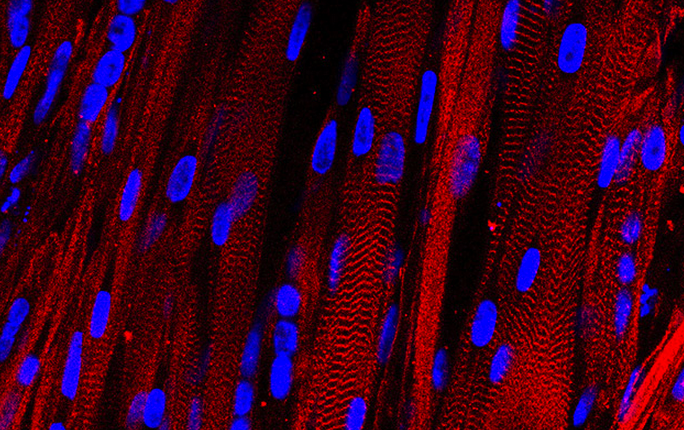
For muscle growth, myoblasts, the precursors of muscle fibers taken by biopsy from an adult, were used. From myoblasts during the development of the embryo and during the regeneration of skeletal muscles in the postnatal period, striated muscle fibers are formed. Scientists placed the cells in very small “scaffolds” and waited for them to turn into muscle fibers. As one of the scientists noted, it was a difficult year of searching for the density of gel cells and optimizing the matrix.
Then the scientists checked whether the fabric works like an “original”. It was found that the muscle responds to an electrical impulse, which was not previously seen in laboratory-grown samples. There was also an answer to the drugs. Since such muscle tissue has a very close resemblance to the present, it can be used to test medications. This, and not prosthetics, is the goal of this development.
In addition, this is a step towards personalized medicine, because you can take a biopsy from a particular patient, grow muscles and test a new drug on this tissue without much risk.
Syncytium is a multinuclear muscle fiber.

Bioengineers from Duke University have long been working on muscle cultivation in the laboratory. Last year they introduced muscle with the ability to repair itself and implanted it into the body of the mouse.
For muscle growth, myoblasts, the precursors of muscle fibers taken by biopsy from an adult, were used. From myoblasts during the development of the embryo and during the regeneration of skeletal muscles in the postnatal period, striated muscle fibers are formed. Scientists placed the cells in very small “scaffolds” and waited for them to turn into muscle fibers. As one of the scientists noted, it was a difficult year of searching for the density of gel cells and optimizing the matrix.
Then the scientists checked whether the fabric works like an “original”. It was found that the muscle responds to an electrical impulse, which was not previously seen in laboratory-grown samples. There was also an answer to the drugs. Since such muscle tissue has a very close resemblance to the present, it can be used to test medications. This, and not prosthetics, is the goal of this development.
In addition, this is a step towards personalized medicine, because you can take a biopsy from a particular patient, grow muscles and test a new drug on this tissue without much risk.
Syncytium is a multinuclear muscle fiber.
Bioengineers from Duke University have long been working on muscle cultivation in the laboratory. Last year they introduced muscle with the ability to repair itself and implanted it into the body of the mouse.