Oumuamua: fragment of a tide-destroyed comet
The discovery of the first interstellar object at the end of 2017 immediately posed theoretical problems for science. An open celestial body did not look a bit like the theory predicted.
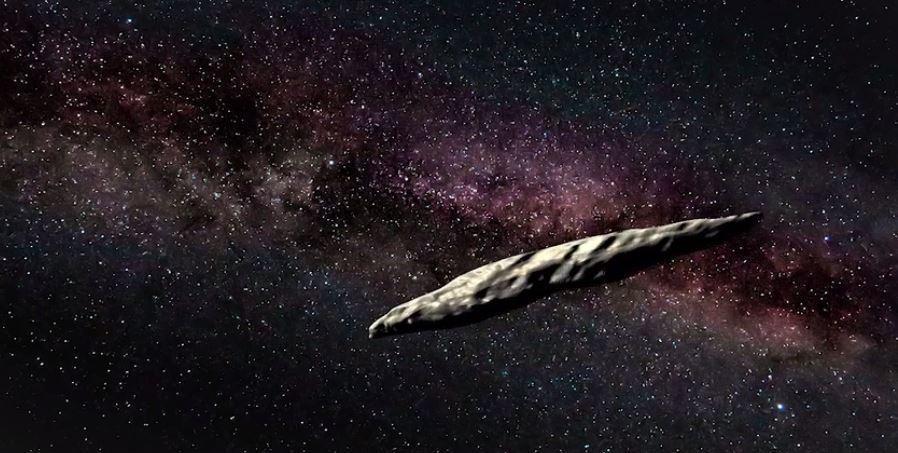
Firstly, it was supposed that it should be a comet in 99 - 99.9% of cases. Secondly, such an elongated shape is still not so common among bodies of a similar size in the Solar System. The elongated shape can, if desired, be attributed to the effect of observational selection. A spherical body of the same mass would have a smaller surface area, and therefore less brightness, than an elongated body at maximum (when turned sideways). For Oumuamua, the difference between the “average” brightness and the maximum reaches 1 value, that is, 2.5 times.
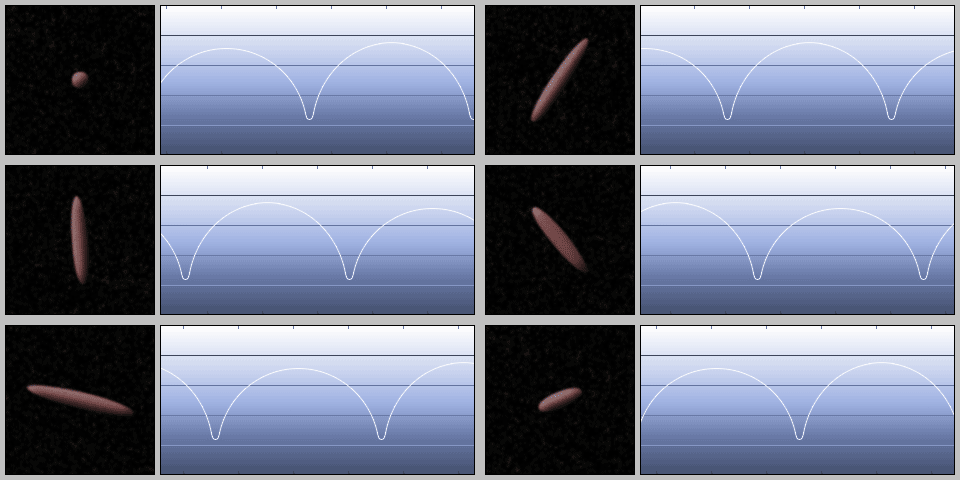
Considering that the object was detected at the sensitivity limit of the instruments, this is quite enough for such objects, but more rounded, to be simply lost.
However, the lack of cometary activity is not so simple. The mechanism of formation of the Oort Cloud, which contains mainly comets and interstellar small bodies, should be approximately the same - the ejection from the forming planetary systems under the influence of gravitational perturbations from growing and migrating protoplanets. There can simply be no other such effective way. Moreover, the objects of the Oort Cloud, which we observe as comets after billions of years, “get stuck” in the vicinity of the starat a great distance (about a light year). Small interstellar bodies must consist of objects that were lost by some Oort Cloud or were unable to “gain a foothold” in it and were finally thrown out not only beyond the boundaries of their “native” planetary system, but also beyond the limits of the “native” cluster of forming stars. From this it seems that the objects from the Oort Cloud should look exactly like interstellar objects. The “storage” conditions of the Oort Cloud objects (radiation, etc.) do not differ from those for small bodies freely plowing the expanses of the Galaxy.
In haste, some scientists have proposed a whole range of explanations for varying degrees of British nature . Examples:
- Oumuamua-type ancestors - red giants stars
- Oumuamua-type ancestors - white dwarf stars
- Promotion and stretching under the influence of the interstellar "wind"
- Oumuamua - an asteroid originating from a binary star system
- etc. etc...
Without going into details, we can responsibly assert that all the options proposed before this do not stand up to criticism. In short, on points:
- Exotic types of stars (whether red giants, white dwarfs, or even black holes) cannot produce typical small bodies of the interstellar medium due to their low prevalence.
- Neither galactic cosmic rays, nor the interstellar medium can in any way be an explanation, since the conditions in our Oort Cloud are exactly the same as those characteristic of a purely interstellar medium, since the distance of the objects of the Oort Cloud from the Sun is very large (of the order of a light year).
- It will also not be possible to assume an “asteroid” origin for most interstellar small bodies, since the bulk of small bodies and planets form behind the so-called “snow line” around stars. This is fully confirmed by the existing statistics on observed exoplanets and protoplanetary disks.
However, on March 9, another article appeared in the public domain, which I would like to dwell on in more detail: Interstellar object 'Oumuamua as an extinct fragment of an ejected cometary planetesimal . The authors propose the first, so far more or less consistent explanation of the properties of Oumuamua, which follow quite directly from the laws of celestial mechanics, and are not far-fetched.
Imagine a protoplanetary disk filled with small bodies and emerging giant planets. In order for a small body to travel on its own star cluster or galaxy, it must experience rapprochement with a giant planet to exchange momentum and change speed. The closer the approach to the giant planet occurs, the stronger the disturbance (impulse exchange) will be and the higher the average speed of a small body when it is “ejected” from the disk. But there is also the Roche limit . Having come very close to the giant planet, small bodies experience tidal destruction, which should look something like this:
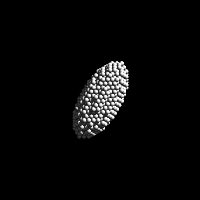 | 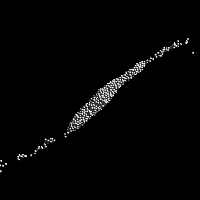 |
Tidal fracture proper may be responsible for the elongated shape of the fragments and is one of the probable causes of the elongated shape. Therefore, the authors suggest that Oumuamua is a fragment of a former comet, destroyed when approaching a giant planet. But this is not the only reason. According to the simulation, up to 1% of small bodies ejected from planetary systems into interstellar space should be fragments as a result of tidal destruction. Each destroyed comet generates many fragments, the number of which can exceed the number of comets ejected as a whole. The difference with objects from the Oort Cloud may be that it is populated predominantly by “whole” objects ejected at lower speeds (more “gently”, without tidal destruction).
To explain the absence of sublimation of Oumuamua, the authors suggest a subsequent approximation of the comet fragments with the star. However, in my opinion, this is not required. Obviously, the vast majority of small bodies are ejected in the first millions of years when the planetary system is formed and migrations occur. At this time, the giant planets are still hot, look like brown / red dwarfs, the surface temperature is usually about 2000 K. This should lead to the disappearance of volatile substances in small bodies that go too close. At the same time, in full accordance with celestial mechanics, bodies approaching closer to giant planets will acquire higher speeds at infinity.
An infographic has already appeared in the media illustrating the new hypothesis about the origin of Oumuamua: