February 17, 2017 at 15:37
Nokia 150: the ideological successor to the Nokia 3310
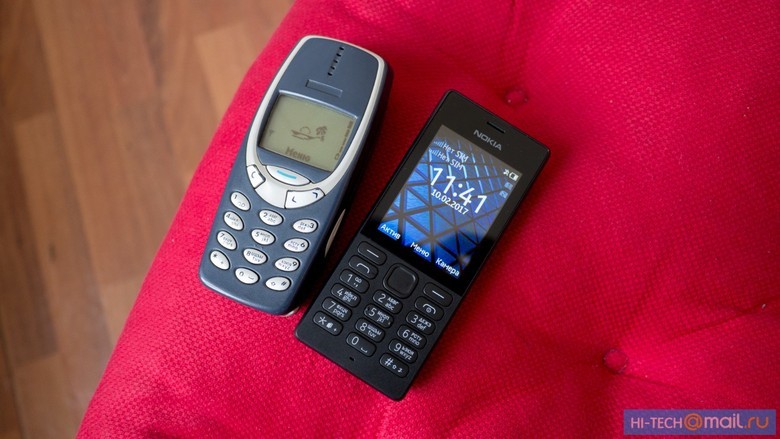
In 2000, Nokia released a simple and even at that time cheap Nokia 3310 phone, which went down in history as one of the most “unkillable” cell phones and almost the most successful product of the company. And 16 years later, Nokia took a strange step: it released a push-button phone, which is designed to become the ideological successor of the old 3310 legend. Did it work out?
For those who were too young to remember the gadgets of 2000: before the first iPhone, which formed our current idea of the smartphone, another 7 years remained.
It was a time when phones became more compact, got rid of protruding antennas, new functions appeared. Oh yes, but do you remember how it was possible to buy replaceable cases for phones on each corner? For a small amount, you could completely (!) Update the appearance of your shabby device, including a protective screen cover and keyboard. At the same time, the range of colors and patterns of interchangeable panels could satisfy any, even the most perverted needs. And what can you say about the current “progress”, when we are forced to shake over our gadgets, carefully wrapping them in all kinds of covers, hopelessly distorting their proportions and our tactile sensations. And an entire industry has grown to protect fragile glasses, recently we even learned about liquid glass to protect smartphones. I don’t know about you, but I really miss those times when you could buy a new panel in a stall for a small amount, and your phone again looked like brand new, and the color could be changed to suit your mood. And all this without distortion in the form of bumpers, silicone covers and films on the screen.
Nokia 3310 is fully consistent with market trends: it was a phone without a protruding antenna, with a smoothed outline of the case, a monochrome display, and a much more original design compared to modern faceless smartphones-tiles, which billions stamp all over one face. It was also quickly discovered by experience that the new product is very durable and manages to survive in the most difficult situations, for which it quickly gained popular love and became one of the iconic Nokia models. In fact, Nokia 3310 has become an analogue of the Kalashnikov assault rifle in the phone market: reliability, unpretentiousness, relative cheapness and huge production volumes.
One and a half hundred
And now, 16 years later,
The design of the 150th is designed in the spirit of the times: an angular brick in black or white. The novelty is almost twice as light - 81 grams against 133. The width and length are comparable to 3310, but the thickness is much less. The assembly is much better than its predecessor. Also has a 150th color display.


Unfortunately, the test sample could not be verified by the method of crash tests, so I can not say anything about physical reliability. However, for a week of barbaric (by the standards of modern smartphones) carrying in a backpack and pockets with keys and other abrasive items, after careless throwing on the tables scuffs and scratches did not appear.
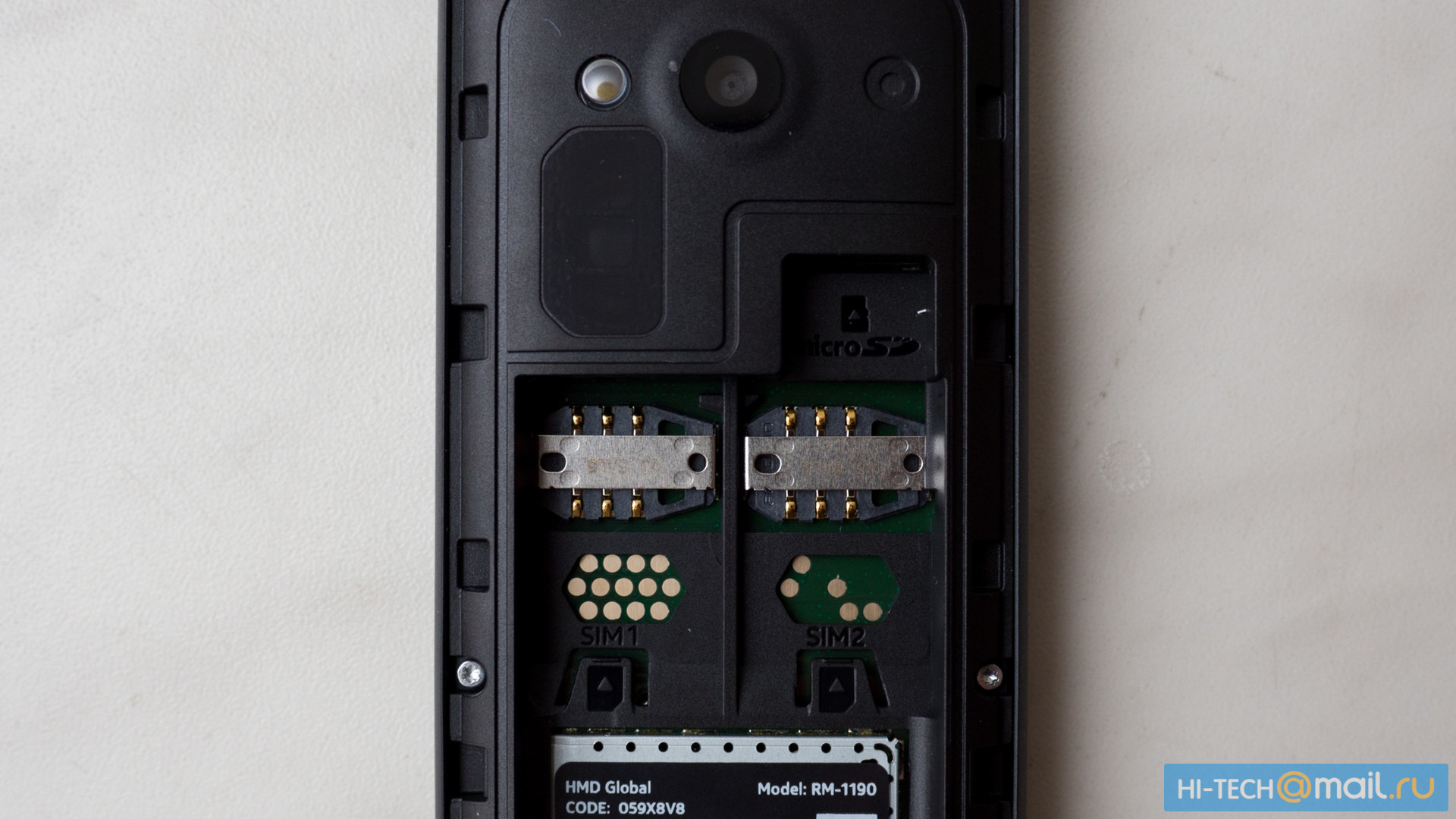
Fortunately, the days of proprietary charging slots are long gone: the Nokia 150 is equipped with standard micro USB. You can insert two SIM cards into the new mobile phone, but you will have to remove the battery for this. At the same time, the "sims" are full-sized, from which many have somehow even lost the habit.
The Nokia 150 also acquired other features that were not in the 3310: a flashlight, a headphone jack, Bluetooth, and a camera. True, the camera would not have been better - the 0.3 megapixel matrix by today's standards is a cynical mockery. The quality of the shots is as if the lens was made from a piece of a box for a CD in an underground Chinese factory.
Today, mobile phones are greeted on the display and escorted through it. The Nokia 150 has a roof-mounted 2.4-inch TFT display with a resolution of 240x320 pixels. Undoubtedly, a significant step forward in comparison with monochrome 84x48 pixels in 3310.
Substantial progress has been made in software. What do we have fun on the road? Naturally, games on the phone. There were four of them in Nokia 3310 (these Google Play and AppStore haven’t come up with yet). And one of the games is no less legendary than the phone itself - the "snake". Fortunately, the developers made her facelift, dacface and transferred it to the Nokia 150 called Snake Xenzia. The other three games have sunk into history, but they have screwed up paid (!) Auto racing.
Another excursion into the past: in 2000, in parallel with Nokia 3310, the world's first cell phone with the ability to install a memory card appeared - Siemens SL45. It supported 32 MB MMC cards. And in Nokia 3310 there was only 1 KB of internal memory (one kilobyte). Just got into 4 games, an alarm clock and a calculator. At the same time, all contacts were recorded on a SIM card. The Nokia 150 with memory is also not a lot, but you can insert an SD card up to 32 GB. Civilization has finally come!

Nokia 3310 came with two batteries - NiMH and Li-ion. Nickel-metal hydride lived a couple of years, and then they had to be changed due to degradation of the tank. The lithium-ion batteries had a capacity of 900 mAh, and that was enough to charge the phone about once every 4-5 days.

In Nokia 150, the battery has grown quite a bit, up to 1020 mAh, but the manufacturer says that this is enough for 22 hours of talk (instead of 4 for 3310).

As mentioned above, the 3310 was a harsh phone for serious people - a minimum of applications, nothing more. In Nokia 150, the developers have given free rein: here you have applications Photo, Video, Music, Calendar, and even FM-radio. But in terms of ringtone volume, the novelty turned out to be much weaker than its predecessor. However, this is partly offset by a stronger vibration alert in the Nokia 150.

Surprisingly, the Nokia 150 costs less than the Nokia 3310. The last one in 2000 cost about 4,000 rubles. ($ 130-140). And the 150th today is sold for about 2500 rubles. But, of course, it is impossible to compare directly, because over so many years the purchasing power of both the ruble and the dollar has changed a lot. 16 years ago, the official average salary in Russia was 2300 rubles, in 2016 - 36 000 rubles. So on the 3310th it was necessary to save several months, as today they are saving up for a new iPhone, and the 150th will make a much smaller hole in the budget.
Someone will be surprised, but today push-button telephones are still in demand: they are cheap, unpretentious, much more resistant to shocks and falls, and the ability to lie down for almost a month without recharging is generally irreplaceable for those who are long out of the benefits of civilization. At the same time, the successor to the 3310th boasts a color display, a memory card, two SIM cards and a set of entertainment applications. What else is needed for a budget phone?