August 12, 2017 at 11:23
New RNA nanodevices can sense and analyze many complex signals in living cells
- Transfer
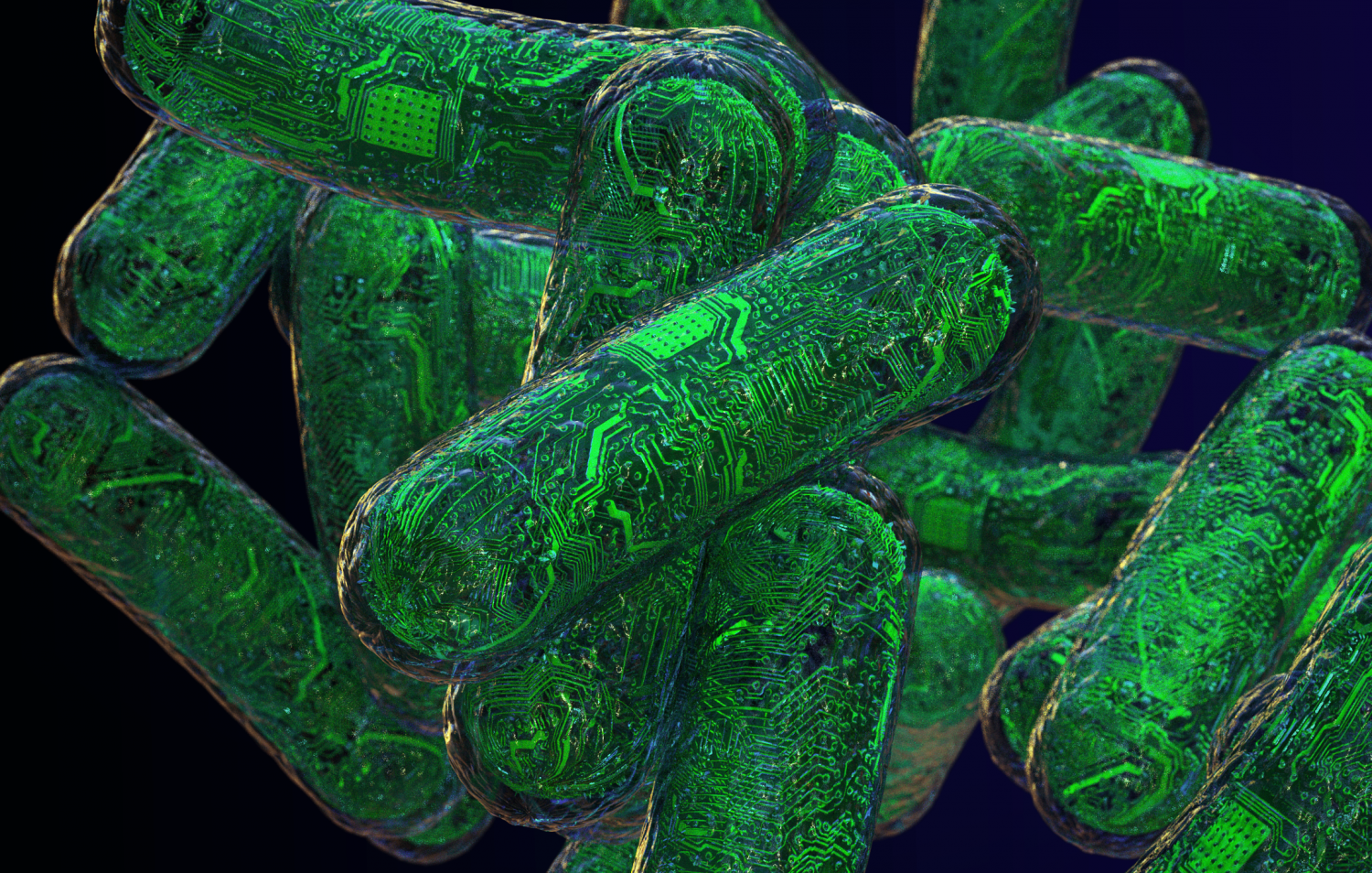
Ribonucleic acid (RNA) is used to create logic circuits that can perform various calculations. In new experiments, Green and colleagues incorporated RNA logic gates into living bacterial cells acting like tiny computers. Image: Jason Drees for the Biodesign Institute The
union of biology and technology, known as synthetic biology, is developing rapidly, opening up new perspectives that could hardly have been imagined recently.
In a new study, Alex Greene, a professor at the ASU Institute of Biodesign, demonstrates how living cells can be used for computing, like tiny robots or computers.
The results of the new study are very important for intelligent design and targeted drug delivery, green energy production, low-cost diagnostic technologies, and even the development of futuristic nanomachines capable of hunting cancer cells or disabling aberrant genes.
“We use easily predictable and programmable RNA-RNA interactions to tune the circuitry,” Green says. "This means that we can use computer software to develop RNA sequences that behave the way we want, which makes the design process much faster."
The study appeared in the online edition of the journal Nature .
Designed RNA
The described approach uses schemes consisting of ribonucleic acid or RNA. These circuits, similar to conventional electronic circuits, organize themselves in bacterial cells, which allows them to perceive incoming messages and respond to them, creating a certain conclusion (in this case, protein).
In a new study, specialized circuits, known as logic gates, were developed in the laboratory and then incorporated into living cells. Tiny switches are triggered when messages (in the form of RNA fragments) are attached to their complementary sequences in the circuit, activating a logic gate and creating the desired output.
RNA switches can be combined in various ways to create more complex logic elements that can evaluate and respond to multiple inputs, just as a regular computer can take several variables and perform sequential operations, such as addition and subtraction, to obtain the final result.
A new study significantly increased the ease of performing cell calculations. The RNA approach to the production of cellular nanodevices is a significant step forward, as previously they required the use of complex intermediaries, such as proteins. Now the necessary components of the ribocomputer can be easily developed on a conventional computer. The mating of the four letters of RNA (A, C, G, and U) provides predictable self-assembly and the functioning of these parts in a living cell.
Green's work in this area began at the Weiss Institute at Harvard, where he helped develop the central component used in cellular circuits, known as the toehold RNA switch. The work was done while Green was a postdoc working with nanotechnology expert Peng Yin, along with synthetic biologists James Collins and Pamela Silver, co-authors of a new article. “The first experiments were in 2012,” Green says. “Basically, toehold switches worked so well that we wanted to find a way to make the best use of them for cell applications.”
The video demonstrates the basic principles of the RNA toehold switch. Video source: Arizona State University
Upon arriving at ASU, Duo Ma, Green's first graduate student, worked on experiments at the Biodesign Institute, and another postdoc, Jongmin Kim continued with similar work at the Weiss Institute. Both of them are co-authors of a new study.
Biological Pentium
The possibility of using DNA and RNA, the molecules of life, to perform computer calculations was first demonstrated in 1994 by Leonard Edleman of the University of Southern California. Since then, progress has made significant advances, and more recently, such molecular calculations have been performed in living cells. (Bacterial cells are commonly used for this purpose because they are simpler and easier to manipulate).
The technique described in the new article exploits the fact that RNA, unlike DNA, is single-stranded when it is produced in cells. This allows researchers to create RNA schemes that can be activated when a complementary RNA strand binds to an open RNA sequence in the design scheme. The binding of complementary strands is regular and predictable, with adenine always mating with uracil, and cytosine with guanine.
With all the elements of a circuit created using RNA that can take an astronomical number of possible sequences, the real power of the newly described method lies in its ability to perform many operations simultaneously. Parallel processing provides faster and more complex calculations while efficiently utilizing limited cell resources.
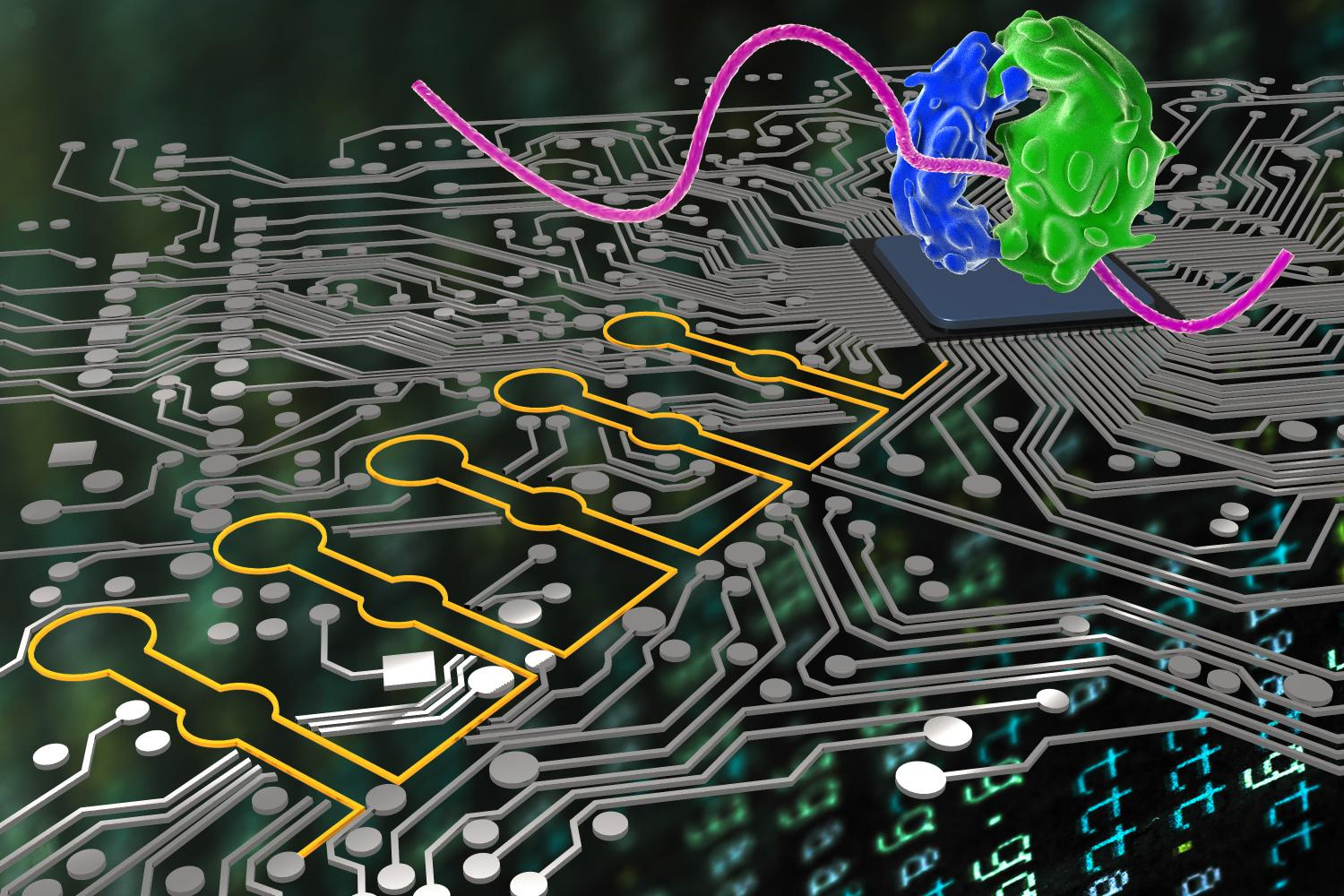
Just as computer scientists use the logical language to make their programs perform precise AND, OR, and NOT operations, the “ribocomputers” (colored in yellow) developed by the team at the Weiss Institute can now be used by synthetic biologists to receive and interpret multiple signals in the cells and instruct their ribosomes (stained with blue and green) in order to produce various proteins. Authors: Weiss Institute at Harvard University
Logical results
A new study developed logic gates known as AND, OR, and NOT. AND only triggers output in the cell when two RNA messages A and B are present. The OR gate responds to either A or B, while NOT blocks output if an RNA molecule is present. Combining these gates leads to complex logic that can respond to multiple inputs.
Using toehold RNA switches, the researchers released the first devices for the ribocomputer, with four AND inputs, six OR inputs, and 12 inputs capable of performing the complex combination of AND, OR, and NOT, known as the normal disjunctive form. When the logic gate meets the correct RNA sequences leading to activation, the toehold switch opens and the protein translation process takes place. All these detection and output functions can be integrated into one molecule, which makes the systems compact and easy to implement in the cell.
The study represents the next phase of ongoing work on the use of universal RNA toehold switches. In earlier works, Green and colleagues demonstrated that an inexpensive array of toehold RNA switches can act as a high-precision platform for diagnosing the Zika virus. Detection of viral RNA in the array activated the toehold switches, causing the production of a protein that was recorded as a color change in the array.
The basic principle of using RNA-based devices to control protein production can be applied to almost any RNA input, marking a new generation of accurate, inexpensive diagnostics for a wide range of diseases. The cell-free approach is particularly suitable for new threats and during outbreaks of disease in the developing world, where medical resources and personnel may be limited.
Computer inside
According to Green, the next phase of research will focus on the use of RNA toehold technology to create neural networks in living cells. Neural networks are able to analyze the range of exciting and inhibitory signals, averaging their values and producing an output signal if a certain threshold of activity has been crossed, just like in ordinary neurons. Ultimately, the researchers hope to motivate cells to communicate with each other through programmable molecular signals, creating a truly interactive, brain-like network.
“Since we use RNA, the universal life molecule, we know that these interactions can also work in other cells, so our method provides a common strategy that can be transferred to other organisms,” says Green, referring to a future in which human cells become fully programmable objects with advanced biological capabilities.