March 31, 2016 at 18:51
8 facts about Brazilian IT and the Internet market from local
Before going to Brazil with our product, we only knew that this country is the birthplace of the Lua language, with which we make our own " fashionable " logs.
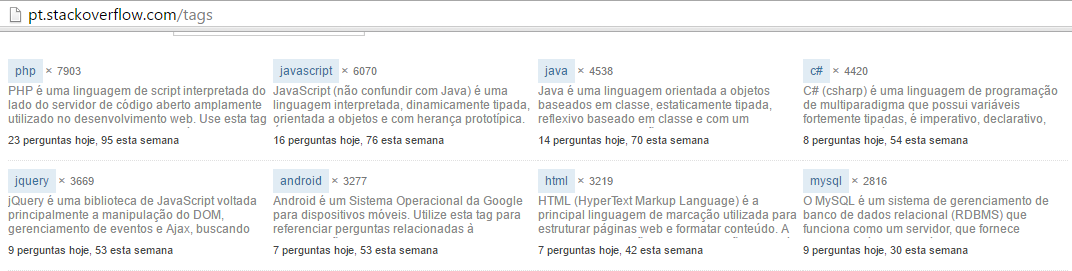
The distribution of topics on the Portuguese-language, mainly Brazilian, version of Stack Overflow (initially there was even br. Instead of pt. In the url).
And then Carlos appeared on our team - a former chemist who found great Russian love on the net, moved to Moscow and went from enikeyschik to Site Designer Localization Manager. Having come to us, he destroyed a couple of myths about Brazil and told a lot of interesting things about how his acquaintances live in Brazilian IT companies - after all, he once studied at one of the main technical universities in his country.
One of the popular comics is called “The Life of a Programmer,” and is similar in style to it as if Dilbert was a developer.
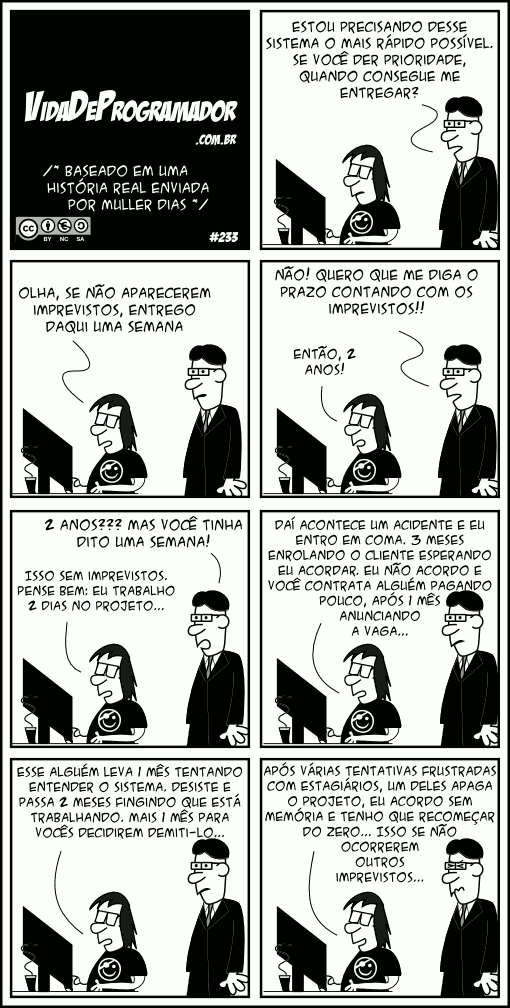
Part of the comics invented. And the part is based on situations in which the author himself got into (since 2002 he wrote in Pascal and C, then switched to PHP and Python), his colleagues or readers of the site.
Here is one of the real stories that happened:
For five years, “Programmer's Life” has grown into a site popular in local IT circles (here, for example, advertise vacancies and new products) and a large - over 180 thousand subscribers - Facebook community.
Now they even release their coffee and T-shirts:

At the same time, the project itself started as a response to the emergence of the Brazilian web comic book “Life of technical support”.
“About 15 years ago, in Brazil, a boom in internetization began. Then we had our own search engine - like your Yandex or Rambler. It was called Cade - from the word “where.” They started in the mid-nineties and by the beginning of the 2000s were very, very popular, but ... They almost stopped developing the engine and simply invested in advertising.
At the same time, Google and Yahoo made their localizations - and their results were objectively better. The need for a local search engine has disappeared - Cade was bought by Yahoo and turned into a storefront for their search. "
According to Nielsen, that deal allowed Yahoo to reach 52% of Brazilian Internet users. And as Carlos notes, people often do not make a difference - a local product or a foreign one.
What happened before Google+? Right, Orkut. In the mid-2000s, this social network was popular in two places - Brazil and India. True, the demand in individual countries did not affect the closure of the Google project.
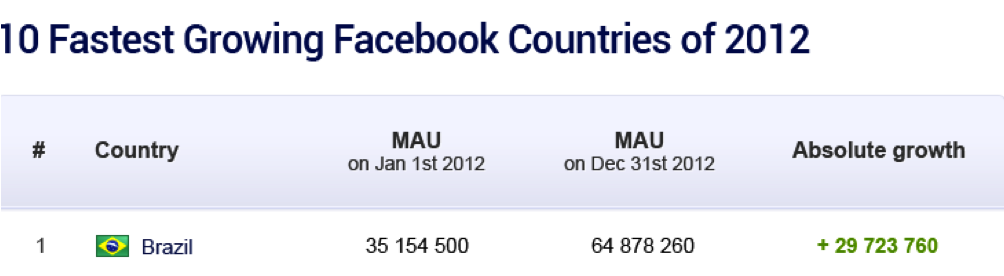
Today, the main social network for Brazilians is Facebook (according to Social Bakers, screen for 2012)
“Sometimes I envy the Russians: you have your own social networks created by local specialists for a local audience. In Brazil, in fact, apart from crib chats, when the Internet was still for geeks, there was nothing of their own social. "
By the mid-2000s, local companies had surrendered some of the delicious consumer segments to foreign players. The niche of online auctions, for example, was captured by the Mercado Libre, an Argentinean project that quickly made Portuguese localization in 1999 and then swallowed up major competitors, which, incidentally, were also foreign.
It is curious that at that time people from offline were better at competing with foreign Internet companies:

For example, Netshoes, an online platform for the sale of sports goods, which now operates in three markets (Brazil, Argentina, Mexico), grew out of a sports equipment store open in sao paulo in the early 2000s. This is their distribution center.
Traditionally, since the 90s, there have been areas where local companies dominated - these are solutions for banks, industry, agriculture, and the public sector. Our Carlos explains the situation with security concerns and, sometimes, with the word “corruption”. But there is another explanation - protectionism.
The demand for IT in industry is explained by local iron: the country has developed the production of electronics, for example, for airplanes and oil rigs. Moreover, there is a strict requirement, what percentage of all production should be located domestically: depending on the industry, it can reach up to 80%.
Government agencies have long been trying to support local software developers through government procurement. Since 2014, there is even a law in force, according to which preferences in tenders are given to local developers. For example, they can offer a price higher than that of a competitor and win. So, although in Brazil all IT companies register local legal entities - this is due to the acceptance of payments - sometimes you can be more local.
NB: At the same time, even local companies must pay additional contributions to the treasury if they purchase foreign software or use the services of data centers outside Brazil. With taxes here is generally interesting.
By the beginning of the 2010s, about 9 thousand companies worked in the Brazilian market of software, IT services and telecom. Among them were 43.9% of micro-enterprises - often companies of one or a couple of people. Moreover, not only startups, which at that time began to support the state.
“At one time, micro-companies were often started by those who in fact did not work for themselves, but for another small IT company. This was done so that the employer did not conclude contracts with the person, but with his company - thus the employer shifted the tax burden from his head to yours. I heard that in the CIS countries one can also encounter such a practice, but in our country, according to our feelings, it has acquired the scale of an industrial disaster. Therefore, to work in the state, and not to freelance, it was already a career achievement. ”
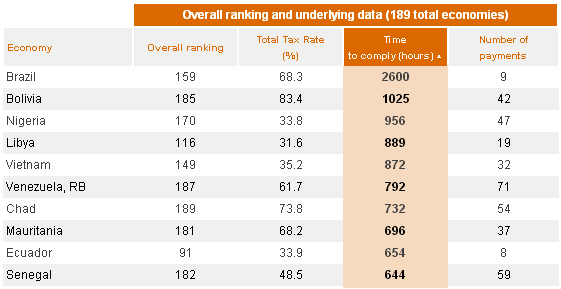
According to a study by PwC and the World Bank, Brazil has the most “time-consuming” tax regime.
Of course, this is not practiced by the largest and most well-known companies. But the truth is that a few years ago, any IT company had to pay 37% of taxes on employee salaries.
Now the situation is changing: for example, tax deductions are being reduced if the employer invests in the training of full-time employees — moreover, the costs of developing people can be offset by the state IT support program.
And how much do they get? Brazilians do not have their “My Circle”, but there is something like a “HeadHunter”:
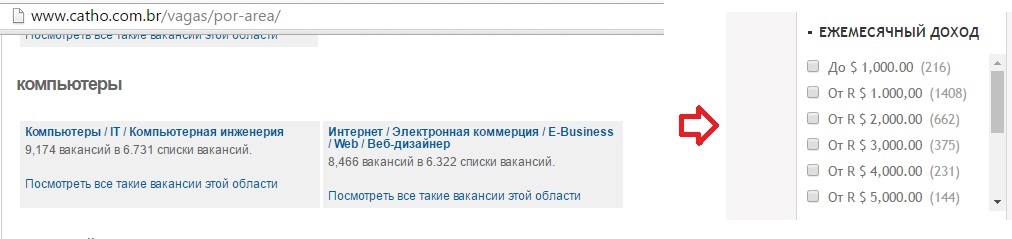
For the convenience and compactness of the display, we translated Google’s vacancy sorting unit.
Often there are offers from 1 to 3 thousand reais - this is the initial level when you are hired, for example, after graduation. The head of technical support, a good specialist in information security or an experienced developer can count on 8-10 thousand reais.
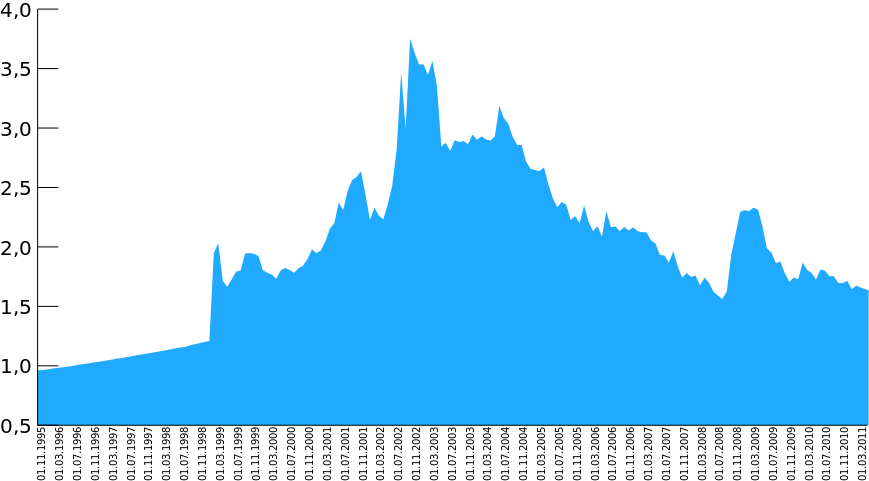
Translated into dollars, the salary range is $ 300-3000 (now for the dollar they give about 3.6 reais). At the same time, as history shows, the real exchange rate against the dollar can significantly change. Here is the dynamics from 1995 (the real in Brazil was introduced in 1994) to 2011:
The ruble exchange rate to the Brazilian real also changed a lot over time. Now it’s about 19 rubles for real:

Accordingly, salaries in the local IT sector in terms of rubles vary from 20 to 200+ thousand.
Even their holidays are longer - 30 days.
“Officially, we have only five holiday weekends in our country. But, like you have in Russia, there are more New Year holidays - they begin before Catholic Christmas and end after the New Year. Plus, of course, the carnival is such an analogue of your May holidays, when work stops and everyone goes on vacation. ”
Brazil also has an interesting tradition about the holidays: if the day off, for example, is on Tuesday, then Monday will be closed. Seems like everything looks familiar? But - no one will arrange a working Saturday about the transfer, as we have in Russia.

It is worth dispelling the popular stereotype that "Brazilians are lazy." In many ways, the roots of the myth grow from the abolition of slavery: many locals refused to work on plantations, and emigrants from Europe occupied a niche. They usually called the Brazilians "lazy."
And to be honest, the same Argentines are ahead of Brazil in the number of holiday weekends - they have 19 of them.
Now in the ICT sector of Brazil employs about a million people. And according to estimates by industry associations and officials, another 900 thousand specialists are needed.
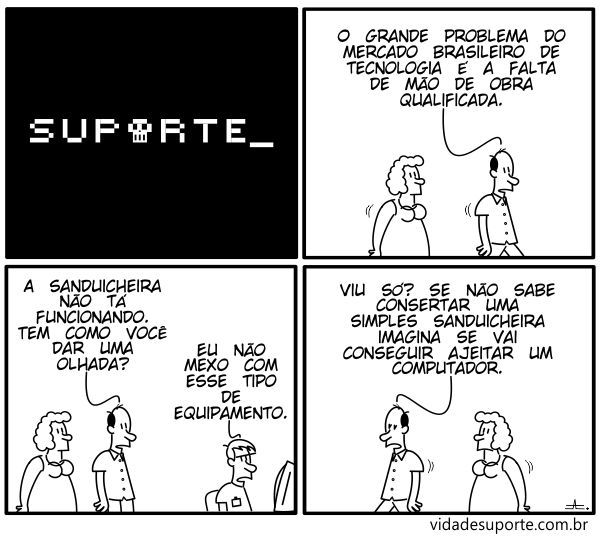
And when there are not enough hands and heads, Brazilians hire neighbors - although they speak different languages, they write, in general, one.
Of course, their cadres are also being raised. Carlos says that although Brazil has many universities with an IT background, only 4 of them are considered good. These are Unicamp, UNESP, the University of São Paulo and ITA (something like a Brazilian MAI) - all of them are located in the same city or nearby. Therefore, in Sao Paulo, the most open IT vacancies.
In order to improve the quality of education, in recent years a program for students of technical specialties has also been working in the country - you can study at a foreign university for two years at the expense of the state, but with the condition that after graduation you will work for several years at home.
Brazil is almost half of the continent’s IT market. And in terms of money, the Brazilian IT market is four times the size of the Russian one. But they still know how to export their software a little worse than us.
The distribution of topics on the Portuguese-language, mainly Brazilian, version of Stack Overflow (initially there was even br. Instead of pt. In the url).
And then Carlos appeared on our team - a former chemist who found great Russian love on the net, moved to Moscow and went from enikeyschik to Site Designer Localization Manager. Having come to us, he destroyed a couple of myths about Brazil and told a lot of interesting things about how his acquaintances live in Brazilian IT companies - after all, he once studied at one of the main technical universities in his country.
Fact 1. Brazilian IT people have original comics.
One of the popular comics is called “The Life of a Programmer,” and is similar in style to it as if Dilbert was a developer.
Manager: This system is needed as soon as possible. If you put off everything else, when will you finish it?
Developer: If nothing unexpected happens, in a week.
Manager: And if you call the term without this “unforeseen”?
Developer: Then two years.
Manager: How two years? We just talked about a week!
Developer:But this was without force majeure. Just imagine: I start work on a project, but then an accident happens - and I find myself in a coma. 3 months you expect me to wake up. But a miracle does not occur. Then you decide to hire someone and close the vacancy for a month. Another month leaves the beginner to deal with the system. The next two months, he pretends to be working. Another month you decide whether to fire him or not ... And now, after several unsuccessful attempts to replace me, someone erases the project. Then I get out of the coma and have to start all over from scratch ...
Part of the comics invented. And the part is based on situations in which the author himself got into (since 2002 he wrote in Pascal and C, then switched to PHP and Python), his colleagues or readers of the site.
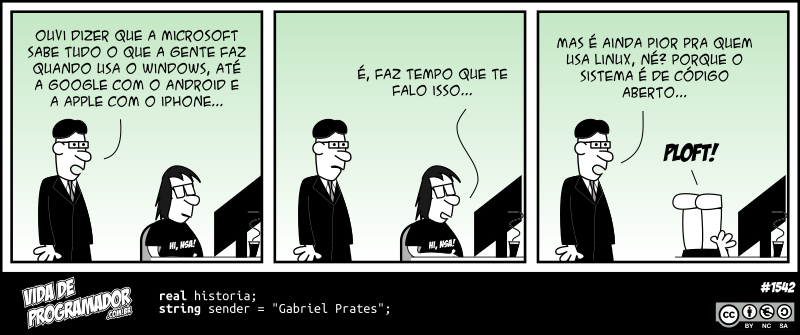
Here is one of the real stories that happened:
Manager: I read that Microsoft knows everything we do on Windows, Google on what we do on Android, and Apple on iOS.
Developer: Yes, I’ve been talking to you about this for a long time.
Manager: But Linux users then generally have the worst, right? There OPEN SOURCE ...
For five years, “Programmer's Life” has grown into a site popular in local IT circles (here, for example, advertise vacancies and new products) and a large - over 180 thousand subscribers - Facebook community.
Now they even release their coffee and T-shirts:
At the same time, the project itself started as a response to the emergence of the Brazilian web comic book “Life of technical support”.
Fact 2. Otherwise, Brazilians do not have many of their services.
“About 15 years ago, in Brazil, a boom in internetization began. Then we had our own search engine - like your Yandex or Rambler. It was called Cade - from the word “where.” They started in the mid-nineties and by the beginning of the 2000s were very, very popular, but ... They almost stopped developing the engine and simply invested in advertising.
At the same time, Google and Yahoo made their localizations - and their results were objectively better. The need for a local search engine has disappeared - Cade was bought by Yahoo and turned into a storefront for their search. "
According to Nielsen, that deal allowed Yahoo to reach 52% of Brazilian Internet users. And as Carlos notes, people often do not make a difference - a local product or a foreign one.
Fact 3. In Brazil, Google was able to build a popular social network
What happened before Google+? Right, Orkut. In the mid-2000s, this social network was popular in two places - Brazil and India. True, the demand in individual countries did not affect the closure of the Google project.
Today, the main social network for Brazilians is Facebook (according to Social Bakers, screen for 2012)
“Sometimes I envy the Russians: you have your own social networks created by local specialists for a local audience. In Brazil, in fact, apart from crib chats, when the Internet was still for geeks, there was nothing of their own social. "
By the mid-2000s, local companies had surrendered some of the delicious consumer segments to foreign players. The niche of online auctions, for example, was captured by the Mercado Libre, an Argentinean project that quickly made Portuguese localization in 1999 and then swallowed up major competitors, which, incidentally, were also foreign.
It is curious that at that time people from offline were better at competing with foreign Internet companies:
For example, Netshoes, an online platform for the sale of sports goods, which now operates in three markets (Brazil, Argentina, Mexico), grew out of a sports equipment store open in sao paulo in the early 2000s. This is their distribution center.
Fact 4. Pure Brazilian companies found their niches
Traditionally, since the 90s, there have been areas where local companies dominated - these are solutions for banks, industry, agriculture, and the public sector. Our Carlos explains the situation with security concerns and, sometimes, with the word “corruption”. But there is another explanation - protectionism.
The demand for IT in industry is explained by local iron: the country has developed the production of electronics, for example, for airplanes and oil rigs. Moreover, there is a strict requirement, what percentage of all production should be located domestically: depending on the industry, it can reach up to 80%.
Government agencies have long been trying to support local software developers through government procurement. Since 2014, there is even a law in force, according to which preferences in tenders are given to local developers. For example, they can offer a price higher than that of a competitor and win. So, although in Brazil all IT companies register local legal entities - this is due to the acceptance of payments - sometimes you can be more local.
NB: At the same time, even local companies must pay additional contributions to the treasury if they purchase foreign software or use the services of data centers outside Brazil. With taxes here is generally interesting.
Fact 5. Brazil has many “one-person IT companies”
By the beginning of the 2010s, about 9 thousand companies worked in the Brazilian market of software, IT services and telecom. Among them were 43.9% of micro-enterprises - often companies of one or a couple of people. Moreover, not only startups, which at that time began to support the state.
“At one time, micro-companies were often started by those who in fact did not work for themselves, but for another small IT company. This was done so that the employer did not conclude contracts with the person, but with his company - thus the employer shifted the tax burden from his head to yours. I heard that in the CIS countries one can also encounter such a practice, but in our country, according to our feelings, it has acquired the scale of an industrial disaster. Therefore, to work in the state, and not to freelance, it was already a career achievement. ”
According to a study by PwC and the World Bank, Brazil has the most “time-consuming” tax regime.
Of course, this is not practiced by the largest and most well-known companies. But the truth is that a few years ago, any IT company had to pay 37% of taxes on employee salaries.
Now the situation is changing: for example, tax deductions are being reduced if the employer invests in the training of full-time employees — moreover, the costs of developing people can be offset by the state IT support program.
And how much do they get? Brazilians do not have their “My Circle”, but there is something like a “HeadHunter”:
For the convenience and compactness of the display, we translated Google’s vacancy sorting unit.
Often there are offers from 1 to 3 thousand reais - this is the initial level when you are hired, for example, after graduation. The head of technical support, a good specialist in information security or an experienced developer can count on 8-10 thousand reais.
Translated into dollars, the salary range is $ 300-3000 (now for the dollar they give about 3.6 reais). At the same time, as history shows, the real exchange rate against the dollar can significantly change. Here is the dynamics from 1995 (the real in Brazil was introduced in 1994) to 2011:
The ruble exchange rate to the Brazilian real also changed a lot over time. Now it’s about 19 rubles for real:
Accordingly, salaries in the local IT sector in terms of rubles vary from 20 to 200+ thousand.
Fact 6. Brazilian IT people can relax longer
Even their holidays are longer - 30 days.
“Officially, we have only five holiday weekends in our country. But, like you have in Russia, there are more New Year holidays - they begin before Catholic Christmas and end after the New Year. Plus, of course, the carnival is such an analogue of your May holidays, when work stops and everyone goes on vacation. ”
Brazil also has an interesting tradition about the holidays: if the day off, for example, is on Tuesday, then Monday will be closed. Seems like everything looks familiar? But - no one will arrange a working Saturday about the transfer, as we have in Russia.
It is worth dispelling the popular stereotype that "Brazilians are lazy." In many ways, the roots of the myth grow from the abolition of slavery: many locals refused to work on plantations, and emigrants from Europe occupied a niche. They usually called the Brazilians "lazy."
And to be honest, the same Argentines are ahead of Brazil in the number of holiday weekends - they have 19 of them.
Fact 7. Brazilians hire Argentine programmers
Now in the ICT sector of Brazil employs about a million people. And according to estimates by industry associations and officials, another 900 thousand specialists are needed.
Bald man: The main problem with the IT market in Brazil is the lack of qualified professionals. Hey man, our waffle maker doesn't work, can't you see?
Technical Support Officer: I do not work with such equipment.
Bald Man: See? He doesn’t even know how to fix a waffle iron, how can he understand computers ??
And when there are not enough hands and heads, Brazilians hire neighbors - although they speak different languages, they write, in general, one.
Of course, their cadres are also being raised. Carlos says that although Brazil has many universities with an IT background, only 4 of them are considered good. These are Unicamp, UNESP, the University of São Paulo and ITA (something like a Brazilian MAI) - all of them are located in the same city or nearby. Therefore, in Sao Paulo, the most open IT vacancies.
In order to improve the quality of education, in recent years a program for students of technical specialties has also been working in the country - you can study at a foreign university for two years at the expense of the state, but with the condition that after graduation you will work for several years at home.
Fact 8. Brazil is still the main IT market in South America.
Brazil is almost half of the continent’s IT market. And in terms of money, the Brazilian IT market is four times the size of the Russian one. But they still know how to export their software a little worse than us.