November 3, 2017 at 07:30
What post-mortem is silent about: the unknown story of the creation of Gothic 3
We all have our weaknesses, which we can occasionally indulge in - the so-called “ guilty pleasures ”. For example, I like to turn over old game magazines from time to time; among other things, they come across interesting interviews and developer diaries, leisurely closing the white spots of my ignorance (which, as it should be, has no borders). With post-mortem, the conversation is separate - they tell of the eternal, and therefore absolutely do not lose their charm.
 Take at least the Portal post-mortem , published in the January 2008 issue of Game Developer magazine . Thanks to him, many readers first learned about the favorite method of creating games within the walls of Valve ( yes, there was a time when Valve was still making games): constant iterations of prototypes of game mechanics and regular play tests with new players. Today, this idea seems obvious to all of us - in fairness, it was known then, but not so widespread - despite the fact that it had already managed to contribute to the emergence of games of the highest gameplay quality - one Half-Life 2 is worth it.
Some more facts from Portal post-mortem
It turns out that Portal itself was ultimately cut down by about half: due to the fact that unprepared players were given difficult levels, developers regularly removed puzzles and replaced them with new ones. As the regulars of Hammer editor suggest, when prototyping levels, Valve uses orange primitives rather than gray ones like everyone else - hence they call this process not “grayboxing”, but “orange boxing” (hence the “orange box”? .. )
Another post-mortem , and only one small (and incredible) detail: the design concepts of the main bosses in Diablo III during the development were remade 50-60 times. Now, every time I remind myself of this fact, when they begin to give up!
Of course, many famous post-mortem games do not exist. Today, a story is being brought to your attention that no one in his right mind will tell about in a post-mortem.
Historical reference

Born in the West several decades ago, the post-mortem format in the context of game projects always carried two meanings. Firstly, in post-mortem, developers shared with the rest of the world their successful and not-so-good finds made during work on projects; secondly, such a retrospective was in fact one of the ways of PR freshly released games.
Having appeared once on the pages of Game Developer magazine, such retrospectives over time became a favorite reading matter for the audience and subsequently repeatedly appeared on its cover. When this publication left us untimely, the Gamasutra banner caught up to it fell in its place., which began as an online division of the same Game Developer, retyping post-mortem from the magazine. (By the way, those who wish can find and download the magazine’s archive for free at the link )
 Today, on Gamasutra, developers still publish dozens of post-mortem a month, but, with rare exceptions, it is usually not so interesting to read them (the reasons will be discussed below). But the GDC is getting more and more active, where dozens of reports were held as part of the A Classic Game Postmortem series , including Sid Meyer's talk about Civilization , Tim Kane's about Fallout and David Breivik's about Diablo .
 If you are interested in the history of id software games, then poor DOOM andQuake also managed to wash all the bones up and down. Do you really want to know more about them? Well, refer to David Kushner’s book “Masters of DOOM”, Wolfenstein 3D black book or, in the end, to the source ( John Carmack’s .plan files and a free collection of interviews in English are at your service ).
Before proceeding directly to our history, let’s finally take a quick look at what post-mortemas are so good (and, to be honest, often useless).
Deconstruction Attempt
Over the years, an unwritten standard has been formed among developers for washing bones "to any offspring," just about to get off the assembly line. The standard post-mortem format is extremely simple: what goals the developers set for themselves, what they were able to achieve, listing three to five positive aspects of the project, listing 3-5 areas that should be improved.
Do not forget that game development is an incredibly difficult task to create software with no clear, objective goals (the game should be “fun”, exciting! ) Within the most severe deadlines. I spotted this definition with Jeff Atwood), and it refers to the period of the 90s and 00s, when games were mainly written in C ++. (I don’t know how fair it is to use it within the framework of the projects of our contemporaries, but most of the famous post-mortem systems belong to this period.)
Therefore, in addition to useful ideas, post-mortem traditionally contain a list of small technical "rakes" that developers encountered when the introduction of new technologies in the shortest possible time; from them you can learn about non-working iterations of game design for years of familiar games and, if you are really lucky, get really excited about what you have read / seen.
Not surprisingly, years later, Gamasutra conducted an analysis of 155 post-mortem systems over the course of several years in order to find out what developers usually write about them. I will not retell the results of their research here, you can read about them here ; for us, another thing is important - the approximate content of an arbitrary post-mortem.
So, the typical post-mortem that you've read dozens of times in your life looks something like this:
| What was good | What was bad |
|---|---|
| Many ongoing development iterations | Iterations could be more |
| Experienced team | Creepy, impossible deadlines and planning |
| An early focus on creating tools | Too large a project, inability to control |
| The right choice of the project scale and confident control | Bad, uncomfortable and slow "tools" |
| Partnership with the company we like | Lack of experience among team members |
| Using feedback from players from the start | Problems Hiring the Right Employees |
| Lack of marketing (indie post-mortem) |
For decades, the unspoken principle of developers has been the same: “about new releases - either good or no way” - to take dirty rubbish from the yard or write about real serious problems that arose on the project was simply not accepted. Given that because of the NDA, developers themselves sometimes do not always know the names of the projects they are working on ( hi, EA! ) - what kind of stories can there be for the general public. From this, we can conclude that the most interesting post-mortem in the world must be devoted either to games that have become real disasters, or projects that are commonly called “living classics”. They are an ideal generator of the most interesting stories in the world.
So, here you are, dear reader, finally the terrible truth has opened: the most interesting thing about post-mortem is usually not. But sometimes , by the will of fate, we still manage to find out one day about what really happened.
Gothic Piranha
Most recently, the release of the new game by Piranha Bytes - ELEX. Despite the fact that in the current Piranha there was practically no employee-veteran, and in fact only the name remained from it, all the familiar advantages of the company's games were in place - many already call the game the best studio game from the time of Gothic 1 and Gothic 2. Surprisingly, branded shortcomings were also reproduced with extreme accuracy - in the game there are problems with control, combat system and animation, because of which the press predicted the game a complete failure only six months ago . Why so - it will become clear by the end of my story.
About the creative path of the studio Piranha Bytes and her famous series GothicYou can write a separate book. Just trying to figure out who and when was hiding under that name would take several pages. Of course, no one will do this - due to the fact that the founding fathers of the “same” Pirahna are still zealously guarding everything related to their offspring. God forbid, a rare alpha version of Gothic 1.5 or screenshots of it will appear on your hard drive, and you will publicly admit it on the forum - gentlemen, copyright holders will throw you “formidable" letters - and all this despite the fact that almost 20 years have passed since the cancellation of the project, which was supposed to be Gothic 2 .
However, if such a book ever came to light, one chapter in it would certainly be worth devoting exclusively to the list of bugs of the third Gothic. Such a parade of bugs, as inGothic 3 on release, hitherto not seen anywhere else: the main character for no reason could grow a second head; the enemies tried to approach him exclusively one at a time in a live queue; NPCs didn’t just walk through the air - they became bald, while their wigs “flew” after them or dangled under their feet; when trying to fight the enemy, the protagonist could easily get stuck in it, and wild boars ...
Gothic 3 wild boars forever remained in the heart of everyone who launched the game on release: worse than monsters from Silent Hill, more dangerous than bosses in Bloodborne who could kill a hero in one light touch - they still dream of some in nightmares; some players even wrote a boar FAQ from Gothic 3. As I managed to find out, most likely the boars became what they are, due to an error in the game design and the balance of the game:
“In the case of the boar, the reason lies in the miscalculation of the balance sheet. The error was not in the numbers of damage, but in the complexity of the game. Unlike Skyrim, locations do not scale in terms of difficulty and have no minimum level restrictions. Boars should never be an adversary who is easy to defeat - because the hero grows very fast at the beginning of the game and it is no longer difficult to fight them. Therefore, the boars, which the player meets already in the starting location, it was decided to do high damage and great HP . Alas, at the same time, someone clearly not very smartly thought up to add speed to them (you cannot run away from the boar to a safe distance) and a charged attack(the problem is not so much in high damage as in critical strike). As a result, we get the famous boars one-shot. ”
It will not be an exaggeration to say that the game became the most zagrebnoy release of 2006 - I do not even want to remember about all its other bugs. Against this background, the current problems of the animation of Mass Effect Andromeda seem like a trifle, on which no one would draw attention.
Loyal fans and the rest of the players were in real shock and could not understand what happened to the company that once made great games.
Judging by the fact that Pirahna Bytes itself over the past ten years has shared with the players only a minimum of details about the most dramatic page of its history, we have zero chances for a full and believable retrospective. Well, dear reader, we will deal on our own, this is not the first time for us.
Passion on the engine
Insiders claim that the publisher’s actions were the cause of the game, and more specifically, improper management.
Many players compared Gothic 3 with The Elder Scrolls: Oblivion in 2006 . In fact, this comparison was foreign to the authors themselves; they contrasted their game with the previous Bethesda masterpiece - Morrowind . I think you yourself understand that in reality the resources of German developers accounted for only a small fraction of what Bethesda disposed of; but in morrowindeverything was done manually, including the design of the dungeons, from which the company subsequently gradually moved towards modular design and procedural generation, due to which Bethesda significantly reduced the time and resources needed to create new locations - and therefore, it should have been no worse in Gothic. Otherwise, according to the publisher, no one would be interested in the game. And what kind of hype lives without high-profile PR promises? ..
By signing a contract for the development and publication of the game, the developers received money for the development of the game, after which they had no choice but to fulfill all the promises of the publisher. Need a huge open world? Receive and sign - as many as 75 square kilometers await you! However, it turned out to be not so simple to realize all the ideas of marketers - and this particular promise, perhaps, harmed the project most of all.

As it will become known later thanks to the repeated evidence of insiders, the repeated change of the engine has become the root of evil in technical terms. Fans of the series know that the very first screenshots of Gothic 3 were made on the Gamebryo engine - the one that beats in the heart of the blood enemy "Gothic" - Morrowind - albeit in a very modified form. Defining screenshots taken on Gamebryo is not difficult - the wild orcs look completely different on them than in the final version. We don’t know the details of the reason for refusing Gamebryo. The developers claimed in an interview that all the fault was their desire to make an open world without reloading, and not a single engine at that time could cope with this task.
The Piranha Bytes team has always been and remains extremely compact - at the time of the development of Gothic 3, it did not exceed 17 people. So, Piranha programmers decided to urgently create a new engine, called the Genome Engine, which - alas! - really managed to bring to life only six months after the release of the game. Everyone knows that Piranha Bytes programmers never dodged mass bike building, so with the exception of PhysX, Speedtree and Emotion FX, everything else was thrown away and written from scratch - while the developers focused on the engine used in the first two Gothicand written by them themselves (however, if I remember correctly, the main ideologist of its creation by that time had already left the company). There is a version that developers continued to use Gamebryo until they were able to transfer to the Genome Engine, and for some time there were two versions of the game.
The resulting engine at that time was really impressive. The objects looked pretty well detailed, because in terms of texture the engine supported specular maps and normal maps, and the number of polygons per character (along with armor) was a little over 6000. The engine supported LODs, and Lighting used outdated - the issue of switching to DirectX 10 was not considered. The loading of meshes, textures, and locations in the background helped get rid of loading screens between locations — a standard approach used today; however, this negatively affected the performance of the game on single-core processors: in addition to standard streams for processing physics and sound, the developers started two more - for loading resources and static geometry. For a normal game in Gothic 3you needed at least a dual-core processor - otherwise you lost 30% of the performance.
Who would have thought that here too an unpleasant surprise awaited the developers? ..
“Any information about the game could be sent to the press only from the publisher’s PR department. Once every few months, a call rang from there, and our boss was asked to report on the development progress. You should have seen him turn pale with fear every time! A month before the release, it was obvious that we weren’t doing anything - the game had already gone to the “gold”, and we urgently made the first patch ... What can I say, because of the developers' attempt to push the whole huge open world into a small amount of RAM , even the “saves” were loaded for 10-15 minutes. ”
If in 2004, the Gothic developers saw that by the time the game was released, at least twice as much “RAM” would be installed in the players' computers as it actually turned out in them in the fall of 2006. All the demos in 2006 that were brought to the exhibitions actually contained only a small part of the world from the final game and were shown on computers with 4 GB of RAM; the developers themselves assured that the game should work perfectly at 2 GB, but the players had only 1-2 GB of RAM installed, but in reality even less. It’s easy to guess what this led to ...
It sounds realistic, right? Alas, I failed to confirm this beautiful hypothesis.
In fact, for testing Gothic 3 by the publisher Jowooda special “daughter” was organized in Romania (why in Romania? in order to save money), which was led by a former SpellForce tester and which was recruited from random students. For at least 4-5 months prior to release, game builds were regularly sent to them - and Gothic 3 was tested not only on top-end, but also on weak PC configurations. Ordinary “crashes” Another thing is that two of the six months were spent exclusively on polishing to the brilliance of that part of the game that was carried at all conferences.
Nonetheless, the commentary given by one of the leading employees of Piranha Bytes while working on Risen is suggestive:
“When it comes to numbers describing the technical characteristics of a future game, then when planning them, it is worth making conservative decisions - there is less likelihood that this will“ kill ”the game’s performance. To double the number of polygons every two years - this is basically normal, but do not go crazy about this. ”
Surprisingly, this risky investment has certainly justified itself a long time ago: a modified version of the Genome Engine still beats in the heart of Piranha games, reviving Risen and ELEX .
Further evolution of engines developed by Piranha Bytes
You can read about it by reference , but look at both - the information in that article was written from official sources and interviews, so it may not correspond to reality.
Crunch
There is one “motivating” phrase that sounded from the publisher regularly and during the development time everyone managed to get bored:
“How many items are there in Morrowind ?” Only 500? We will have 900 in the third Gothic! ”
 Of course, there was no time to produce objects and how to fill the game world properly. Separate settlements of the third "Gothic" - the Potemkin villages built using the copy-paste method - some of which were inhabited exclusively by males. Alas, there was no time left to fix all this.
 In the last weeks before the release, the life of the developers became completely unbearable: people worked for 48 hours, went home for a few hours to sleep, and then went back to work. Some programmers and designers slept right on the couch in the office, food boxes were strewn around the perimeter ...
However, not everyone had to work out:
Testing Gothic 3 ? Come on, new assemblies were not often sent. Usually people came to work and played WoW all day , all the more so since none of them had specialized education and there was little sense in their work.
If in June 2006 the game was in alpha, then in mid-October its European release took place (the international release took place in November - the first patch was already ready by that moment, fixing a huge number of shortcomings).
For the mentioned reasons, by the time the release date was set by the publisher, it was simply impossible to manage to do everything as it should. But the game’s publisher, Jowood, could not delay the release of the game. Under no circumstances - after all, they once once gave the developers a respite despite their own deplorable state. If the release of the game were postponed again, then Jowood would not have suffered (about the mental health of the players, please note, no one even thought about it).
However, we will not write off the inherent flaws of the series - poor animation and control, as a result of which - a controversial combat system (in the case of Gothic 3, it was completely reworked in patches). So hanging everything on the publisher would be a mistake.
Budget and sales
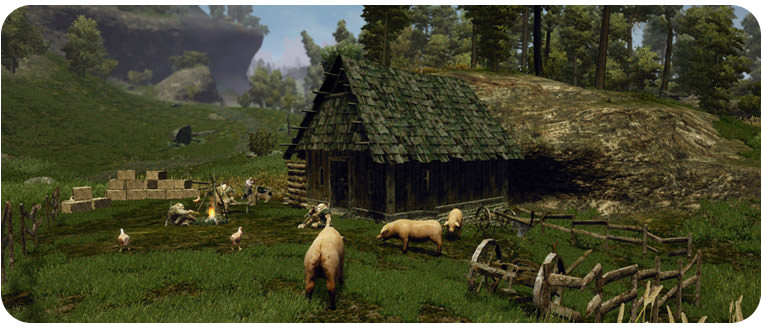
As a result, Jowood’s financial expectations were justified - the game sold out in an excellent circulation in North America and Germany. In Germany, the positions of the Gothic series have always been extremely strong - there fans of the game still celebrate their annual "Gothic day".
The game was released in Europe in October 2006; 350,000 copies were sold by November, and by March 2007 the game had a print run of 500,000 copies (at least these figures were reported by Jowood - but the American publisher-partner expressed extreme satisfaction with the way the third " Gothic " was sold ). Agree, these are impressive results!
However, official data do not take into account one important detail that no one knows about:
Yes, the game’s sales were excellent, but the number of refunds was just off scale. It seemed that the reason for the development of patches was that Jowood covered with a wave of cancellation of pre-orders of a game that had not yet been released, and if it hadn't been for it, it would have remained in that deplorable state.
According to independent estimates, the entire project took 3.5 years, no more than 17 people worked on it, the game budget was 5-6 million euros. But with the budgets in the case of " Gothic " is not so simple. The first game in the series cost several millions in production and recaptured only a part of them, the second brought the series to zero, and only starting with the addon Raven Night Gothic began to bring money to its creators - this information was disclosed by Pirahna Bytes in an interview .
For comparison, here are the indicators of a modern game in the open world genre, Horizon: Zero Dawn. Its development took over 6 years, of which 3 years was only pre-production: game design, prototyping and outline of game locations; during the production of the game, the project team reached a peak of 250 employees (not counting about 100 outsourcers from China); The total production cost of the game was about € 45 million.
Epilogue
I think you might already have a question - why then do the players love the Gothic games so much? I already know the answer approximately: the thing is in those who made these games! They were one of the most active gamers among all that I have ever met, and their sphere of interests almost entirely consisted of RPG games. They still can not remember blinking an eye on which builds were the best in Diablo II and Neverwinter Nights; they know Heroes of Might & Magic by heart and continue to admire the skills of Baldur's Gate scriptwriters ... True, it is not surprising that they are skeptical of almost all modern "mainstream" games - with rare exceptions, like Guild Wars 2 , Shadowrun Returns andDivinity: Original Sin 2 .
After the release, the developers even apologized at one of the fan forums for unfulfilled promises and technical problems that the players faced, promising to fix them in patches. By the way, they kept their promises.
Alas, among the management of Jowood was full of those who did not play games at all.
After several patches and making the game playable, in May 2007 Pirahna Bytes decided to leave Jowood. As the head of the studio notes in an interview years later, “the choice we were given to Jowood was like a gun attached to our temple.” A team of enthusiasts took their place: at one time on the Jowood website, anyone could sign the NDA and gain access to the game’s source code in order to fix its bugs and write patches. This team released several more official patches for the game and subsequently developed an addon for it.
The fourth part of Gothic , called Arcania , was made under the Jowood flag by completely different people - Spellbound Entertainment, the authors of the well-known Desperados series, an original and high-quality clone of Commandos in the scenery of the Wild West; they still continue to work on games, only now under the guise of Black Forest Games.
How did it end for Jowood? Thanks to the release of Gothic 3 on time, she was able to stay afloat for several more years, but she could not escape. In 2010, the company declared itself bankrupt and sold most of its intellectual property to Nordic Games.
By the way, the rights to publish new parts of Gothic belong to Piranha itself - only the studio has repeatedly repeated over the years that it’s returning to Gothicnot going to, at least not in the foreseeable future. Why? According to the developers, the expectations of the players are too high, and therefore, in order to satisfy everyone, the game should be something much bigger - a real hit, and they have no ideas about this yet. Believe the word? ..
PS

Under the roof, the German publisher Jowood had many other well-known "franchises" - for example, the SpellForce game series. It is difficult for me to assess the scale of the popularity of the original game in the CIS, and even more so - its sequel; but I remember very well that when its sequel came out in 2006 - the SpellForce 2 game - it looked, to put it mildly, completely different from the screenshots a year ago ...
Ten years later, a random acquaintance finally put everything in its place:
“SpellForce 2? Oh, I remember how we selected screenshots for her! It was like this ... It was urgent to take some screenshots for marketing and promotional materials. The game itself at that time didn’t work very well and looked so-so, so I had to make about 1000 screenshots, and out of all their diversity, I could choose only 3, or 5 pieces. So, you say, did you like the screenshots? .. "
I hope that now you are sure that not all post-mortem are boring and useless.
Materials for this article have been collected over two years. During the collection of information and writing of the article, not a single direct participant in the events suffered from rectothermal cryptanalysis. Have a good Friday and weekend!