Historical review of the great mathematician Karl Friedrich Gauss
Karl Friedrich Gauss
Mathematician and mathematician historian Jeremy Gray tells Gauss and his enormous contribution to science, the theory of quadratic forms, the discovery of Ceres, and non-Euclidean geometry *
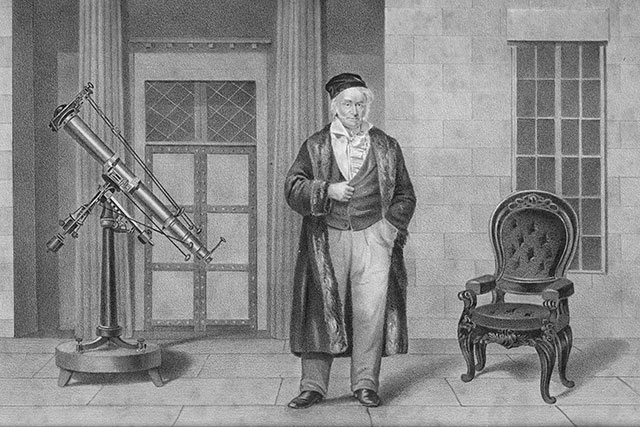
Portrait of Gauss Eduard Ritmüller on the terrace of the Göttingen Observatory // Karl Friedrich Gauss: Titan of Science G. Waldo Dunnington, Jeremy Gray, Fritz-Egbert Dohe
Karl Friedrich Gauss was a German mathematician and astronomer. He was born to poor parents in Braunschweig in 1777 and died in Göttingen in Germany in 1855, and by then all who knew him considered him one of the greatest mathematicians of all time.
Gauss study
How do we study Karl Friedrich Gauss? Well, when it comes to his early life, we must rely on the family stories that his mother shared when he became famous. Of course, these stories are prone to exaggeration, but his remarkable talent was noticeable even when Gauss was in his early teens. Since then, we have more and more records about his life.
When Gauss grew up and was noticed, letters began to appear about him by people who knew him, as well as official reports of various kinds. We also have a long biography of his friend, based on the conversations they had at the end of Gauss's life. We have his publications, we have a lot of his letters to other people, and he wrote a lot of material, but never published. And finally, we have obituaries.
Early life and the path to math
Gauss's father was engaged in various matters, was a worker, a foreman of a construction site and a merchant's assistant. His mother was smart, but barely literate, and devoted all of herself to Gauss until her death at the age of 97. It seems that Gauss was seen as a gifted student at school, at the age of eleven, his father was persuaded to send him to a local academic school, instead of getting him to work. At that time, the Duke of Braunschweig sought to modernize his duchy, and attracted talented people who would help him in this. When Gauss was fifteen, the duke brought him to the College of Carolinum for his higher education, although by then Gauss had already studied Latin and mathematics at the high school level. At the age of eighteen, he entered the University of Gottingen,
Gauss originally intended to study philology, a priority subject in Germany at that time, but he also conducted extensive research on the algebraic construction of regular polygons. Due to the fact that the vertices of a regular polygon from N sides are given by solving the equation (which is numerically equal
  . Gauss found that for n = 17 the equation is factored in such a way that a regular 17-sided polygon can only be constructed using a ruler and a compass. This was a completely new result, the Greek geometers were unaware of this, and the discovery caused a slight sensation - news about this was even published in the city newspaper. This success, which came when he was barely nineteen, made him decide to study mathematics.
But what made him famous was two completely different phenomena in 1801. The first was the publication of his book entitled Arithmetic Reasoning, which completely rewrote number theory and made it (number theory) become, and still is, one of the central subjects of mathematics. It includes the theory of equations of the form x ^ n - 1, which is both very original and at the same time easily perceived, as well as a much more complex theory called the quadratic form theory. This has already caught the attention of two leading French mathematicians, Joseph Louis Lagrange and Adrienne Marie Legendre, who admitted that Gauss went very far beyond what they were doing.
The second important event was the re-discovery by Gauss of the first known asteroid. It was found in 1800 by the Italian astronomer Giuseppe Piazzi, who named it Ceres after the Roman goddess of agriculture. He watched her for 41 nights before she disappeared behind the sun. It was a very exciting discovery, and astronomers really wanted to know where it would appear again. Only Gauss calculated this correctly, which none of the professionals did, and this made his name as an astronomer, with whom he remained for many years to come.
Late life and family
The first work of Gauss was a mathematician in Göttingen, but after the discovery of Ceres, and then other asteroids, he gradually switched his interests to astronomy, and in 1815 became director of the Göttingen Observatory, and held this position almost until his death. He also remained a professor of mathematics at the University of Gottingen, but this did not seem to require much teaching, and the record of his contacts with the younger generations was rather insignificant. In fact, he seems to have been an alienated figure, more comfortable and sociable with astronomers, and the few good mathematicians in his life.
In the 1820s, he led a massive study of northern Germany and southern Denmark, and during this he rewrote the theory of surface geometry or differential geometry, as it is called today.
Gauss married twice, the first time quite happily, but when his wife Joanna died in childbirth in 1809, he again married Minna Waldeck, but this marriage was less successful; She died in 1831. He had three sons, two of whom emigrated to the United States, most likely because their relationship with his father was a problem. As a result, there is an active group of people in the States who are descended from Gauss. He also had two daughters, one from each marriage.
The greatest contribution to mathematics
Considering the contribution of Gauss in this area, we can start with the least squares method in statistics, which he invented in order to understand the Piazzi data and find the Ceres asteroid. This was a breakthrough in averaging a large number of observations, all of which were slightly inaccurate, in order to obtain the most reliable information from them. As for the theory of numbers, it can be talked about for a very long time, but he made remarkable discoveries about what numbers can be expressed by quadratic forms, which are expressions of the form . It may seem to you that this is important, but Gauss turned what was a collection of disparate results into a systematic theory and showed that many simple and natural hypotheses have proofs that lie in what looks like other sections of mathematics in general. Some of the techniques he invented turned out to be important in other areas of mathematics, but Gauss discovered them even before these branches were correctly studied: group theory is an example.
His work on equations of the form  and, more surprisingly, by the deep features of the theory of quadratic forms, she discovered the use of complex numbers, for example, to prove results on integers. This suggests that much has happened under the surface of the subject.
Later, in the 1820s, he discovered that there is a concept of surface curvature, which is an integral part of the surface. This explains why some surfaces cannot be precisely copied onto others, without transformations, as we cannot make an exact map of the Earth on a piece of paper. This freed the study of surfaces from the study of solids: you may have an apple peel, without having to present the apple underneath.
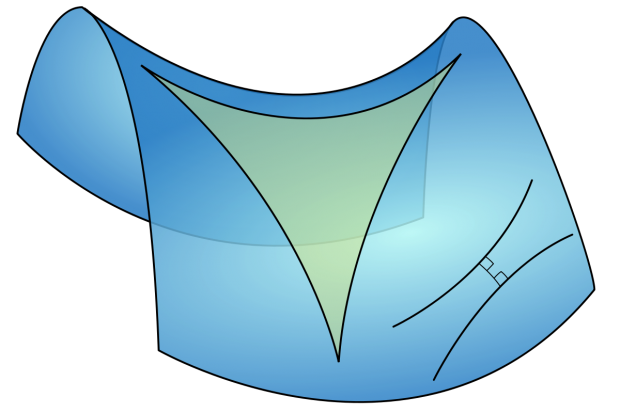
A surface with negative curvature, where the sum of the angles of a triangle is less than that of a triangle in the plane // source: Wikipedia
In the 1840s, regardless of the English mathematician George Green, he invented the subject of potential theory, which is a huge extension of the calculus of functions of several variables. It is the right mathematics for studying gravity and electromagnetism and has since been used in many areas of applied mathematics.
And we must also remember that Gauss discovered, but did not publish quite a lot. No one knows why he did so much for himself, but one theory is that the stream of new ideas that he kept in mind was even more exciting. He convinced himself that Euclidean geometry is not necessarily true and that at least one other geometry is logically possible. The glory of this discovery went to two other mathematicians, Boyai in Romania-Hungary and Lobachevsky in Russia, but only after their death - it was so controversial at that time. And he worked a lot on the so-called elliptic functions - you can consider them as generalizations of the sinusoidal and cosine trigonometry functions, but, more precisely, they are complex functions of a complex variable, and Gauss invented a whole theory of them.
Work in other areas
After his reopening of the first asteroid, Gauss worked hard to find other asteroids and calculate their orbits. It was a difficult job in the pre-computer era, but he turned to his talents, and he seemed to feel that this work allowed him to pay his debt to the prince and to the society that had given him the education.
In addition, while shooting in northern Germany, he invented the heliotrope for accurate shooting, and in the 1840s he helped create and build the first electric telegraph. If he also thought about amplifiers, he could have been noted in this, since without them the signals could not travel very far.
Lasting Legacy
There are many reasons why Karl Friedrich Gauss is still so relevant today. First of all, number theory has turned into a huge subject with a reputation for being very complex. Since then, some of the best mathematicians have gravitated toward him, and Gauss has given them a way to approach him. Naturally, some problems that he could not solve attracted attention, so you can say that he created a whole field of research. It turns out that it also has deep connections with the theory of elliptic functions.
In addition, his discovery of the internal concept of curvature enriched the entire study of surfaces and inspired subsequent generations for many years of work. Anyone who studies surfaces, from enterprising modern architects to mathematicians, is indebted to him.
The internal geometry of surfaces extends to the idea of the internal geometry of higher order objects, such as three-dimensional space and four-dimensional space-time.
Einstein's general theory of relativity and all modern cosmology, including the study of black holes, became possible due to the fact that Gauss made this breakthrough. The idea of non-Euclidean geometry, so shocking at the time, made people realize that there could be many kinds of rigorous mathematics, some of which might be more accurate or useful - or just interesting - than those that we knew about.
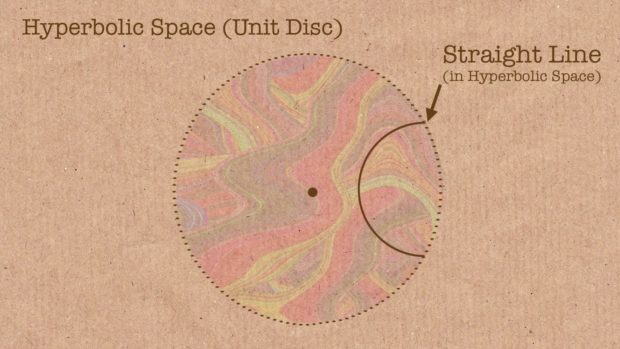
Non-Euclidean geometry // source: Numberphile
The man behind the legend
The life of Gauss has given rise to many stories and jokes. For example, no matter how incredible, his mother liked to say that no one taught the basics of arithmetic to Gauss, but he dealt with it himself, listening to his father at work. Undoubtedly, he was one of the few mathematicians with extraordinary ability to mental arithmetic and could quickly and accurately carry out long calculations in his mind. It was also reported that his sons said that he discouraged them from pursuing a career in science because "he did not want the name of Gauss to be associated with second-rate work."
In the same vein, he had a frightening habit of telling people that he already knew what they had just discovered. The most famous case, when his old university friend Farkash Boyai wrote to him, enclosing a copy of the discovery of his son Janos of non-Euclidean geometry, Gauss replied that he could not praise the work, saying “because doing it is like praising yourself.” This not only exaggerated what Gauss knew in 1831, he did nothing to help the young Boya gain recognition for his work, and Janos was so disappointed that he never published it again.
However, you should not have the impression that Gauss was an unpleasant person. He was a man of principle, he was happy to accept Sophie Germain as a serious mathematician at a time when women were expelled from higher education, and he always sought to use his talents for productive use. But his exceptional talents, and although we can only rejoice over them, Radaktorostroi, made him very lonely.
Jeremy Gray, Doctor, Emeritus Professor of History of Mathematics, Open University.
* Inaccurate translation.