June 23, 2017 at 16:05
ECS (Elastic Cloud Storage) - Dell EMC Cloud Storage Platform
The volume of unstructured data is growing exponentially, and it does not seem that this process has slowed down. Some organizations still manage to manage them using a traditional storage infrastructure, but it is expensive and does not support scaling in accordance with the growth of data volume.
However, these problems are far from the only ones. IT budgets remain at the same level or increase slightly (by about 5% per year), and the capital expenditures of most organizations almost double each year. In addition, companies need to maintain and improve the level of service, spending less and less resources on this.

The growth in data volumes (and, correspondingly, requirements for storage infrastructure) is by no means a temporary trend, and if companies do not transform their business on time, they will face very serious problems. But the development of technology allows us to find the necessary solutions. For example, Dell EMC, the world's largest storage provider, has created the cost-effective ECS cloud platform.
First, it should be noted that ECS is not a public Cloud Storage when a user does not know where his data is stored. On the contrary, Dell EMC (Elastic Cloud Storage ) is a physical storage array (although there is a version in the form of software), and the client chooses where to place it. And ECS is called cloud storage, because the system can be used for this purpose.
ECS software allows you to store, administer and analyze unstructured data in a large-scale infrastructure of standard components. This is a comprehensive multi-user cloud storage platform that allows you to take into account resource consumption and independently allocate them.
Customers can purchase ECS as a ready-made hardware and software system (Dell EMC ECS Appliance) or as a software product (ECS software): it is installed on customer servers and typical Dell EMC certified drives. ECS includes an unstructured data storage module that supports object management and HDFS services, as well as support for file services.
Technically, this system is:
System configuration includes 4/8 nodes. The capacity of the solution reaches 3840 TB per rack.
ECS is a third generation object storage system. It allows you to:
Object Storage Benefits:
Businesses and cloud service providers can use ECS as the basis for "digital transformation." Traditional business applications are now replaced by cloudy ones - and ECS bridges the gap between the applications of the “second” and “third” platforms, allowing them to use a single storage system. ECS not only manages a huge amount of unstructured data - as a multi-purpose platform, it takes on a variety of workloads and is able to prepare a company for any challenges.
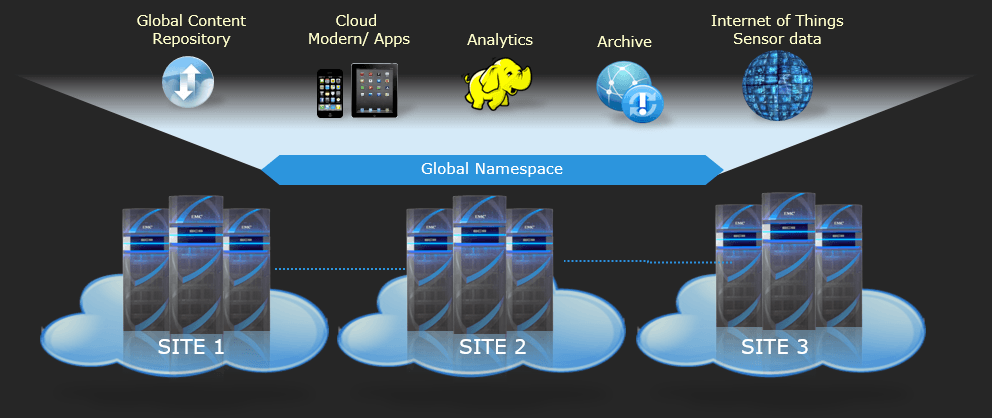
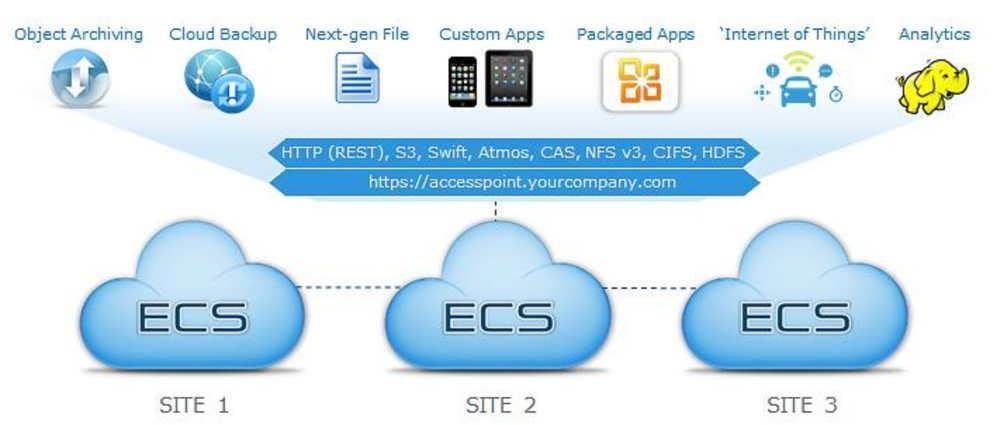
ECS is compatible with HDFS, OpenStack Swift, and Amazon S3, as well as the Centera and Atmos APIs. At the customer’s choice, it can be deployed as a fully integrated solution that scales to 3.8 PB per rack, or as a software solution for storing data on certified equipment. In addition, ECS is available on a per-use basis. Thanks to this, the system is gaining popularity among corporate customers and service providers.
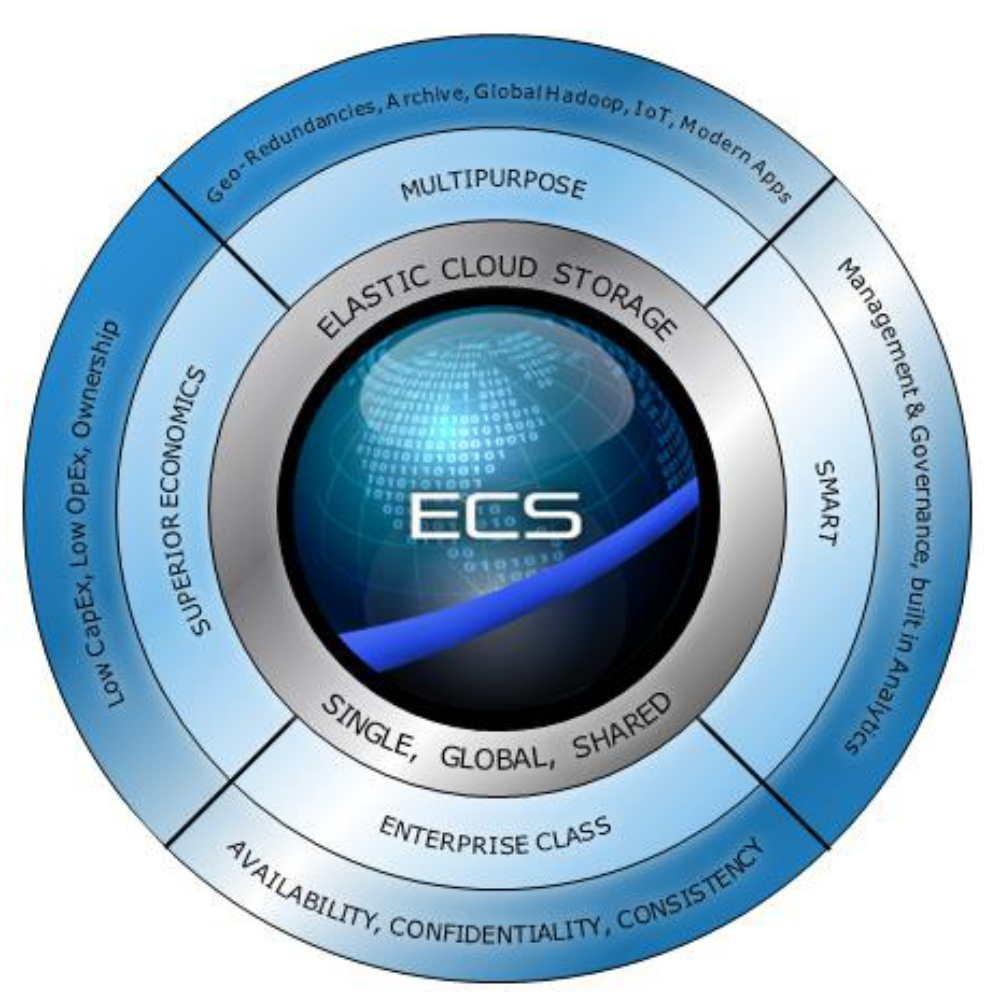
The manufacturer positions ECS for cases when it is required:
The ECS platform is used as:
Here are a few options for using ECS with other Dell EMC storage systems:
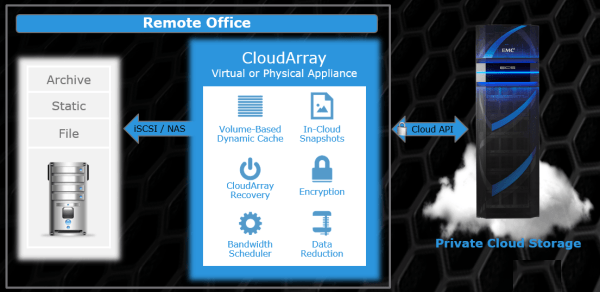
Example 1: Combining ECS with a Dell EMC Cloud Array. File services and storage for remote offices without deploying a storage array to a remote site.
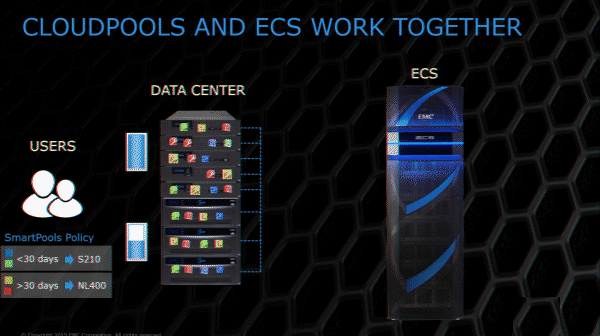
Example 2. The combination of ECS with Isilon (cloud pools). Isilon (horizontally scaled NAS) with automatic file transfer to low-cost storage according to specified rules.
Example 3. Classical archiving. ECS is used as an archive.
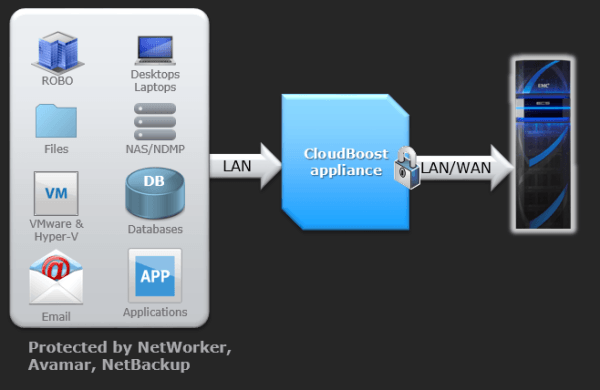
Example 4. Combination with Dell EMC Cloud Boost. Long-term data storage.
Example 5. Development using object storage. Mobile applications have become so developed that it is difficult to associate with well-known storage protocols (FC, NAS) without a “gateway” - for example, a web server. Thanks to ECS, mobile applications get direct access to the repository using HTTP / HTTPS and can receive or save the necessary objects.
The ECS platform was released in June 2015. Now more than 250 clients use it, and many of them have installation capacities that exceed petabytes. ECS supports Objects, NFS, and the Hadoop Distributed File System (HDFS), which allows it to store billions of files for cloud applications.
However, these problems are far from the only ones. IT budgets remain at the same level or increase slightly (by about 5% per year), and the capital expenditures of most organizations almost double each year. In addition, companies need to maintain and improve the level of service, spending less and less resources on this.
The growth in data volumes (and, correspondingly, requirements for storage infrastructure) is by no means a temporary trend, and if companies do not transform their business on time, they will face very serious problems. But the development of technology allows us to find the necessary solutions. For example, Dell EMC, the world's largest storage provider, has created the cost-effective ECS cloud platform.
What is ECS?
First, it should be noted that ECS is not a public Cloud Storage when a user does not know where his data is stored. On the contrary, Dell EMC (Elastic Cloud Storage ) is a physical storage array (although there is a version in the form of software), and the client chooses where to place it. And ECS is called cloud storage, because the system can be used for this purpose.
ECS software allows you to store, administer and analyze unstructured data in a large-scale infrastructure of standard components. This is a comprehensive multi-user cloud storage platform that allows you to take into account resource consumption and independently allocate them.
Customers can purchase ECS as a ready-made hardware and software system (Dell EMC ECS Appliance) or as a software product (ECS software): it is installed on customer servers and typical Dell EMC certified drives. ECS includes an unstructured data storage module that supports object management and HDFS services, as well as support for file services.
Technically, this system is:
- Intel x86 server with JBOD shelves connected to it (up to 60 disks per server),
- 10GbE network adapters for connecting nodes.
System configuration includes 4/8 nodes. The capacity of the solution reaches 3840 TB per rack.
ECS is a third generation object storage system. It allows you to:
- Consolidate primary storage resources and increase return on investment
- Upgrade traditional and legacy applications for more efficient storage utilization
- Accelerate cloud-based applications with new business features.
Object Storage Benefits:
- Access to facilities is provided through specialized protocols. Unlike block or file ones, they work on top of HTTP and are based on REST: S3, Swift, Atmos.
- Focus on storing unstructured information (any files that are static or dynamic content on the client side).
- Each object has a unique address.
- Global object namespace: any object is available at any time from any infrastructure segment.
What is convenient for ECS?
- Profitability. ECS is a feature-rich platform that offers many usage scenarios and protects Dell EMC storage infrastructure investments. It simplifies management, increases flexibility, and most importantly - reduces costs. In terms of scaling, ECS is one of the most cost-effective solutions on the market. According to a study by Enterprise Strategy Group (ESG), storing files in ECS is at least 60% more profitable than other cloud services.
- Integration with your existing storage environment. ECS “extends” the cloud to primary storage and frees up storage infrastructure with Dell EMC cloud computing solutions (CloudPools, CloudBoost, CloudArray, etc.). Customers can push inactive data from the primary storage (Isilon, VMAX Series, VPLEX, VNX Series, Vx Series, Data Domain, Data Protection Suite, etc.) to the cloud by moving them to ECS. This consolidation of resources allows you not to buy additional and more expensive platforms and significantly increases the efficiency of your existing storage environment.
- Online and ubiquitous data access. The ECS object platform is capable of drastically improving response times and increasing data access speed compared to traditional NAS. Data is protected by encoding and distributed across all nodes of the system, providing instant access to read / write from anywhere. In this case, the latest copy of the data is available, which simplifies application development. Support for geocaching also makes access faster thanks to intelligent system recognition of operation patterns: it minimizes WAN traffic and improves latency.
- Ease of application development. A single global namespace does not require developers to access complex NFS file systems. They can focus on building applications, not the details of operations. By upgrading traditional applications in the object storage, users get additional resources, access to content via the Internet and global accessibility through a single namespace. In addition, they can optimally use storage resources in the data center. Native cloud applications take full advantage of the cloud infrastructure.
- The user has access to all the advantages of software-defined storage. The ECS platform makes full use of the software-defined architecture, which allows you to independently scale computing and storage resources. All data in the ECS is containerized; no hardware dependency, no need to transcode or reconfigure applications, as ECS provides support for multiple protocols. This allows developers to innovate much faster and bring their applications to the market.
Digital transformation is easy
Businesses and cloud service providers can use ECS as the basis for "digital transformation." Traditional business applications are now replaced by cloudy ones - and ECS bridges the gap between the applications of the “second” and “third” platforms, allowing them to use a single storage system. ECS not only manages a huge amount of unstructured data - as a multi-purpose platform, it takes on a variety of workloads and is able to prepare a company for any challenges.
ECS is compatible with HDFS, OpenStack Swift, and Amazon S3, as well as the Centera and Atmos APIs. At the customer’s choice, it can be deployed as a fully integrated solution that scales to 3.8 PB per rack, or as a software solution for storing data on certified equipment. In addition, ECS is available on a per-use basis. Thanks to this, the system is gaining popularity among corporate customers and service providers.
The manufacturer positions ECS for cases when it is required:
- distributed architecture
- global namespace (all data centers with active / active nodes, geo-protection, multi-protocol access and metadata search).
ECS Use Scenarios
The ECS platform is used as:
- Global content repository. This relatively easy-to-implement solution provides global file access and enterprise-level data protection.
- Large-scale implementation of big data analytics. The system provides global analytics of data from geographically distributed archives. This is an economical high-density storage solution for Hadoop.
- A modern platform for applications. ECS supports many APIs and protocols, and its active / active architecture is optimized for data storage and access.
- Inactive data cold archiving system. Allows you to create archives ready to support future applications, and optimizes existing storage environments.
- Deploy a management platform for the Internet of Things (IoT). The IoT architecture is effective for handling large amounts of unstructured data. And at the recent Dell EMC World 2017 forum , it was announced that IoT streaming is now possible in ECS.
Here are a few options for using ECS with other Dell EMC storage systems:
Example 1: Combining ECS with a Dell EMC Cloud Array. File services and storage for remote offices without deploying a storage array to a remote site.
Example 2. The combination of ECS with Isilon (cloud pools). Isilon (horizontally scaled NAS) with automatic file transfer to low-cost storage according to specified rules.
Example 3. Classical archiving. ECS is used as an archive.
Example 4. Combination with Dell EMC Cloud Boost. Long-term data storage.
Example 5. Development using object storage. Mobile applications have become so developed that it is difficult to associate with well-known storage protocols (FC, NAS) without a “gateway” - for example, a web server. Thanks to ECS, mobile applications get direct access to the repository using HTTP / HTTPS and can receive or save the necessary objects.
The ECS platform was released in June 2015. Now more than 250 clients use it, and many of them have installation capacities that exceed petabytes. ECS supports Objects, NFS, and the Hadoop Distributed File System (HDFS), which allows it to store billions of files for cloud applications.