April 29, 2017 at 12:13
How Three Schoolchildren Hacked Final Fantasy V Source Code to Localize It
- Transfer
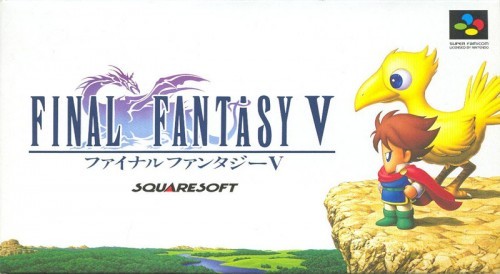
One day in the late 90's Miria (Myria) went to the computer lab and Irvine High School came across a Man, Play of Final Fantasy the V . This was unusual: first, Final Fantasy V was never released in the United States. To play this 1992 Japanese game in English, you first had to download ROM, and then install an unofficial fan patch with a translation that recently appeared on the Internet. Miriya knew about this patch, and it was also unusual: she helped in its creation.
The guy was shocked that this patch was created by his classmate. “He did not know that I was working on a patch,” said Miriya, who asked not to reveal her real name. “I was surprised that there was someone who really plays it.”
For twenty years, Miria was used to meeting people, playing in an informal English version of Final Fantasy the V . Although this was not the first fan translation of the video game (the first was the Dutch translation of the 1993 MSX SD Snatcher game ), but it became the most significant. He made it clear to countless Western fans that Squaresoft's “ Final Fantasy III ” was not really the third part of Final Fantasy , and, more importantly, demonstrated to the world the power that fans have in the video game industry. Tired of the fact that companies such as Square refuse to distribute games in Western markets, fans simply localized Final Fantasy V on their own. Later they did the same with RPG, for example, withSeiken Densetsu 3 and Mother 3 . They translated scripts from Japanese into English, edited the translation and implemented these scripts in games using constantly improving programs.
“It’s hard to convey how important it was during that era,” says Clyde “Mato” Mandelin, primarily known as the professional localizer for the third part of Mother . “We not only managed to play the“ missing ” Final Fantasy in English: the quality of the game was almost like the official version. At that time, most fan translations were primitive and sloppy, but the amateur translation of Final Fantasy V overtook them many light years. ”
There is no way to find out how many people played the Final Fantasy V patch - today it is stored on a lot of pirated ROM sites, so you won’t be able to calculate the exact number. But he had a huge impact. Today, Miriya works as an engineer in a large video game company with millions of fans, but Final Fantasy V may have become her most celebrated achievement. “I talked with people at work, with random people, talked with them,” she says. “Sooner or later, they would find out that I was working on this translation, and were always very impressed.”
Miriya doesn’t remember exactly when she found out about the problem with Final Fantasy numbering - it was in 1996 or 1997 - but she remembers how she watched the advertisements of Final Fantasy VII. “We were surprised:“ what, the seventh part? ”,” She says, repeating after all RPG lovers in the USA. Just a few years ago, in 1994, Squaresoft released Final Fantasy III for Super Nintendo. How did they switch from three to seven?
As it turned out, Square hid some of the games from North America. This venerable publisher missed the localization of both Final Fantasy II and Final Fantasy III for the Nintendo Entertainment System, so when it came time to bring Final Fantasy IV to the western market, the company called the game Final Fantasy II . Square then decided to skip Final Fantasy V , although, according to its lead localizer, Ted Woolsey, the company pondered for some time on the release of the game in the West under a different name.
Then the publisher released Final Fantasy VI and named it Final Fantasy III .
It’s easy to get confused in these names and numbers, so here’s a brief outline of
Final Fantasy (NES) [1987] - released worldwide
Final Fantasy II (NES) [1988] - only in Japan
Final Fantasy III (NES) [1990] - only in Japan
Final Fantasy IV (SNES) [1991] - released in the USA as Final Fantasy II
Final Fantasy V (SNES) [1992] - only in Japan
Final Fantasy VI (SNES) [1994] - released in the USA as Final Fantasy III
When Miriya began to explore strange Square localization decisions, she began to speculate on taking part in unofficial fan projects. She was always obsessed with RPG and noticed that the Final Fantasy IV ( II ) script was pretty chaotic, full of clumsy sentences and inappropriate words. “I wanted to remake this game,” says Miriya. “The translation was in terrible chaos.”
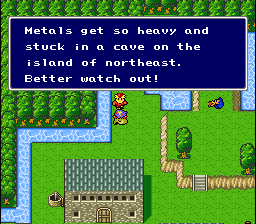
A screenshot taken by Clyde Mandelin from the mediocre localization of Final Fantasy IV for SNES.
Once, surfing the Internet in the late 90s, Miriya came across a group of geeks who looked like her, who called themselves RPGe. On IRC, they discussed their favorite Japanese role-playing games and made ambitious plans to translate into English those games that did not end up in the West. When Miriya found them, they talked about the localization of Final Fantasy V , which they wanted to do by hacking the Japanese version of the game’s ROM file and translating the script into English. Miriya was intrigued and postponed her plans to remake the FFIV . Final Fantasy V seemed a lot cooler. (A group called J2E later re-translated the FFIV with mediocre results. This is documented by Clyde Mandelin on his Legends of Localization website .)
Unlike the two lost games for NES, Final Fantasy V was excellent in every way . People who managed to understand FFV in Japanese said that it was interesting to play it, it had an excellent storyline and a well-thought-out class change system that allowed players to creatively customize their team. It was complicated, and this is one of the reasons Square didn't sell it in the West, but RPG fans still wanted to appreciate this game.
The problem was that RPGe did not have enough experience. None of the group had ever done anything like this, so they did not know how to do amateur translations. RPGe team unearthed Japanese ROM Final Fantasy V, hacked it and started editing text files, directly translating fragments of the game from Japanese to English. But these files were moody and difficult to work with. When they changed the Japanese string to English in ROM, it did not display correctly in the game, because the rendering of Japanese and English characters was different. Japanese characters are larger than English letters, and one sentence, occupying 12 characters in English ("how are you?") Could consist of only three Japanese characters ("元 気?"). Final Fantasy V limited each line of dialogue to 16 characters. It looked good in Japanese, but the English translation was distorted and hard to read.
Miriya realized that they needed to edit not only text files, but also the code itself, which processed in Final Fantasy Vthese text files. “I felt that they had chosen the wrong approach,” she says. "This was my contribution to the work of the ROM hacking community: to create a high-quality translation, it is not enough just to change the game data, you need to modify its code."
To localize the Japanese text into English and make it readable, Miriya decided to reprogram the game. Their version of Final Fantasy V should have understood that English letters, unlike Japanese characters, have different sizes. It was necessary to teach the game that each dialog should contain more English characters (including those annoying spaces) than Japanese kanji or kana.
Miriya (by then known on the Internet under the nickname Barubary; both names are references to Breath of Fire) began discussing with the Japanese-English translator SoM2freak the departure from the rest of RPGe. In mid-1997, they planned to start their own translation of Final Fantasy V , which would be correct, not just hacked. “I decided to abandon those people who, it seemed to me, did not understand what they were doing,” Miriya says. "We founded our own subgroup within [RPGe] because I felt that they were unable to cope with this task."

Collected by Clyde Mandelin, examples of how other amateur translations looked in the 90s.
It was very hot in the California Irvine in the summer of 1997, and Miriya did not want to go outside. She had just finished her second year of high school and planned to spend the summer as any self-respecting teenager would like: to disassemble the ROM code. Listening to music remixes of old video games and CDs, she studied the inner workings of Final Fantasy the V . In her room there was a slow Intel 486 computer, which she could use for development, but to test the game, she had to go downstairs and turn on her father's fast Pentium. 486 just could not run emulators. (To complete the picture, we, with the permission of Miriya, add that at that time she was male.)
SoM2freak translated the lines of Japanese dialogs Final Fantasy Vinto English, and Miriya tried to find the best way to insert them into the game. She downloaded the disassembler to parse the Final Fantasy V code , which turned into such a huge file that even parsing it required a special program for working with XTree Gold text. Then she began to change the variables, through trial and error, trying to figure out what each line of code was responsible for. “There was almost no documentation,” says Miriya. “I had to figure out what to do myself.”
Each disassembled code file looked something like this:

Screenshot of a disassembled program made by Miriya.
This screenshot shows the code in Final Fantasy Vused to render dialogs. Since the game assumed that each Japanese character would have the same width - 12 pixels - this code renders a character in each dialog box, then the invisible cursor moves 13 pixels to the right, renders a new character, and so on. For English letters with different widths, Miriya needed to find a different approach. “The natural solution for changing the code for the English translation is to vary the number of cursor transitions to the right depending on the character being drawn,” Miriya says. "I replaced this code with the transition to the code I added, which determines the amount of cursor movement depending on the rendered English character."
Miriya spent the whole summer searching for solutions to this problem, and therefore was different from the rest of the community of amateur translators. Previously, translators never thought about disassembling code or changing the renderers of dialogs, perhaps because they were not as passionate (or obsessed) as Miriya. “Often the work was monotonous,” she says. “I spent a lot of time in the [emulator] SNES 9x trying to figure out what was happening [from ROM]. I looked at hex dumps and assembler dumps for many hours and just tried to debug this annoying word processing routine. ”
In the process of working on the project, they brought in a new editor, Katsuyuki “harmony7” Omuro (Katsuyuki “harmony7” Ohmuro), who was in the same school as Miriya. Omuro believed that SoM2freak translations are bad and full of problems. SoM2freak was young, Japanese was not his first language, so Omuro began editing large chunks of SoM2freak translation. Frustrated by this decision, SoM2freak left the band, but later he helped translate other major RPGs such as Final Fantasy III and Seiken Densetsu 3 .
Probably the team’s most controversial translation decision was choosing the name of the main character. According to Square Enix, the main star of Final Fantasy V was a man named Bartz. But in the amateur translation, the name was different:

This name often caused a giggle . transl.: consonant with the English word butts (buttocks)] , but in all respects it was the most accurate translation, and Miriya adheres to it. Alliterative translation of the Japanese name バ ッ ツ - Battsu, or briefly Butz. “In Japan, there were documents, for example, a strategy guide, and in the game there were small silver figurines on which Butz was written as we wrote. We used examples like translation reference materials. ”
Summer changed in the fall, Miriya finished her amateur translation work by writing a program that inserted the translated English text into the game so that she would not have to spend tens of hours manually copying and pasting. The rest she left Omuro, who initially planned to revise the entire script, but a dramatic turn forced them to change course.
The remaining groups inside the RPGe abandoned their attempts to translate Final Fantasy V , and Miriya's team had to finish on their own. But in October 1997, someone got access to an early version of the fan translation and uploaded it on the Geocities website, trying to claim fame. To restore justice, Miriya and Omuro had to release their own patch, which was almost ready, but not as good as Omuro wanted.
On October 17, 1997, Miriya and her team released v0.96, the first public version of the FFV fan translation . It has spread like a virus, through IRC channels and forums. RPG fans have discovered that there is another great new Final Fantasy that none of them have played. Although SNES emulators were only nascent and raw, they could be found. Finding a copy of Final Fantasy V and an English patch for a regular gamer was also easy. The patch was applied in accordance with simple instructions from the Readme file. "[The patch] actually spread by itself," says Miriya. “He quickly became known in the emulation community and people started playing him. We didn’t have to care about his popularity at all. ”
Omuro several months working on completing and editing the script, and in June 1998 the team released the "official" patch version of Final Fantasy the V . At that time it was considered revolutionary, and even today it is recognized as one of the best translations in the history of games. “The amount of work done on the FFV translation set a high standard for subsequent amateur translations,” says localization specialist Mandelin. Having studied Final Fantasy V , future amateur translators realized that in order for the game to look good in English, you need to edit not only the text, but also the code.
“I don’t even know exactly how they achieved this - the emulation at that time was taking its first steps, and the tools and knowledge for hacking the ROM did not exist yet,” says Mandelin. "It's like the developers came to us from the future, to share the translation patch of Final Fantasy the V . At first I thought that emulation was just a funny invention, but after the patch was released I realized that it gives a lot more possibilities. My curiosity was hurt, I needed to find out how these translation patches work. Soon, I also started programming and translation for fan groups, which only a few years later led me to the career of a professional translator. In this sense, I believe that the amateur translation of FFV gave us all more than the official release could. ”
According to Miriya, the publisherFinal Fantasy , Squaresoft never discussed their translation with RPGe, even though they had an office in the Costa Mesa in the United States, just a few miles from her parents ’home. But in September 1999, the official English version of Final Fantasy V finally reached North America . This version, combined with Final Fantasy VI in the PS1 build called Final Fantasy Anthology , was disgusting.
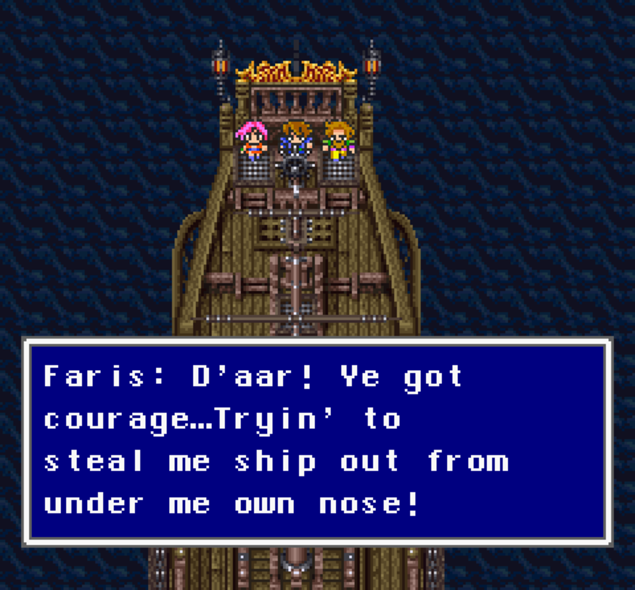
In the translation of Final Fantasy V for PS1, the protagonist Faris (Faris) throughout the game stubbornly sought to speak pirate. Screenshot taken from LPArchive.org
“We just laughed because the translation was absolutely terrible,” Miriya says. “We thought:“ Well, a couple of schoolchildren in four months did better than Square. Probably, it took them a whole year to do it. ”
And only in 2006 in the port for Game Boy Advance Final Fantasy V: Advance Square finally released a decent localized version of this unfortunate role-playing game. The main character was still called Bartz. “When the Game Boy Advance version came out, I thought,“ Oh my God, they finally defeated us, ”says Miriya. “They still did a better translation than ours, even though it took eight years.” After Final Fantasy V, Miriya started hacking PS1, the reverse development of old RPGs, in order to be able to write her own cheat codes, for example, a hack forFinal Fantasy VII , allowing players to walk through walls. The whole process helped her start a career in the video game industry. She still points to Final Fantasy V in her resume, and says that without this project, she would not have learned reverse engineering.
“Now I often communicate with different people, they ask me questions and I reply:“ Yes, my greatest achievement is working on that translation 20 years ago. ” I’m still surprised at the number of people who played it. ”