March 7, 2017 at 20:02
The role of a payment service in online transactions
In the first part of the history of the evolution of financial transactions, we showed the reflection of payments between the seller and the buyer, from checks to digital innovations of contactless payments. Entropy is increasing, and interaction patterns are changing. A new link appears in the chain - a payment service that performs the functions of processing and routing the transaction from the payer to the recipient. These business tasks are also performed by our Fondy payment platform .
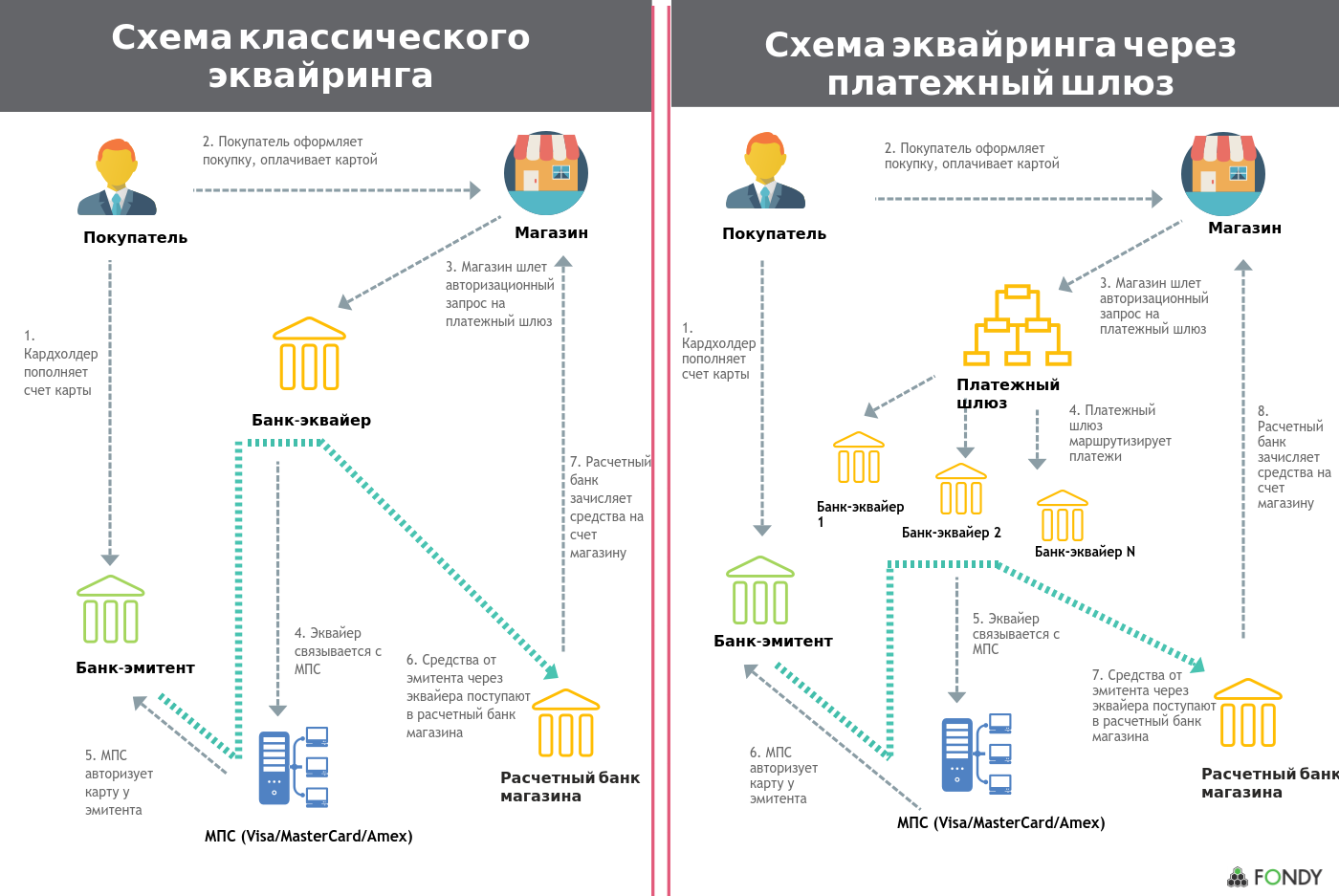
With the advent of a new member online - the Payment Gateway or PSP Gateway (Payment Service Provider Gateway), the acquiring scheme began to differ from the traditional one.
One of the definitions of a payment gateway might be: payment gateway- a service intermediary that processes electronic transactions and is only a payment router. In technical language, a payment gateway is a software module that routes payments between an online store and various acquiring banks and other Internet acquiring service providers through a single interaction protocol.
Thus, it is more logical to call a payment gateway an integrator of payment solutions and remember that no financial and settlement functions have been incorporated in its activities.
Consider the role of the payment gateway in the entire chain of payment from the payer to the merchant. The transaction path will consist of the following participants: Cardholder - Store - Payment Gateway - Acquiring processor - MPS (Visa / Mastercard) - Card issuing bank - Issuer's processor.
What is changing in modern conditions? The merchant (store), due to integration with the payment gateway, has additional payment channels, new payment providers (payment providers). Perhaps their number will increase as much as the payment gateway can absorb and process requests from possible payment providers.

Here it is necessary to clearly distinguish the capabilities and areas of activity of integrators and aggregators.
Functions of aggregators: integrate several payment methods at once into the seller’s website. With this business model, a payment service is forced to pass cash flows through its accounts. Therefore, aggregators work either with a partner credit organization, or they themselves are licensed by a bank or non-bank credit organization.
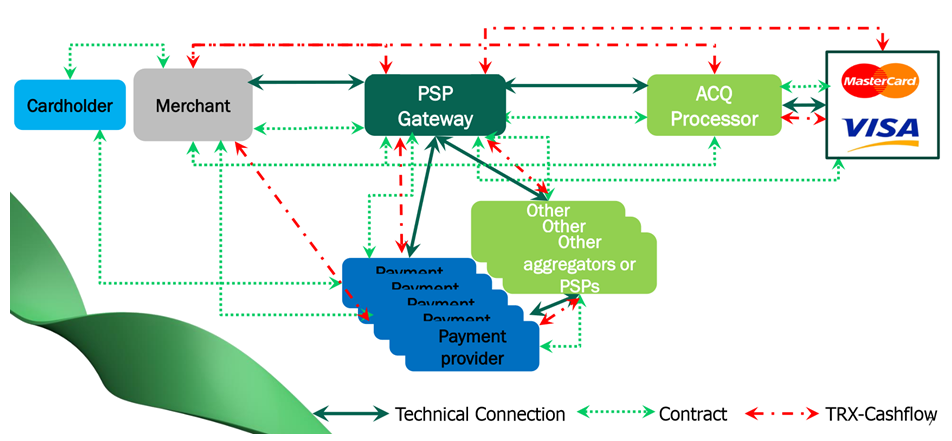
What you need to know about PSP providers? How can they be useful for business and why did they get so quickly involved in payment processing? The answer lies on the surface. They help retailers accept online payments. They offer a single payment interface for one or more than one payment method.
They help e-commerce merchants accept traditional payment cards, alternative payment methods (direct debit, electronic bank payments, and wallet payments (PayPal, Qiwi, Yandex.Money, Webmoney), but in contrast to the model of interaction with the aggregator, In the framework of cooperation with the PSP provider, the merchant will have to conclude a separate agreement for each method of receiving payments.
The PSP provider works exclusively as a technical integrator, providing a single interface for one or more payment methods. He can connect any store to the processing of the selected acquirer bank. A TSP (store) should still contact a bank or other financial institution to discuss commission rates and payments.
Alternatively, the payment integrator can also work according to the model of the payment aggregator, providing a single interface for one or more payment methods, collecting payments and commissions and contacting banks and financial institutions. But this is not a typical story. To do this, the TSP must conclude an agreement with the aggregator of payments, and not with a credit institution directly.
Read more about the difference between aggregators and payment integrators here .
The Austrian-English provider Kalixa explains its functions to stores in this way:
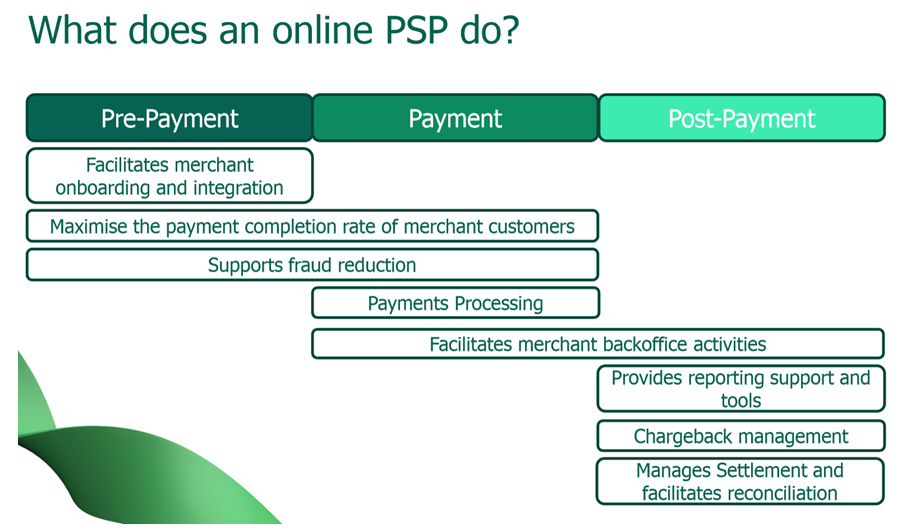
At the pre-payment level, it helps TSPs with integration, works to minimize fraud and risks. Makes payments. Supports back office activities.
At the post-pay level provides reports. Dispute management (appeal of payments). Settlement and reconciliation management.
Thus, two models of work have entrenched in the processing services market:
The first - integration (payment gateway) - consists in passing payments from the payer directly to the online store or through the processing center. This is a technology model that does not involve cash processing. The integrator will connect the acquirer bank indicated by the customer. The customer (store) will conclude an agreement with the bank and payment systems for settlement services. The implementation of the entire operational and financial daily routine lies on the online store.
The second - the model of aggregators - in addition to combining all payment acceptance options in a single technological gateway, it includes the receipt of payments to the settlement account of the processing center, and only after that the funds are transferred to the online store account.

The main global suppliers of integration payment solutions today:

Report from The Forrester Wave: Global Commerce Payment Providers, Q4 2016:

Find Adyen in the Forrester chart in the upper right corner of the chart. Now, let's look at Adyen customers to understand the scope of their activities, as well as where to strive:
This is the current development of events. And the operating flows here. More than Visa? More than Mastercard? We do not specifically check. But the trend is set, and it is read unambiguously. Cross-platform payments are no longer news, but reality.
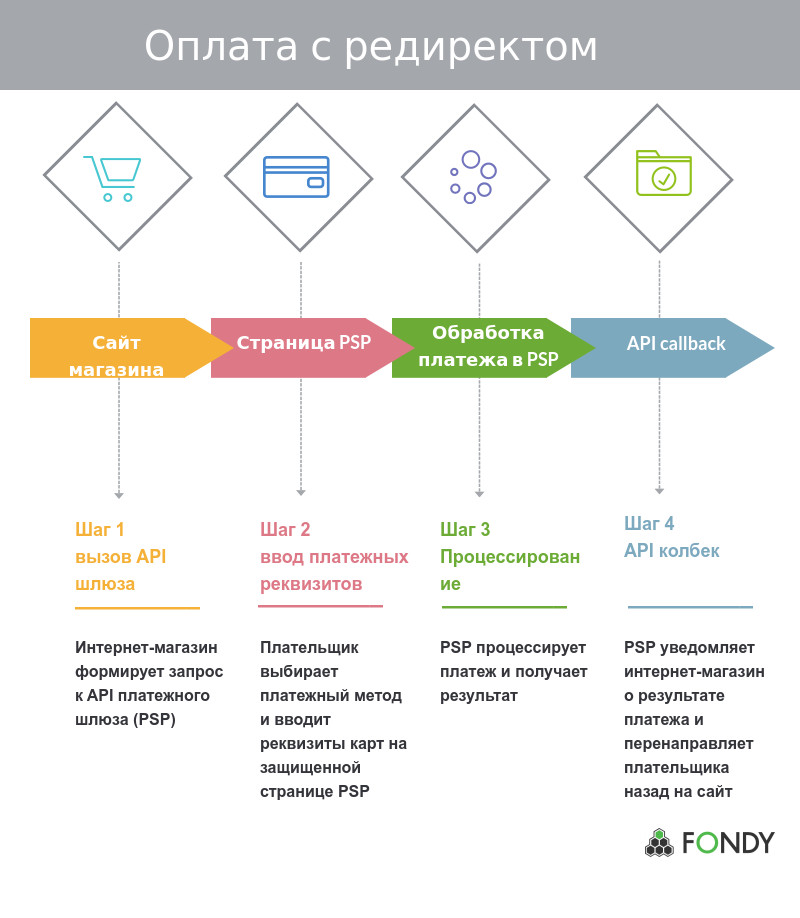
Consider a typical PSP scheme when PSP uses the redirect method. In this case, the store almost does not require any efforts for integration. The choice of technical solution here remains with the PSP.
A PSP technical solution might look like a redirect to a gateway page:
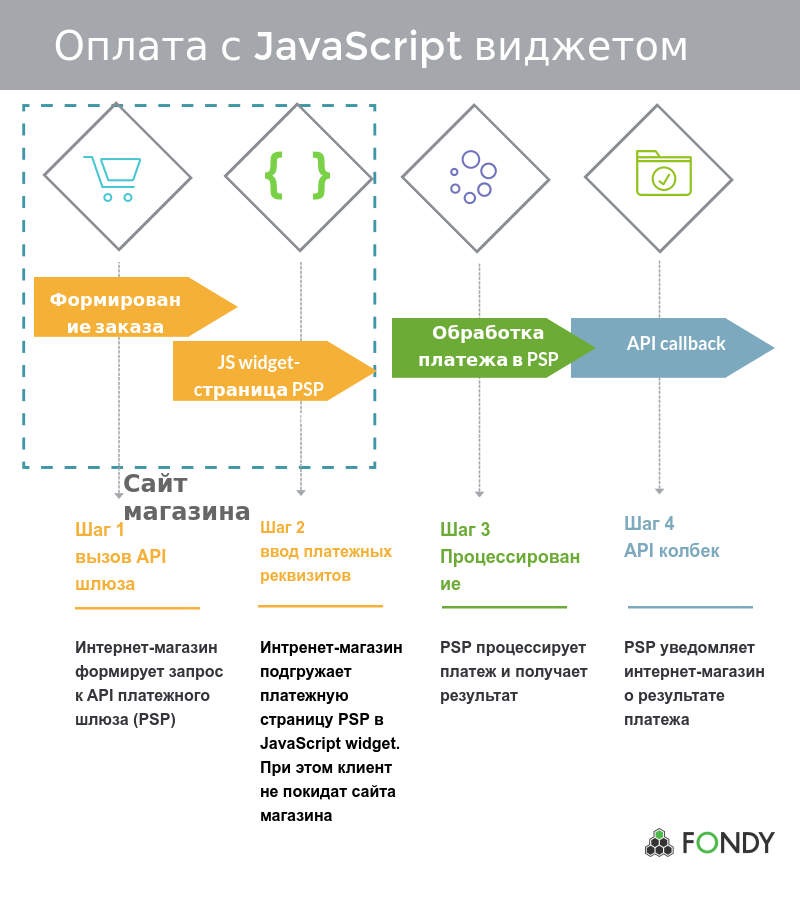
Or with loading a payment page in a JavaScript widget: A successful financial transaction depends on each leg of the path:
And the main tasks of PSP here are to provide the basic needs of the business:
The struggle for successful transactions is the struggle of the business for its sustainability. Each refusal leads to a loss of trust on the part of the customer, be it a store that has become a customer of an aggregator or a payment integrator, or a customer who has visited a store page.
A financial transaction is not just an informational message sent from the server of one entity to another. It has the status of a guarantee document for the transfer of ownership of certain entities (goods or money). The importance of a financial intermediary in the process of this exchange cannot be underestimated. The buyer, seller, issuing bank and acquiring bank, and even the aggregator of payments, if involved in the process, all of them trust the selected processing (payment integrator, independent processing center). At the time of confirmation of a successful transaction, the transaction is considered complete.
In order for new technologies, for example, blockchain technology, to win the minds of users, another round of development of the information and financial system must happen. From the popular to the settled method of calculations, this method is still far. Nevertheless, we recall with increasing difficulty the moments when unique technologies became widespread. Whether a single electronic settlement ledger (blockchain) can simplify the settlement process is a matter of time. Modern processors, integrators and payment aggregators have good reasons to continue to improve their products for breakthrough innovations.

With the advent of a new member online - the Payment Gateway or PSP Gateway (Payment Service Provider Gateway), the acquiring scheme began to differ from the traditional one.
One of the definitions of a payment gateway might be: payment gateway- a service intermediary that processes electronic transactions and is only a payment router. In technical language, a payment gateway is a software module that routes payments between an online store and various acquiring banks and other Internet acquiring service providers through a single interaction protocol.
Thus, it is more logical to call a payment gateway an integrator of payment solutions and remember that no financial and settlement functions have been incorporated in its activities.
Consider the role of the payment gateway in the entire chain of payment from the payer to the merchant. The transaction path will consist of the following participants: Cardholder - Store - Payment Gateway - Acquiring processor - MPS (Visa / Mastercard) - Card issuing bank - Issuer's processor.
- Buyer of services (cardholder, individual)
- Service seller (store, legal entity)
- Buyer's financial representative (bank 1 - card issuer)
- Seller’s financial representative (bank 2 - payment acquirer)
- Payment system (Visa / Mastercard / AmericanExpress) as an intermediary between the issuing bank and the acquirer in processing and financial settlements between them
- New Member - Payment Gateway
- The buyer enters the payment details / payment data through the web interface.
- Information about the details of the transaction is transmitted to the payment gateway, the payment gateway sends it to the acquirer bank.
- The acquiring bank sends an information (authorization) request to the payment system (Mastercard, VISA, others).
- If an authorization request is received, the issuing bank returns an authorization code that allows the payment system to complete the transaction.
- This code is returned to the payment gateway, and from there - a report to the seller with the authorization result.
- With positive authorization, the transaction is considered complete, the merchant can provide a service or ship the goods. Funds will be debited from the payer's card and reimbursed to the merchant's account.
What is changing in modern conditions? The merchant (store), due to integration with the payment gateway, has additional payment channels, new payment providers (payment providers). Perhaps their number will increase as much as the payment gateway can absorb and process requests from possible payment providers.
Here it is necessary to clearly distinguish the capabilities and areas of activity of integrators and aggregators.
Functions of aggregators: integrate several payment methods at once into the seller’s website. With this business model, a payment service is forced to pass cash flows through its accounts. Therefore, aggregators work either with a partner credit organization, or they themselves are licensed by a bank or non-bank credit organization.
What you need to know about PSP providers? How can they be useful for business and why did they get so quickly involved in payment processing? The answer lies on the surface. They help retailers accept online payments. They offer a single payment interface for one or more than one payment method.
They help e-commerce merchants accept traditional payment cards, alternative payment methods (direct debit, electronic bank payments, and wallet payments (PayPal, Qiwi, Yandex.Money, Webmoney), but in contrast to the model of interaction with the aggregator, In the framework of cooperation with the PSP provider, the merchant will have to conclude a separate agreement for each method of receiving payments.
The PSP provider works exclusively as a technical integrator, providing a single interface for one or more payment methods. He can connect any store to the processing of the selected acquirer bank. A TSP (store) should still contact a bank or other financial institution to discuss commission rates and payments.
Alternatively, the payment integrator can also work according to the model of the payment aggregator, providing a single interface for one or more payment methods, collecting payments and commissions and contacting banks and financial institutions. But this is not a typical story. To do this, the TSP must conclude an agreement with the aggregator of payments, and not with a credit institution directly.
Read more about the difference between aggregators and payment integrators here .
What does a payment gateway do?
The Austrian-English provider Kalixa explains its functions to stores in this way:
At the pre-payment level, it helps TSPs with integration, works to minimize fraud and risks. Makes payments. Supports back office activities.
At the post-pay level provides reports. Dispute management (appeal of payments). Settlement and reconciliation management.
Thus, two models of work have entrenched in the processing services market:
The first - integration (payment gateway) - consists in passing payments from the payer directly to the online store or through the processing center. This is a technology model that does not involve cash processing. The integrator will connect the acquirer bank indicated by the customer. The customer (store) will conclude an agreement with the bank and payment systems for settlement services. The implementation of the entire operational and financial daily routine lies on the online store.
The second - the model of aggregators - in addition to combining all payment acceptance options in a single technological gateway, it includes the receipt of payments to the settlement account of the processing center, and only after that the funds are transferred to the online store account.
The main global suppliers of integration payment solutions today:
Report from The Forrester Wave: Global Commerce Payment Providers, Q4 2016:
Find Adyen in the Forrester chart in the upper right corner of the chart. Now, let's look at Adyen customers to understand the scope of their activities, as well as where to strive:
This is the current development of events. And the operating flows here. More than Visa? More than Mastercard? We do not specifically check. But the trend is set, and it is read unambiguously. Cross-platform payments are no longer news, but reality.
Consider a typical PSP scheme when PSP uses the redirect method. In this case, the store almost does not require any efforts for integration. The choice of technical solution here remains with the PSP.
A PSP technical solution might look like a redirect to a gateway page:
Or with loading a payment page in a JavaScript widget: A successful financial transaction depends on each leg of the path:
- Choice of payment method
- Enter payment details
- Payment Routing
- Payment Authorization
And the main tasks of PSP here are to provide the basic needs of the business:
- reliability: level of service (SLA) and% conversion of payments into successful purchases at a level higher than a single acquiring bank or payment provider can provide
- protection: block fraudulent payments using antifraud systems without lowering the conversion level
- convenience for the payer: adaptive payment page for any devices with a high level of usability
- accounting: analytics, reports, reconciliation reports required by the Internet enterprise
The struggle for successful transactions is the struggle of the business for its sustainability. Each refusal leads to a loss of trust on the part of the customer, be it a store that has become a customer of an aggregator or a payment integrator, or a customer who has visited a store page.
A financial transaction is not just an informational message sent from the server of one entity to another. It has the status of a guarantee document for the transfer of ownership of certain entities (goods or money). The importance of a financial intermediary in the process of this exchange cannot be underestimated. The buyer, seller, issuing bank and acquiring bank, and even the aggregator of payments, if involved in the process, all of them trust the selected processing (payment integrator, independent processing center). At the time of confirmation of a successful transaction, the transaction is considered complete.
In order for new technologies, for example, blockchain technology, to win the minds of users, another round of development of the information and financial system must happen. From the popular to the settled method of calculations, this method is still far. Nevertheless, we recall with increasing difficulty the moments when unique technologies became widespread. Whether a single electronic settlement ledger (blockchain) can simplify the settlement process is a matter of time. Modern processors, integrators and payment aggregators have good reasons to continue to improve their products for breakthrough innovations.