January 26, 2017 at 04:54
How to train your dragon. A short example on clang-c
Once, sitting in front of a computer in the evening and indulging in melancholy and thoughts about the frailty of everything, I thoughtfully typed the abbreviation “LLVM” in a search for a large job search site, not hoping, however, to see something special there, and began to look rather poor, directly let's say catch.
As expected, almost nothing special was found, but one announcement interested me. It contained the following lines:
“Who will we take“ without looking ”or the level of tasks to be performed:
You downloaded any open source project compiled with gcc (the amount of source code is more than 10 megabytes) and for the largest cpp file you were able to build an AST tree using clang with –fsyntax-only;
You downloaded any open source project built using Visual C ++ (the amount of source code is more than 10 megabytes) and for the largest cpp file you were able to build an AST tree using clang with –fsyntax-only;
You were able to write a utility that will highlight all places of declarations and use of local variables, as well as all functions not defined in this file . "
Well, I thought, no way, but entertainment for the evening.

The first two points are briefly reviewed, everything is very simple there.
We take any project in c ++, you can clang itself (it is built on gcc and VC ++).
We get AST in text form. For a large file, AST is huge, I won’t give all ast-dump here, but for clarity, I’ll give a small piece:
You can also get the tree with another option: -ast-print. It will also be textual and huge, and I will not give it either.
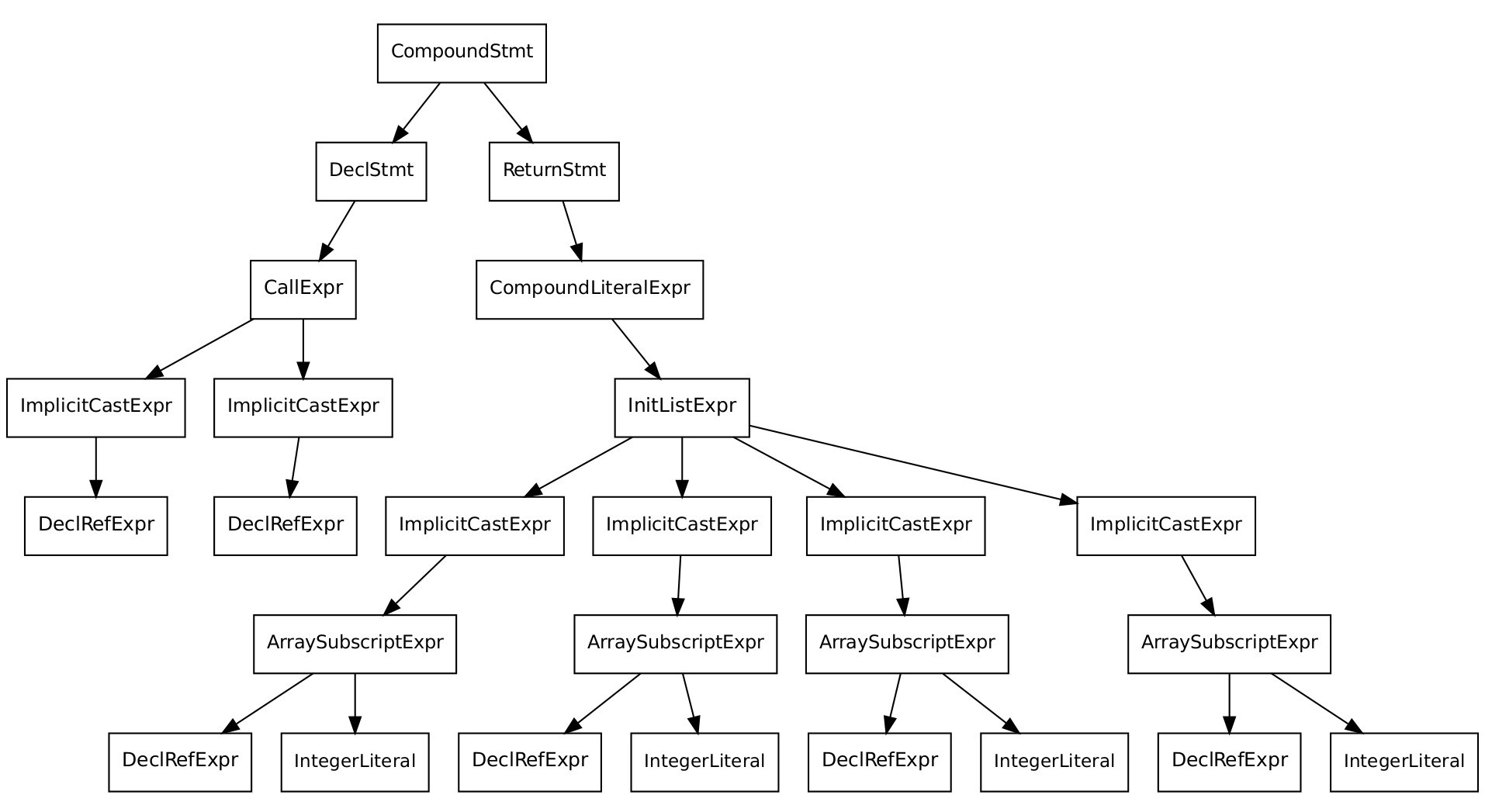
Finally, you can get a graphical representation of the tree in Graphviz (widely used for debugging in LLVM). This is done using the -ast-view option. Of course, in this case Graphviz should be installed and the paths to the files 'dot' and 'gv' should be registered. In this case, many windows will open, in each of which there will be a small section of AST, for example, this:
However, before continuing, I would like to briefly tell you what AST is and what it is for. Readers with a degree in Computer Science can boldly skip through the next section, and the rest may be interesting.
You can see strict definitions on Wikipedia, and I will try to explain “on fingers”.
An abstract syntax tree is a structure by which the compiler presents the source code of a program in a form convenient for further compilation. In the leaves of the tree are variables (to be precise, links to variable declarations) and constants, at other vertices are operators, data type declarations, etc. The root of the tree is the "translation unit" of the program.
For example, a simple program:
This gives rise to AST:
In the clang compiler, each AST node is represented by an object of a particular class, and there are only three base classes: clang :: Decl (declaration class), clang :: Stmt, which includes all the operators, and the clang :: Type class, a data type class.
So, clang is written in C ++ and has an object oriented API. You can use it to write various utilities and tools using clang. However, knowledgeable people prefer another API, clang-c, which is a wrapper over the clang API written in pure C. The meaning is simple: firstly, it is simpler, secondly, the clang-c API is stable, unlike the clang API, which changes with every release. Finally, using clang-c does not preclude the use of the clang API, which we will soon see.

The first thing to do is write a tree walk in depth. This is a completely standard operation:
Everything is very clear here: clang_parseTranslationUnit is a function that performs all compilation steps up to and including building the AST. Any compilation options can be passed to it. In this case, the file name can be passed both in arguments and directly (source_filename). The source text can be transmitted not only as a file, but also as a CXUnsavedFile structure representing the text in memory. After parsing, the tree is traversed in depth, for each vertex, the visitor function is called, to which CXCursor, a structure representing the top of the tree, is passed. Also, the CXClientData parameter representing arbitrary user data can be passed to the visitor function.
Let's try to find all the local program variables.
Everything here is also simple: CXCursor_VarDecl - the cursor points to a variable. dyn_cast_or_null - type conversion template in LLVM.
Next, we transform the cursor into an instance of the VarDecl class, and check whether the variable is local. If it is, we display the name of the cursor and its location in the source, using auxiliary functions for this:
To find the values of Decl, Expr and Stmt, we use auxiliary functions:
Next, we look for all uses of local variables:
And finally, we find all calls to functions not defined in this file:
Here we check if the cursor is a function call (CXCursor_CallExpr). However, it should be noted that CXCursor_CallExpr is not only a function call, it is also a call to the constructor, destructor and method, so an additional check (isa) is needed. After that, we look for the definition of the function (clang_getCursorDefinition), and if we do not find (clang_equalCursors (Definition, clang_getNullCursor ())), then we found a function not defined in this file.

For the test, we will write two simple programs, one in C, one in C ++.
So, the C program:
We run our utility, we get the output:
Everything seems to be right. Now check on the file in C ++:
We get the output:
OK, everything seems to work.
The extensive capabilities of clang can be used for a variety of purposes, which include parsing and transforming C, C ++, and Objective C sources.
List of sources on the topic:
1. Project code on Gihub .
2. http://bastian.rieck.ru/blog/posts/2015/baby_steps_libclang_ast/
3. http://bastian.rieck.ru/blog/posts/2016/baby_steps_libclang_function_extents/
4. https://jonasdevlieghere.com/ understanding-the-clang-ast /
5. https://habrahabr.ru/post/148508/
As expected, almost nothing special was found, but one announcement interested me. It contained the following lines:
“Who will we take“ without looking ”or the level of tasks to be performed:
You downloaded any open source project compiled with gcc (the amount of source code is more than 10 megabytes) and for the largest cpp file you were able to build an AST tree using clang with –fsyntax-only;
You downloaded any open source project built using Visual C ++ (the amount of source code is more than 10 megabytes) and for the largest cpp file you were able to build an AST tree using clang with –fsyntax-only;
You were able to write a utility that will highlight all places of declarations and use of local variables, as well as all functions not defined in this file . "
Well, I thought, no way, but entertainment for the evening.
The first two points are briefly reviewed, everything is very simple there.
How to build an AST
We take any project in c ++, you can clang itself (it is built on gcc and VC ++).
clang -std=c++11 -Xclang -ast-dump /путь/к/файлу/cpp -I/путь/к/директории/с/include/файлами -Dнужные_макросы -fsyntax-onlyWe get AST in text form. For a large file, AST is huge, I won’t give all ast-dump here, but for clarity, I’ll give a small piece:
Fragment of clang itself AST
TranslationUnitDecl 0x576e190 <>

|-TypedefDecl 0x576e718 <>  implicit __int128_t '__int128'

| `-BuiltinType 0x576e400 '__int128'

|-TypedefDecl 0x576e778 <>  implicit __uint128_t 'unsigned __int128'

| `-BuiltinType 0x576e420 'unsigned __int128'

|-TypedefDecl 0x576eaa8 <>  implicit __NSConstantString 'struct __NSConstantString_tag'

| `-RecordType 0x576e860 'struct __NSConstantString_tag'

|   `-CXXRecord 0x576e7c8 '__NSConstantString_tag'

|-TypedefDecl 0x576eb38 <>  implicit __builtin_ms_va_list 'char *'

| `-PointerType 0x576eb00 'char *'

|   `-BuiltinType 0x576e220 'char'

|-TypedefDecl 0x576ee58 <>  implicit referenced __builtin_va_list 'struct __va_list_tag [1]'

| `-ConstantArrayType 0x576ee00 'struct __va_list_tag [1]' 1

|   `-RecordType 0x576ec20 'struct __va_list_tag'

|     `-CXXRecord 0x576eb88 '__va_list_tag'

|-NamespaceDecl 0x57cc578  line:18:11 clang

| |-CXXRecordDecl 0x57cc5e0  col:7 class Decl

| |-CXXRecordDecl 0x57cc6a0 :2:1> col:1 referenced class AccessSpecDecl

| |-CXXRecordDecl 0x57cc760 :3:1> col:1 class BlockDecl

| |-CXXRecordDecl 0x57cc820 :4:1> col:1 class CapturedDecl

| |-CXXRecordDecl 0x57cc8e0 :5:1> col:1 referenced class ClassScopeFunctionSpecializationDecl

| |-CXXRecordDecl 0x57cc9a0 :6:1> col:1 class EmptyDecl

| |-CXXRecordDecl 0x57cca60 :7:1> col:1 class ExternCContextDecl

| |-CXXRecordDecl 0x57ccb20 :8:1> col:1 class FileScopeAsmDecl

| |-CXXRecordDecl 0x57ccbe0 :9:1> col:1 referenced class FriendDecl

| |-CXXRecordDecl 0x57ccca0 :10:1> col:1 referenced class FriendTemplateDecl

| |-CXXRecordDecl 0x57ccd60 :11:1> col:1 class ImportDecl

| |-CXXRecordDecl 0x57cce20 :12:1> col:1 class LinkageSpecDecl

| |-CXXRecordDecl 0x57ccee0 :13:1> col:1 class NamedDecl

| |-CXXRecordDecl 0x57ccfa0 :14:1> col:1 class LabelDecl

| |-CXXRecordDecl 0x57cd060 :15:1> col:1 class NamespaceDecl

| |-CXXRecordDecl 0x57cd120 :16:1> col:1 class NamespaceAliasDecl
You can also get the tree with another option: -ast-print. It will also be textual and huge, and I will not give it either.
Finally, you can get a graphical representation of the tree in Graphviz (widely used for debugging in LLVM). This is done using the -ast-view option. Of course, in this case Graphviz should be installed and the paths to the files 'dot' and 'gv' should be registered. In this case, many windows will open, in each of which there will be a small section of AST, for example, this:
However, before continuing, I would like to briefly tell you what AST is and what it is for. Readers with a degree in Computer Science can boldly skip through the next section, and the rest may be interesting.
Abstract Syntax Tree
You can see strict definitions on Wikipedia, and I will try to explain “on fingers”.
An abstract syntax tree is a structure by which the compiler presents the source code of a program in a form convenient for further compilation. In the leaves of the tree are variables (to be precise, links to variable declarations) and constants, at other vertices are operators, data type declarations, etc. The root of the tree is the "translation unit" of the program.
For example, a simple program:
// file foo.h
void foo(int x, int y);
// file main.c
#include "foo.h"
typedef struct {
	int x, y;
} st_coord;
int main() {
	st_coord coord;
	foo(coord.x, coord.y);
}
This gives rise to AST:
Many letters
TranslationUnitDecl 0x4e64ad0 <>
| -TypedefDecl 0x4e65018 <> implicit __int128_t '__int128'
| `-BuiltinType 0x4e64d40 '__int128'
| -TypedefDecl 0x4e65078 <> implicit __uint128_t 'unsigned __int128'
| `-BuiltinType 0x4e64d60 'unsigned __int128'
| -TypedefDecl 0x4e65338 <> implicit __NSConstantString 'struct __NSConstantString_tag'
| `-RecordType 0x4e65150 'struct __NSConstantString_tag'
| `-Record 0x4e650c8 '__NSConstantString_tag'
| -TypedefDecl 0x4e653c8 <> implicit __builtin_ms_va_list 'char *'
| `-PointerType 0x4e65390 'char *'
| `-BuiltinType 0x4e64b60 'char'
| -TypedefDecl 0x4e65678 <> implicit __builtin_va_list 'struct __va_list_tag [1]'
| `-ConstantArrayType 0x4e65620 'struct __va_list_tag [1]' 1
| `-RecordType 0x4e654a0 'struct __va_list_tag'
| `-Record 0x4e65418 '__va_list_tag'
| -FunctionDecl 0x4ebc390 col: 6 used foo 'void (int, int)'
| | -ParmVarDecl 0x4e656d8col: 14 x 'int'
| `-ParmVarDecl 0x4e65748col: 21 y 'int'
| -RecordDecl 0x4ebc488 line: 3: 9 struct definition
| | -FieldDecl 0x4ebc540col: 6 referenced x 'int'
| `-FieldDecl 0x4ebc598col: 9 referenced y 'int'
| -TypedefDecl 0x4ebc630col: 3 referenced st_coord 'struct st_coord': 'st_coord'
| `-ElaboratedType 0x4ebc5e0 'struct st_coord' sugar
| `-RecordType 0x4ebc510 'st_coord'
| `` -Record 0x4ebc488 ''
`` -FunctionDecl 0x4ebc6e8line: 7: 5 main 'int ()'
`-CompoundStmt 0x4ebc9c8
| -DeclStmt 0x4ebc820
| `-VarDecl 0x4ebc7c0col: 11 used coord 'st_coord': 'st_coord'
`-CallExpr 0x4ebc960'void'
| -ImplicitCastExpr 0x4ebc948 'void (*) (int, int)'
| `-DeclRefExpr 0x4ebc838'void (int, int)' Function 0x4ebc390 'foo' 'void (int, int)'
| -ImplicitCastExpr 0x4ebc998 'int'
| `-MemberExpr 0x4ebc888'int' lvalue .x 0x4ebc540
| `-DeclRefExpr 0x4ebc860'st_coord': 'st_coord' lvalue Var 0x4ebc7c0 'coord' 'st_coord': 'st_coord'
`-ImplicitCastExpr 0x4ebc9b0 'int'
`-MemberExpr 0x4ebc8e8'int' lvalue .y 0x4ebc598
`-DeclRefExpr 0x4ebc8c0 'st_coord': 'st_coord' lvalue Var 0x4ebc7c0 'coord' 'st_coord': 'st_coord'
| -TypedefDecl 0x4e65018 <
| `-BuiltinType 0x4e64d40 '__int128'
| -TypedefDecl 0x4e65078 <
| `-BuiltinType 0x4e64d60 'unsigned __int128'
| -TypedefDecl 0x4e65338 <
| `-RecordType 0x4e65150 'struct __NSConstantString_tag'
| `-Record 0x4e650c8 '__NSConstantString_tag'
| -TypedefDecl 0x4e653c8 <
| `-PointerType 0x4e65390 'char *'
| `-BuiltinType 0x4e64b60 'char'
| -TypedefDecl 0x4e65678 <
| `-ConstantArrayType 0x4e65620 'struct __va_list_tag [1]' 1
| `-RecordType 0x4e654a0 'struct __va_list_tag'
| `-Record 0x4e65418 '__va_list_tag'
| -FunctionDecl 0x4ebc390 col: 6 used foo 'void (int, int)'
| | -ParmVarDecl 0x4e656d8
| `-ParmVarDecl 0x4e65748
| -RecordDecl 0x4ebc488 line: 3: 9 struct definition
| | -FieldDecl 0x4ebc540
| `-FieldDecl 0x4ebc598
| -TypedefDecl 0x4ebc630
| `-ElaboratedType 0x4ebc5e0 'struct st_coord' sugar
| `-RecordType 0x4ebc510 'st_coord'
| `` -Record 0x4ebc488 ''
`` -FunctionDecl 0x4ebc6e8
`-CompoundStmt 0x4ebc9c8
| -DeclStmt 0x4ebc820
| `-VarDecl 0x4ebc7c0
`-CallExpr 0x4ebc960
| -ImplicitCastExpr 0x4ebc948
| `-DeclRefExpr 0x4ebc838
| -ImplicitCastExpr 0x4ebc998
| `-MemberExpr 0x4ebc888
| `-DeclRefExpr 0x4ebc860
`-ImplicitCastExpr 0x4ebc9b0
`-MemberExpr 0x4ebc8e8
`-DeclRefExpr 0x4ebc8c0
Using the clang-c API
In the clang compiler, each AST node is represented by an object of a particular class, and there are only three base classes: clang :: Decl (declaration class), clang :: Stmt, which includes all the operators, and the clang :: Type class, a data type class.
So, clang is written in C ++ and has an object oriented API. You can use it to write various utilities and tools using clang. However, knowledgeable people prefer another API, clang-c, which is a wrapper over the clang API written in pure C. The meaning is simple: firstly, it is simpler, secondly, the clang-c API is stable, unlike the clang API, which changes with every release. Finally, using clang-c does not preclude the use of the clang API, which we will soon see.
AST tree traversal
The first thing to do is write a tree walk in depth. This is a completely standard operation:
#include
#include
#include
using namespace clang;
void printCursor(CXCursor cursor) {
    CXString displayName = clang_getCursorDisplayName(cursor);
    std::cout << clang_getCString(displayName) << "\n";
    clang_disposeString(displayName);
}
CXChildVisitResult visitor( CXCursor cursor, CXCursor /* parent */, CXClientData /*clientData*/ )
{
    CXSourceLocation location = clang_getCursorLocation( cursor );
    if( clang_Location_isFromMainFile( location ) == 0 )
        return CXChildVisit_Continue;
    printCursor(cursor);
    clang_visitChildren( cursor, visitor, nullptr );
    return CXChildVisit_Continue;
}
int main (int argc, char** argv) {
    CXIndex index = clang_createIndex (
        0, // excludeDeclarationFromPCH
        1  // displayDiagnostics
        );
    CXTranslationUnit unit = clang_parseTranslationUnit (
        index, // CIdx
        0, // source_filename
        argv, // command_line_args
        argc, // num_command_line_args
        0, // unsave_files
        0, // num_unsaved_files
        CXTranslationUnit_None // options
        );
    if (!unit) {
        std::cout << "Translation unit was not created\n";
    }
    else {
        CXCursor root = clang_getTranslationUnitCursor(unit);
        clang_visitChildren(root, visitor, nullptr);
    }
    clang_disposeTranslationUnit(unit);
    clang_disposeIndex(index);
}
Everything is very clear here: clang_parseTranslationUnit is a function that performs all compilation steps up to and including building the AST. Any compilation options can be passed to it. In this case, the file name can be passed both in arguments and directly (source_filename). The source text can be transmitted not only as a file, but also as a CXUnsavedFile structure representing the text in memory. After parsing, the tree is traversed in depth, for each vertex, the visitor function is called, to which CXCursor, a structure representing the top of the tree, is passed. Also, the CXClientData parameter representing arbitrary user data can be passed to the visitor function.
We write the visitor function
Let's try to find all the local program variables.
 CXCursorKind cursorKind = clang_getCursorKind( cursor );
    // finding local variables
    if(clang_getCursorKind(cursor) == CXCursor_VarDecl) {
        if(const VarDecl* VD = dyn_cast_or_null(getCursorDecl(cursor))) {
            if( VD->isLocalVarDecl()) {
                std::cout << "local variable: ";
                printCursor(cursor);
            }
        }
    }
Everything here is also simple: CXCursor_VarDecl - the cursor points to a variable. dyn_cast_or_null - type conversion template in LLVM.
LLVM and RTTI
LLVM does not use RTTI and normal dynamic_cast will not work.
The following templates are used for type casting in LLVM:
isa (A) - checking whether the object A belongs to type B.
cast (A) - converting the object A to type B. The type A is not checked for type B. Checking A for nullptr fails.
cast_or_null (A) —convert object A to type B. A type A type B type is not checked. If A == nullptr, the result will be nullptr.
dyn_cast (A) - conversion of object A to type B with type checking. Checking A for nullptr fails.
dyn_cast_or_null (A) - conversion of object A to type B with type checking. If A == nullptr, the result will be nullptr.
How to use the LLVM implementation of RTTI in their classes is written here.
The following templates are used for type casting in LLVM:
isa (A) - checking whether the object A belongs to type B.
cast (A) - converting the object A to type B. The type A is not checked for type B. Checking A for nullptr fails.
cast_or_null (A) —convert object A to type B. A type A type B type is not checked. If A == nullptr, the result will be nullptr.
dyn_cast (A) - conversion of object A to type B with type checking. Checking A for nullptr fails.
dyn_cast_or_null (A) - conversion of object A to type B with type checking. If A == nullptr, the result will be nullptr.
How to use the LLVM implementation of RTTI in their classes is written here.
Next, we transform the cursor into an instance of the VarDecl class, and check whether the variable is local. If it is, we display the name of the cursor and its location in the source, using auxiliary functions for this:
//logging functions
std::string getLocationString(CXSourceLocation Loc) {
    CXFile File;
    unsigned Line, Column;
    clang_getFileLocation(Loc, &File, &Line, &Column, nullptr);
    CXString FileName = clang_getFileName(File);
    std::ostringstream ostr;
    ostr << clang_getCString(FileName) << ":" << Line << ":" << Column;
    clang_disposeString(FileName);
    return ostr.str();
}
void printCursor(CXCursor cursor) {
    CXString displayName = clang_getCursorDisplayName(cursor);
    std::cout << clang_getCString(displayName) << "@" << getLocationString(clang_getCursorLocation(cursor)) << "\n";
    clang_disposeString(displayName);
}
To find the values of Decl, Expr and Stmt, we use auxiliary functions:
// extracted from CXCursor.cpp
const Decl *getCursorDecl(CXCursor Cursor) {
    return static_cast(Cursor.data[0]);
}
const Stmt *getCursorStmt(CXCursor Cursor) {
    if (Cursor.kind == CXCursor_ObjCSuperClassRef ||
            Cursor.kind == CXCursor_ObjCProtocolRef ||
            Cursor.kind == CXCursor_ObjCClassRef)
        return nullptr;
    return static_cast(Cursor.data[1]);
}
const Expr *getCursorExpr(CXCursor Cursor) {
    return dyn_cast_or_null(getCursorStmt(Cursor));
}
Next, we look for all uses of local variables:
// finding referenced variables
    if(cursorKind == CXCursor_DeclRefExpr) {
        if(const DeclRefExpr* DRE = dyn_cast_or_null(getCursorExpr(cursor))) {
            if(const VarDecl* VD = dyn_cast_or_null(DRE->getDecl())) {
                if(VD->isLocalVarDecl()) {
                    std::cout << "reference to local variable: ";
                    printCursor(cursor);
                }
            }
        }
    }
And finally, we find all calls to functions not defined in this file:
    // finding functions not defined in the module
    if(cursorKind == CXCursor_CallExpr) {
        if (const Expr *E = getCursorExpr(cursor)) {
            if(isa(E)) {
                CXCursor Definition = clang_getCursorDefinition(cursor);
                if (clang_equalCursors(Definition, clang_getNullCursor())) {
                    std::cout << "function is not defined here: ";
                    printCursor(cursor);
                }
            }
        }
    }
Here we check if the cursor is a function call (CXCursor_CallExpr). However, it should be noted that CXCursor_CallExpr is not only a function call, it is also a call to the constructor, destructor and method, so an additional check (isa) is needed. After that, we look for the definition of the function (clang_getCursorDefinition), and if we do not find (clang_equalCursors (Definition, clang_getNullCursor ())), then we found a function not defined in this file.
Test
For the test, we will write two simple programs, one in C, one in C ++.
So, the C program:
//file func.h
void foo_ext(int x);
//file simple.c
#include "func.h"
int global1;
int foo(int x)
{
    return x;
}
int global2;
int main(int arg)
{
    int local;
    local = arg;
    foo_ext(arg);
    return foo(local);
}
We run our utility, we get the output:
local variable: [email protected]:13:9
reference to local variable: [email protected]:14:5
function is not defined here: [email protected]:15:5
reference to local variable: [email protected]:16:16
Everything seems to be right. Now check on the file in C ++:
#include "func.h"
class MyClass {
    public:
    MyClass() {
        int SomeLocal_1;
    }
    void foo() {
        int SomeLocal_2;
    }
    ~MyClass() {
        int SomeLocal_3;
    }
};
MyClass myClass_global;
int foo(int x) {return 0;}
int main(int argc, char** argv)
{
    int local;
    MyClass myClass_local;
    foo(argc);
    foo_ext(local);
    return 1;
}
We get the output:
local variable: [email protected]:6:13
local variable: [email protected]:9:13
local variable: [email protected]:12:13
local variable: [email protected]:22:9
local variable: [email protected]:23:13
function is not defined here: [email protected]:25:5
reference to local variable: [email protected]:25:13
OK, everything seems to work.
How can this be used?
The extensive capabilities of clang can be used for a variety of purposes, which include parsing and transforming C, C ++, and Objective C sources.
Yet
You can also use it to search for work, but while I was writing all this, the ad disappeared from the site. Alas.
Literature
List of sources on the topic:
1. Project code on Gihub .
2. http://bastian.rieck.ru/blog/posts/2015/baby_steps_libclang_ast/
3. http://bastian.rieck.ru/blog/posts/2016/baby_steps_libclang_function_extents/
4. https://jonasdevlieghere.com/ understanding-the-clang-ast /
5. https://habrahabr.ru/post/148508/