August 9, 2016 at 14:48
Cambium cnPilot - inexpensive wifi that surprised us
It's no secret that there are a lot of WiFi solutions on the market right now. You can even say that too much - eyes run wide. And it’s not just about “consumer” home “dirtrist”, which you can buy a thousand and never repeat under any brand in any case: we’re talking about systems that are positioned as equipment for building large WiFi networks with centralized control . This means that we do not just put dozens of APs in one place (hereinafter referred to as the access point), but also configure them in such a way that either they all know about each other and take into account each other’s frequencies during radio planning, they hand over clients, or any separate network node immediately controls all as one large network.
Otherwise, the installation of a large number of access points within the visibility of each other will not improve, but rather worsen the situation due to mutual interference and loss of communication by customers when switching between points.
If you look closely at the whole variety of corporate solutions, then you can conditionally divide them into two large groups:
1.Productive enterprise solutions from well-known manufacturers, players of the first division: Cisco, Ruckus, Aruba. These systems have excellent performance, scalability, allow you to build networks for thousands of access points, support a seamless handover, 3G-offload, can integrate with any registration systems via SMS ... and yet, there’s a lot more other functionality. Alas, the cost of decisions of this echelon starts from the values of the order of $ 500 per "point-to-place" (access point plus location and license on the controller). Naturally, in many projects, especially constrained by the budgetary framework, even after applying all the discounts, such a price is indicated, frankly, protective.
2.Something completely cheap: Ubiquiti, MikroTik and hundreds of others. They bribe their price in the range of 80-200 dollars for a modern access point, but cheapness is fraught with many unpleasant surprises - limited package performance, problems with a large number of subscribers to TDs (more than 15, that is, quite a bit). The controller of such a network actually turns out to be a monitoring and application system of settings, there is no really working handover (often what is, it can be called handover only if you register this word as the name of the technology), there is no WISPr. The scalability of solutions in practice is limited to a hundred or two APs (or even substantially less than a hundred), and it’s better not to think about high-dense implementations (and generally a bit overloaded network with demanding services such as voice transfer). Verified by many of our partners.
Is it possible to combine the best of two worlds and get functionality at an affordable cost? Why not.
There are already publications on Cambium products on our blog, for example, hereAt that time, we tested the new Cambium 650 RRL. Cambium, the proud heirs of the famous Motorola Canopy, began building new equipment based on time-tested solutions and gradually modernizing and making them cheaper, purposefully move from the expensive point-to-point links of the PTP 650 and 8xx series and expensive PMP 450 point-to-multipoint systems on proprietary transport protocols towards not yet cheap, but much more functional and reliable than Ubiquiti ePMP point-to-multipoint systems. This series, which was codenamed Avenger in development, has come a long way in its development and several software revisions back got the opportunity to work with clients not only according to “their” transport protocols, but also according to the usual and well-understood 802.11. The result of this work we see in a serious increase in ePMP sales - operators,
It is logical that, developing a product line for operators, Cambium now offers a WiFi solution. Moreover, with the same features that operators in EPMP already liked, that is, scalable, manageable, productive and inexpensive. On the one hand, there are few models, and on the other, it’s enough for any application.
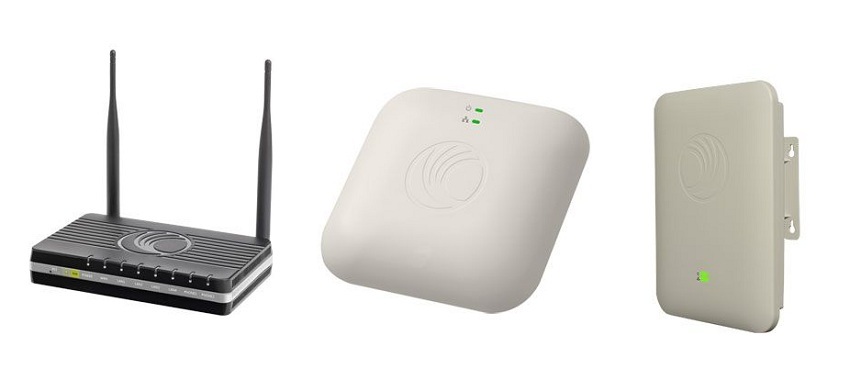
Firstly, these are the so-called home routers - devices, in addition to TDs, which include a cable Ethernet switch and ports for connecting telephone lines. Why do we need more players in this saturated, before precipitation, market? And then, since this particular device can be controlled by the operator, this same operator can now see the network connectivity and status of links directly to subscriber devices, and not to its CPE port .

In fact, under the 200/201 index there are several models that differ in support for 802.11ac (201) or simpler 802.11n (200), the presence or absence of PoE Out for ePMP and RJ-11 ports.
Secondly, for offices, Cambium offers a modern dual-channel 802.11ac wave 1 access point that fits into the energy consumption of the 802.3af standard. The device is compact, with support for 16 SSIDs, efficient (unlike Ubiquiti) traffic prioritization and, which is not very characteristic for this price segment, seamless roaming (IEEE 802.11r).

Thirdly, these are the new all-weather dual-band 802.11ac access points with integrated antennas in a compact IP67 package. It seems like nothing special, a typical middle-class Enterprise solution: two gigabit ports with support for 802.3af, two two-channel 802.11ac Wave 1 radio modules. But the prices were surprising - see the table at the end of the article ...

It is easier and more visual to consider the general functionality of the solution in comparison:
The general conclusion that can be drawn from these several comparison parameters is that Cambium is significantly closer to recognized enterprise solutions than the usual UniFi. First of all, of course, the support for seamless roaming is striking - something that was always lacking on Ubiquiti and that they unsuccessfully tried to add with the Zero Handoff function (the actual inoperability of which forced the manufacturer to abandon it). The second important point is the HotSpot 2.0 service, which allows you to save the user from the need for Web authentication in each new network - pay for a subscription to one operator, and connect to the networks of all its partners: that is, regardless of the SSID, it allows you to organize an analogue of roaming in cellular networks.

A few words must be said about the network management system. It is called cnMaesto, and its full review will take a whole separate article, or even a small training course. First of all, this system is not just a simple utility for applying the settings to the selected group of APs, but a powerful monitoring and configuration complex for a large heterogeneous wireless network into which you can enter and manage all types of Cambium equipment, from RRL to home router.

In short, cnMaestro is capable of simultaneously creating thousands of objects (that is, entering into the system immediately entire “bushes” of the last mile, for example on ePMP1000, and hundreds of home routers connected to subscriber households), while using its flexible network settings according to flexible templates, (and also immediately name them by templates, group, configure radio modules, and so on - the syntax of the templates at this stage is already flexible enough to automate almost any task that occurs when the equipment is put into operation). Scheduled software updates by groups of devices, monitoring of all key parameters of radio connections at any stage - the system is designed to provide comfortable control of large radio networks. Unlike other solutions, for example from Ubiquiti or Xclaim, cnMaestro leaves it possible to distribute all network points to its own network settings, that is, not only controls the use of radio settings, but also allows you to configure, for example, a tunnel to the provider at each point.
cnMaestro is available both in the form of a cloud and a local image, which is especially nice for our operators who do not trust the clouds. It is located at the address and currently requires a single Cambium support login for registration (obtained free of charge in the Support section of the site). At the time of publication of the article, there is one restriction for the controller in its free version: the number of managed elements cannot be more than 2500, this number includes both the base and the ePMP point-to-multipoint subscriber modules and the subscriber TDs. The requirements for system resources in the cloud version, of course, are limited by the requirements for the browser in which the system interface will be displayed, the requirements for local installation (the virtual machine is available for download in the corresponding support section on the manufacturer’s website the following:
Thus, Cambium now provides the opportunity to relatively inexpensively build a carrier-level WiFi with sufficient functionality and, most importantly, flexible and convenient monitoring and control. Warning the question "How inexpensive?", We will announce the recommended prices:
Access points are already in stock, you can try. Do we have checked, they were amazed and ready to become the results of comparative testing Ruckus, Cambium and Ubiquiti. Follow our publications!
Otherwise, the installation of a large number of access points within the visibility of each other will not improve, but rather worsen the situation due to mutual interference and loss of communication by customers when switching between points.
If you look closely at the whole variety of corporate solutions, then you can conditionally divide them into two large groups:
1.Productive enterprise solutions from well-known manufacturers, players of the first division: Cisco, Ruckus, Aruba. These systems have excellent performance, scalability, allow you to build networks for thousands of access points, support a seamless handover, 3G-offload, can integrate with any registration systems via SMS ... and yet, there’s a lot more other functionality. Alas, the cost of decisions of this echelon starts from the values of the order of $ 500 per "point-to-place" (access point plus location and license on the controller). Naturally, in many projects, especially constrained by the budgetary framework, even after applying all the discounts, such a price is indicated, frankly, protective.
2.Something completely cheap: Ubiquiti, MikroTik and hundreds of others. They bribe their price in the range of 80-200 dollars for a modern access point, but cheapness is fraught with many unpleasant surprises - limited package performance, problems with a large number of subscribers to TDs (more than 15, that is, quite a bit). The controller of such a network actually turns out to be a monitoring and application system of settings, there is no really working handover (often what is, it can be called handover only if you register this word as the name of the technology), there is no WISPr. The scalability of solutions in practice is limited to a hundred or two APs (or even substantially less than a hundred), and it’s better not to think about high-dense implementations (and generally a bit overloaded network with demanding services such as voice transfer). Verified by many of our partners.
Is it possible to combine the best of two worlds and get functionality at an affordable cost? Why not.
There are already publications on Cambium products on our blog, for example, hereAt that time, we tested the new Cambium 650 RRL. Cambium, the proud heirs of the famous Motorola Canopy, began building new equipment based on time-tested solutions and gradually modernizing and making them cheaper, purposefully move from the expensive point-to-point links of the PTP 650 and 8xx series and expensive PMP 450 point-to-multipoint systems on proprietary transport protocols towards not yet cheap, but much more functional and reliable than Ubiquiti ePMP point-to-multipoint systems. This series, which was codenamed Avenger in development, has come a long way in its development and several software revisions back got the opportunity to work with clients not only according to “their” transport protocols, but also according to the usual and well-understood 802.11. The result of this work we see in a serious increase in ePMP sales - operators,
It is logical that, developing a product line for operators, Cambium now offers a WiFi solution. Moreover, with the same features that operators in EPMP already liked, that is, scalable, manageable, productive and inexpensive. On the one hand, there are few models, and on the other, it’s enough for any application.
Home routers
Firstly, these are the so-called home routers - devices, in addition to TDs, which include a cable Ethernet switch and ports for connecting telephone lines. Why do we need more players in this saturated, before precipitation, market? And then, since this particular device can be controlled by the operator, this same operator can now see the network connectivity and status of links directly to subscriber devices, and not to its CPE port .
In fact, under the 200/201 index there are several models that differ in support for 802.11ac (201) or simpler 802.11n (200), the presence or absence of PoE Out for ePMP and RJ-11 ports.
WiFi for offices
Secondly, for offices, Cambium offers a modern dual-channel 802.11ac wave 1 access point that fits into the energy consumption of the 802.3af standard. The device is compact, with support for 16 SSIDs, efficient (unlike Ubiquiti) traffic prioritization and, which is not very characteristic for this price segment, seamless roaming (IEEE 802.11r).
Street wifi
Thirdly, these are the new all-weather dual-band 802.11ac access points with integrated antennas in a compact IP67 package. It seems like nothing special, a typical middle-class Enterprise solution: two gigabit ports with support for 802.3af, two two-channel 802.11ac Wave 1 radio modules. But the prices were surprising - see the table at the end of the article ...
Comparison with competitors
It is easier and more visual to consider the general functionality of the solution in comparison:
| Manufacturer | Ubiquiti | Cambium | Ruckus | Cisco |
| Model | UAP-AC-PRO / Outdoor | E400 / E500 | R310 / T300 | 1700/1562 |
| Number of Radio Modules | 2, 802.11ac W1 | 2, 802.11ac W1 | 2, 802.11ac W1 | 2, 802.11ac W1 / 2 |
| Mimo | 3x3 | 2x2 | 2x2 | 3x3 |
| Nutrition | 802.3af | 802.3af | 802.3af | 802.3at |
| Seamless roaming | Not | Yes, 802.11r and OKC | Yes, 802.11r and OKC | Yes, 802.11r and OKC |
| SSID | 4 on the radio | 16 on the radio | 8 on the radio | 16 on the radio |
| VLAN | On SSID | On SSID or client | On SSID or client | On SSID or client |
| Controller | Software x86, cloud, arm | Software x86, cloud | Software x86, hardware | Software x86, hardware |
| Hotspot 2.0 | Not | Yes | Yes | Yes |
Functional Conclusions
The general conclusion that can be drawn from these several comparison parameters is that Cambium is significantly closer to recognized enterprise solutions than the usual UniFi. First of all, of course, the support for seamless roaming is striking - something that was always lacking on Ubiquiti and that they unsuccessfully tried to add with the Zero Handoff function (the actual inoperability of which forced the manufacturer to abandon it). The second important point is the HotSpot 2.0 service, which allows you to save the user from the need for Web authentication in each new network - pay for a subscription to one operator, and connect to the networks of all its partners: that is, regardless of the SSID, it allows you to organize an analogue of roaming in cellular networks.
Network management system
A few words must be said about the network management system. It is called cnMaesto, and its full review will take a whole separate article, or even a small training course. First of all, this system is not just a simple utility for applying the settings to the selected group of APs, but a powerful monitoring and configuration complex for a large heterogeneous wireless network into which you can enter and manage all types of Cambium equipment, from RRL to home router.
In short, cnMaestro is capable of simultaneously creating thousands of objects (that is, entering into the system immediately entire “bushes” of the last mile, for example on ePMP1000, and hundreds of home routers connected to subscriber households), while using its flexible network settings according to flexible templates, (and also immediately name them by templates, group, configure radio modules, and so on - the syntax of the templates at this stage is already flexible enough to automate almost any task that occurs when the equipment is put into operation). Scheduled software updates by groups of devices, monitoring of all key parameters of radio connections at any stage - the system is designed to provide comfortable control of large radio networks. Unlike other solutions, for example from Ubiquiti or Xclaim, cnMaestro leaves it possible to distribute all network points to its own network settings, that is, not only controls the use of radio settings, but also allows you to configure, for example, a tunnel to the provider at each point.
cnMaestro is available both in the form of a cloud and a local image, which is especially nice for our operators who do not trust the clouds. It is located at the address and currently requires a single Cambium support login for registration (obtained free of charge in the Support section of the site). At the time of publication of the article, there is one restriction for the controller in its free version: the number of managed elements cannot be more than 2500, this number includes both the base and the ePMP point-to-multipoint subscriber modules and the subscriber TDs. The requirements for system resources in the cloud version, of course, are limited by the requirements for the browser in which the system interface will be displayed, the requirements for local installation (the virtual machine is available for download in the corresponding support section on the manufacturer’s website the following:
| Number of devices | Required amount of vCPU | Required RAM, in GB |
| 1 to 100 | 2 | 2 |
| 101 to 1000 | 4 | 4 |
| From 1001 | 4 | 8 |
Price comparison
Thus, Cambium now provides the opportunity to relatively inexpensively build a carrier-level WiFi with sufficient functionality and, most importantly, flexible and convenient monitoring and control. Warning the question "How inexpensive?", We will announce the recommended prices:
| Manufacturer | Indoor model | Price | Outdoor model | Price |
| Ubiquiti | UAP AC PRO | $ 149 | UAP AC outdoor | $ 489 |
| Cambium | E400 | $ 269 | E500 | $ 469 |
| Ruckus | R310 | $ 670 | T300 | $ 1900 |
| Cisco | 1702 | $ 695 | 1562 | $ 1695 |
Access points are already in stock, you can try. Do we have checked, they were amazed and ready to become the results of comparative testing Ruckus, Cambium and Ubiquiti. Follow our publications!