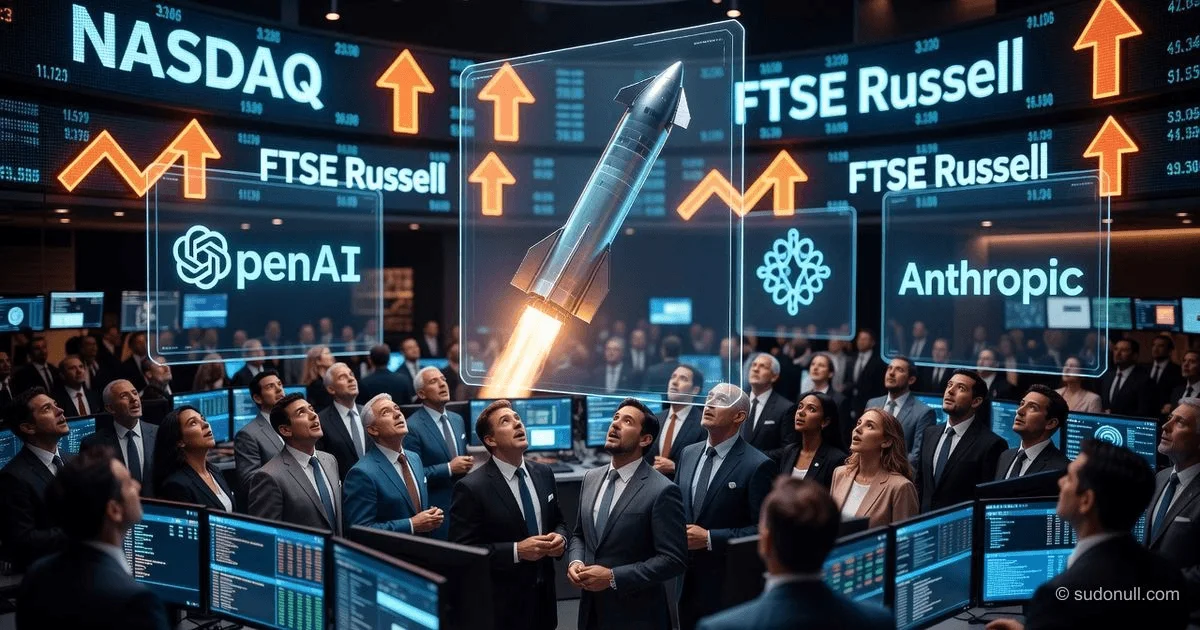
Index Providers to Accelerate Inclusion of AI Giant Stocks
Nasdaq and FTSE Russell will change rules to fast-track inclusion of SpaceX, Anthropic, and OpenAI shares in their flagship indices. This could trigger extreme demand from index-tracking ETFs.
The market stands on the brink of perhaps the most significant capital reallocation in decades. While the public debates the prospects of artificial intelligence or space tourism, the rules of the game are quietly changing. What we are seeing now is not just a technical tweak to index committee regulations. It is a tectonic shift that breaks the logic of passive investing that has existed since the dot-com crash. As an analyst working at the intersection of algorithmic trading and structural arbitrage, I can say one thing: we are headed for a "collapse" of the liquidity premium that Goldman Sachs and JPMorgan are already modeling but afraid to voice aloud.
[The Core]: What Is Really Happening
Let's strip away the official language. Nasdaq and FTSE Russell have officially announced plans to "accelerate inclusion" of giants like SpaceX, Anthropic, and OpenAI into their flagship indices. Translating from press-release speak to money talk: they are simultaneously lowering the minimum public trading period requirement. Now just 15 trading days for the Nasdaq-100 and, get this, only 5 days for Russell indices.
But why now and not two years ago? Because we are dealing with a new phenomenon—"private unicorns" whose capitalization in private rounds already exceeds 95% of S&P 500 companies. SpaceX is targeting a valuation of around $1.75 trillion. This is not a startup—it is already a ready-made empire that decided to go public for liquidity, not for money.
Mainstream media writes: "ETFs will be forced to buy shares to match the index." That's true, but only the tip of the iceberg. The real story is different: index regulators have created a mechanism of forced market capture. Previously, passive funds were "price takers"—they entered an asset after the market found a fair price and volatility subsided. Now they are turning into "first-hour market makers." Rules are being rewritten for specific IPOs to guarantee the success of the offering at any cost.
I see a direct parallel to the Kodak incident in 2020, but multiplied by a thousand. Back then, sudden index inclusion forced ETFs to buy shares at $60, even though intrinsic value was much lower. Now the situation is exacerbated by the fact that the free float (shares available for public trading) for these AI giants will be minuscule—according to State Street estimates, around 2.5% to 5%. Imagine: a narrow stream of supply hit by an avalanche of demand worth tens of billions of dollars. The price impulse will be extreme, like a point-blank shot.
[Timeline and Context]
Pay attention to the chronology of events—it reveals the whole backstory. Back in March 2026, Bloomberg reported that S&P, Nasdaq, and FTSE Russell were simultaneously "studying the possibility" of changes. That was market sounding. But on May 1, 2026, Nasdaq officially introduces "Fast Entry." And on June 5, S&P Dow Jones unexpectedly states: "No, we will not change the rules. Wait 12 months and show a profit."
Why did the S&P 500 stay out? Because they protect the planet's "main asset"—the dollar and trust in US pension funds. The S&P 500 is the "granddaddy" of all indices, where 401(k) accounts are invested. If you stuff SpaceX with losses of $4.94 billion for 2025 (and such data exists in the prospectus) into it, the entire passive investing structure built on the idea of "safe diversification" will crack.
But S&P's loss is Nasdaq's gain. Nasdaq won the competitive battle for SpaceX's listing not just with tax incentives, but with guaranteed index inclusion. This is called "conditional listing": you choose our exchange, and in 15 days we will pour money from thousands of ETFs into your shares. It is an anti-competitive practice disguised as a technical regulation update.
Breaking it down by numbers:
- Nasdaq-100: inclusion after 15 days (since May 2026).
- FTSE Russell: after 5 days.
- MSCI: at the first quarterly review (roughly 2-3 months).
- S&P 500: only after 12 months and subject to GAAP profitability.
Thus, the market now has an arbitrage time gap. The same asset will trade in some ETFs and be absent from others for nearly a year. Smart hedge funds are already preparing spread strategies to profit from this desynchronization.
[Who Wins and Who Loses]
The obvious winners are insiders and venture funds. Early SpaceX investors, such as Founders Fund or Elon Musk himself, get a unique opportunity to exit at a huge premium. Bloomberg Intelligence estimates passive demand inflow for SpaceX at around $14 billion. That's money legally required to hit the market within the first two weeks of trading. Venture capitalists will use this liquidity to dump positions at inflated prices to passive retail investors. It's a classic "pump and dump" scheme, but at the global infrastructure level.
The most interesting part is who loses in this scheme. The loser is the retail investor who buys ETFs "forever." They will fall victim to massive slippage. Index funds will buy shares not at fundamental value, but at the bid price during the chaotic early days of trading. When the dust settles, the price will return to reality—but ETF portfolios will already contain assets overvalued by 30-40%. I remind you that SpaceX, according to public data from Q1 2026, continues to incur losses, having absorbed the unprofitable xAI (which lost $2.47 billion on revenue of $818 million). This is not stable cash flow; it's a capital black hole.
Also losing are European ETF providers with strict replication. UCITS funds typically rebalance quarterly, and they physically cannot buy these assets as quickly as their US counterparts. This will create a divergence in NAV between US and European versions of the same index. The spread could reach 2-3%, which is anomalous for passive instruments.
[What the Media Isn't Saying]
The media writes about "demand" but stays silent about "structural supply deficit." Securities brokers are already sounding the alarm: there will be no shares available for shorting at all. Normally, a healthy market has longs and shorts, but with a free float of 2.5% and ETF buying obligations, the short interest ratio could go to infinity. This is a perfect storm for a short squeeze in the first few days, but with the opposite sign—a "long squeeze" where there is no one to sell to.
A non-obvious insight: the problem with voting shares. SpaceX plans to issue a class of shares with reduced (or zero) voting rights for the public market. Indices that include the company will formally get weight in capitalization, but minority shareholders will get zero control. This breaks the logic of corporate governance in indices. Previously, it was assumed that an index fund, owning a stake in a company, votes for the board of directors. Now, technically, the ETF will own "dummy" shares. The SEC is silent for now because it doesn't know how to classify this hybrid.
And most importantly, what is not being said: the conflict of interest within Nasdaq itself. After all, SpaceX will trade on Nasdaq. By accelerating index inclusion, Nasdaq as the exchange operator guarantees itself record volumes in the first month. This is a direct violation of fiduciary responsibility to investors, because the exchange puts its commissions above market stability. But who will stop the exchange from making money?
[Forecast: Next 30 Days and 90 Days]
Next 30 days (through end of June 2026):
X-date is June 12. In the first hours of SpaceX trading, we will see wild volatility. Many brokers, including Robinhood, may even disable the "Buy" button due to overload. I expect a gap up of +40-50% from the offering price. But the catch is different: the market will realize that the S&P 500 is not buying. This will cool things down. From June 12 to June 27 (day 14), panic will begin among ETFs waiting for day X+15. Algorithms will start pre-market buying 1-2 days before official inclusion. Around June 20, expect a peak price (around 180-200% of the IPO price). That will be a local top. Advice: any speculator should exit longs exactly one day before official Nasdaq inclusion, because the "buy the rumor, sell the fact" effect will play out on massive volumes.
Next 90 days (July – September 2026):
Media will start writing exposés about how "ETFs cheated retirees." S&P Dow Jones, likely under public pressure, will eventually hold consultations but will tighten free float requirements, excluding OpenAI and Anthropic. This will create a discount on shares not included in the S&P 500. I foresee a 25-30% drop in SpaceX shares from June highs once the hype subsides and ETFs complete their rebalancing. By September, the market will realize that profitability for these AI giants is a 3-5 year question, not 3 months. Focus will shift to cash flow.
Bottom line: Index providers have opened Pandora's box. Now any large private unicorn will blackmail exchanges: "Either you include me in the index within 5 days, or I go to blockchain or London." Nasdaq lost this battle for the future by winning the tactical battle for today. As an analyst, I am moving 40% of my assets from passive ETFs to cash for the period June 10-25, to enter a correction in these giants in July with a 5-year horizon. The market is changing, and you need to change with it in time, not by the index.
— Editorial Team










No comments yet.