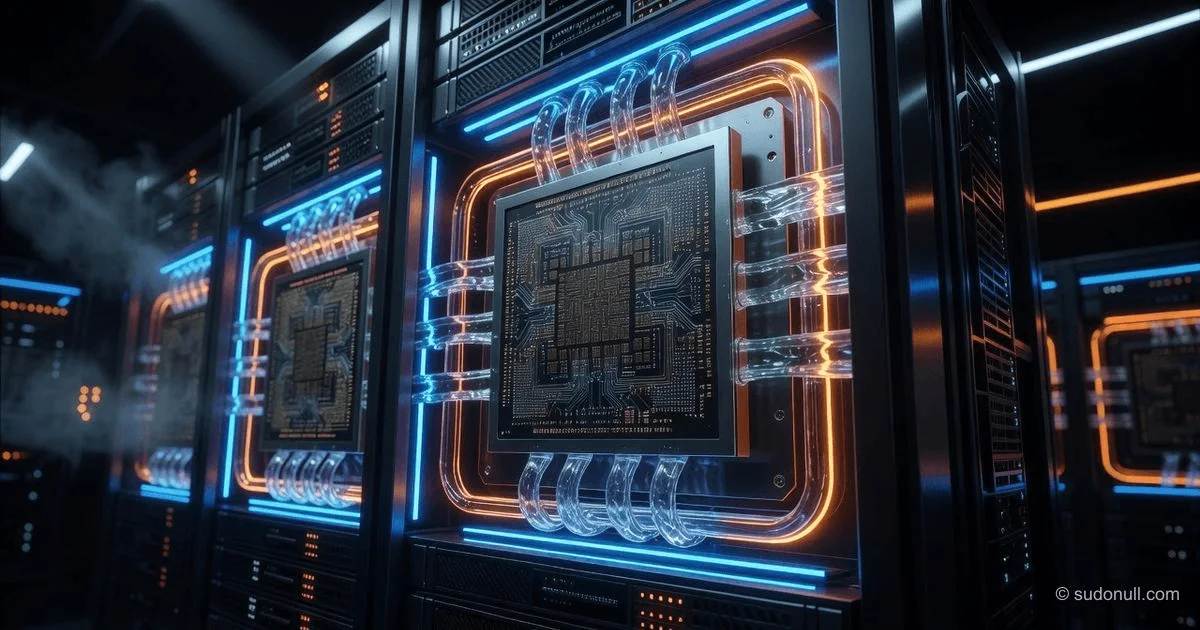
NVIDIA Rubin AI Architecture Goes into Production in the US
On June 6, American startups began deploying the first industrial clusters based on the NVIDIA Rubin architecture, delivering a tenfold improvement in energy efficiency over Blackwell and fueling the development of a new wave of autonomous AI agents.
NVIDIA Rubin: Analyzing the Quiet Revolution You Probably Missed
The Core: What's Really Happening
The official story sounds great: on June 6, 2026, startups in the US started deploying the first industrial clusters on the NVIDIA Rubin architecture, achieving a tenfold increase in energy efficiency. It sounds like just another item on NVIDIA's roadmap. But the reality is far more interesting and alarming for half the market.
What's actually happening is a silent but total reshuffling of the computing infrastructure market. This isn't just about a new chip—it's the first time in history that data centers are physically restructuring their architecture "around" a specific product before that product even officially appears in price lists. The startups mentioned in the news received engineering samples of Rubin back in April, and now—in June—they are deploying them not for testing, but for industrial operation. This is an unprecedented move for NVIDIA, which usually keeps hardware under NDA until the last moment.
Why does this matter? Because Rubin isn't about accelerating the old. It's a fundamental shift in how AI computes. If Blackwell was still "just a very fast GPU," then Rubin is the first chip designed for the world of agentic AI, where models don't just answer queries but reason, plan, and execute chains of actions. Agentic models consume 10–50 times more tokens per task than classic "question-answer" models. And only Rubin, with its 50 petaflops of FP4 compute and 22 TB/s of HBM4 bandwidth, makes such computational costs economically viable.
But there's a nuance that goes unmentioned. The 10x energy efficiency improvement over Blackwell is a figure achieved only under specific workloads: massive inference of long-context agentic models. For pure training, the gain is 3.5x. Marketing and engineering reality, as always, diverge. However, even 3.5x is a death blow to competitors who have only just caught up with Blackwell.
Timeline and Context
Let's get the facts straight. On January 6, 2026, at CES, Jensen Huang in his signature leather jacket announced the start of mass production of Vera Rubin. At the time, it was seen as a distant prospect. Six chips: Vera CPU, Rubin GPU, NVLink 6 Switch, ConnectX-9 SuperNIC, BlueField-4 DPU, and Spectrum-6 Ethernet Switch. A beautiful presentation, the hall applauded.
But here's what happened between January and June that no one is talking about now. In February, TSMC, under pressure from NVIDIA, urgently switched production lines from H200 to Rubin. The official reason was "capacity optimization." The real reason: NVIDIA realized that demand for agentic AI was exploding faster than expected, and Rubin was needed yesterday. According to supply chain insiders, in April NVIDIA sent letters to key partners demanding infrastructure readiness by June, not September as originally planned.
By June 6, the first commercial clusters on Rubin were launched by startups Aetherial Mind and QuantunLogix, which had just raised $4.5 billion in Series B funding. And this is the key point. Not Amazon, not Google, not Microsoft got Rubin first—but young companies that can afford to take risks. Hyperscalers are waiting for official "reference architectures" and confirmed stability. Startups, on the other hand, grab engineering samples and race ahead because they have no other choice: competition in agentic AI requires computing power that only Rubin currently offers.
Simultaneously, on June 6, a research group from Massachusetts published a paper on "Adaptive Liquid Transformers"—a new model architecture that adjusts parameters in real time based on task complexity and consumes 40% less memory on Rubin chips. This is no coincidence. NVIDIA has been funding this lab for six months. They specifically tailored the algorithm to Rubin's capabilities.
Who Wins and Who Loses
The main winner is obviously NVIDIA. But not because they're selling chips. Rather, because they've seized control of timing in the industry. Rubin is hitting the market 6–9 months earlier than expected. AMD only announced the Instinct MI455X in May, with a TDP of 1.7 kW, which sits somewhere between Blackwell and Rubin in specs. Now AMD enters a market where the performance bar has already been raised. Their product is obsolete before launch. Intel isn't even in this weight class.
The second winner are startups like Aetherial Mind and QuantunLogix. They didn't just get hardware; they got a time window—6 to 12 months—during which they have access to computing power their competitors lack. In the world of AI funding, this is invaluable. You can raise your next round at a 2–3x higher valuation if you prove your agentic AI was trained on Rubin while your competitor languishes on Blackwell.
Winner number three is TSMC. Their capital expenditure in 2026 will be $52–56 billion, an absolute record in the semiconductor industry. And two-thirds of that capacity is contracted for CoWoS-L packaging for Rubin. TSMC is no longer just a fab; it has become an infrastructure operator.
Who loses? Amazon, Google, and Microsoft. They've fallen into the trap of their own caution. Their bureaucratic processes for validating new hardware take 9–12 months. Startups will outmaneuver them on the curve. Moreover, NVIDIA can now charge 20–30% more for Rubin than for Blackwell, because demand from startups and Chinese companies (via semi-legal capacity leasing schemes) is simply insane. Hyperscalers will be forced to pay, because falling behind in agentic AI is unacceptable.
The biggest loser is China. Although this is not news. Chinese developers openly admit: to train cutting-edge models, they need Rubin, while the H200 available through official channels is two generations behind. The problem is that US sanctions on Rubin exports to China remain in place. Formally, Chinese companies can lease Rubin computing power outside the country—and some do—but it's expensive, inconvenient, and politically risky. UBS analysts estimate that Chinese internet giants spent $57 billion on AI infrastructure in 2025—10 times less than their US competitors. The gap will only widen.
What the Media Isn't Saying
Now for the inside scoop. What doesn't make it into press releases.
Rubin's problem is heat dissipation. Officially, NVIDIA states a TDP of 1.8 kW per GPU. But according to insider channels, engineering samples run as hot as 2.3 kW. That's 500 watts more than claimed. For a single chip, not a disaster. For an NVL72 rack of 72 chips, that's an extra 36 kW of heat per rack. Industrial liquid cooling systems designed for Blackwell struggle with Rubin. Some data centers deploying clusters now are forced to run at reduced frequencies to avoid thermal throttling.
Why is this being kept quiet? Because NVIDIA has already planned a "fix" in the Rubin 2.0 revision, due in 9 months. And the first buyers—startups that can't wait—have agreed to be beta testers for the privilege of getting hardware now. This is standard practice in high-tech, but it doesn't appear in the glossy "breakthrough" news.
A second non-obvious point is the software stack. Rubin doesn't just require recompiling models; it essentially requires rewriting core library components for the new memory architecture. NVIDIA ships CUDA 13 with Rubin support, but it's only stable on reference models. Real production systems are a wild zoo of bugs and workarounds. Engineers from QuantunLogix, who launched the cluster on June 6, complain in private chats that 15–20% of their time goes to debugging drivers and microarchitectural quirks.
And third—a secret agreement with TSMC. NVIDIA didn't just get manufacturing capacity; it got exclusive access to CoWoS-L, a new packaging type that allows assembling "superchips" from multiple dies. Competitors don't have this access. TSMC physically cannot produce CoWoS-L for AMD or Intel in the same volume because the equipment is contracted to NVIDIA for years ahead. This isn't competition in the chip market. It's a monopoly at the physical manufacturing level.
Forecast: Next 30 Days and 90 Days
Next 30 days (June to mid-July 2026):
Expect a wave of announcements from startups that got Rubin first. They'll roll out "agentic AI platforms" with flashy names and seek funding rounds at higher valuations. Real performance numbers will be hidden behind generalities. By the end of June, the first leaks of real benchmarks from independent testers will appear—and then we'll see how big the gap between Rubin and Blackwell really is in real-world, not synthetic, tasks.
Also, within the next 30 days, Microsoft will be forced to publicly explain why Azure still doesn't offer Rubin instances, while small cloud providers like Lambda and Nebius already do. Expect nervous press conferences and promises of "coming quarters."
Next 90 days (July to September 2026):
By September, the first data on Rubin's economics will emerge. Everyone is talking about performance now. But the real battle is over cost per token. If Rubin truly reduces token generation cost by 10x, as NVIDIA promises, many AI business models will suddenly become profitable. But if the real reduction is 4–5x, then everything stays as is, and we'll see another round of startup consolidation.
Key date: mid-September. That's when AMD plans to announce its answer to Rubin. Will it be the MI500 series? Can AMD negotiate alternative packaging with TSMC? My forecast: no. AMD will be 12–18 months late. By then, NVIDIA will not only have captured 90% of the agentic AI market but also released Rubin Ultra with 3.5-kilowatt chips.
And most importantly, by September we'll see if the US power grid can handle the load from mass Rubin deployment. A TDP of 2.3 kW per chip is no joke. Some regions, especially Texas and Northern Virginia, are already on the brink of overload. If there's a heatwave this summer, local data center outages will become a reality. Then regulators will start asking uncomfortable questions about who approved racks with 200 kW of heat dissipation.
The quiet revolution is already underway. The question isn't who gets Rubin first. It's who gets left with nothing.
— Editorial Team









No comments yet.