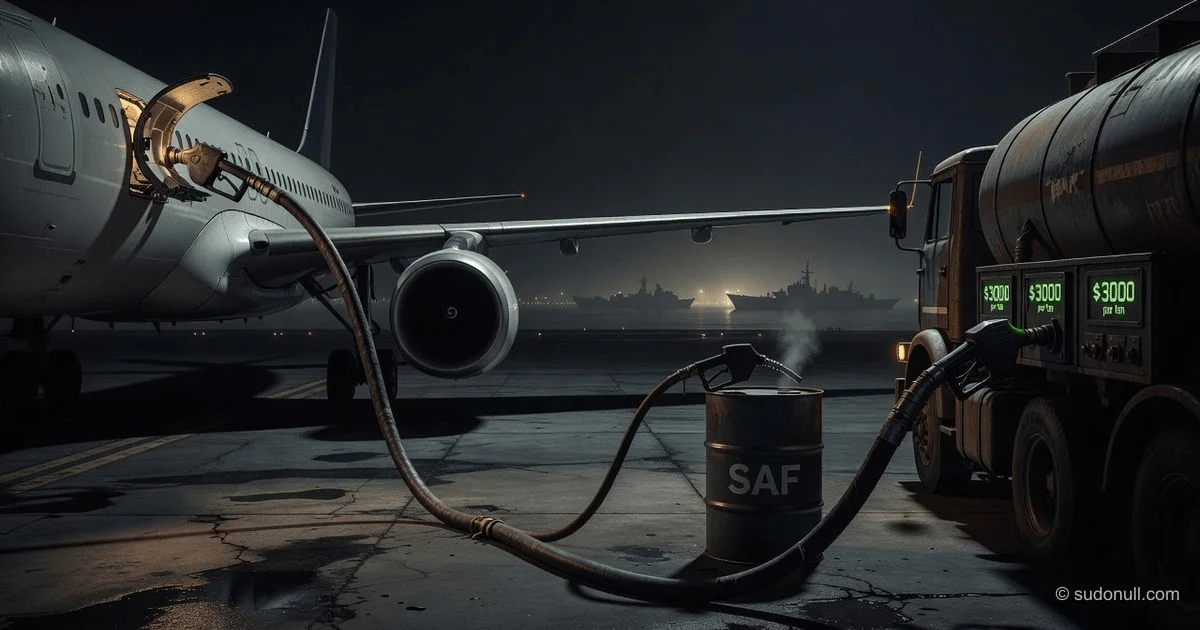
Iran Crisis Drives Airlines Toward Sustainable Aviation Fuel
The blockade of the Strait of Hormuz has brought kerosene and eco-friendly cooking oil fuel prices to a record convergence. United Airlines and other carriers are accelerating their shift to SAF due to supply shortage fears.
Analytical article: SAF at $3,000 per ton — The Iran crisis has exposed the "green fiction" of global aviation
[The Gist]: What's Really Happening
The official narrative that the blockade of the Strait of Hormuz is spurring a shift to "eco-friendly cooking oil fuel" is a cruel irony. In reality, we are witnessing not a "green transition" but a panicked scramble. The issue isn't that SAF has suddenly become cost-effective. The problem is that traditional kerosene is disappearing from the market, with its price doubling since February 2026.
According to data from the International Air Transport Association (IATA), released on June 6 at its annual meeting in Rio de Janeiro, the global average price of jet fuel soared from $96 per barrel in November 2025 to $188 in April 2026. In Asia, spot prices in Singapore temporarily exceeded $220 per barrel. Traditional fuel has become so expensive that the gap with SAF, which has always been its "expensive sibling," has narrowed sharply. But this is no victory lap for environmentalists — it's a catastrophe for flight economics.
The real story: SAF, which was supposed to save the planet, is produced in laughably small volumes. IATA estimates SAF production in 2026 at 2.4 million tons — just 0.8% of global consumption of aviation fuel. Meanwhile, the global capacity of existing plants exceeds 9 million tons. That means the technology exists, the equipment is in place, but it's idle because producers find it more profitable to make "green" diesel for trucks (renewable diesel) than SAF for planes. Airlines are now forced to pay around $3,000 per metric ton for SAF — astronomical sums, but they have no choice because there isn't enough kerosene to go around.
Timeline and Context
The crisis began in late February 2026, when Iran, in response to Israeli military actions against Hezbollah, effectively blocked the Strait of Hormuz, threatening to "completely close" this strategic corridor. About 20% of global seaborne oil shipments passed through the strait, and critically for aviation, huge volumes of already refined jet fuel exported directly from Gulf refineries.
The impact on aviation was devastating. Europe, which sourced 24% of its jet fuel from the region, found itself vulnerable. Africa fared even worse: 33% of its aviation fuel came through the strait. Airlines began cutting summer schedules, reducing flight frequencies, and grounding aircraft. Gulf hubs (Dubai, Doha, Abu Dhabi) — the world's aviation crossroads — saw a 46.6% drop in passenger traffic.
Then on June 6, 2026, at the same IATA assembly, another alarming announcement was made. Hemant Mistry, IATA's Director of Energy Transition, stated that the closure of the strait had driven up prices not only for conventional kerosene but also for sustainable aviation fuel (SAF). The price of SAF jumped from just over $2,000 per ton in February to around $3,000 in May. This completely shatters the narrative that the crisis is making SAF "competitive." SAF rose in tandem with kerosene because the supply chains for raw materials (used cooking oil, biomass) also depend on global logistics, which have collapsed.
Winners and Losers
Airlines are losing — and they are the main victims. IATA halved its forecast for the industry's net profit in 2026, from $41 billion to $23 billion. For comparison, profit in 2025 was $45 billion. Airlines' fuel bill will rise from $252 billion (2025) to roughly $350 billion. Fuel will now account for nearly a third of operating expenses. The first casualty has already fallen: U.S. low-cost carrier Spirit Airlines ceased operations last month. Willie Walsh, IATA's Director General, warned that smaller carriers face bankruptcy or acquisition.
SAF producers are winning — Neste, World Energy, and others. They now have a captive buyer with no alternatives. While kerosene costs $188 per barrel and SAF $3,000 per ton, in monetary terms SAF is still more expensive than traditional fuel, but the shock of scarcity forces airlines to sign any contract. United Airlines, which has long invested in future production of 5 billion gallons of SAF, now looks more prescient than its competitors. But even United is forced to buy SAF at spot prices because its own production is woefully insufficient.
Passengers are losing. They will have to pay — and already are. Fuel surcharges (the infamous YQ line on tickets) on some business-class routes have already exceeded $1,000. Base ticket prices remain low on search engines, but "additional fees" have risen. The mechanism introduced as "temporary" in 2004 has become a permanent lever on wallets.
The "old oil lobby" is winning. The crisis has shown that the world still depends on physical hydrocarbons, not "green" fantasies. Brazil, for example, continues to use parity pricing, where kerosene prices are set as if all fuel is imported from the U.S., even though only 16% is imported. Brazilian airlines overpay $220 million per year for this "phantom import."
What the Media Isn't Saying
First and most counterintuitive insight: SAF prices rose because "cooking oil" ran out. Seriously. The base of SAF is used cooking oil (UCO), fat, and biomass waste. This is a limited resource. The world doesn't produce enough fried potatoes to fuel aviation. With current capacity of 9 million tons, that's the ceiling. To meet IATA's target of covering 65% of SAF needs by 2050, either agriculture must be converted to energy crops (causing hunger), or Power-to-Liquid (PtL) fuel must be invented from renewable electricity and water. That costs even more and requires trillions in investment in "green" hydrogen.
Second hidden detail: the "book and claim" system is a fiction, but IATA prays to it. On June 6, IATA launched an alliance to "split" SAF supplies and carbon credits. The idea is that an airline in Europe can buy SAF that is physically loaded onto a plane in California and "credit" it toward its own emissions. This is cosmetic accounting that doesn't solve the problem of burning kerosene here and now. It only allows reporting to ESG investors.
Third omission: the U.S. Navy is already escorting tankers, but that's not a panacea. U.S. Central Command denied Iranian reports of attacks on its ships but confirmed a naval blockade of Iranian ports. The U.S. has deployed 15,000 troops and over 100 aircraft to escort vessels. But even military escort doesn't revive refineries in the Gulf that are idle or destroyed. Crude oil is available. But specifically aviation kerosene is in short supply because specific refining capacity is needed, and that capacity is under threat.
Forecast: Next 30 Days and 90 Days
Next 30 days (through early July 2026). Watch OPEC+ meetings. The cartel has already raised production quotas for the fourth time in months, compensating for lost Iranian volumes (about 600,000 barrels per day). But oil is not kerosene. Refining takes time. Over the next four weeks, conventional kerosene prices will remain in the $150-180 per barrel range. SAF will cost $2,500-3,000 per ton, but available SAF volumes will cover at most 1% of flights. The rest will fly on expensive kerosene and pass the cost on to tickets. Expect new surcharges on tickets to and from the U.S. and Europe.
Next 90 days (through September 2026). The main risk is not price but physical fuel availability at airports. The head of the International Energy Agency warned in April that Europe could be "six weeks away from a serious shortage." September is the peak of the tourist season. If no diplomatic solution for the strait is found by then, or if alternative supplies (U.S., Nigeria, Venezuela) are not sharply increased, airports in Frankfurt, London, and Paris may start rationing fuel.
In the longer term, the crisis could destroy the model of cheap long-haul travel. Experts already say: if this drags on, global aviation will return to the 1970s, when a transatlantic ticket was a luxury. The only silver lining is that Iran, through Pakistani intermediaries, has offered the U.S. a deal to unblock the strait in exchange for delaying nuclear talks. If a deal is reached in the coming weeks, prices will crash as fast as they rose. But the "green transition" to SAF will not accelerate — it will remain as expensive and inaccessible as before the crisis.
— Editorial Team










No comments yet.