Content marketing: how to write an understandable and minimally annoying email text
- Transfer

Over the past few years, a lot has changed in the field of email marketing . Today, companies use new marketing techniques, but you know what's funny? A simple correctly composed text of an email can be as effective (if not more) as a tricked email with a bunch of "bells and whistles".
Moreover, no matter how bright and colorful your letters may be, if they do not contain interesting content, subscribers will not read them.
So how do you make an attractive email? The rules for creating texts from HubSpot specialists will help you with this - below is an adapted translation of their notes on this topic.
10 rules for writing high-quality texts for emails
First, we’ll talk about what the headers should be, and then we’ll move on to tips for writing text for emails.
How to choose the right title?
One of the key elements of an effective email is its header. He plays the role of a gatekeeper: no one will read your wonderful email if the headline is not interesting enough. Despite the fact that there are conflicting statistics about how really the heading affects the openness of letters, making it attractive and revealing the subject of the letter will clearly not hurt.
1) Call for action
The headline should call the reader to action. Use verbs for this. For example, the OpenTable restaurant reservation service sent me an email, the title of which read: "Take your mom to lunch." Using the verb in the imperative mood (for example, “reduce”, “download”, “book”, “ask”, “buy”, etc.), you let the reader understand what he can do.
But there are other ways to encourage subscribers to take action. The goal of the heading is to tell the reader how the information in the letter can be useful to him, and whether it is worth opening it at all. In other words, the value of the letter to the subscriber should be your priority.
Once I received a letter from the TicketMaster reservation and ticketing service with the headline “Do not miss the performance of Bruce Springsteen and the E Street Band”. They did not urge me to buy a ticket by writing “Buy tickets for tomorrow’s performance by Bruce Springsteen and the E Street Band” (although such a headline might work) - their version showed what benefit the information contained in the letter would bring me. Thanks to this, I prepared for the start of ticket sales at 10:00 and now I will go to the concert.
2) If possible, make letters personal
Personalized emails tend to have higher clickthrough rates [eng. click-through rate, CTR]. According to the results of the research of the Direct Marketing Association, segmented mailings and targeted letters bring 58% of all marketing profits, and letters sent to specific target groups of subscribers - 36%.
There is nothing surprising. After all, the more segmented the mailing list is, the easier it is to create a personalized headline and generate useful content for the recipient of the message.
So ask yourself the question: “Is it possible to make the headline of my letter more personal?”. And it’s not about adding the name of the addressee - you won’t surprise anyone with this for a long time.
Instead, let's look at an example. Let's say you are a realtor with a huge customer database ...
- Some of them want to rent real estate, others want to buy.
- People choose houses in several cities and neighborhoods.
- All clients have different financial capabilities.
- Someone is looking for a studio, and someone is a mansion.
- You even know that some of them agree only on houses that have been repaired in the last 5 years.
Of course, you will not send out the same letter with the same heading to customers from different segments of your list, right?
For example, one message may be entitled: “1-bedroom apartment for rent in Cambridge: Hurry to inspect”, and another - “Come to the open view of the colonial house in Sudbury”. Each title meets the different requirements of different segments of your list.
3) First, clarity, and only then “tenacity”
The title should be clear, not just catchy. When writing promotional text, clarity always comes first. If, having come up with an understandable headline, you can make it funny, catchy or eccentric, then the flag is in your hands. But never put the entertainment aspect first.
UrbanDaddy is one of those companies whose email headers are always clear, interesting and funny. Here are some examples:
UD | Hotel in the middle of the ocean
UD | Beer can nunchucks. At last.
UD | Bringing All Together: Now Not So Tiring
UD | The size of a table football table grill
UD | This is ice cream. This is a beer. This is a beer ice cream.
UD | Private island in the Bahamas. Do what you like.
Some of these headers make the recipient smile, but they always make it very clear what the letter will be about. This brings us to the next point.
4) The title should reflect the content of the letter
You should be aware of how important it is for the call to action to match the sentence on the landing page. The same principle should be followed when creating the title and body of the email.
What you promise the reader in the title should be revealed in the text of the letter. If the recipient does not see what was promised, the click-through rate may “suffer” (and in the long run, the open rate will follow).
In 2011, we conducted our own research , sending out the same email with different headers to two groups of people:
- “54 new information slides for your presentation”: 26% click-through rate
- “Keep up to date with the latest trends in marketing”: 10.4% click-through rate
Thus, the CTR of the first, more accurate and understandable heading was 15.6% higher than the CTR of the second with a more vague wording.
This leads us to the idea that a high rate of discoveries means nothing without subsequent clicks on the links in the letter.
How to write compelling message text
Now that you have chosen an excellent headline, all of your audience’s attention is focused on the text of the email. So how do you write material that interests them? Here are some important tips to follow!
5) Do not forget about relevance
Like the headline, the text of the message should be relevant to the reader.
Personalization in this case also does not come down to writing the name of the recipient in circulation. In the introduction, explain to the reader how you met him.
This is an example of a letter from the Warby Parker glasses online store to my colleague (by the way, the title of the letter was very good: “Oops, your prescription for glasses expires”).
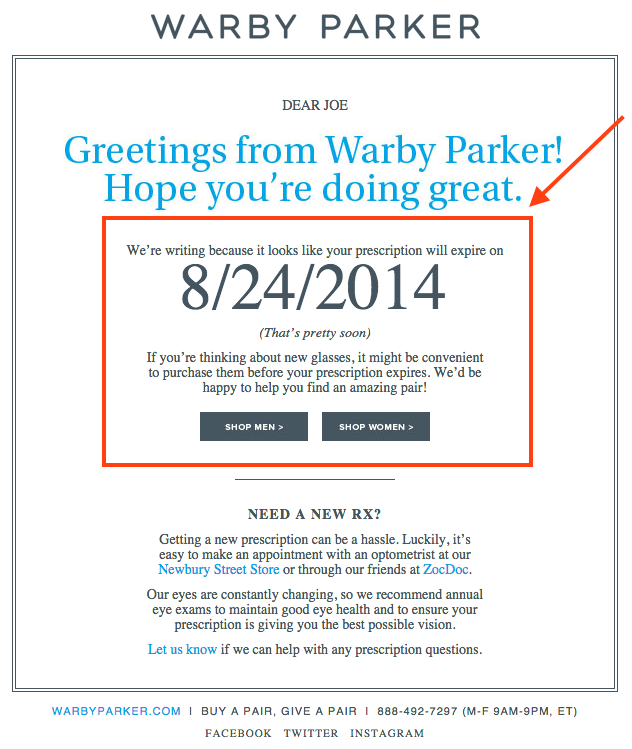
Take a look at the first paragraph highlighted in red. Warby Parker marketers do not beat around the bush, but immediately tell the reader why they sent this letter - the prescription for glasses expires.
Now imagine that the letter would begin immediately with the second paragraph: “Getting a new recipe can be a lot of trouble. Fortunately, you can easily make an appointment with an ophthalmologist at our Newbury Street store or through the ZocDoc service. ”
... Why are you writing me about a new recipe? Why should I listen to your advice? How did you know that I live near Newbury Street? A customer who was reminded that in the past he transmitted his data to Warby Parker is more likely to follow the link in the letter and make a purchase.
6) Use second person pronouns
In the text of the message, use the pronouns of the second person: “you”, “your” and “you”. For example: "Leaving home in the morning, do not forget to take your jacket." Thus, the "focus" of the letter is shifted towards the reader. Consider the text of the email from the Zappos online store:
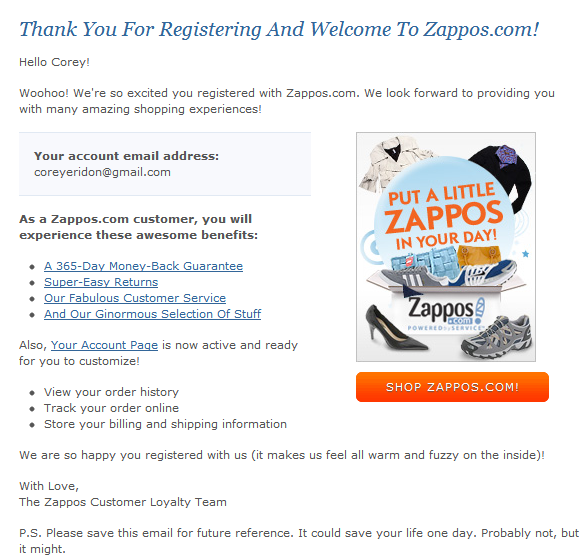
Now count how many times the pronoun “you” is used instead of “we” or “me” in this letter. So be it, you can not assume: the words “you” and “your” are used 12 times, while “we”, “our” or “us” are used only 5 times.
So many second-person pronouns help shift the focus to the customer, not the brand. This tricky tactic will allow you to prioritize correctly, but the next point is especially important.
7) Talk about the benefits of the product, not about its properties
You know the value of your letter. But does the recipient know it? No, not yet. And your task is to explain to him.
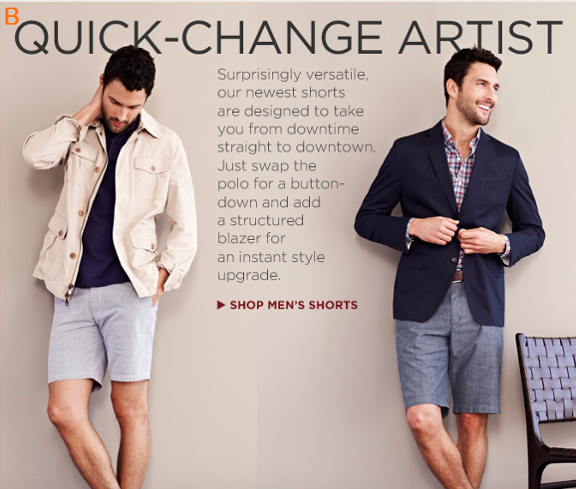
The problem is that most emails talk about product features, not about their benefits. Compare the texts from the two emails I received. Which of them explains the benefits for the client, and not just lists the properties of the product?

As you might have guessed, the correct answer is B. The first email just offers a 30% discount, but doesn’t tell what the GoDaddy product is for me. Will it allow optimizing the costs of infrastructure and hiring new employees? This advantage is much more attractive than a 30% discount on unspecified value.
Take a look at email B from the Banana Republic brand. His goal is to sell shorts, but there is no pressure on the reader. After all, these are just shorts, nothing special. But the brand emphasizes their advantage: versatility. The buyer can walk in them at home, and then, without changing clothes, go to the city. How convenient! How easy! How versatile!
In this case, the reader sees the benefits of acquiring shorts, and the text (or rather its absence) in the email from GoDaddy does not explain the advantage of the 30% discount.
8) Be brief
One of the blunders that copywriters make is to try to fit an entire story into one e-mail. Remember how you check your mail yourself? Do you read every word in the text? Unlikely. Most likely, you quickly browse through the content and look for key points to decide what to do next.
Therefore, if you send out a text of hundreds of words, it will be much more difficult for recipients to decide whether they want to accept your proposal. They will not be able to quickly absorb all the information from the letter.
Instead, in a few sentences, try to convince the reader to follow the link to your website for more information.
Look at the laconic email from the Postmates service, urging readers to take advantage of the special offer:
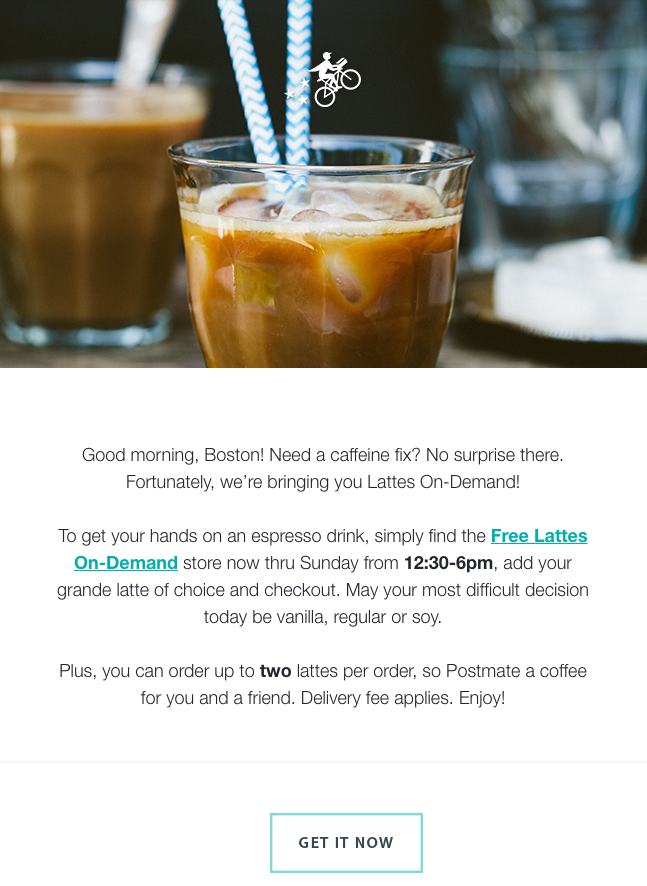
After a brief friendly greeting, Postmates marketers immediately move on to the goal of the newsletter and inform customers about their new promotion, “Free Latte on Demand.” After which they add some important details, and then place the call to action button.
To write a short and meaningful text, you need to focus on your ultimate goal. If you know what exactly you want to achieve with your letter - so that subscribers order a free latte, manage to buy a ticket for a Bruce Springsteen concert or go to a training session - it will be much easier for you to state the essence of your proposal in a concise form.
If for some reason you do not want to write a short message, remember that letters with one call to action have higher click-through rates than letters with several CTA buttons.
9) Try to arouse sympathy
The fact that emails are designed to transmit information does not mean that they cannot bring joy. In some cases, email can be used to present your brand in the best light and build relationships with customers. In the end, a good attitude of people depends on your manner of communication.
Consider the email from the Death to Stock team. They sent a letter to apologize for having upset many of their customers during the previous mailing. The last time they advertised goods sold too quickly and did not indicate that they did not deliver to other countries.
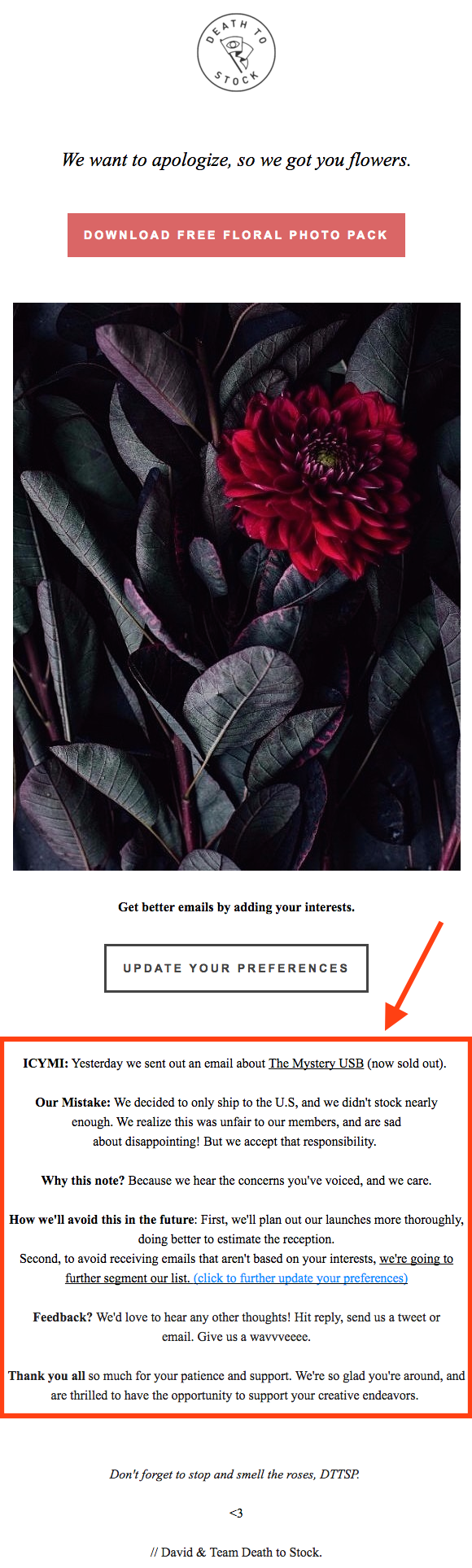
Pay attention to the part of the letter in a red frame. In a short form, they explain the situation, apologize for the mistake and promise that in the future this will not happen again, while offering the recipient several further actions to choose from.
Such a compressed email format is designed for a large number of subscribers who are fluent through the content. Bold font and paragraphs in one line increase the readability of the text. And finally, Death to Stock marketers are not afraid to add “personal” phrases to “humanize” their brand. As a result, subscribers are likely to forgive the company for this oversight.
10) Use calls to action correctly
Yes, emails also use calls to action. At least in good letters. First of all, your call should attract attention. Remember: people scan mail fluently, and if you want to highlight any element of the letter - make it a call to action.
If you send an HTML letter, you can add a call to action button, as AmazonLocal does: An
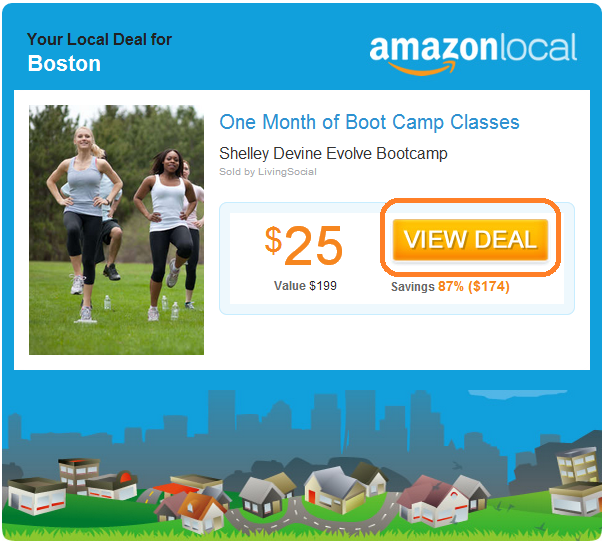
effective call to action button has the following qualities:
- Attractive design design: Notice how a huge bright orange button stands out against a blue background. Find her is not difficult.
- Clear text: The text on the button also plays an important role. Your call should be concise and clear. The AmazonLocal button tells you what will happen if you click on it.
It is also worthwhile to devote time to the study of ordinary text messages. No matter how colorful your HTML email is, not every email client will display the images used in it. We decided to conduct a study and find out which letters are more effective. And although people say that they prefer to receive HTML-letters with images, simple text letters bring the best result.
Take a look at how in one of our letters we used an anchor link to draw readers' attention to a call to action:
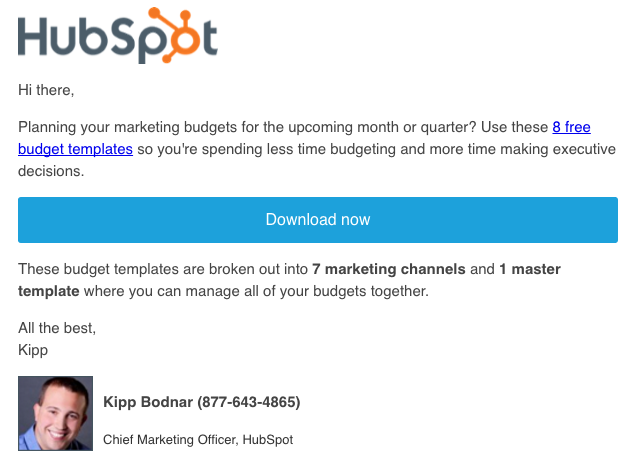
This post doesn’t have much graphics compared to most HTML emails, so the hyperlink stands out even more. When readers look at the text, their attention is attracted by bold words, images and hyperlinks. Thus, repeating your sentence again and again, you lead the reader to click on the call to action button.
Other posts on the Pechkina blog :
- How to write good text for a website or email: WIIFM technology
- Email, social networks, messengers: What are the means of communication, and how to choose them
- How to write email auto-replies: Analysis of 100 applications to IT companies support services
- Work with email: How to reduce the number of incoming messages to zero
- Why spam is so hard to beat
- Email and security: Is it possible to protect mail correspondence