
 June 10, 2015 at 11:37
Online stores teach customers to pay online
A few years ago, Russian buyers of online stores most often paid for the goods upon receipt, and not on the online site. Most users have stated that they do not trust stores and online payment systems. Now the situation is gradually changing, and the share of Internet payments is growing every year. Yandex found out what payment options are offered by online stores, and Data Insight conducted a study of the preferences of Runet customers.
Shop offers
At the end of May, Yandex published a study on methods for accepting online payments in Russian online stores. Specialists analyzed 86 thousand sites that have the opportunity to pay for purchases online.
More than half of online stores offer various payment methods - from three or more. The share of such sites has grown significantly over the year. But 46 percent still have only one option for accepting payments online.
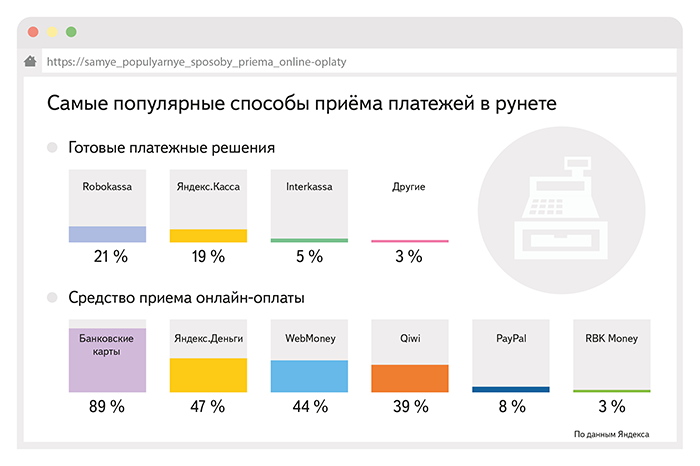
Almost all sites offer payment by credit cards - 89 percent. Almost half accept funds through Yandex.Money and WebMoney payment systems, 39 percent through Qiwi, eight through PayPal, and three percent through RBK Money.
It turned out that about half of the Internet resources do not develop their own payment solutions, but use ready-made services such as Robokassa and Yandex.Kassa. With Robokassa, 21 percent of online stores accept money, and through Yandex.Cash, 19 percent. Another five percent of sites use Interkassa, less than three percent chose other payment solutions - Wallet One, Oplata, PayOnline, PayAnyWay.
But so far, not all Russian online stores accept payments online. Even in Moscow, the percentage of sites where you can only select and order goods, but cannot be paid, is 20 percent, according to a study by the Department of Information Technology.
At the same time, 90 percent of Moscow online stores have pickup. This is a feature of Russian online retail, since in Europe goods are most often delivered by postal or courier services, and stores accept payment only online.
User preferences
For 28 percent of customers, it is important that the online store has different payment options for the order, according to a study by Data Insight. 33 percent admit that if payment cannot be made online, then they can forget about the order.
But more than half of the orders buyers still pay in cash upon receipt of the goods. A quarter - by credit card on the site, 10 percent - through electronic payment systems, and six percent - by credit card upon receipt.
Previously, the proportion of those who pay for purchases online was even lower. For example, in the largest Russian online store Ozon, the share of prepaid goods among all orders increased from 9.5 to 21 percent in three years.
According to PwC, as early as 2012, about 43 percent of respondents to the question “Why do not you buy goods online?” Answered: “I do not trust the methods of online payments.” In 2013, this figure was 38 percent. Now, according to Data Insight, there is no such problem. Novice Internet users are more likely to refuse online payments due to obscure and complex interfaces than because of a lack of confidence.
According to Ozon’s press secretaries, Maria Nazamutdinova, the service, along with payment operators, conducted special promotions that encourage people to pay for purchases online. For example, it provided free shipping for prepaid orders.
Experts also attribute the increase in the share of cashless payments to the increasing popularity of purchases in foreign online stores, especially in Chinese Aliexpress. The share of buyers of foreign online stores increased from 18 to 31 percent per year.
How exactly do they pay and receive
Most users - 87 percent - pay for the order online with a debit card, three quarters through online banking. 64 percent use electronic money, about half use mobile banking and SMS payments, and 46 percent use credit cards. In 2014, the largest segment grew in electronic money (one and a half times) and mobile banking (by 39 percent).
Most often, buyers receive goods by mail (41 percent). Almost a third choose courier services, 20 percent - points of delivery of orders online store. Six percent take the goods in the offline department of the store, and two percent - at the points of delivery of orders of courier services. Postamata (automatic points of delivery of orders) in Russia are not very common - they account for only one percent of orders.
It is worth noting that in small cities, online shoppers more often receive goods by mail. Residents of Moscow prefer courier delivery, and Petersburg - pickup.