July 20, 2015 at 15:50
About Burali-Forti, Poincare and the very definition of unit
If you, my dear reader, tend to spend a lot of time on the Internet, you probably already saw this picture with a quote:
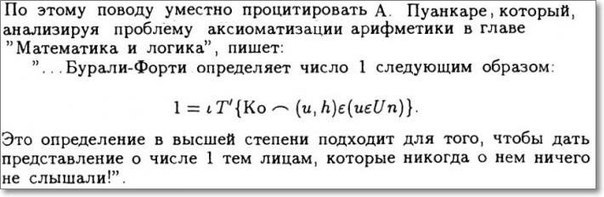
Surely you also wondered: what the hell is written here? The formula from this quotation is interesting in that for a person with a higher mathematical education, this question arises as implacably as a curious seventh grader. Non-curious seventh graders have a slightly different range of interests that goes beyond the scope of this article; however, even they will not deny themselves the pleasure of giggling over "these crazy nerds," or as it is formulated there on modern youth slang.
In the following text, I will reveal to you the secret of this mysterious combination of characters. Come under the cut, but remember the instructive story about the curious Barbarian, who was told about the Banach-Tarsky paradox in the bazaar, why she lost her mind, cut her nose into a finite number of parts and glued the horned sphere of Alexander from them.
If you are not interested in historical information, feel free to proceed to the next section .
So, here is a quote from the text of an anonymous author, who is quoting Poincare, quoting, in turn, a certain Burali-Forti. To understand all this postmodernism, let's start with the author of the top-level quotation. His name is Viktor Filippovich Zhuravlev, he is a doctor of physical and mathematical sciences, professor, academician of the Russian Academy of Sciences, and also the author of the book under the unshakable title “Fundamentals of Theoretical Mechanics”. It is in it, on page number eight (if you look at the 2008 edition) that the above formula occurs. I’ll give you a little context here to make it clear what it is for.
Who is Poincare, I believe, does not need to be explained. In the light of recent events, even terry humanitarians should remember this surname in combination with the word "hypothesis" and another surname "Perelman." If very briefly (for those who sat in a stone bag from the mid-nineteenth century until the present moment), Jules Henri Poincare is one of the greatest mathematicians of all time, an encyclopedic scientist, the creator of topology, mathematical foundations of the theory of relativity and all sorts of funny and useful things . The cited quote-in-quote is borrowed from his work Science and Method of the 1910 edition. This work is a collection of essays on various mathematical, scientific, philosophical and didactic topics. Very curious, easy to read and still relevant thing that can be pulled into quotes a little less than completely.
However, we are interested in one specific quote. It is located in the chapter "Mathematics and Logic", which begins as follows:
I suppose the reader already understood what will be discussed further. Poincare with some vehemence attacks the mathematicians of the "new school" with their obscure notation and revision of the fundamentals. As subsequent events showed, in this matter he turned out to be a retrograde - however, he had good reasons for this. What happened in mathematics in the harsh 1890s was able to stun a more indifferent person than this enthusiastic Frenchman.
So we got to the end of the chain, to a quote that does not contain internal quotes. Its author is Cesare Burali-Forti, a mathematician not so great, but who managed to write his name in history thanks to some paradox, which we will return to later. The information about him is rather scarce, I could not even find how the stresses in his last name are. The formula that encouraged me to write this article was contained in his article, “The Question of Transfinite Numbers.” I found this article in a book by Jean van Heyenort - by the way, of the famous Trotskyist - entitled "From Frege To Gödel: A Source Book in Mathematical Logic" (hereinafter, I do not risk translating the names, since May English is from notes and notes). This was a great success, as Peano's article “The principles of arithmetic, presented by a new method” was contained in the book with her.
If you don’t want to look at the funny crackers, you can go directly to the next section.
Before the articles by Peano and Burali-Forti in the book of van Heyenort, there was Frege's article “Calculus of concepts, or the formal language of pure thinking imitating arithmetic”. Friedrich Ludwig Gotlob Frege, a mathematician and philosopher, can, in principle, be considered the creator of predicate calculus. He has a rather indirect relation to the subject of this habrapost (Poincare did not even mention it in his book, although it was Frege who, in fact, brewed all this mess with the reduction of mathematics to logic). However, I simply could not help but share its most fashionable designations. Fortunately (or unfortunately), they did not take root in modern logic because of their complexity. Frege stated, of course, that “the convenience of a typesetter in a printing house is definitely not the highest good”, however, as we can see, this factor also played a certain role. However, quite a preface.
Of course, we must admit that for a person who is far from “this is all”, the modern notation of predicate logic formulas looks a little more clear.
If you know what ordinals are and what the Burali-Forti paradox consists of, you can immediately proceed to the final section .
The German mathematician Georg Cantor is one of the first who began to understand the varieties of infinity. Before him, there were only two of these varieties - potential infinity and actual infinity . These concepts can be explained as follows:
Until some point in mathematics, only potential infinity was encountered, and only theologians operated on actual infinity to describe various categories of the divine. Cantor, having roughly introduced actual infinity into mathematics, caused a wave of indignation both among religious figures and among contemporary mathematicians, including the aforementioned Poincare. Moreover, upon careful examination, it turned out that actual infinities are different. The number of natural numbers is one infinity, the number of real ones is another, and the second infinity is greater than the first. And the number of functions of a real argument is the third infinity, surpassing the first two combined!
Natural numbers are used to indicate finite quantities, but what about infinite quantities? To do this, the natural series has been expanded to many so-called cardinal numbers . A cardinal number is the number (in the broad sense of the word) of the elements of a certain set. Unit - the number of elements in the set of one element. Two - the number of elements in the set of two elements. Further, for natural numbers, looms the number N 0 , equal to the number of natural numbers. In general, instead of the letter N, the Hebrew letter “Aleph” should be, but when I tried to insert the appropriate Unicode character, mymatzo crawled out of my ears, the direction of the text changed to “from right to left,” and without understanding how to return it to its original state, I spat.
So, N 0 follows a certain N 1 , but the question of which set corresponds to it turned out to be non-trivial (see the Continuum hypothesis ). With the concept of the “next number”, a hitch arose in the transition from finite to infinite.
However, there are other "infinite numbers" - the so-called ordinal numbers , they are ordinals , also invented by Cantor. Their definition is rather complicated, but I will try to outline it in a nutshell. If cardinal numbers correspond to simple sets, then ordinals correspond to ordered sets , i.e. such that for any of the two elements indicated. which one is larger and which is smaller. Order relationmust meet some obvious criteria, which we humbly keep silent about. In addition, to construct ordinals, additional conditions are imposed on an ordered set under which it is called completely ordered . If between two completely ordered sets it is possible to establish an unambiguous correspondence preserving the relation of order, then these sets have the same ordinal.
Finite ordinals can be mapped to natural numbers. For example, the ordinal of the set {1, 2, 3} can be associated with a natural number 3. The ordinals can be added together, and in the case of finite ordinals, the addition will be consistent with the addition of natural numbers (for example, Ord {1, 2} + Ord {1 , 2, 3} = Ord {1, 2, 3, 4, 5}). To add two ordinals, you need to take the sets corresponding to them, and then combine them into one set and set the following order relation on it:
The ordinal of such a multitude will be the sum of the ordinals. Thus, there is no problem with determining the next ordinal: you just need to take the previous ordinal and add ordinal 1 to it. The ordinal of the
set of natural numbers is denoted by the letter ω. It is followed by the ordinal ω + 1. It corresponds to the set of natural numbers, to which they added the "last" number, greater than any other. Then comes the ordinal ω + 2 - it corresponds to the natural series with the "last" and "penultimate" numbers. There are also ordinals such as 2ω (natural series followed by another natural series), 3ω, 4ω, ω 2 , ω ω ...
As you can see, Cantor was a big joker. Ironically, it was ordinal numbers that marked the beginning of the end of his theory, which would later be called the "naive set theory." Using ordinal numbers, Burali-Forti came to a paradox. The course of his reasoning was something like this: take a lot of ordinals and prove that it is quite ordered. So, he himself corresponds to some ordinal. Let us prove that this ordinal is greater than or equal to any other ordinal. Now add one to it. Make surprised eyes.
Now, armed with knowledge and enthusiasm, we are ready to go to the bottom and figure out what all the same mean that formula at the very beginning of the Habrapost, far, far above.
It was not easy to understand the designations of Burali-Forti. To the notation introduced by Peano, he added a number of his own notation. Unlike Peano, he did not at the beginning of the article describe in detail his innovations. Perhaps these descriptions are contained elsewhere, but, unfortunately (or fortunately), I could not find the complete works of Burali-Forti on the Internet. Therefore, in a couple of places I had to think out the meaning based on the context. This process was reminiscent of the solution of the famous puzzle from the NSA.
To begin with, Poincaré (and then Zhuravlev) has an incorrect formula. In the original, it looks like this:

Pay attention to two overlays, their presence is fundamental.
The letter "epsilon" here means belonging, it is from it that the modern sign "∈" originated. Un is the set of all sets containing exactly one element. Accordingly, the notation “u ε Un” means only that u is a set with one element. Such a non-trivial notation, apparently, is caused by the fact that the “construction” of a set of individual elements by means of the notation u = {a, b, c ...} has not yet been adopted.
By underlining, the Burali-Forti replaces the square brackets introduced by Peano as the “sign of inversion”. Peano used it in a fairly wide range of cases. For example, b [+ a] in it meant ba, the expression [sin] (x) symbolized arcsin (x). The notation [x ε] (a certain condition) meant a lot of Xs satisfying this condition. Thus, the notation [(u, v) ε] (u ε Un) means "the set of pairs (u, v) such that u is a set of one element". I’ll probably use Peano’s notation, because I don’t see a convenient way to add markup in the Habra Editor.
Ko is the set of ordered sets. Burali-Forti ordered sets are defined as pairs (set, order relation). Therefore, the notation {Ko ⋂ [(u, v) ε] (u ε Un)} simply means “the set of ordered singleton sets”.
With the help of the “T '” symbol, Burali-Forte denotes the operation of taking an ordinal. More strictly: the expression T '(u, v) means the ordinal of the set u on which a relation of order v is given. Here, however, there is some inconsistency: in the formula under consideration, the function T 'is applied not to a pair (set, order relation), but to the set of such pairs. Based on the context, I can only assume that there is a certain agreement according to which in such cases the function is applied to each element, and the output is a set consisting of its values for all elements. With this reading, T '{Ko ⋂ [(u, v) ε] (u ε Un)} is the set of ordinals of all singleton ordered sets. Since all singleton ordered sets are equivalent, this set of ordinals will contain only one element - the ordinal unit.
As for the squiggly with a dash, with her understanding I had the most problems. I had to look for other works of Burali-Forti. In one of them, “Logica Matematica” (apparently, a textbook, but I'm not completely sure, since it was written in Italian), I found the function L (there was a lowercase “l”, but it looks too much like a wand, therefore, for clarity, I will use the capitalization). It works as follows: takes its argument and converts it into a set, the only element of which is this same argument. In modern notation: L (x) = {x}.
If we identify the squiggle as L and the dash as the inverse, it turns out that [L] is the inverse transform that extracts its only element from the set. In this case, [L] T '{Ko ⋂ [(u, v) ε] (u ε Un)} is really a unit. Ordinary unit, but these are trifles.
Next time, when someone shows you a picture with this formula (and this will happen, this is the Internet), you can tell him what this formula means. More precisely, you can start telling. It is unlikely that he will listen to the end. And he will be, in principle, right: this is a completely ordinary, unremarkable formula. In the arguments of Burali-Forti, she did not occupy any central place, but was only a passing moment in the formulation of the paradox. All her guilt lies in the fact that she caught the eye of Poincaré, who saw in her a certain undesirable philosophical meaning, “extension of the braces”. As for its infernal appearance, Frege’s notation will give one hundred odds.
Here I would like to place links to the books mentioned, but thanks to the efforts of the righteous, I had to download them from all sorts of strange places, from suspicious file hosting services, from the ed2k network ... If you are interested, find a similar way and read “Science and Method” by Poincare, it’s really easy and interesting reading. “From Frege to Gödel” by van Heyenort is also very curious, but it is hard to understand and in Russian, it seems, does not exist.
In light of recent events (the transfer of "iron" hubs to the tick times), I want to conduct a small survey that is not directly related to the topic of the hub post. I hope you forgive me this liberty.
Surely you also wondered: what the hell is written here? The formula from this quotation is interesting in that for a person with a higher mathematical education, this question arises as implacably as a curious seventh grader. Non-curious seventh graders have a slightly different range of interests that goes beyond the scope of this article; however, even they will not deny themselves the pleasure of giggling over "these crazy nerds," or as it is formulated there on modern youth slang.
In the following text, I will reveal to you the secret of this mysterious combination of characters. Come under the cut, but remember the instructive story about the curious Barbarian, who was told about the Banach-Tarsky paradox in the bazaar, why she lost her mind, cut her nose into a finite number of parts and glued the horned sphere of Alexander from them.
Who are all these people?
If you are not interested in historical information, feel free to proceed to the next section .
So, here is a quote from the text of an anonymous author, who is quoting Poincare, quoting, in turn, a certain Burali-Forti. To understand all this postmodernism, let's start with the author of the top-level quotation. His name is Viktor Filippovich Zhuravlev, he is a doctor of physical and mathematical sciences, professor, academician of the Russian Academy of Sciences, and also the author of the book under the unshakable title “Fundamentals of Theoretical Mechanics”. It is in it, on page number eight (if you look at the 2008 edition) that the above formula occurs. I’ll give you a little context here to make it clear what it is for.
Note that the presentation of any formal axiomatization of classical mechanics in the course of mechanics is inappropriate, since it is actually the head of mathematical logic, and not mechanics proper.
Similarly, the axiomatization of arithmetic is not the subject of arithmetic itself. <the same quote follows, I won’t retype it>
So in mechanics, it makes sense to assume that readers have sufficient physical intuition so as not to overload the exposition of the foundations with excessive formalism.
Who is Poincare, I believe, does not need to be explained. In the light of recent events, even terry humanitarians should remember this surname in combination with the word "hypothesis" and another surname "Perelman." If very briefly (for those who sat in a stone bag from the mid-nineteenth century until the present moment), Jules Henri Poincare is one of the greatest mathematicians of all time, an encyclopedic scientist, the creator of topology, mathematical foundations of the theory of relativity and all sorts of funny and useful things . The cited quote-in-quote is borrowed from his work Science and Method of the 1910 edition. This work is a collection of essays on various mathematical, scientific, philosophical and didactic topics. Very curious, easy to read and still relevant thing that can be pulled into quotes a little less than completely.
For example:
How to explain that many minds refuse to understand mathematics? Is this paradoxical? In fact, here is a science that appeals only to the basic principles of logic, for example, to the principle of contradiction, appeals to what constitutes, so to speak, the skeleton of our understanding, to that which cannot be abandoned without refusing at the same time thinking itself and yet there are people who find this science dark! And most of these people! Let them be unable to invent - this is still permissible. But they don’t understand the evidence that they are offered, they remain blind when they bring light to them that burns with a clean and bright flame — that’s extremely strange.
Or on the other hand:
Here in the fourth grade. The teacher dictates: “a circle is the geometric location of points on a plane that are at the same distance from one internal point, called the center.” A good student writes this phrase in his notebook; a poor student draws “little men” in her, but neither one nor the other understood anything. Then the teacher takes chalk and draws a circle on the blackboard. “Yeah,” the students think, “why he didn’t say right away: the circle is a circle, and we would immediately understand.”
However, we are interested in one specific quote. It is located in the chapter "Mathematics and Logic", which begins as follows:
Is it possible to reduce mathematics to logic without first resorting to those principles that are peculiar to it, mathematics? There is a school of mathematicians, which with all the passion and faith in the cause seeks to prove this. She developed a special language in which there are no more words, and there are only signs. This language is understood only by a few initiates, so the profane tend to bow to the categorical statements of ardent adherents.
I suppose the reader already understood what will be discussed further. Poincare with some vehemence attacks the mathematicians of the "new school" with their obscure notation and revision of the fundamentals. As subsequent events showed, in this matter he turned out to be a retrograde - however, he had good reasons for this. What happened in mathematics in the harsh 1890s was able to stun a more indifferent person than this enthusiastic Frenchman.
So we got to the end of the chain, to a quote that does not contain internal quotes. Its author is Cesare Burali-Forti, a mathematician not so great, but who managed to write his name in history thanks to some paradox, which we will return to later. The information about him is rather scarce, I could not even find how the stresses in his last name are. The formula that encouraged me to write this article was contained in his article, “The Question of Transfinite Numbers.” I found this article in a book by Jean van Heyenort - by the way, of the famous Trotskyist - entitled "From Frege To Gödel: A Source Book in Mathematical Logic" (hereinafter, I do not risk translating the names, since May English is from notes and notes). This was a great success, as Peano's article “The principles of arithmetic, presented by a new method” was contained in the book with her.
By the way
a brief retelling of the contents of the same article by Peano is in one of my hubs
Lyrical digression
If you don’t want to look at the funny crackers, you can go directly to the next section.
Before the articles by Peano and Burali-Forti in the book of van Heyenort, there was Frege's article “Calculus of concepts, or the formal language of pure thinking imitating arithmetic”. Friedrich Ludwig Gotlob Frege, a mathematician and philosopher, can, in principle, be considered the creator of predicate calculus. He has a rather indirect relation to the subject of this habrapost (Poincare did not even mention it in his book, although it was Frege who, in fact, brewed all this mess with the reduction of mathematics to logic). However, I simply could not help but share its most fashionable designations. Fortunately (or unfortunately), they did not take root in modern logic because of their complexity. Frege stated, of course, that “the convenience of a typesetter in a printing house is definitely not the highest good”, however, as we can see, this factor also played a certain role. However, quite a preface.
Behold!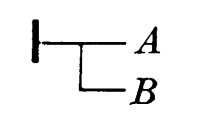
“From A follows B”

“From A follows B, and from this follows G”
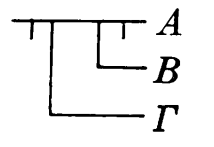
“It is not true that from the negation of A follows B, it follows G”

“The haze of hell divided by chthonic horror”

“Ph'nglui blame ' nafh Cthulhu R'layh vgah'nagl fhtagn! Ayia Cthulhu, Ayia Dagon! ”
“From A follows B”
“From A follows B, and from this follows G”
“It is not true that from the negation of A follows B, it follows G”
“The haze of hell divided by chthonic horror”
“Ph'nglui blame ' nafh Cthulhu R'layh vgah'nagl fhtagn! Ayia Cthulhu, Ayia Dagon! ”
Of course, we must admit that for a person who is far from “this is all”, the modern notation of predicate logic formulas looks a little more clear.
Theoretical information
If you know what ordinals are and what the Burali-Forti paradox consists of, you can immediately proceed to the final section .
The German mathematician Georg Cantor is one of the first who began to understand the varieties of infinity. Before him, there were only two of these varieties - potential infinity and actual infinity . These concepts can be explained as follows:
- Potential infinity. Suppose we have a bunch of apples, and every day we put another apple there. Sooner or later, the number of apples in the pile will be greater than any given number in advance.
- Actual infinity. Suppose we have a bunch in which an infinite number of apples.
Until some point in mathematics, only potential infinity was encountered, and only theologians operated on actual infinity to describe various categories of the divine. Cantor, having roughly introduced actual infinity into mathematics, caused a wave of indignation both among religious figures and among contemporary mathematicians, including the aforementioned Poincare. Moreover, upon careful examination, it turned out that actual infinities are different. The number of natural numbers is one infinity, the number of real ones is another, and the second infinity is greater than the first. And the number of functions of a real argument is the third infinity, surpassing the first two combined!
Natural numbers are used to indicate finite quantities, but what about infinite quantities? To do this, the natural series has been expanded to many so-called cardinal numbers . A cardinal number is the number (in the broad sense of the word) of the elements of a certain set. Unit - the number of elements in the set of one element. Two - the number of elements in the set of two elements. Further, for natural numbers, looms the number N 0 , equal to the number of natural numbers. In general, instead of the letter N, the Hebrew letter “Aleph” should be, but when I tried to insert the appropriate Unicode character, my
So, N 0 follows a certain N 1 , but the question of which set corresponds to it turned out to be non-trivial (see the Continuum hypothesis ). With the concept of the “next number”, a hitch arose in the transition from finite to infinite.
However, there are other "infinite numbers" - the so-called ordinal numbers , they are ordinals , also invented by Cantor. Their definition is rather complicated, but I will try to outline it in a nutshell. If cardinal numbers correspond to simple sets, then ordinals correspond to ordered sets , i.e. such that for any of the two elements indicated. which one is larger and which is smaller. Order relationmust meet some obvious criteria, which we humbly keep silent about. In addition, to construct ordinals, additional conditions are imposed on an ordered set under which it is called completely ordered . If between two completely ordered sets it is possible to establish an unambiguous correspondence preserving the relation of order, then these sets have the same ordinal.
Finite ordinals can be mapped to natural numbers. For example, the ordinal of the set {1, 2, 3} can be associated with a natural number 3. The ordinals can be added together, and in the case of finite ordinals, the addition will be consistent with the addition of natural numbers (for example, Ord {1, 2} + Ord {1 , 2, 3} = Ord {1, 2, 3, 4, 5}). To add two ordinals, you need to take the sets corresponding to them, and then combine them into one set and set the following order relation on it:
- If we compare two elements from the same source set, then we use the order relation that was in that set
- If we compare two elements from different source sets, then the element from the second set is always larger
The ordinal of such a multitude will be the sum of the ordinals. Thus, there is no problem with determining the next ordinal: you just need to take the previous ordinal and add ordinal 1 to it. The ordinal of the
set of natural numbers is denoted by the letter ω. It is followed by the ordinal ω + 1. It corresponds to the set of natural numbers, to which they added the "last" number, greater than any other. Then comes the ordinal ω + 2 - it corresponds to the natural series with the "last" and "penultimate" numbers. There are also ordinals such as 2ω (natural series followed by another natural series), 3ω, 4ω, ω 2 , ω ω ...
As you can see, Cantor was a big joker. Ironically, it was ordinal numbers that marked the beginning of the end of his theory, which would later be called the "naive set theory." Using ordinal numbers, Burali-Forti came to a paradox. The course of his reasoning was something like this: take a lot of ordinals and prove that it is quite ordered. So, he himself corresponds to some ordinal. Let us prove that this ordinal is greater than or equal to any other ordinal. Now add one to it. Make surprised eyes.
Now, armed with knowledge and enthusiasm, we are ready to go to the bottom and figure out what all the same mean that formula at the very beginning of the Habrapost, far, far above.
Essence
It was not easy to understand the designations of Burali-Forti. To the notation introduced by Peano, he added a number of his own notation. Unlike Peano, he did not at the beginning of the article describe in detail his innovations. Perhaps these descriptions are contained elsewhere, but, unfortunately (or fortunately), I could not find the complete works of Burali-Forti on the Internet. Therefore, in a couple of places I had to think out the meaning based on the context. This process was reminiscent of the solution of the famous puzzle from the NSA.
To begin with, Poincaré (and then Zhuravlev) has an incorrect formula. In the original, it looks like this:
Pay attention to two overlays, their presence is fundamental.
The letter "epsilon" here means belonging, it is from it that the modern sign "∈" originated. Un is the set of all sets containing exactly one element. Accordingly, the notation “u ε Un” means only that u is a set with one element. Such a non-trivial notation, apparently, is caused by the fact that the “construction” of a set of individual elements by means of the notation u = {a, b, c ...} has not yet been adopted.
By underlining, the Burali-Forti replaces the square brackets introduced by Peano as the “sign of inversion”. Peano used it in a fairly wide range of cases. For example, b [+ a] in it meant ba, the expression [sin] (x) symbolized arcsin (x). The notation [x ε] (a certain condition) meant a lot of Xs satisfying this condition. Thus, the notation [(u, v) ε] (u ε Un) means "the set of pairs (u, v) such that u is a set of one element". I’ll probably use Peano’s notation, because I don’t see a convenient way to add markup in the Habra Editor.
Ko is the set of ordered sets. Burali-Forti ordered sets are defined as pairs (set, order relation). Therefore, the notation {Ko ⋂ [(u, v) ε] (u ε Un)} simply means “the set of ordered singleton sets”.
With the help of the “T '” symbol, Burali-Forte denotes the operation of taking an ordinal. More strictly: the expression T '(u, v) means the ordinal of the set u on which a relation of order v is given. Here, however, there is some inconsistency: in the formula under consideration, the function T 'is applied not to a pair (set, order relation), but to the set of such pairs. Based on the context, I can only assume that there is a certain agreement according to which in such cases the function is applied to each element, and the output is a set consisting of its values for all elements. With this reading, T '{Ko ⋂ [(u, v) ε] (u ε Un)} is the set of ordinals of all singleton ordered sets. Since all singleton ordered sets are equivalent, this set of ordinals will contain only one element - the ordinal unit.
As for the squiggly with a dash, with her understanding I had the most problems. I had to look for other works of Burali-Forti. In one of them, “Logica Matematica” (apparently, a textbook, but I'm not completely sure, since it was written in Italian), I found the function L (there was a lowercase “l”, but it looks too much like a wand, therefore, for clarity, I will use the capitalization). It works as follows: takes its argument and converts it into a set, the only element of which is this same argument. In modern notation: L (x) = {x}.
If we identify the squiggle as L and the dash as the inverse, it turns out that [L] is the inverse transform that extracts its only element from the set. In this case, [L] T '{Ko ⋂ [(u, v) ε] (u ε Un)} is really a unit. Ordinary unit, but these are trifles.
Next time, when someone shows you a picture with this formula (and this will happen, this is the Internet), you can tell him what this formula means. More precisely, you can start telling. It is unlikely that he will listen to the end. And he will be, in principle, right: this is a completely ordinary, unremarkable formula. In the arguments of Burali-Forti, she did not occupy any central place, but was only a passing moment in the formulation of the paradox. All her guilt lies in the fact that she caught the eye of Poincaré, who saw in her a certain undesirable philosophical meaning, “extension of the braces”. As for its infernal appearance, Frege’s notation will give one hundred odds.
List of references
Here I would like to place links to the books mentioned, but thanks to the efforts of the righteous, I had to download them from all sorts of strange places, from suspicious file hosting services, from the ed2k network ... If you are interested, find a similar way and read “Science and Method” by Poincare, it’s really easy and interesting reading. “From Frege to Gödel” by van Heyenort is also very curious, but it is hard to understand and in Russian, it seems, does not exist.
Post script
In light of recent events (the transfer of "iron" hubs to the tick times), I want to conduct a small survey that is not directly related to the topic of the hub post. I hope you forgive me this liberty.
Only registered users can participate in the survey. Please come in.
Do I need a hub "Mathematics" on Habrahabr?
- 81.8% Yes, it is fully consistent with the theme of Habr 1031
- 4.5% No, he must relocate to some of the related resources 57
- 13.5% I don’t care, I still have Frecke’s crooks in front of my eyes. 171