
 May 9, 2015 at 08:03
Tribute to the memory
Today is the day of the Great Holiday, which we hope will never be forgotten. The people who gave us peace leave over the years, but we will remember their feat, what they did for us ...
On this day, we would like to remember those who provided communication throughout the war. It will be about the communications troops, about the feat of the signalmen during the Great Patriotic War.
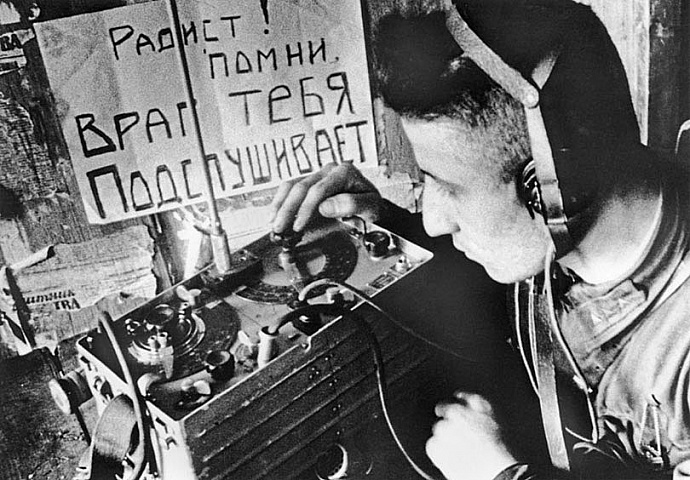
The combat work of radio operators is no less than the work of telephone operators and line supervisors, replete with examples of courage and heroism. And they had to work under enemy fire, taking a personal part in the battle, if the situation required it. Here are a few of the exploits of military signalmen:
It was impossible to do without continuous management and close interaction in the Battle of Kursk. Radio communication was the only means of command of the tank forces, and it was also used in case of wire communication failure.
Repeatedly corrected cable breaks under a flurry of fire, telephone operator V.P. Ponomarev. In one day, he sometimes had to repair up to 30-40 injuries. If it was impossible to reconnect, the telephone operator became a foot connected. For heroism, Private Ponomarev was awarded the title Hero of the Soviet Union.

Telephone operator V.A. Yatsenevich showed heroism, serving the telephone exchange to the last, transmitting information about the enemy, while already surrounded. He died during brutal torture. Title of Hero of the Soviet Union V.A. Yatsenevich assigned posthumously.
In the armies of the 2nd Belorussian Front, providing wire communications was difficult. Signalers just did not have time to build communication lines - the attack was so swiftly carried out.
When crossing the Vistula River, cable connection across the river Sergeant F.D. Razin, subsequently awarded the title Hero of the Soviet Union, and Corporal N.N. Kralya, awarded the Order of Lenin.
When laying two cable lines across the Oder River, four out of five telephone operators died. Corporal V.A. Mitryaev alone laid both lines, and then, being wounded in the enemy’s mug, he called fire on himself. This thwarted the counterattack of the enemy, and V.A., Mitryaev for the military feat received the title of Hero of the Soviet Union.

When storming the Reichstag to ensure communication, there was not enough cable. Telephone Division Commander A.I. Kozlov quickly spotted the German cable in the ruins of the houses, fought off the enemy, and provided communications. For which he was awarded the tenth award during the war years - the Order of the Red Star.
There are also known cases when signalmen, when the wire was broken, being wounded, connected the ends with their teeth and provided communication even after death ...
Providing communications during the war was incomplete. Throughout the entire period of the war, the troops felt a shortage, especially in the automotive versions of the PAT. In 1941-1942, the front headquarters had only one radio station, and only by the end of 1942 it was possible to provide them with second sets of these stations, which made it possible to maintain uninterrupted communication with the General Staff. At the same time, the availability of RAT radio stations when applying for 76 radio stations amounted to only 23 radio stations, that is 32% of the required.
To create a full-fledged communication, the General Staff-Front and Front-Front lines were used.
The only way to ensure radio communications between the General Staff and the fronts throughout the war was the RAT radio station, developed in 1936 at the plant named after Comintern in Leningrad. The RAT radio station was produced in two versions: stationary and mobile. The mobile version of the radio station was mounted in one ZIS-6 car (power unit) and two ZIS-5 cars (transmitting and receiving parts). The stationary version during the war years was called “Dal-G” and fundamentally differed from the automobile only in a power source.

With the outbreak of war, the production of RAT radio stations was significantly increased compared with the pre-war period, but it was not possible to expand production to a level that fully met the needs of the troops because of the inability to provide manufacturers with components (radio tubes, generators and engines). In addition, it was decided to replace high-quality materials with radio stations with simpler ones, and the processing of parts (silvering, copper plating, chromium plating, etc.) was not carried out in full, which naturally negatively affected the quality of the product. It should also be noted that the quality of the produced radio stations in the initial period of the war was very low, due to the widespread opinion that during the hostilities the radio station will have a short lifespan and will be quickly destroyed by the enemy.
In total, the deliveries of the RAT radio station to the troops during the war amounted to: in 1941 - 0, 1942 - 14 pcs., 1943 - 27 pcs. This problem was exacerbated by the large losses of PAT especially at the beginning of the war. For comparison: in the six months from 06.22.41 to 12.31.41 the Red Army lost 19 radio stations, and over the next three and a half years - 13 radio stations.
The accuracy and stability of the operating frequencies of the RAT transmitter was ensured through the use of an original scheme for obtaining a working frequency grid by converting the frequencies of a quartz short-wave oscillator and a long-wave oscillator of a smooth range with subsequent allocation of their total and difference frequencies, which ensured the receipt of operating frequencies in the range from 1.25 to 2 , 3 MHz, and with two- and three-fold multiplication in subsequent stages - in the range from 2.5 to 12 MHz. The accuracy and stability of the operating frequencies were mainly determined by the crystal oscillator, since the frequencies of the smooth range generator were 7-20 times lower than the frequencies of the crystal oscillator. The use of quartz with a low temperature coefficient and their placement in a thermostat weakened the effect of changes in external temperature on the frequency of the transmitter.

The receivers of all the radio stations that were in service during the Great Patriotic War were superheterodyne with a single frequency conversion, with one, less often with two intermediate and low frequency amplification stages, had a sensitivity in the telephone mode of 5-10 μV, a bandwidth of 4 kHz, but significantly lagged behind the transmitters in terms of accuracy and stability of the operating frequencies (the US-type receiver had an error of the operating frequency scale of up to 5%).
In the modern army, communications troops are a complex multifunctional organism, including numerous communication centers for various purposes, many thousands of kilometers of radio, radio relay, tropospheric, wireline and other types of communication lines.
The equipment used by the troops at the moment is very developed and functional, but does not exclude the old, time-tested, point-to-point telephone lines that have been showing their reliability for a very long time because of the ease of implementation. For example, the TA-57 telephone, which is still used in combat units of many military branches, is used to communicate with the organization of combat guard positions between remote combat guard posts deployed in the form of temporary fortifications on the ground. These devices are connected with the same "vole" (P-274 M wire) which is very difficult to damage.
The device itself is made of a very durable carbolite case and is powered by a 10 V battery type GB-10-U-1.3 that can last for 6 months, but often this battery is replaced by a simple “crown” on which the TA-57 does not lose its operating time. It also has a hand-held generator, with the help of which an inductor call is made, for a call it is necessary to twist the handle of the inductor and a bell rings at the opposite end.

These devices are also used with telephony systems and operate according to the “star” scheme, the center of which is the switch, the operator connecting the subscribers is located on the switch, that is, to call someone you need to turn the inductor knob when the switch operator answers the call and is informed which subscriber needs a connection, the operator switches to the desired subscriber, after making a call to him from the switch.

As you can see, from the time of World War II, some technical developments are still used in our army. Once again, we congratulate everyone on the Great Victory Day and hope that not only technology, but also the heroism of past years are alive in our Army.
On this day, we would like to remember those who provided communication throughout the war. It will be about the communications troops, about the feat of the signalmen during the Great Patriotic War.
The combat work of radio operators is no less than the work of telephone operators and line supervisors, replete with examples of courage and heroism. And they had to work under enemy fire, taking a personal part in the battle, if the situation required it. Here are a few of the exploits of military signalmen:
It was impossible to do without continuous management and close interaction in the Battle of Kursk. Radio communication was the only means of command of the tank forces, and it was also used in case of wire communication failure.
Repeatedly corrected cable breaks under a flurry of fire, telephone operator V.P. Ponomarev. In one day, he sometimes had to repair up to 30-40 injuries. If it was impossible to reconnect, the telephone operator became a foot connected. For heroism, Private Ponomarev was awarded the title Hero of the Soviet Union.
Telephone operator V.A. Yatsenevich showed heroism, serving the telephone exchange to the last, transmitting information about the enemy, while already surrounded. He died during brutal torture. Title of Hero of the Soviet Union V.A. Yatsenevich assigned posthumously.
In the armies of the 2nd Belorussian Front, providing wire communications was difficult. Signalers just did not have time to build communication lines - the attack was so swiftly carried out.
When crossing the Vistula River, cable connection across the river Sergeant F.D. Razin, subsequently awarded the title Hero of the Soviet Union, and Corporal N.N. Kralya, awarded the Order of Lenin.
When laying two cable lines across the Oder River, four out of five telephone operators died. Corporal V.A. Mitryaev alone laid both lines, and then, being wounded in the enemy’s mug, he called fire on himself. This thwarted the counterattack of the enemy, and V.A., Mitryaev for the military feat received the title of Hero of the Soviet Union.
When storming the Reichstag to ensure communication, there was not enough cable. Telephone Division Commander A.I. Kozlov quickly spotted the German cable in the ruins of the houses, fought off the enemy, and provided communications. For which he was awarded the tenth award during the war years - the Order of the Red Star.
There are also known cases when signalmen, when the wire was broken, being wounded, connected the ends with their teeth and provided communication even after death ...
Providing communications during the war was incomplete. Throughout the entire period of the war, the troops felt a shortage, especially in the automotive versions of the PAT. In 1941-1942, the front headquarters had only one radio station, and only by the end of 1942 it was possible to provide them with second sets of these stations, which made it possible to maintain uninterrupted communication with the General Staff. At the same time, the availability of RAT radio stations when applying for 76 radio stations amounted to only 23 radio stations, that is 32% of the required.
To create a full-fledged communication, the General Staff-Front and Front-Front lines were used.
The only way to ensure radio communications between the General Staff and the fronts throughout the war was the RAT radio station, developed in 1936 at the plant named after Comintern in Leningrad. The RAT radio station was produced in two versions: stationary and mobile. The mobile version of the radio station was mounted in one ZIS-6 car (power unit) and two ZIS-5 cars (transmitting and receiving parts). The stationary version during the war years was called “Dal-G” and fundamentally differed from the automobile only in a power source.
With the outbreak of war, the production of RAT radio stations was significantly increased compared with the pre-war period, but it was not possible to expand production to a level that fully met the needs of the troops because of the inability to provide manufacturers with components (radio tubes, generators and engines). In addition, it was decided to replace high-quality materials with radio stations with simpler ones, and the processing of parts (silvering, copper plating, chromium plating, etc.) was not carried out in full, which naturally negatively affected the quality of the product. It should also be noted that the quality of the produced radio stations in the initial period of the war was very low, due to the widespread opinion that during the hostilities the radio station will have a short lifespan and will be quickly destroyed by the enemy.
In total, the deliveries of the RAT radio station to the troops during the war amounted to: in 1941 - 0, 1942 - 14 pcs., 1943 - 27 pcs. This problem was exacerbated by the large losses of PAT especially at the beginning of the war. For comparison: in the six months from 06.22.41 to 12.31.41 the Red Army lost 19 radio stations, and over the next three and a half years - 13 radio stations.
The accuracy and stability of the operating frequencies of the RAT transmitter was ensured through the use of an original scheme for obtaining a working frequency grid by converting the frequencies of a quartz short-wave oscillator and a long-wave oscillator of a smooth range with subsequent allocation of their total and difference frequencies, which ensured the receipt of operating frequencies in the range from 1.25 to 2 , 3 MHz, and with two- and three-fold multiplication in subsequent stages - in the range from 2.5 to 12 MHz. The accuracy and stability of the operating frequencies were mainly determined by the crystal oscillator, since the frequencies of the smooth range generator were 7-20 times lower than the frequencies of the crystal oscillator. The use of quartz with a low temperature coefficient and their placement in a thermostat weakened the effect of changes in external temperature on the frequency of the transmitter.
The receivers of all the radio stations that were in service during the Great Patriotic War were superheterodyne with a single frequency conversion, with one, less often with two intermediate and low frequency amplification stages, had a sensitivity in the telephone mode of 5-10 μV, a bandwidth of 4 kHz, but significantly lagged behind the transmitters in terms of accuracy and stability of the operating frequencies (the US-type receiver had an error of the operating frequency scale of up to 5%).
In the modern army, communications troops are a complex multifunctional organism, including numerous communication centers for various purposes, many thousands of kilometers of radio, radio relay, tropospheric, wireline and other types of communication lines.
The equipment used by the troops at the moment is very developed and functional, but does not exclude the old, time-tested, point-to-point telephone lines that have been showing their reliability for a very long time because of the ease of implementation. For example, the TA-57 telephone, which is still used in combat units of many military branches, is used to communicate with the organization of combat guard positions between remote combat guard posts deployed in the form of temporary fortifications on the ground. These devices are connected with the same "vole" (P-274 M wire) which is very difficult to damage.
The device itself is made of a very durable carbolite case and is powered by a 10 V battery type GB-10-U-1.3 that can last for 6 months, but often this battery is replaced by a simple “crown” on which the TA-57 does not lose its operating time. It also has a hand-held generator, with the help of which an inductor call is made, for a call it is necessary to twist the handle of the inductor and a bell rings at the opposite end.
These devices are also used with telephony systems and operate according to the “star” scheme, the center of which is the switch, the operator connecting the subscribers is located on the switch, that is, to call someone you need to turn the inductor knob when the switch operator answers the call and is informed which subscriber needs a connection, the operator switches to the desired subscriber, after making a call to him from the switch.
As you can see, from the time of World War II, some technical developments are still used in our army. Once again, we congratulate everyone on the Great Victory Day and hope that not only technology, but also the heroism of past years are alive in our Army.