# Failed Maiden Launch of Reusable Tianlong-3 Rocket: Failure Analysis
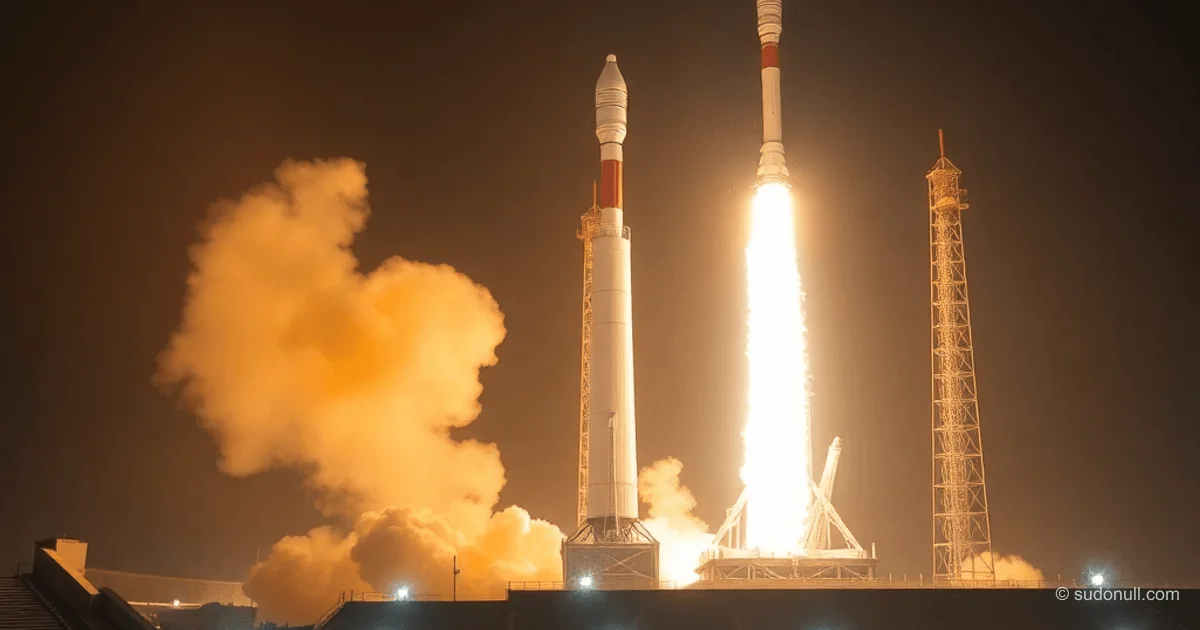
China's Space Pioneer reusable launch vehicle, Tianlong-3, suffered a setback on its first flight on April 3, 2026. At the 30-second mark, a spontaneous explosion with a burst of flames occurred, dooming the mission. The rocket carried only a mass mockup rather than a real payload, and no first-stage landing was planned.
Tianlong-3 Specifications
Tianlong-3 is designed as a heavy-lift rocket with a reusable first stage, conceptually similar to Falcon 9. The stages have a diameter of 3.8 m, total height of 71 m, and fueled mass of 590 tons. The payload fairing measures 4.2 m in diameter and 12 m in height.
The first stage is powered by nine kerosene liquid rocket engines Tianhuo-12 with a throttling range of 40–110% and multiple restart capability. This is essential for vertical landing. The second stage uses the vacuum-optimized TH-12 Vac engine, capable of delivering 17 tons to low Earth orbit (LEO).
The launch took place from a commercial site at the Jiuquan Satellite Launch Center, with landing planned on a ground platform. Future plans include using a launch site on Hainan with barge landings.
Test History and Issues
Tianlong-3 development draws on experience from launches of the small-payload kerosene rockets Tianlong-1 and Tianlong-2. However, the project encountered incidents:
- On June 30, 2024, the first stage lifted off spontaneously due to inadequate securing on the test stand, crashed about a kilometer away, and exploded.
- In 2025, hot-fire tests proceeded without issues on a sea platform to minimize risks.
Preparation for the maiden launch was postponed several times.
Launch Timeline and Failure
Liftoff from the pad and initial ascent were nominal. At 30 seconds, a flame outburst was observed, likely an engine explosion. The rocket continued flying briefly, but its trajectory deviated, resulting in mission failure.
For comparison: Falcon 9 can complete its mission even if one of nine engines fails, as demonstrated in the CRS-1 launch on October 8, 2012. There, at 79 seconds, the nozzle detached from the first engine; it was shut down safely, and the remaining engines achieved orbit. Tianlong-3 likely lacks this engine-out capability.
Context of Chinese Reusable Programs
China is aggressively pursuing reusable rockets:
- Zhuque-3 and Long March 12A completed maiden flights without stage landings.
- Kinetica-2 (prospectively reusable).
- Test of Long March 10A first stage.
- Upcoming: Long March 10B, Long March 12B, Hyperbola-2/3, Gravity-2.
This expands options for launching Chinese and international satellites.
Key Points
- Tianlong-3's maiden launch failed at 30 seconds due to a probable engine explosion.
- The rocket features 9 Tianhuo-12 liquid rocket engines with 40–110% throttling for reusability.
- Prior tests included a 2024 incident where a stage lifted off spontaneously.
- China is building a fleet of reusable launch vehicles to compete globally.
- Tianlong-3's redundancy appears inferior to Falcon 9 based on available data.
— Editorial Team










No comments yet.