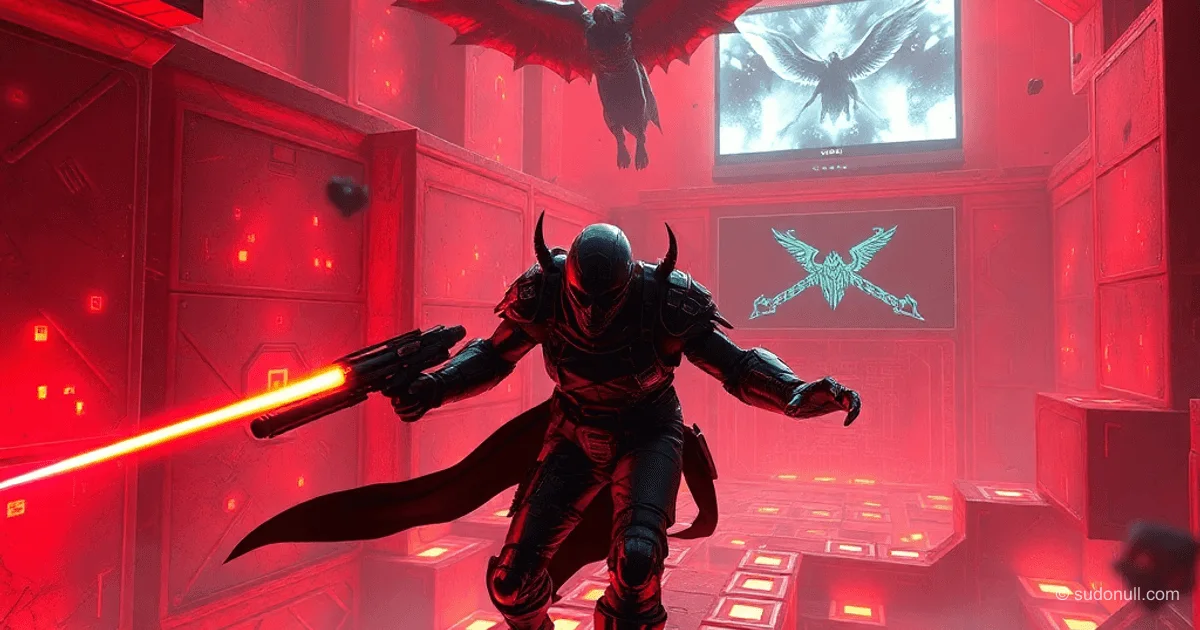
Open-Source Project HYPERHELL: 4D Labyrinth in the Style of Doom on WebGPU
HYPERHELL is an open-source project featuring a 4D labyrinth reminiscent of classic Doom. The demo runs directly in your browser on WebGPU-compatible hardware. Testing confirmed on MacBook M1/M2 and Nvidia GPUs in Chrome. Players navigate four-dimensional space, battling demons, lost souls, and dark angels. Encounters with the Merchant let you trade resources to keep going.
The developer uses '4D-eye' rendering—a camera with a 3D sensor based on Unblink mechanics. This visualizes 4D structures without traditional projections.
Technical Implementation of 4D Rendering
HYPERHELL leverages WebGPU to process four-dimensional geometry. The key is the 4D camera, which simulates perceiving the third dimension within 4D space. This goes beyond standard 3D projections that lose data from higher dimensions.
- WebGPU requirements: Compatible browser (Chrome) and GPU (Nvidia, Apple Silicon M1/M2).
- 4D visualization: Unblink mechanics with a 3D sensor for native rendering of 4D objects.
- Game mechanics: Navigation through a hypercube, real-time combat, resource trading.
- Open-source code: Available on GitHub for study and modifications.
The project targets experiments with real-time hypergeometry, ideal for mid- and senior-level GPU rendering developers.
Alternative: cssDoom Without Canvas or WebGL
Also featured is cssDoom—a Doom port using pure CSS for graphics and JavaScript for logic. Skipping canvas and WebGL makes it a standout demo of CSS power in game development.
It faithfully recreates the original Doom code. Licensed under GPLv2, with source on GitHub. Great for grasping low-level rendering without hardware acceleration.
- Graphics: CSS animations and transformations for sprites and environments.
- Logic: Vanilla JavaScript, works in any modern browser.
- Advantages: Minimal dependencies, emphasis on CSS styling.
- Limitations: Lower performance than WebGL counterparts due to CPU rendering.
Comparing Approaches to Retro Shooters
HYPERHELL pushes Doom into 4D with WebGPU handling the heavy computations. cssDoom sticks to CSS/JS, trading speed for a pure tech stack.
| Aspect | HYPERHELL | cssDoom |
|-------------|---------------|-----------|
| Rendering | WebGPU, 4D | CSS-only |
| Dependencies| GPU | Browser |
| Complexity | High (4D geometry) | Low (2.5D) |
| License | Open Source | GPLv2 |
Both projects offer fresh spins on classics for web development.
Key Takeaways
- HYPERHELL brings 4D rendering via WebGPU and Unblink mechanics for true perception of hyperspace.
- Tested on M1/M2 and Nvidia; demo runs online, no install needed.
- cssDoom recreates Doom using only CSS+JS, no canvas or WebGL.
- Both open on GitHub, perfect for exploring alternative rendering techniques.
- Emphasis on performance and minimalism, no marketing hype.
— Editorial Team










No comments yet.