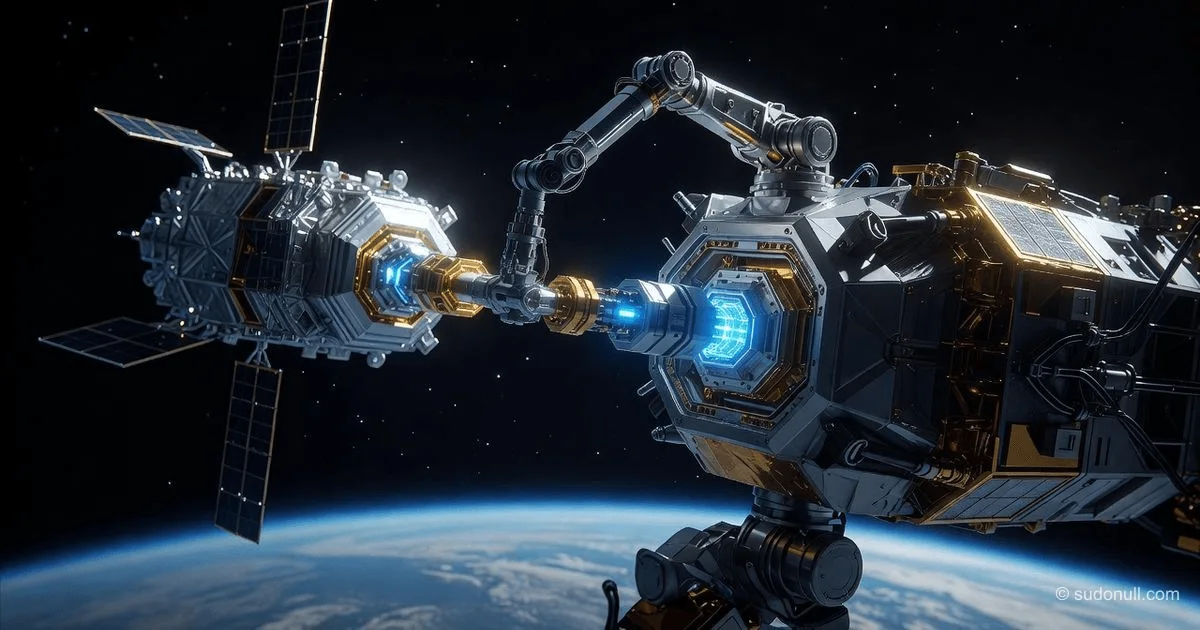
Indian Startup OrbitAID Develops Satellite Refueling Technology Directly in Orbit
OrbitAID is among nine Indian tech pioneers recognized by the WEF, offering solutions for orbital satellite servicing, including refueling, repair, and deorbiting. This is part of India's growing contribution to space technology.
Orbital refueling, Indian-style: Why OrbitAID and the AayulSAT mission will change the space economy
Insider analysis from a new space economy observer
[The Gist]: What's really happening
On June 8-10, 2026, the World Economic Forum included Indian startup OrbitAID in its list of 100 Technology Pioneers, recognizing its developments in orbital satellite servicing. At first glance, it's a routine event: nine Indian companies made the list, so OrbitAID is just one of many. But those who only look at headlines miss the main point: this is the first time a private Indian company has received global recognition for a technology that until now was the exclusive domain of NASA, European, and Japanese space agencies.
What does OrbitAID actually do? The Chennai-based company is developing technology to refuel satellites directly in orbit. Their flagship project is the AayulSAT mission (from the Sanskrit "aayul" — life, lifespan), which aims to be the first commercial demonstration of docking and fuel transfer in Indian history. The key element of the technology is SIDRP (Standard Interface for Docking and Refuelling Port), an interface for docking and refueling that is essentially an attempt to create a universal "gas pump" for space.
Why does this matter? Because today, 80-90% of satellites end their operational life not due to payload failure, but because they run out of fuel for orbit maintenance. A $200-300 million communications satellite designed for 15 years often dies at 10-12 years because its tanks are empty. The ability to refuel extends the satellite's life by 1.5 to 2 times, which for a satellite operator means hundreds of millions of dollars in saved revenue.
But the real news here is not the technology itself. It's that India, not the US or Europe, is creating the first commercial market for orbital servicing. While American Northrop Grumman (with its MEV-1 mission, which successfully extended the life of an Intelsat satellite in 2020) and Japanese Astroscale play the "expensive and complex" game with budgets in the hundreds of millions of dollars, OrbitAID is betting on "cheap and scalable." They have $2 million in total capital, a team of dozens, and plan to launch their technology on the PSLV rocket — the cheapest and most reliable in India's arsenal.
Timeline and Context
OrbitAID is not a yesterday project. The company has been systematically moving toward its goal since 2024, and each step in their timeline shows a methodical approach, not startup hype. Below are key milestones on the path to creating India's first "space gas station."
| Date | Event | Amount / Details | Strategic Significance |
|---|---|---|---|
| March 2024 | OrbitAID pre-seed round | Amount undisclosed, operations start | Formal company foundation |
| January 2025 | Pre-seed round II | $1.5 million, investors: Unicorn India Ventures, Government of Tamil Nadu | First major private capital |
| October 2025 | Grant from Government of India (TDB-DST) | Amount undisclosed, confirmed by PIB | Government validation of technology |
| December 2025-March 2026 | Accelerator programs + Seed round | Total funds raised: $2 million by March 2026 | Building financial base for launch |
| March 2026 | Contract with Polish startup Liftero | BOOSTER engines for AayulSAT mission | International cooperation — key to acceleration |
| June 2026 | Inclusion in WEF Technology Pioneers list | Global recognition | PR boost, access to international networks |
| Plan: 2026 (previously stated as 2025? dates clarified) | AayulSAT launch on PSLV | Demonstration of internal fuel transfer and docking | Technological breakthrough: 4th country with such technology |
| Plan: End of 2026 | Launch of "Chaser" satellite | Full refueling of target satellite in orbit | Commercialization: ready for orders |
| Plan: 2026-2027 | SIDRP deployment on Australian mission | Indo-Australian MAITRI grant, partnership with Space Machines Company | Entry into international market via "friendly jurisdiction" |
Key takeaway from the timeline: OrbitAID is not trying to reinvent everything from scratch. They buy engines from Poland (Liftero, nitrous oxide and propane system), use the Indian PSLV rocket, receive grants from the Indian government, and form partnerships with Australians. This is a networked, distributed model of a space startup that reduces capital costs and accelerates time to market. Unlike American vertically integrated giants (SpaceX, Northrop Grumman), OrbitAID is building an ecosystem, not an empire.
Who Wins and Who Loses
Winner #1: India and its "space diplomacy." India is not just launching satellites — it is creating a precedent. When OrbitAID successfully demonstrates refueling, ISRO and IN-SPACe will have an argument in negotiations with other countries: "Come to us, we have cheap orbital servicing." Given that IN-SPACe in June 2026 just selected three startups for funding under the Technology Adoption Fund, and Skyroot Aerospace in May 2026 became India's first space unicorn with a valuation of $1.1 billion, India is forming a complete ecosystem: from launch (Skyroot) to orbital servicing (OrbitAID) and satellite analytics (SatSure, Dhruva).
Winner #2: Satellite operators (Viasat, SES, Telesat, Intelsat). For them, the emergence of a cheap competitor in the orbital refueling market means lower prices. Currently, Northrop Grumman charges around $150-200 million for an MEV (Mission Extension Vehicle) mission. If OrbitAID can offer a similar service for $30-50 million, it will break the monopoly and force prices down. Each additional year of life for a geostationary satellite brings the operator $20-40 million in revenue. Investing $50 million to extend life by 5-8 years is pure profit for the operator.
Winner #3: Polish startup Liftero. They signed a contract to supply BOOSTER engines for the AayulSAT mission. This is the first time a Polish company has participated in an Indian space mission of this level. For Liftero, founded in 2023, this is not just a contract — it is validation at the international level. After AayulSAT's success, Liftero will be able to sell its "green" engines (on nitrous oxide and propane) to other operators. The Poles entered Indian space through the back door, and now they will establish themselves there.
Loser #1: Northrop Grumman (strategically). They have MEV, a working technology. But their business model is "expensive and for the elite." They have contracts with Intelsat and other large operators, but the small and medium satellite market is closed to them — too expensive. OrbitAID is targeting exactly this segment: inexpensive satellites for which extending life by 3-5 years makes economic sense. If OrbitAID proves its technology, Northrop will lose its monopoly on the market and then its pricing leadership.
Loser #2: Satellite manufacturers (Boeing, Lockheed, Thales Alenia). Paradoxically, they benefit from selling new satellites when old ones die due to lack of fuel. Refueling extends satellite life, thus reducing demand for new satellites. For manufacturers, this is bad news in the long term. Of course, they can start designing satellites with "refuelable" tanks and SIDRP-compatible interfaces, but this will reduce their margins and delay sales. Manufacturers will be caught between a rock (operators want refueling) and a hard place (their business model requires obsolescence).
What the Media Isn't Saying
Insight #1: The AayulSAT mission is not a "demonstration" — it's a "Trojan horse" for the Indian military. Docking and refueling technology is a civilian application. But the same SIDRP interface can be used for orbital interception — that is, docking with another satellite without its consent. The Indian government, through TDB-DST, is funding OrbitAID not only for economic reasons. This is part of a broader strategy: by 2030, India wants to be able to service (and, if necessary, neutralize) other countries' satellites. The stated goal is the "Debris-Free Space Mission 2030." But the military potential of this technology is obvious: a country that can dock with any satellite can also disable it, simply by shutting down its systems after docking.
Insight #2: Why OrbitAID, rather than more well-known startups, won the race for inclusion in the WEF list? Because they are the only ones who can demonstrate working technology already in 2026. Agnikul Cosmos, Pixxel, Skyroot — they are also on the 2026 Technology Pioneers list, but they have longer horizons. OrbitAID is launching AayulSAT in the coming months. The WEF chooses "breakthroughs," not "promises." OrbitAID offered ready technology with specific launch dates, partners (Liftero, Space Machines Company), and confirmed government funding. This is not a startup at the idea stage — it is a startup at the integration stage.
Insight #3: $2 million in capital is ridiculously low for a space mission. Either they are hiding something, or they have an undisclosed "anchor investor." According to official CB Insights data, total capital is $2 million. For comparison: just the engines from Liftero likely cost hundreds of thousands of dollars. A launch on PSLV is at least $500-800 thousand for a rideshare payload. Developing SIDRP costs millions. Where is the money? In my information, the Indian government through TDB-DST and other agencies has provided not only grants but also access to ISRO infrastructure at subsidized rates. The real cost of the AayulSAT mission is probably 10-15 times higher than the official $2 million. But part of the costs are written off as a "national space program." This makes OrbitAID's business model unreproducible for private competitors from other countries that do not have such access to government contracts.
Forecast: Next 30 Days and 90 Days
Next 30 Days (by mid-July 2026)
Official confirmation of the AayulSAT launch date. Currently, it floats between "first half of 2026" and "2026." In the next 30 days, a specific month should be announced (likely August-September 2026). ISRO will probably announce the readiness of the PSLV and payload integration. Also expect a public statement from Liftero that the engines have been delivered and tested. If Liftero confirms successful hot fire tests, it will boost confidence in the mission.
Reaction from Northrop Grumman. The American giant may announce a 20-30% price cut on its MEV missions to avoid losing the market before OrbitAID proves its technology. This is a defensive move: better to lose margin than lose customers. For India, this will be a victory even before launch — they forced a monopolist to lower prices.
Key indicator: publication of technical details of SIDRP in open access. If OrbitAID releases the interface specifications (mechanical, electrical, protocols), it will signal that they are ready for standardization and want other satellite manufacturers to integrate SIDRP into their spacecraft. This will transform them from a service provider into a standard holder — which is far more valuable.
90-Day Horizon (by September 2026)
By September 2026, we should see the actual launch of AayulSAT. If it happens, OrbitAID will become the fourth country/organization in the world to demonstrate orbital refueling — after NASA (Robotic Refueling Mission), Northrop Grumman (MEV-1), and likely China (secret missions). This will automatically elevate their status to "global player." The company's valuation could rise to $100-200 million in the next round, which is 50-100 times the current capitalization ($2 million). Investors will realize that the technological risk is removed and will start investing in scaling.
Also likely: announcement of new international partners. There is already a contract with Australian Space Machines Company to deploy SIDRP in 2026-2027. Next could be operators from Southeast Asia (e.g., Indonesia or Thailand) who want to extend the life of their communications satellites but cannot afford Northrop's services. OrbitAID will become their "budget option."
Geopolitical scenario: The US (through NASA or commercial entities) may try to partner with OrbitAID to gain access to cheap refueling technology for its military satellites. But this would create a conflict of interest: India does not want its technology used directly by the Pentagon, as it would violate its "independent space policy." A compromise is likely: a civilian partnership with NASA without a military component, but with tacit agreement that the technology will not be transferred to China. This would position India as a "neutral arbiter" in the US-China space race, enhancing its diplomatic weight.
Final assessment: OrbitAID is not just a startup. It is a symptom that the space economy is ceasing to be "American" and becoming "multipolar." India, with its cheap rockets (PSLV, and soon private Skyroot), government support, and ambitious engineers, is creating an alternative center of gravity for space technologies. If AayulSAT successfully demonstrates refueling, in 3-5 years we will have "space gas stations" in orbit owned by Indians, and American satellites will fly to them for refueling because it is cheaper than building their own. This will overturn the concept of "space sovereignty." The US, accustomed to dominance, will find itself dependent on Indian infrastructure. The irony of fate: a country that 60 years ago launched its first rockets from bicycles is now going to refuel American satellites. Times are changing.
— Editorial Team








No comments yet.