March 10, 2014 at 08:13
[User experience] Audio-Technica ANC7b - Complete Immersion
Here you are, do you like silence? - And I love. How much not even the silence itself, but the absence of external stimuli. While studying, work, you need to concentrate on the problem / problem being solved and do it when the household is dancing around or the phone is tearing around the office, it’s quite difficult ... Of course, there are times when you are very passionate about work when you are already involved in process and nothing can distract you. But what to do when there is no particular desire to do the work, and here it is impossible to concentrate? For myself, I found a way out in the face of headphones with an active noise reduction system.
To begin with, I first found out about headphones with an active noise reduction system after reading
this post, where habrazhiteli actively shared photos and discussed their jobs. The author of that thread mentioned the rather expensive Bose QC-15 headphones (~ $ 500 in the CIS), so an operation was launched to search for cheaper alternatives. As a result, the choice fell on Audio-Technica ANC7b - headphones from a well-known Japanese manufacturer of well-established all over the world.
It would be logical to continue the article with a description of the packaging and delivery set of the device under review, but due to frequent relocations over the past six months, all the equipment was lost and only the headphones and the box were left on hand. Initially, in the latter one could find: a hard case for transportation (I have no idea where I profiled it), a removable cable (similarly), an AAA battery, an adapter for using headphones on airplanes + an adapter for 6.3 mm connector and a pair of interchangeable cables (with microphone) and without).

What did the complete cover cost ... Well, okay, let's not talk about the sad things, for the last few months I have been using headphones with a cable from Philips, which wasimpudently wrung out politely lent to me by user dcoder_mm . On occasion, I say hello and undertake to return the cable. ;)

The headband size adjustment mechanism has 15 positions in 3 mm increments. There are no signs, therefore, it is assumed that the user must set the desired size once, or each time be guided by the clicks that emit guides when resizing.

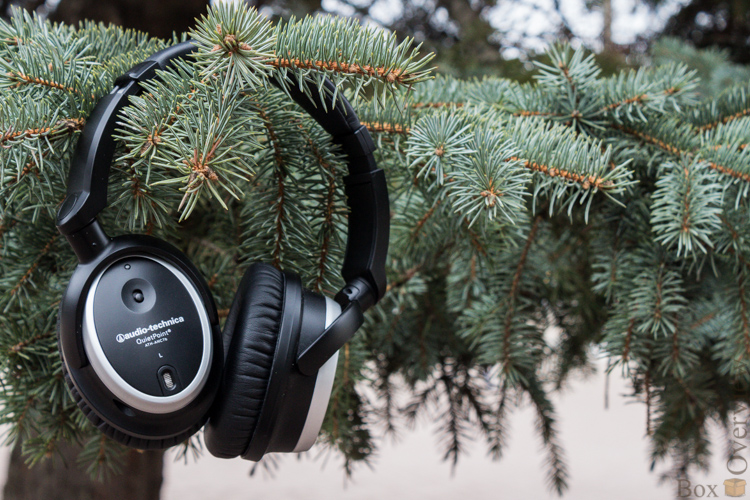
Headphone cups are medium (in relation to other overhead monitors) sizes. By tradition, the manufacturer’s logo, headphone model and “left-right” marking are located on the outside.

The microphones at the bottom of the cups are part of the active noise reduction system. The battery compartment, which is hidden behind the false panel, is also brought here. Any AAA type batteries up to 1.5 V are suitable.

On the left “ear”, in addition to the already mentioned elements, there is an ACP system switch. The activation of the latter is signaled by a bright bluevyrviglazny LED. There is also a connector for connecting a 3.5 mm audio cable, but it is worth noting that a plug with a large diameter may not "fit" into this port.

By the way, on the axis connecting the right cup with the headband there is a small raised point, thanks to which you can blindly determine where the right and where the left “ear”.

The ear pads are medium in size, moderately elastic, as well as the headband covered with leatherette. Headphones tightly clasp a head, but at the same time do not cause any inconvenience.

As for my personal impressions of convenience, I write these lines after 5 (or maybe even more) hours of staying in the headphones. Overboard winter, in a room in the region of 20 degrees - ears in comfort. In the summer, of course, there is little discomfort, as the ears sweat, but on the other hand, show me the headphones in which your ears will remain dry in the thirty-degree heat?

Secondly, given the sensitivity of 109 dB / mW, headphones even with proprietary technology turned off can be paired with a smartphone or player. But here it is worth considering that there will be no margin in volume. So, even for ordinary listening to music, you have to twist the volume to maximum. And in general, for comfortable listening to music in these headphones without "noise reduction" it is worth getting a more serious source, for example - FiiO E10 .

If it weren’t for such a huge size (on my head, and so far from a small one, such headphones look very deplorable), then I would love to ride these headphones in the subway. The bottom line is that the ACP works best with lower frequencies, i.e. the metro buzz cuts off completely, and the female voice announcing the station remains audible (provided that you listen to an audio book / podcast or music at low volume). Here, one of the main disadvantages was noticed: due to the use of active electronics, the device has the ability to catch pickups from mobile phones, albeit periodically, but this effect causes some discomfort.
Active noise reduction, in turn, requires the introduction of electronics in the headphones. The principle of operation of this system is simple enough to understand, even if you skipped physics lessons at school. Sound is a physical phenomenon, which is the propagation of elastic waves in a particular medium. More precisely, sound is a wave. Music, the roar of a jackhammer, the cries of a baby - all these are sound waves that we encounter everywhere. One of the main phenomena inherent in waves is interference.

This is exactly how the ACP system works. Special microphones that are located in the ear cups pick up external sounds, and the built-in electronics invert them and add them to the music being played, thereby removing external noise.

Under the thin foam rubber filter (not shown in the photo) there is a microphone of the ACP system and a dynamic emitter. For surround sound, the earcups are filled with foam.

Once again, we make sure that the headphone housing is entirely made of plastic. On the left cup are three screws for the CR-VT8 screwdriver - they hold the bezel under which the electronics of the active noise reduction system are hidden.

More and more: the oval-shaped printed circuit board (by clicking on the picture below - full size) occupies almost the entire internal space of the left cup. Dirt in the area of the audio jack slightly spoils the impression, but overall everything is fine. On the reverse side are two lonely electrolytic capacitors and a standard 3.5 mm TRS connector.


In the production of these headphones, serial components were used, for example, the eight-legged microcircuit on the right side of the board is the MAX660, a voltage inverter that can act as a source of negative voltage or as a boost converter for an amplifier. In the upper left corner - ST V324 (14 pins) - a four-channel amplifier with THD (THD) of not more than 0.01%. Unfortunately, the appointment of the MS located above could not be established. And yes, I subsequently replaced the blue LED with awarm tube yellow.

A few words about autonomy. For the ACP system, I use a AAA Ni-MH battery. As you already know, in headphones I spend ~ 2-3 hours a day, respectively, I have to charge a battery with a capacity of 700 mAh once every two weeks. I did not like the absence of any charge indicator - you can learn about a completely dead battery only through periodic snoring in the ears, accompanied by a slow dimming of the LED. I also advise you to monitor the shutdown of noise reduction, because no auto-shutdown function was found.
Advantages and disadvantages
 Active noise cancellation system
Autonomy
Sound
 No charge / discharge
indicator Pickups from mobile phones
Reviews on Yandex.Market
Product on the manufacturer’s official website ANC7
review from Mobile-review.com I
remind you that you can subscribe in order not to miss new reviews and articles on the company’s page (“subscribe” button), or in your favorite social network:
  Vkontakte , on
  Google + , on
  Twitter
To begin with, I first found out about headphones with an active noise reduction system after reading
this post, where habrazhiteli actively shared photos and discussed their jobs. The author of that thread mentioned the rather expensive Bose QC-15 headphones (~ $ 500 in the CIS), so an operation was launched to search for cheaper alternatives. As a result, the choice fell on Audio-Technica ANC7b - headphones from a well-known Japanese manufacturer of well-established all over the world.
▐ Specifications
| Emitter | Dynamic (neodymium, 40 mm) |
| frequency range | 10 Hz - 25 kHz |
| Noise reduction level | up to 20 dB |
| Impedance | 300 ohm |
| Sensitivity | 109 dB / mW |
| Cable | 1.6 m (removable) |
| Plug | 3.5 mm |
| Body material | Plastic |
| Type of ear pads | Monitor |
| Acoustic design | Closed |
| Weight | 210 g (without cord and battery) |
What did the complete cover cost ... Well, okay, let's not talk about the sad things, for the last few months I have been using headphones with a cable from Philips, which was
▐ Design, construction, wearing comfort
When I first met, Audio-Technica ANC7b headphones did not make any vivid impressions on me. An ascetic design due to the use of exclusively plastic in the body materials, the classic shape with an arc mount, slight creaking when bending the headphones and turning the cups. The latter have two degrees of freedom: a rotation of 90 degrees on the vertical axis and 45 on the horizontal.The headband size adjustment mechanism has 15 positions in 3 mm increments. There are no signs, therefore, it is assumed that the user must set the desired size once, or each time be guided by the clicks that emit guides when resizing.
Headphone cups are medium (in relation to other overhead monitors) sizes. By tradition, the manufacturer’s logo, headphone model and “left-right” marking are located on the outside.
The microphones at the bottom of the cups are part of the active noise reduction system. The battery compartment, which is hidden behind the false panel, is also brought here. Any AAA type batteries up to 1.5 V are suitable.
On the left “ear”, in addition to the already mentioned elements, there is an ACP system switch. The activation of the latter is signaled by a bright blue
By the way, on the axis connecting the right cup with the headband there is a small raised point, thanks to which you can blindly determine where the right and where the left “ear”.
The ear pads are medium in size, moderately elastic, as well as the headband covered with leatherette. Headphones tightly clasp a head, but at the same time do not cause any inconvenience.
As for my personal impressions of convenience, I write these lines after 5 (or maybe even more) hours of staying in the headphones. Overboard winter, in a room in the region of 20 degrees - ears in comfort. In the summer, of course, there is little discomfort, as the ears sweat, but on the other hand, show me the headphones in which your ears will remain dry in the thirty-degree heat?
▐ Sound, compatibility, some aspects of operation
For starters, you should not be afraid of a resistance of 300 ohms. Firstly, it is an indicator when the ACP system is off. Unfortunately, the manufacturer did not provide the value of this parameter with the “noise reduction” turned on, but judging by the change in the volume level, a very “peppy” amplifier is built into the headphones.Secondly, given the sensitivity of 109 dB / mW, headphones even with proprietary technology turned off can be paired with a smartphone or player. But here it is worth considering that there will be no margin in volume. So, even for ordinary listening to music, you have to twist the volume to maximum. And in general, for comfortable listening to music in these headphones without "noise reduction" it is worth getting a more serious source, for example - FiiO E10 .
Frequency response
As for the sound quality itself, which is actually a purely subjective concept and, ideally , IRL headphones should be listened to before buying , I am more than happy with the sound. I use headphones mainly at home, paired with an external DAC, so in both modes I don’t feel the lack of volume. And I use it quite often - at least 3-5 hours a day and often with noise reduction turned on (+ sounds of nature nourishing or light music). Such a set makes it possible to completely disengage from the roar of the old man of the refrigerator, conversations of cohabitants and those moving around the room. At the same time, louder conversations are leaking, which for me personally is a plus.If it weren’t for such a huge size (on my head, and so far from a small one, such headphones look very deplorable), then I would love to ride these headphones in the subway. The bottom line is that the ACP works best with lower frequencies, i.e. the metro buzz cuts off completely, and the female voice announcing the station remains audible (provided that you listen to an audio book / podcast or music at low volume). Here, one of the main disadvantages was noticed: due to the use of active electronics, the device has the ability to catch pickups from mobile phones, albeit periodically, but this effect causes some discomfort.
▐ Active noise canceling device
And what is a noise reduction system? First you need to understand that noise reduction is both active and passive . The latter is basically the prerogative of closed monitor headphones. The cup cases of such devices do not contain any openings on the outside, and the walls of such headphones are usually quite massive and the material from which they are made often has the ability to damp sound vibrations. Headphones with the best passive noise cancellation have 35-37 dB.Active noise reduction, in turn, requires the introduction of electronics in the headphones. The principle of operation of this system is simple enough to understand, even if you skipped physics lessons at school. Sound is a physical phenomenon, which is the propagation of elastic waves in a particular medium. More precisely, sound is a wave. Music, the roar of a jackhammer, the cries of a baby - all these are sound waves that we encounter everywhere. One of the main phenomena inherent in waves is interference.
Wave interference - a mutual increase or decrease in the resulting amplitude of two or more coherent waves when they are superimposed on each other. (c) WikipediaBut how does the active noise reduction system depend on the phenomenon of interference? - And such that this noise reduction method is based on interference! If the waves arrive at a point in the medium (meet) in antiphase, then the displacement of the particles will be multidirectional, which leads to a decrease in the amplitude of the oscillations, i.e. sound vibrations coming from the outside are damped. Due to limitations (possibly temporary, because progress does not stand still) imposed by internal noise suppressors, it is unfortunately not possible to fully compensate for external noise.
This is exactly how the ACP system works. Special microphones that are located in the ear cups pick up external sounds, and the built-in electronics invert them and add them to the music being played, thereby removing external noise.
▐ Inside, autonomy
Recently, it has been fashionable to rate devices for their maintainability, in order to keep up with trends, we will prepare headphones, and at the same time we will see what kind of magic is hidden in the body of these. We peel off the ear pads:Under the thin foam rubber filter (not shown in the photo) there is a microphone of the ACP system and a dynamic emitter. For surround sound, the earcups are filled with foam.
Once again, we make sure that the headphone housing is entirely made of plastic. On the left cup are three screws for the CR-VT8 screwdriver - they hold the bezel under which the electronics of the active noise reduction system are hidden.
More and more: the oval-shaped printed circuit board (by clicking on the picture below - full size) occupies almost the entire internal space of the left cup. Dirt in the area of the audio jack slightly spoils the impression, but overall everything is fine. On the reverse side are two lonely electrolytic capacitors and a standard 3.5 mm TRS connector.

In the production of these headphones, serial components were used, for example, the eight-legged microcircuit on the right side of the board is the MAX660, a voltage inverter that can act as a source of negative voltage or as a boost converter for an amplifier. In the upper left corner - ST V324 (14 pins) - a four-channel amplifier with THD (THD) of not more than 0.01%. Unfortunately, the appointment of the MS located above could not be established. And yes, I subsequently replaced the blue LED with a
A few words about autonomy. For the ACP system, I use a AAA Ni-MH battery. As you already know, in headphones I spend ~ 2-3 hours a day, respectively, I have to charge a battery with a capacity of 700 mAh once every two weeks. I did not like the absence of any charge indicator - you can learn about a completely dead battery only through periodic snoring in the ears, accompanied by a slow dimming of the LED. I also advise you to monitor the shutdown of noise reduction, because no auto-shutdown function was found.
▐ Price, results
Audio-Technica ANC7b - great closed-type headphones with an active noise reduction system. With its main task - to cut off external noise copes relatively well. Despite the modest design and cheap materials of the case, the headphones are well assembled, have a comfortable fit and decent sound. Of the main flaws: the lack of a charge indicator, periodic pickups from cell phones ... The price, both on the world and the CIS markets, fluctuates around 5-7 thousand rubles (140 - 190 dollars).Advantages and disadvantages
Active noise cancellation system Autonomy Sound No charge / discharge indicator Pickups from mobile phones▐ Links
External test ATH-ANC7bReviews on Yandex.Market
Product on the manufacturer’s official website ANC7
review from Mobile-review.com I
remind you that you can subscribe in order not to miss new reviews and articles
on the company’s page (“subscribe” button), or in your favorite social network: Vkontakte , on Google + , on TwitterOnly registered users can participate in the survey. Please come in.
What type of headphones do you use?
- 41% Closed (monitor / overhead) 473
- 17.6% Open consignment notes (monitor / consignment notes) 203
- 24.8% Intra-channel (gag, IEM) 286
- 6.6% In-Ear (a la EarPods) 77
- 2.2% I do not use headphones - they spoil the hearing! 26
- 7.6% I am a UFO and can abstract from external stimuli using the built-in electronics. :) 88