
 December 24, 2012 at 17:10
UCLA creates a new type of magnetoresistive memory
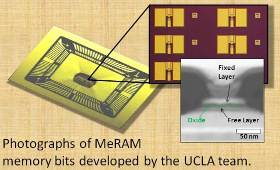 Magnetoresistive memory (MRAM) is one of the hottest areas of research into new types of memory. In the future, it can surpass all existing types of memory in all respects. MRAM cells are comparable in performance with SRAM - memory used in the processor cache, in cell density - with DRAM. MRAM is non-volatile and is much more economical and more durable than flash memory.
Information in MRAM cells is stored in two ferromagnetic layers separated by a thin dielectric layer. One of the layers is a permanent magnet, the direction of the magnetic field of the second layer can change. To change the magnetic field, a current is passed through the cell. The electrical resistance of the cell (the effect of tunnel magnetoresistance) depends on the mutual orientation of the fields in these layers. By measuring this resistance, one can consider the bits stored in the cell. Today, the most advanced recording method uses the spin-transfer torque effect - “polarized” electrons passing through a layer of a ferromagnet help to rotate the magnetic field in a certain direction, resulting in a much smaller current, and the cells can be smaller .
Researchers at the University of California at Los Angeles (UCLA) have found a way to switch the magnetic field using electric voltage rather than current, so that you can get a gain in energy consumption of 10 to 1000 times, respectively reduce the heating of the cells during recording and increase the density of their placement by crystal 5 times. They call this type of memory MeRAM (magnetoelectric random access memory).
The manufacturing technology of a new type of memory is very close to that used for spin-transfer memory (STT-RAM). Since the first experimental batches of STT-RAM are already in production, it is possible that we will wait for MeRAM quite soon.
The massive use of magnetoresistive memory can open up completely new possibilities. Unlike dynamic memory, it is non-volatile and requires much less electricity to write than flash memory. On its basis, you can create ultra-miniature and almost no electricity-consuming devices, or ordinary computers, always ready to work, with almost zero boot time.