
 April 20, 2015 at 11:42
Deaf-deafness: how to live in silence and darkness?
Deaf-deafness - congenital or acquired at an early age (before mastering the speech) blindness and deafness, to which dumbness associated with the absence of hearing is added. In this case, a person cannot “replace” with hearing a lack of vision and vice versa, which causes considerable problems: children do not develop and do not acquire elementary self-service skills if they are not worked with using various techniques and technical means.
How do deafblind people communicate? How do they navigate in space? What devices help them with this? More details - under the cut.
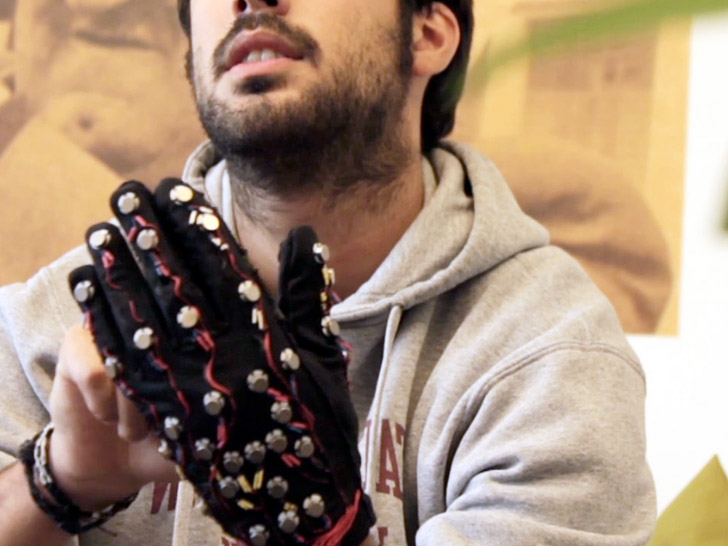
Let's start by talking to the teacher. Blind people hear speech, deaf people use gestures and read lips. If both of these feelings are absent in a person at the same time, touch remains. In the 1940s, I.A. Sokolyansky developed a system that allows you to transfer information from teacher to student: this is a teleactor. The teacher pressed the keys of the device, and the student read the message in Braille. Later, another problem arose - how to transmit information to several students at once, to a whole class of children? In 1966, they began to use an improved version of the teleactor, but so far with one-way communication - the “dactylator”.
In the learning process, two-way communication is always needed. This call was accepted by VV Lebedev, and developed a teletactor of direct, feedback and reciprocal communication - TEPROIVS.
Another device for transmitting messages to a group of students was created by M.M. Germanov, he used a keyboard similar to a typewriter. A special transcoding device made it possible to communicate with the deaf-blind with people who do not have special communication skills with them. In 1968, he developed a class with direct, feedback, and reciprocal communication, but the device issued only one letter at a time - each word had to be typed for a long time. Three years later, the problem was solved with the help of a new version of the teleactor with a tactile display that displays 24 embossed dot characters.
How do deafblind people get information from the Internet? Speech synthesizers transform data not only into sound, they can work with Braille. A special “display” allows you to read information with your fingers. A set of convex points rises and falls in the desired sequence. The system has flaws. You cannot see the image, you cannot determine the value of information on a web page - you will have to read all the text from left to right and top to bottom, and you won’t be able to work with tables. Moreover, many pages contain data that cannot be translated into text. Mouse navigation is convenient for the sighted, but for the blind and deaf-blind, special versions need to be made. Or create universal methods for interaction. Ways to solve these problems open for developers the market of technical means of rehabilitation for the deaf-blind.

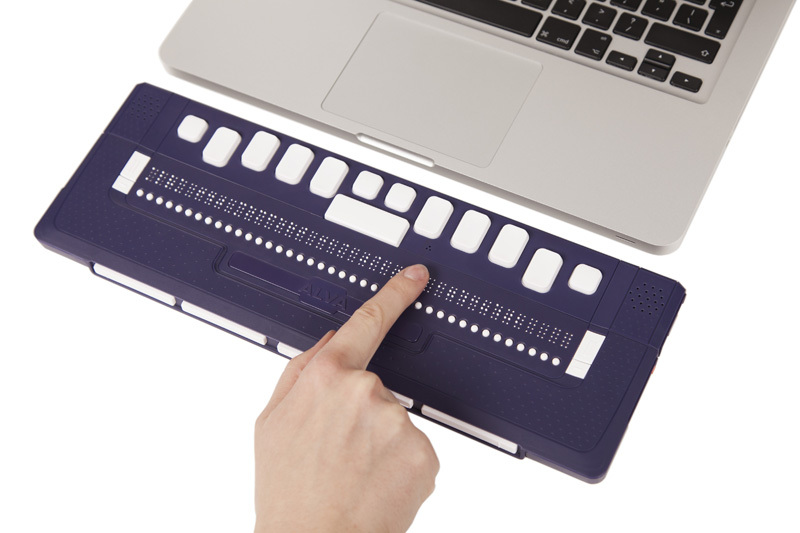
Mac OS has built-in features for people with vision and hearing problems. Apple's computers and mobile devices work with 40 different braille displays.

Such a special display works in conjunction with a computer. Apple works with a number of similar devices, as I noted above.

Smartphones have special applications for the blind. They allow you to play books, read information from sites, recognize objects.
But for the deaf-blind, a smartphone is more suitable, which will not involve either hearing or vision. The prototype (unfortunately, so far ...) of the B-Touch by Zhenwei You smartphone is endowed with GPS, a camera for object recognition and the functions of a standard phone, including SMS. The display is based on braille. The problem with such smartphones is the cost of the Braille display, precisely because of the high cost of the end device, they can not yet make a mass product.

Another smartphone option for the blind.

Today, most often for communication you have to be content with devices with large buttons and a printed Braille. In the event that a person does not yet know the font, devices like this glove can help him. The user hears text in the headphone.
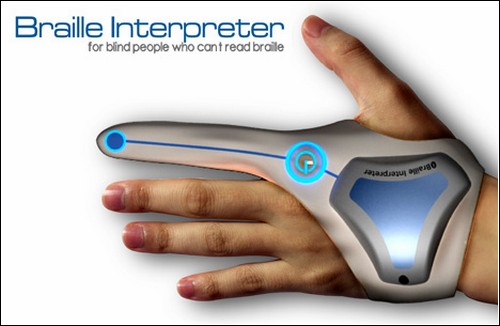
But there is a separate type of gadget - special communicators. Braille EDGE 40 combines a smartphone and a computer. It has its own operating system and preinstalled software. The device allows you to create and save notes, read books and documents, it reminds you of important dates, it has an alarm clock, timer, calculator. Braille EDGE 40 supports SD cards up to 32 gigabytes, works 20 hours on a single charge.

Now more about the braille display and why they cost crazy money. The points that transmit symbols are controlled by piezoelectric biomorphic elements. A biomorph consists of piezoceramic plates glued together between a thickness of 0.3 to 0.35 millimeters. Silver or nickel electrodes are applied to the plate. Biomorphs use electrical signals to convert them into mechanical forces, that is, it serves as an actuator - a mover for points.
The technology is very expensive to manufacture, so a portable braille display can cost from 100 to 500 thousand rubles or more.

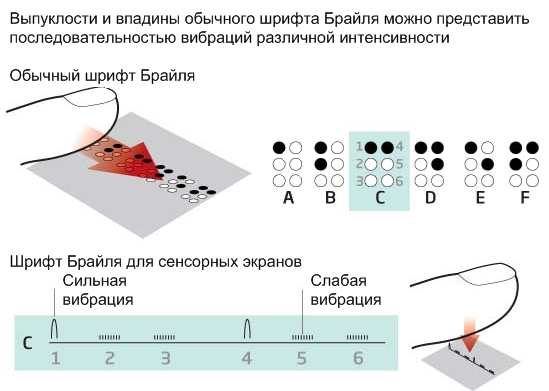
Scientists have attempted to make alternative methods of information output. Can regular smartphones be used to transmit braille? In the journal New Scientist in 2009 were presentedexperimental results . Researchers from the University of Tampere in Finland took the Nokia 770 tablet and wrote an application for it that controls the piezoelectric layer of the touch screen. The protruding points are transmitted by fast and strong impulses, and a weaker and longer vibration corresponds to the troughs. One character is read in 1.25 seconds, so people who are used to the simultaneous perception of the entire character will need time to get used to.
A few years earlier, the University of Tokyo developed a displaybased on organic transistors. Polymer drives controlled by transistors are applied to a flexible substrate. Motors and electronics are made of the same material, so the thickness of this display is only 1 millimeter. Traditional piezoelectric actuators are much thicker than this option.
The device from Japanese scientists displays 24 characters, the points in them rise by 0.5 mm.


How to navigate the city, how to cross the road at a pedestrian crossing and how to understand when the right light is on at the traffic lights?
First of all, a cane comes to the rescue. In 2013 introduced Fujitsu. introduced a cane for the elderly with a built-in GPS tracker, and the display on the handle shows the way with arrows. A thermometer, humidity sensor and a heart rate monitor under the thumb are built into the handle. If there was a braille display in the handle, it would be possible to use the cane with the deaf-blind. What is still missing? Need a distance sensor.

In 2008, designer Jin Woo Han came up with a conceptAn interesting and useful gadget for people with vision problems, this device determines the distance to the object. The stronger the vibration, the closer the object. But this is a concept, and we are more interested in devices that already exist.

Smart canes with a sonar make it easier for people with vision problems to orient themselves. An ultrasonic locator searches for obstacles in the way and reports about them, while depending on the device, obstacles are detected at different levels - on the floor, at the level of the belt, chest or head. Then reports by vibration or using the earpiece. Signal intensity may indicate distance.

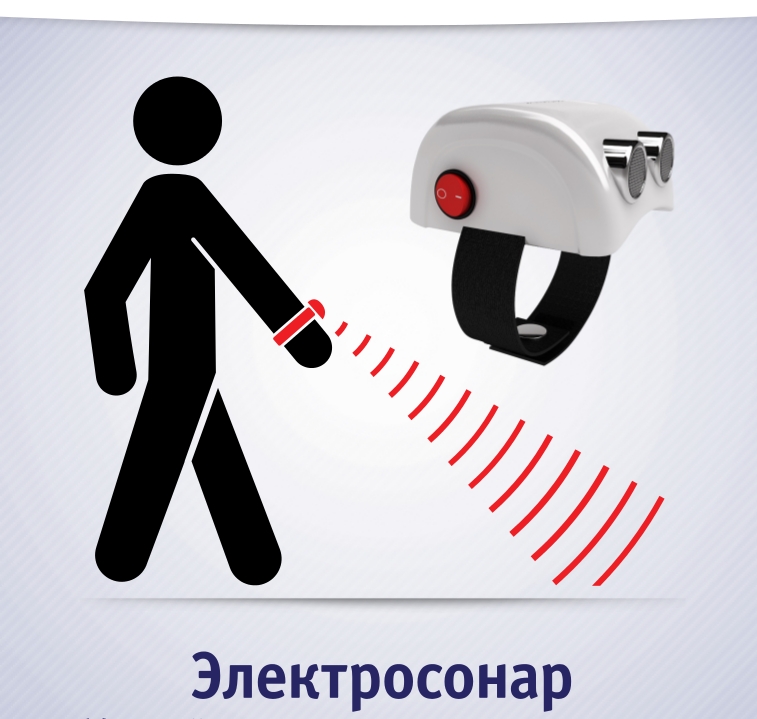
Sonar can be installed not only on a cane, it can also be worn on the arm, as proved by oleammin 2013. He made an electric sonar in the form of a device that is mounted on his wrist. The obstacle detection range is 7 meters, weight is less than 150 grams, battery life is more than 4 hours. BrainPort

technology allows you to see with an electrode mounted on the tongue. The device transforms the signals from the camera and converts them into electrical impulses, which the brain is able to recognize as visual. The BrainPort V100 complements existing guidance methods - walking sticks and assistants in the form of guide dogs.
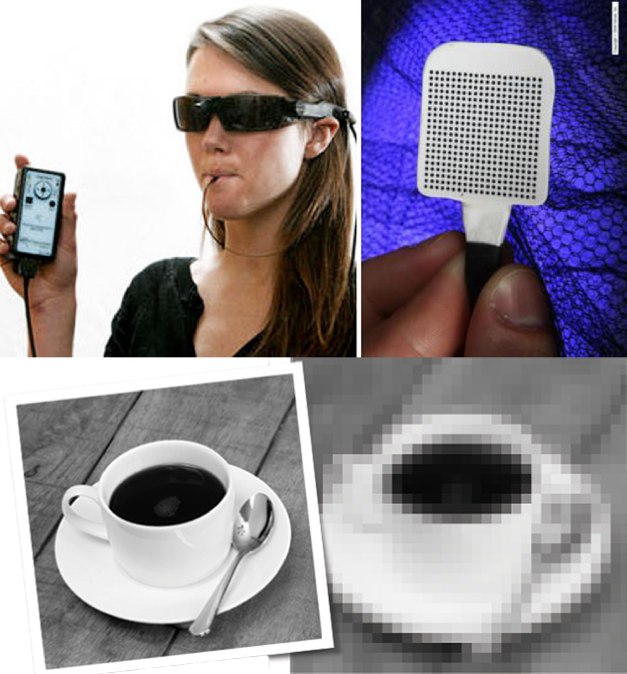
If images can be projected onto the tongue, why not do the same for the forehead? The Japanese company EyePlusPlus and the University of Tokyo come to the rescue. The camera of the AuxDeco device captures images and translates it into a “tactile” look, which can be determined using the skin of the user's forehead.
This may not be the highest resolution of the picture, but in this way, as a result, the user “sees” in front of him with the help of the device.


In 2014, OrCam glasses were presented for the blind , and already in April of that year they appeared on sale. The device recognizes objects and reads the necessary information to the owner. The combination of this device with some wearable Braille keyboard could make sense.

Watch with braille give time.

OCR scanners allow reading newspapers, recognizing colors and money. Such scanners recognize characters and translate them into sound or display them using a braille display.
An example of a “multimedia center" for the blind. The device is called EClipse Scan And Read Entertainment Center.

In this case, an iPhone or iPad is used as a scanning device, and the gadget itself, which allows you to do this, is just a stand. The iOS gadget on the stand with the camera is aimed at a newspaper or document, and the OCR application recognizes the text and transfers it to the braille display. Or, again, using sound if there is a sufficiently loud device.

Another pocket scanner for example.


Scanners can be more portable. The main thing is to make a high-quality bundle between the scanner and the information output device for the deaf-blind.

When vision is not completely absent, but severely damaged, magnifiers are used. Like a magnifying glass, but smarter.
One such device is Zoomax Snow 7 HD. This seven-inch HD tablet is designed to be used as a video magnifier. Design dictate the requirements for the convenience of people with low vision: these are huge buttons for increasing, moving away, changing the color mode, photographing. The camera adjusts to the distance - near or far is what a person is looking at.


Using the gadget on the street. The distance to the object can be from 6.5 centimeters (when reading books) to 500 centimeters (for example, for reading road signs and inscriptions on stores).

You can read newspapers, but this is not the only difficulty for a person without vision and hearing. The complexity is also in the convenience of devices. A large gadget like a seven-inch tablet will increase the time it takes to count bills. Although, probably, most of the blind can still calculate according to the applied Braille.
EyeRing is a wearable device, a visual assistant that allows you to see with your finger.
Another wearable gadget - the Mobile Lorm Glove is designed specifically for the deaf-blind. She translates the alphabet of Lorm into the text. Clicking on the sensors located on the glove allows the deaf-blind user to write a text message. Data is transmitted via Bluetooth to the device - for example, to the communicator. Then the recipient sees this message in the form of SMS.
But there is also a feedback: the holder of the glove will feel the received message due to vibration on it.


The LORM alphabet was developed by the German philosopher Heinrich Landesman more than a hundred years ago. The philosopher was blind, and then lost his hearing. The alphabet, which involves the transfer of characters by touch, is useful for the elderly, as their fingers may lose their ability to use fingerprinting, and LORM is easier to remember.

This is a liquid level indicator made for the blind grandfather. Pouring tea without seeing anything is not an easy task. Moreover, the device is homemade, the experience is described on Habré .
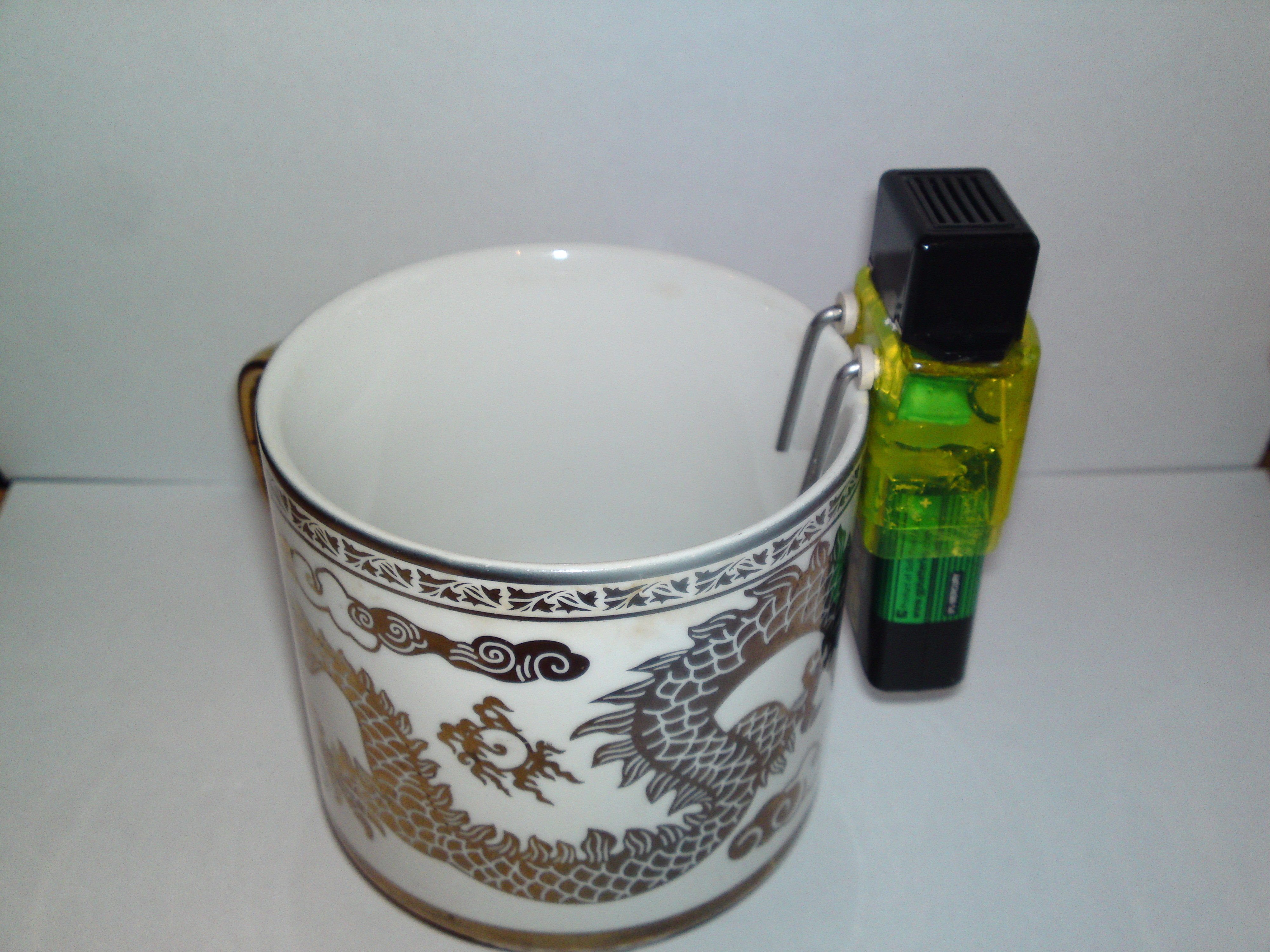
Another gadget is a Braun singing cup . The user hears a signal when the liquid reaches the level selected using the button on the handle.

Legitimate question: both devices above are intended for the blind, but deafness will interfere with hearing the signal? This is a new task worth solving. I thought about the possibility of using a “smart” bracelet that would vibrate under certain conditions. For example, a smart mug is connected to the bracelet, after which the wearable gadget gives a signal from the mug, and not from any other source. Later, I clarified this question with a specialist from the Foundation for the Support of Deaf-Deaf "Deafness" and found out that deafness with deaf-deafness is often incomplete - that is, a person is able to hear loud sounds, so sometimes the speaker doesn’t stop louder.
Within the framework of the Russian Foundation for the Support of the Deaf-Deaf, “Soyedinenie” , the “Technical Support” direction is developing . The purpose of the direction is to provide development and promotion of domestic developments for the deaf-blind in Russia and on foreign markets. Now the fund is holding a competition of innovators, which received more than 80 projects from all over Russia. So if you have an interesting idea while reading an article, do not lose the opportunity: the fund staff will carefully study all the responses and comments.
How do deafblind people communicate? How do they navigate in space? What devices help them with this? More details - under the cut.
Communication
Let's start by talking to the teacher. Blind people hear speech, deaf people use gestures and read lips. If both of these feelings are absent in a person at the same time, touch remains. In the 1940s, I.A. Sokolyansky developed a system that allows you to transfer information from teacher to student: this is a teleactor. The teacher pressed the keys of the device, and the student read the message in Braille. Later, another problem arose - how to transmit information to several students at once, to a whole class of children? In 1966, they began to use an improved version of the teleactor, but so far with one-way communication - the “dactylator”.
In the learning process, two-way communication is always needed. This call was accepted by VV Lebedev, and developed a teletactor of direct, feedback and reciprocal communication - TEPROIVS.
Another device for transmitting messages to a group of students was created by M.M. Germanov, he used a keyboard similar to a typewriter. A special transcoding device made it possible to communicate with the deaf-blind with people who do not have special communication skills with them. In 1968, he developed a class with direct, feedback, and reciprocal communication, but the device issued only one letter at a time - each word had to be typed for a long time. Three years later, the problem was solved with the help of a new version of the teleactor with a tactile display that displays 24 embossed dot characters.
Network Communication
How do deafblind people get information from the Internet? Speech synthesizers transform data not only into sound, they can work with Braille. A special “display” allows you to read information with your fingers. A set of convex points rises and falls in the desired sequence. The system has flaws. You cannot see the image, you cannot determine the value of information on a web page - you will have to read all the text from left to right and top to bottom, and you won’t be able to work with tables. Moreover, many pages contain data that cannot be translated into text. Mouse navigation is convenient for the sighted, but for the blind and deaf-blind, special versions need to be made. Or create universal methods for interaction. Ways to solve these problems open for developers the market of technical means of rehabilitation for the deaf-blind.
Mac OS has built-in features for people with vision and hearing problems. Apple's computers and mobile devices work with 40 different braille displays.
Such a special display works in conjunction with a computer. Apple works with a number of similar devices, as I noted above.
Smartphones have special applications for the blind. They allow you to play books, read information from sites, recognize objects.
But for the deaf-blind, a smartphone is more suitable, which will not involve either hearing or vision. The prototype (unfortunately, so far ...) of the B-Touch by Zhenwei You smartphone is endowed with GPS, a camera for object recognition and the functions of a standard phone, including SMS. The display is based on braille. The problem with such smartphones is the cost of the Braille display, precisely because of the high cost of the end device, they can not yet make a mass product.
Another smartphone option for the blind.
Today, most often for communication you have to be content with devices with large buttons and a printed Braille. In the event that a person does not yet know the font, devices like this glove can help him. The user hears text in the headphone.
But there is a separate type of gadget - special communicators. Braille EDGE 40 combines a smartphone and a computer. It has its own operating system and preinstalled software. The device allows you to create and save notes, read books and documents, it reminds you of important dates, it has an alarm clock, timer, calculator. Braille EDGE 40 supports SD cards up to 32 gigabytes, works 20 hours on a single charge.
Now more about the braille display and why they cost crazy money. The points that transmit symbols are controlled by piezoelectric biomorphic elements. A biomorph consists of piezoceramic plates glued together between a thickness of 0.3 to 0.35 millimeters. Silver or nickel electrodes are applied to the plate. Biomorphs use electrical signals to convert them into mechanical forces, that is, it serves as an actuator - a mover for points.
The technology is very expensive to manufacture, so a portable braille display can cost from 100 to 500 thousand rubles or more.
Scientists have attempted to make alternative methods of information output. Can regular smartphones be used to transmit braille? In the journal New Scientist in 2009 were presentedexperimental results . Researchers from the University of Tampere in Finland took the Nokia 770 tablet and wrote an application for it that controls the piezoelectric layer of the touch screen. The protruding points are transmitted by fast and strong impulses, and a weaker and longer vibration corresponds to the troughs. One character is read in 1.25 seconds, so people who are used to the simultaneous perception of the entire character will need time to get used to.
A few years earlier, the University of Tokyo developed a displaybased on organic transistors. Polymer drives controlled by transistors are applied to a flexible substrate. Motors and electronics are made of the same material, so the thickness of this display is only 1 millimeter. Traditional piezoelectric actuators are much thicker than this option.
The device from Japanese scientists displays 24 characters, the points in them rise by 0.5 mm.
Moving
How to navigate the city, how to cross the road at a pedestrian crossing and how to understand when the right light is on at the traffic lights?
First of all, a cane comes to the rescue. In 2013 introduced Fujitsu. introduced a cane for the elderly with a built-in GPS tracker, and the display on the handle shows the way with arrows. A thermometer, humidity sensor and a heart rate monitor under the thumb are built into the handle. If there was a braille display in the handle, it would be possible to use the cane with the deaf-blind. What is still missing? Need a distance sensor.
In 2008, designer Jin Woo Han came up with a conceptAn interesting and useful gadget for people with vision problems, this device determines the distance to the object. The stronger the vibration, the closer the object. But this is a concept, and we are more interested in devices that already exist.
Smart canes with a sonar make it easier for people with vision problems to orient themselves. An ultrasonic locator searches for obstacles in the way and reports about them, while depending on the device, obstacles are detected at different levels - on the floor, at the level of the belt, chest or head. Then reports by vibration or using the earpiece. Signal intensity may indicate distance.
Sonar can be installed not only on a cane, it can also be worn on the arm, as proved by oleammin 2013. He made an electric sonar in the form of a device that is mounted on his wrist. The obstacle detection range is 7 meters, weight is less than 150 grams, battery life is more than 4 hours. BrainPort
technology allows you to see with an electrode mounted on the tongue. The device transforms the signals from the camera and converts them into electrical impulses, which the brain is able to recognize as visual. The BrainPort V100 complements existing guidance methods - walking sticks and assistants in the form of guide dogs.
If images can be projected onto the tongue, why not do the same for the forehead? The Japanese company EyePlusPlus and the University of Tokyo come to the rescue. The camera of the AuxDeco device captures images and translates it into a “tactile” look, which can be determined using the skin of the user's forehead.
This may not be the highest resolution of the picture, but in this way, as a result, the user “sees” in front of him with the help of the device.
In 2014, OrCam glasses were presented for the blind , and already in April of that year they appeared on sale. The device recognizes objects and reads the necessary information to the owner. The combination of this device with some wearable Braille keyboard could make sense.
Self-service devices in the home
Watch with braille give time.
OCR scanners allow reading newspapers, recognizing colors and money. Such scanners recognize characters and translate them into sound or display them using a braille display.
An example of a “multimedia center" for the blind. The device is called EClipse Scan And Read Entertainment Center.
In this case, an iPhone or iPad is used as a scanning device, and the gadget itself, which allows you to do this, is just a stand. The iOS gadget on the stand with the camera is aimed at a newspaper or document, and the OCR application recognizes the text and transfers it to the braille display. Or, again, using sound if there is a sufficiently loud device.
Another pocket scanner for example.
Scanners can be more portable. The main thing is to make a high-quality bundle between the scanner and the information output device for the deaf-blind.
When vision is not completely absent, but severely damaged, magnifiers are used. Like a magnifying glass, but smarter.
One such device is Zoomax Snow 7 HD. This seven-inch HD tablet is designed to be used as a video magnifier. Design dictate the requirements for the convenience of people with low vision: these are huge buttons for increasing, moving away, changing the color mode, photographing. The camera adjusts to the distance - near or far is what a person is looking at.
Using the gadget on the street. The distance to the object can be from 6.5 centimeters (when reading books) to 500 centimeters (for example, for reading road signs and inscriptions on stores).
You can read newspapers, but this is not the only difficulty for a person without vision and hearing. The complexity is also in the convenience of devices. A large gadget like a seven-inch tablet will increase the time it takes to count bills. Although, probably, most of the blind can still calculate according to the applied Braille.
EyeRing is a wearable device, a visual assistant that allows you to see with your finger.
Another wearable gadget - the Mobile Lorm Glove is designed specifically for the deaf-blind. She translates the alphabet of Lorm into the text. Clicking on the sensors located on the glove allows the deaf-blind user to write a text message. Data is transmitted via Bluetooth to the device - for example, to the communicator. Then the recipient sees this message in the form of SMS.
But there is also a feedback: the holder of the glove will feel the received message due to vibration on it.
The LORM alphabet was developed by the German philosopher Heinrich Landesman more than a hundred years ago. The philosopher was blind, and then lost his hearing. The alphabet, which involves the transfer of characters by touch, is useful for the elderly, as their fingers may lose their ability to use fingerprinting, and LORM is easier to remember.
This is a liquid level indicator made for the blind grandfather. Pouring tea without seeing anything is not an easy task. Moreover, the device is homemade, the experience is described on Habré .
Another gadget is a Braun singing cup . The user hears a signal when the liquid reaches the level selected using the button on the handle.
Legitimate question: both devices above are intended for the blind, but deafness will interfere with hearing the signal? This is a new task worth solving. I thought about the possibility of using a “smart” bracelet that would vibrate under certain conditions. For example, a smart mug is connected to the bracelet, after which the wearable gadget gives a signal from the mug, and not from any other source. Later, I clarified this question with a specialist from the Foundation for the Support of Deaf-Deaf "Deafness" and found out that deafness with deaf-deafness is often incomplete - that is, a person is able to hear loud sounds, so sometimes the speaker doesn’t stop louder.
Within the framework of the Russian Foundation for the Support of the Deaf-Deaf, “Soyedinenie” , the “Technical Support” direction is developing . The purpose of the direction is to provide development and promotion of domestic developments for the deaf-blind in Russia and on foreign markets. Now the fund is holding a competition of innovators, which received more than 80 projects from all over Russia. So if you have an interesting idea while reading an article, do not lose the opportunity: the fund staff will carefully study all the responses and comments.