
 September 1, 2017 at 13:05
Hubble data indicates that there may be water on the planets of the TRAPPIST-1 system
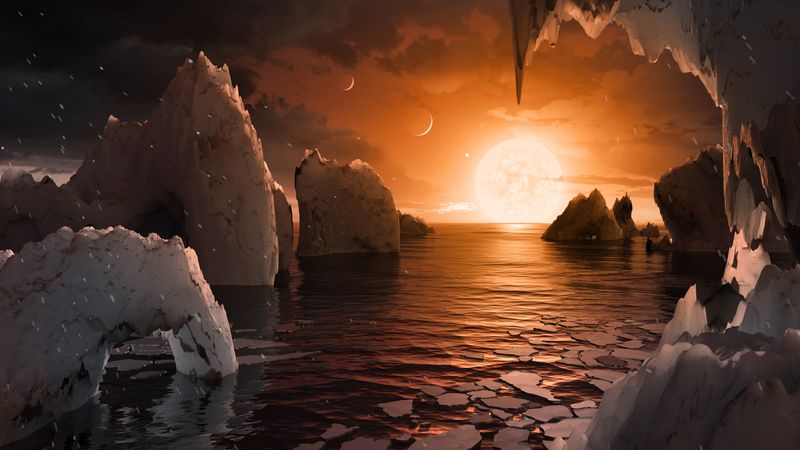
Perhaps this is exactly what the surface of the planet TRAPPIST-1f looks like. Source: NASA.
After astronomers announced the discovery of the TRAPPIST-1 system, where several earth-like planets revolve around a star, many publications immediately appeared on the topic “Life on TRAPPIST-1 exoplanets”. If there was only one earth-like planet in a potentially inhabited zone, then they would talk and forget how it often happens. But in the system immediately three planets are in the “warm” zone, where the existence of water in liquid form is possible, which means life supported by water.
Scientists can only guess about whether there really is water on these planets. Until recently, these were just discussions on this topic. But now there is evidence that indirectly confirms the existence of H 2 O in the TRAPPIST-1 system. Scientists got this information thanks to the Hubble telescope.
True, no matter how powerful and functional this device may be, scientists still can not see the water on exoplanets. This is not about this, but about the observation data on the dynamics of ultraviolet radiation from a star of the TRAPPIST-1 system. Having studied the indicators over a long period, astronomers modeled a change in the distribution of radiation over a period of several billion years. Then, based on the results obtained during the testing of the first model, scientists built additional models for each of the three “warm” planets of the system. We are talking about models that allow us to track the influence of star radiation on the possible water sources of each of the TRAPPIST-1 exoplanets.
Using information about the origin and evolution of planets, which is now considered generally accepted, astronomers from the University of Liege (Belgium)They tried to imagine how the system itself was evolving. Most likely, initially the exoplanets in the TRAPPIST-1 system formed much farther from their star, in the cold zone filled with the substance of which comets in the solar system consist. That is, ice, frozen gases, etc. Thus, many TRAPPIST-1 planets, if not all, received initially solid ice reserves. As the planets were approaching their star over the past 8 billion years (time frames are obvious for obvious reasons), objects were heating up, planets, especially those that are closest to their star, began to lose water.
Inner planets, as far as one can judge, have lost a huge amount of their reserves - their volume is approximately 20 times the volume of water in the oceans and seas of the Earth. But those planets that are a little further from the star of the TRAPPIST-1 system are likely to retain water. And it can be there in liquid form right now.
“Planets the size of the Earth can capture huge volumes of water at the beginning of formation, but it all depends on a large number of factors, so it’s hard to say exactly how many,” said one of the study participants. “We can say that the inner planets probably lost a huge amount of water, the outer ones less.”
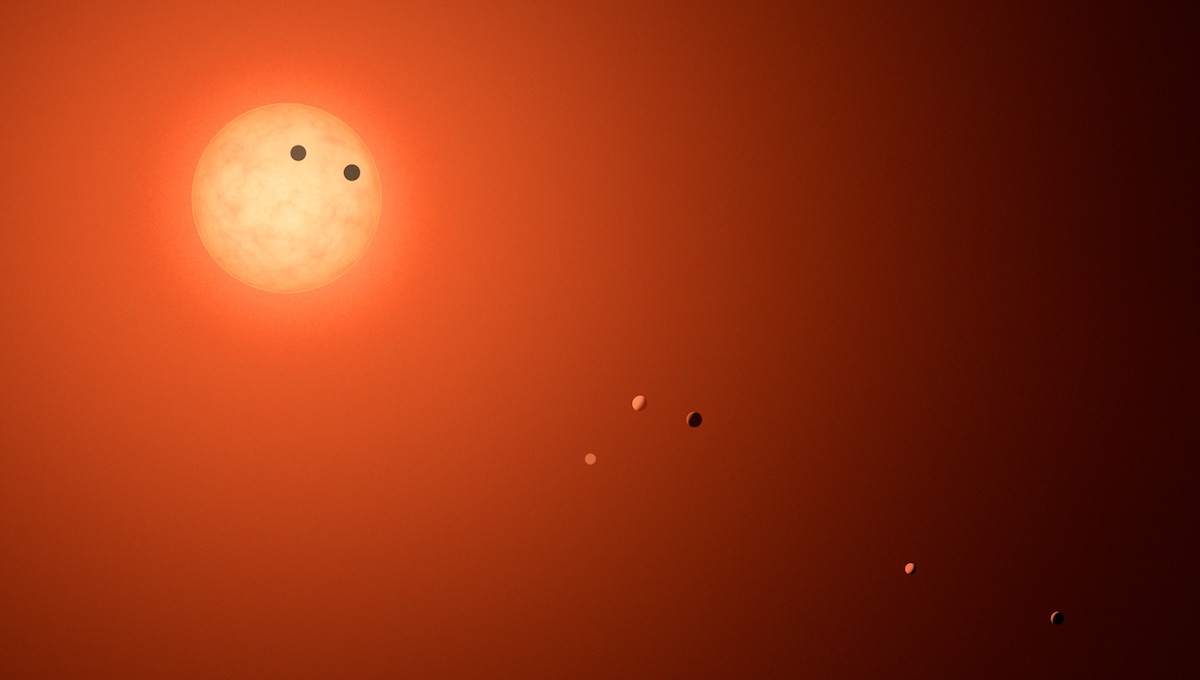
Now scientists plan to carefully monitor the system using the Hubble telescope. In the course of their work, astronomers will try to detect hydrogen around the exoplanets of this system. If there is a lot of it, this may mean that the planets have an atmosphere, and in it there is water vapor, which under the influence of UV radiation loses hydrogen.
Regardless of the results, the chances of life on these planets are small. The fact is that the star in the TRAPPIST-1 system is a red dwarf. The star's catalog name is 2MASS J23062928-0502285 , it is eight times smaller than the Sun. Data from scientists from the gPhoton projectshow that red dwarfs regularly bombard the surface of their planets with streams of high-energy particles. And if it is true that complex organic structures simply cannot exist, they are destroyed. This applies even to not too complex compounds, not to mention such complex structures as RNA and DNA.
Be that as it may, this system is one of the most interesting stellar systems encountered by scientists for all the time of astronomical observations.